The Name That Saved a City
Four days after the Church celebrates the birth of the Blessed Virgin Mary on September 8th, the liturgical calendar pauses again on September 12th for a quieter, more intimate celebration: the Most Holy Name of the Blessed Virgin Mary. On the General Roman Calendar this day is an optional memorial, which means a parish may choose whether to celebrate it, yet its history is anything but optional. This is a celebration that was born in a small Spanish diocese, nearly vanished twice, and returned to the universal Church because of one of the most dramatic days in European history.
Why would the Church set aside a day simply to honor a name? Because in the biblical world, a name is never just a label. The Catechism of the Catholic Church teaches that “the name is the icon of the person” (CCC 2158), a truth so deep that God Himself chose to reveal His own name to Moses as an act of covenant intimacy (CCC 203). When Christians speak the name of Jesus, they touch the mystery of the Incarnation itself (CCC 435). And when they speak the name of Mary, they call upon the woman whom God chose from all eternity to be the Mother of His Son, the one who carried the Word made flesh in her womb and whose whole life points to Him.
The 2004 Roman Martyrology describes this day as one that recalls “the inexpressible love of the Mother of God for her Holy Child” and proposes the Mother of the Redeemer to the faithful, to be invoked with devotion. That is the heart of the celebration: not a name studied at a distance, but a name spoken with love. Children instinctively understand this. A toddler in distress does not compose a speech; the child simply cries out for a mother by name, and the mother comes. The Church, in her wisdom, has canonized that instinct. She teaches her members, from the youngest to the oldest, to cry out “Mary” in every storm, and she promises, on the strength of 20 centuries of experience, that this Mother comes. The story of how this day earned its place on the calendar is proof of it.
From a Quiet Spanish Diocese to the Gates of Vienna
The celebration began humbly. In 1513, the Diocese of Cuenca in Spain received approval to celebrate a feast of the Name of Mary, with a proper Office assigned to September 15th, the octave day of Mary’s Nativity, according to the Catholic Encyclopedia. The devotion was local, tender, and Spanish. It was suppressed during the breviary reform of Pope St. Pius V, then restored by a decree of Pope Sixtus V dated January 16th, 1587, which moved it to September 17th. Pope Gregory XV extended the celebration to the Archdiocese of Toledo in 1622, and in 1671 it spread more widely still; sources differ on whether the extension covered the whole Kingdom of Spain or the Kingdoms of Naples and Milan, a discrepancy the historical record has not fully resolved.
Then came 1683. The Church already had a living memory of what Marian intercession could do in such a crisis: in 1571, the outnumbered fleet of the Holy League had prevailed at Lepanto while Rome prayed the Rosary at the urging of Pope St. Pius V, a victory the Church still commemorates every October 7th as Our Lady of the Rosary. Just over a century later, history seemed to repeat itself on land. That summer, an enormous Ottoman army under Grand Vizier Kara Mustafa laid siege to Vienna, the gateway to Christian Europe. The city starved behind its walls for 2 months while Pope Innocent XI begged the faithful across Europe to pray the Rosary for its deliverance. King John III Sobieski of Poland answered the call, marching his army south and placing his troops under the protection of the Blessed Virgin Mary. On the morning of September 12th, on the Kahlenberg heights above the city, the Capuchin papal legate Blessed Marco d’Aviano, beatified by St. John Paul II in 2003, celebrated Mass for the allied forces before the attack. By evening, the famous Polish winged hussars had broken the siege in one of the largest cavalry charges in history, and Vienna was saved.
Sobieski entered the city in triumph, attended a Mass of thanksgiving, and wrote to Pope Innocent XI with a phrase that deliberately corrected Julius Caesar’s old boast: “Veni, vidi, Deus vicit,” that is, “I came, I saw, God conquered.” In gratitude for a victory the whole Catholic world attributed to Mary’s intercession, Innocent XI extended the feast of her Holy Name to the universal Church, assigning it to the Sunday within the octave of the Nativity; sources date the formal inscription to 1683 or 1684. Under Pope St. Pius X the celebration was fixed to September 12th itself, the anniversary of the battle. The 1969 calendar reform removed it as a seeming duplication of September 8th, though its Votive Mass remained; St. John Paul II, a Polish pope who knew Sobieski’s story in his bones, restored it as an optional memorial in the 2002 edition of the Roman Missal, together with the Holy Name of Jesus on January 3rd.
And the Virgin’s Name Was Mary
Unlike Lourdes or Fatima, this celebration commemorates no apparition, so there is no approval status to weigh; it rests instead on the solid ground of Scripture and the Church’s living Tradition. The foundation is a single, luminous line in The Gospel of Luke: “In the sixth month the angel Gabriel was sent from God to a city of Galilee named Nazareth, to a virgin betrothed to a man whose name was Joseph, of the house of David; and the virgin’s name was Mary” (Luke 1:26-27). The Evangelist slows down to record her name, because Heaven itself addressed her by it. Gabriel’s greeting inaugurates the prayer the Church has never stopped praying (CCC 2676).
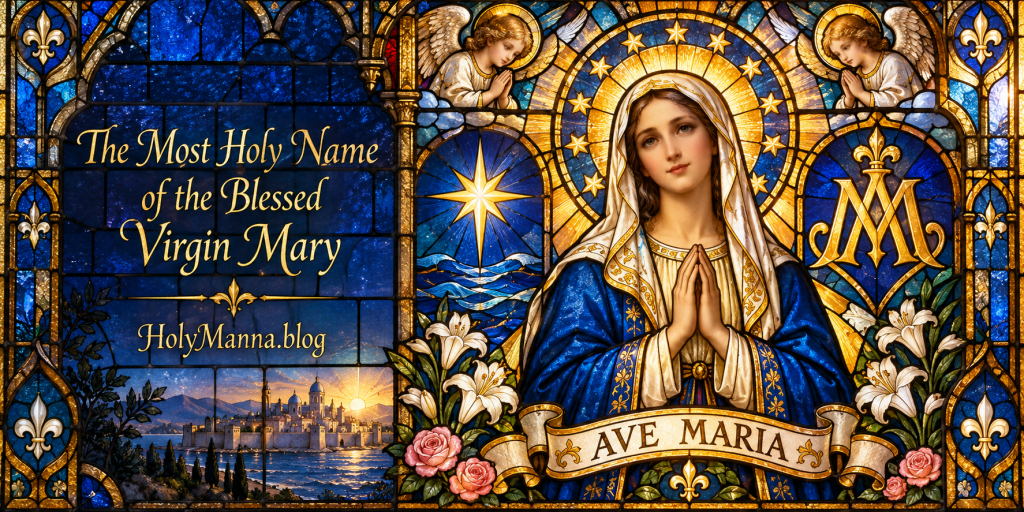
What does the name mean? In Hebrew it is Miryam, in Aramaic Maryam, in Greek Mariam or Maria. Tradition has offered several interpretations, and scholars still differ on the etymology, so honesty requires holding them lightly: “bitterness” or “bitter sea,” fitting for the Mother of Sorrows; “lady” or “sovereign lady,” fitting for the Queen of Heaven; “beloved,” fitting for the one full of grace; and, most famously, “star of the sea,” Stella Maris, a beautiful interpretation that tradition developed from a rendering associated with St. Jerome. None of these is defined doctrine; together they read like facets of a single jewel.
It was the “star of the sea” tradition that inspired the greatest sermon ever preached on her name. St. Bernard of Clairvaux, the Doctor of the Church whom later tradition honored as the Marian Doctor, wrote in his second homily on the words Missus est: “If the winds of temptation arise; if you are driven upon the rocks of tribulation look to the star, call on Mary. If you are tossed upon the waves of pride, of ambition, of envy, of rivalry, look to the star, call on Mary” (Homilia II super “Missus est,” 17). For Bernard, her name is not information; it is navigation. Mary herself, filled with the Holy Spirit, prophesied that her name would be honored in every age: “henceforth all generations will call me blessed; for he who is mighty has done great things for me, and holy is his name” (Luke 1:48-49). Notice her instinct even there: she speaks of her own blessedness only to magnify the holiness of God’s name. Her name always works that way, like a window that exists to let in someone else’s light.
Why the Church Bows at Her Name
The theology of this optional memorial flows directly from the theology of the Holy Name of Jesus. St. Paul teaches that God has exalted Christ so that “at the name of Jesus every knee should bow” (Philippians 2:10), and the Catechism places His name at the very heart of Christian prayer (CCC 435). Mary’s name is venerated, never adored, precisely because of her relationship to that Name above every name. The General Instruction of the Roman Missal even directs a bow of the head at the mention of her name in the liturgy (GIRM 275), a small gesture carrying an entire doctrine: honor given to Mary is a lesser, essentially different honor than the worship owed to God alone, and it always terminates in her Son (CCC 971; Lumen Gentium 66).
To speak her name is to confess everything the Church believes about her. It names the Theotokos, the Mother of God, as the Council of Ephesus defined in 431, because the Son she conceived is true God (CCC 495). It names the Immaculate Conception, preserved from all stain of original sin from the first moment of her existence (CCC 491-492). It names the ever-Virgin, whose virginity before, during, and after Christ’s birth the Church has always professed (CCC 499). It names the Mother of the Church, given to the beloved disciple, and to all disciples, from the Cross (CCC 963-964). And it names the intercessor whom the faithful invoke, in the Catechism’s words, “under the titles of Advocate, Helper, Benefactress, and Mediatrix” (CCC 969), titles that neither add to nor subtract from the unique mediation of Christ.
The Catechism devotes a whole meditation to what actually happens when a believer prays to Mary (CCC 2676-2679). The Hail Mary moves in 2 great breaths. The first breath is God’s own word, Gabriel’s greeting and Elizabeth’s blessing, so that the one who prays begins by repeating what heaven has already said about her. The second breath is the Church’s petition, entrusting the present moment and the hour of death to her maternal care, because asking Mary to pray is an act of humility that acknowledges sinners need a mother’s help to reach her Son. Prayer to Mary, the Catechism teaches, is always prayer with Mary and never a detour around Jesus; she magnifies the Lord, and souls who pray with her learn to do the same.
The modern popes have poured this teaching into their Marian documents: Lumen Gentium chapter VIII, Paul VI’s Marialis Cultus, and John Paul II’s Redemptoris Mater all frame devotion to Mary as a road that leads to Jesus. Providence added its own commentary in 2008, when Benedict XVI began his apostolic journey to France on this very date, September 12th, celebrating Vespers at Notre-Dame de Paris, a cathedral itself named for Our Lady. There he described her with words drawn from his encyclical Deus Caritas Est: “Mary is completely at home with the word of God; with ease she moves in and out of it. She speaks and thinks with the word of God; the word of God becomes her word, and her word issues from the word of God” (Deus Caritas Est, 41). Her name, in other words, is shorthand for a life perfectly transparent to God.
Litanies, Rosaries, and a Hill Above Vienna
Devotion to Mary’s name has taken concrete, tangible forms across the centuries. The most universal is the one many Catholics carry in their pockets: the Rosary, whose every Hail Mary speaks her name and asks her prayers “now and at the hour of our death” (CCC 2676-2677). The Angelus does the same 3 times a day, ringing her name across towns and fields at morning, noon, and evening. The Church has also long approved a Litany of the Holy Name of Mary, in which the faithful invoke her under a cascade of scriptural and traditional titles, each petition another way of saying the same beloved name.
The devotion also has deep roots in the Church’s contemplative families. As early as 1666, the Discalced Carmelites received permission to recite the Divine Office of the Name of Mary 4 times a year, decades before the feast reached the universal calendar, evidence that love for her name flourished first in houses of prayer before it was sealed on a battlefield. That order of events is worth noticing: the liturgy of a cloister preceded the deliverance of a city.
Religious life bears the devotion in a striking way. Numerous religious orders and congregations customarily give each member “Mary” as part of the name received in religion, a sign of entrustment to her; countless men in religious life have carried names like Louis Marie or Maximilian Maria for exactly this reason. St. Louis de Montfort’s True Devotion to Mary channels the same instinct into the practice of total consecration, teaching souls to belong entirely to Jesus through Mary, a spirituality that shaped St. John Paul II’s own motto, Totus Tuus.
Pilgrimage sites tied to this celebration cluster around its history. In Cuenca, Spain, where the feast was born in 1513, the devotion remains part of the diocese’s patrimony. Above Vienna, the church of St. Joseph on the Kahlenberg, near where Blessed Marco d’Aviano celebrated Mass on the morning of the battle, is today cared for by Polish priests as a living memorial of September 12th, 1683, and draws pilgrims retracing Sobieski’s steps. Pilgrims to Vienna itself can stand where a civilization was rescued and remember that the rescue began with prayer. These places matter because they keep the devotion from floating into abstraction. The name of Mary was invoked by real soldiers on a real hillside on a real morning, and pilgrims who climb the Kahlenberg today are reminded that heaven’s help arrives in history, not merely in theory.
How the World Keeps Her Name
The cultural footprint of this celebration is wider than many Catholics realize. In Austria, September 12th became a day of national gratitude for generations, and the memory of the deliverance of Vienna is woven into the city’s identity. In Poland, Sobieski’s victory belongs to the national soul; the king who credited God and trusted Mary remains a hero of both church and country, and Polish communities abroad have carried the Kahlenberg memory with them. A charming story, and it must be labeled a story rather than verified history, holds that Viennese bakers celebrated the victory by shaping pastries like the crescent on the Ottoman standards, an ancestor of the croissant. True or not, it captures how completely the events of 1683 entered popular imagination.
In Spain and throughout Latin America, the name itself became a culture. For centuries, families have given daughters names built on María: María del Carmen, María de los Dolores, María del Pilar, and many more, so that a single baptismal name carries both the Mother’s name and one of her titles. In many Catholic countries, the custom of celebrating a name day, the feast associated with one’s name, means that September 12th has served as a personal celebration for millions of women named Mary, Marie, María, or Maria. Religious families keep the day too; the Society of Mary founded by Blessed William Joseph Chaminade, whose members are known as the Marianists, celebrates September 12th as a patronal feast, bearing Mary’s name in their very title.
The Church’s music carries the devotion as well. The ancient hymn Ave Maris Stella greets Mary as star of the sea, the very image St. Bernard preached; the Salve Regina closes each day of the Liturgy of the Hours in ordinary time by calling to her across the distance of exile. From Baroque cathedrals to mission chapels, from Polish battle hymns to Mexican lullabies, the melody changes but the name does not. Few facts about Catholic culture are more telling than this: across every language the Church speaks, the most common thread in her art, her music, her geography, and her baptismal registers is the name of a village girl from Nazareth.
Speaking Her Name in Your Own Storms
Here is where the history becomes personal, because the siege of Vienna is not only an event from 1683; it is a picture of the interior life. You know what it feels like to be surrounded. Deadlines, diagnoses, debts, temptations that camp outside your walls for months, the slow siege of loneliness or doubt. The lesson of September 12th is not that Catholics once won a battle. The lesson is what the whole Church did while the battle loomed: it prayed, it trusted, and it called on Mary by name.
So take St. Bernard’s counsel literally this week. When temptation rises, when anxiety hits at 2 in the morning, when the argument is about to escalate, look to the star and call on Mary. Say her name, slowly, even just once. It is a prayer a single breath can carry, and it is never said alone, because her name always draws you toward the holy name of her Son. When the pressure is on, whose name do you actually reach for first?
Some practical ways to keep this optional memorial well: pray the Angelus at noon and let her name interrupt your workday; pray a decade of the Rosary for someone under siege in their own life; if your name, or your daughter’s, or your mother’s, is a form of Mary, celebrate September 12th as a name day with a small feast, the way Catholic cultures have for centuries; and consider learning the Litany of the Holy Name of Mary as a family prayer. Above all, imitate what the name stands for. Mary’s name means nothing apart from her fiat, her “Behold, I am the handmaid of the Lord; let it be to me according to your word” (Luke 1:38). Benedict XVI left a prayer perfectly suited to this day: “Holy Mary, Mother of God, our Mother, teach us to believe, to hope, to love with you. Show us the way to his Kingdom!” (Spe Salvi, 50). Speak her name, and then live like someone who has a mother watching from the walls.
Engage With Us!
The conversation does not end here; share your thoughts and reflections in the comments below. The HolyManna community grows stronger every time someone tells the truth about their own walk with God, and your story about calling on Mary might be exactly what another reader needs today.
- When in your life have you experienced Mary’s intercession after calling on her by name, and what changed?
- What “siege” are you facing right now that you could entrust to Our Lady this September 12th?
- How could praying the Angelus or a daily decade of the Rosary realistically fit into your schedule this week?
- If your name or a loved one’s name honors Mary, how might you celebrate that name day this year?
Keep pressing forward in faith, one small prayer at a time. A name spoken with love changed the course of history on September 12th, 1683, and that same name is available to you today, free of charge, in every language, at every hour. Grow together in faith with the whole HolyManna family, under the guidance of our Blessed Mother, who never fails to lead her children to Jesus.
Most Blessed Virgin Mary, pray for us!
Follow us on YouTube, TikTok, Instagram and Facebook for more insights and reflections on living a faith-filled life.


Leave a Reply