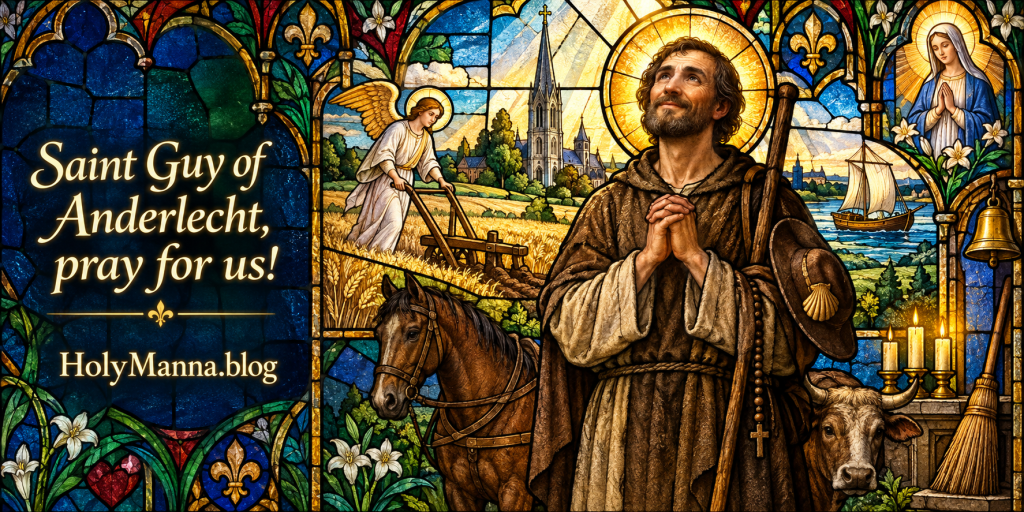
The Poor Man Who Lost Everything and Found Heaven
Some saints commanded armies. Some governed dioceses, founded religious orders, or wrote theology that shaped the mind of the Church for centuries. Saint Guy of Anderlecht, celebrated on September 12th, did none of these things. He swept a church floor. He rang a bell. He arranged flowers on an altar in a small Belgian village a thousand years ago, and he gave away nearly everything he ever had. Yet the Church holds him up as a saint, and for ten centuries the people of Belgium have loved him with a devotion so deep that horses were once led in procession to his tomb to be blessed. Known across the centuries as the Poor Man of Anderlecht, Guy, also called Guido, Guidon, or Wye of Laeken, lived from roughly 950 to 1012, and his story is one of the most tender and most human in the whole calendar of saints. It is the story of a man who loved God simply, stumbled once, and spent the rest of his life walking his way back home.
Saint Guy holds a remarkable collection of patronages. He is the patron of the town of Anderlecht itself, of sacristans and sextons, of laborers and farmers, of bachelors, of work horses and horned animals, and of the protection of stables, sheds, and outbuildings. He is also invoked against epilepsy, convulsions, mad dogs, and rabies. It is a wonderfully earthy list, full of barns and animals and ordinary working people, and it fits him perfectly. Guy was never a priest, never a monk, never a scholar. He was a layman who worked with his hands, and the Church teaches that this is no obstacle to holiness at all. The Catechism declares that “all Christians in any state or walk of life are called to the fullness of Christian life and to the perfection of charity” (CCC 2013). Saint Guy is living proof that the call is real, and that it reaches all the way down to the man holding the broom.
Born Poor, Raised Rich in Faith
Guy was born around the year 950 in the countryside near Brussels, in what was then the Duchy of Lower Lorraine and is now Belgium. The sources do not fully agree on the exact place. The older Catholic hagiographies, including the tradition preserved by the Petits Bollandistes, say he was born at Anderlecht, a small village outside Brussels, while other accounts place his birth at nearby Laeken, the village where he would later serve. What every source agrees on is the shape of his childhood. His parents were poor in material things and rich in faith. They could give their son no inheritance, no education, and no connections, but they gave him the one treasure that mattered: they taught him to know and love Jesus Christ and to hold a tender devotion to the Blessed Virgin Mary.
The fruit of that formation showed early. Tradition holds that even as a boy Guy had two great loves, the Church and the poor, and that he longed to count himself among that special little flock of Christ, the poor themselves. He visited the sick and the elderly of his village, shared what little he had, and was regarded by his neighbors as a young saint in the making. Our Lord’s words could have been written over the doorway of his childhood home: “Blessed are the poor in spirit, for theirs is the kingdom of heaven” (Matthew 5:3). The Catechism explains what Guy seems to have grasped by instinct, teaching that “the Lord grieves over the rich, because they find their consolation in the abundance of goods” and that abandonment to the providence of the Father in heaven frees the soul from anxiety about tomorrow (CCC 2547). Guy did not merely tolerate his poverty. He embraced it as a gift and a calling.
The decisive encounter of his young life came at the church of Our Lady in Laeken, a short distance from Brussels. Guy loved to pray there, and tradition says that his devotion before Our Lady’s shrine was so striking that the priest of the church drew him into conversation and asked him to stay on and serve as sacristan. Guy accepted with joy. He was around fourteen years old, and he had found his place in the world: not a pulpit, not a cloister, but a church building to care for, an altar to dress, and a bell to ring.
The Angel at the Plow
What did holiness look like in Guy’s daily life? It looked like work. As assistant sacristan at Laeken, Guy swept the church, dressed the altars, cared for the vestments and the altar linens, rang the bell for Mass and Vespers, and gathered flowers and greenery to decorate the house of God. None of it was glamorous. All of it was love. He treated the church building the way a man treats the home of someone he adores, because that is exactly what it was to him. The Catechism teaches that human work “can also be redemptive” and that by enduring the hardship of work in union with Jesus the carpenter of Nazareth, man collaborates in a certain fashion with the Son of God in his redemptive work (CCC 2427). Guy’s broom was his collaboration.
His wages were almost nothing, and yet he became famous in the region for his generosity. He gave to the poor out of his own poverty, sharing food, alms, and time with anyone in need. Here the Church sees the works of mercy in action, which the Catechism calls “charitable actions by which we come to the aid of our neighbor in his spiritual and bodily necessities” (CCC 2447), naming among them feeding the hungry, clothing the naked, and giving alms to the poor. Guy did not wait until he had a surplus to be generous. He understood that the widow’s two copper coins outweigh the rich man’s overflow, because Jesus said so.
One famous story from his early years has followed Guy through the centuries and even shaped his image in sacred art. It is said that when Guy worked the fields of his parents, an angel would come and push the plow for him, so that he might give himself to prayer undisturbed. Painters and sculptors have loved this scene ever since, and Guy’s traditional representation shows a peasant kneeling in prayer while an angel guides the plow behind him. It is a beautiful story, and it preaches a true sermon about a soul so given to prayer that heaven itself seemed to bend down and help with the chores. It must be said plainly, however, that this account comes from later tradition and cannot be verified.
Beyond that single story, the historical record attributes no other specific miracles to Guy during his lifetime, and honesty requires saying so. His earliest biography was written by a canon of Anderlecht well over a century after his death, so even the main outline of his life reaches the present day through tradition rather than contemporary documentation. Yet in a real sense, the miracle of Guy’s life was the life itself: a poor man, perfectly content, perfectly generous, hidden in a village church, radiating Christ. That is why he matters, and that is why he deserves to be remembered and imitated. Sanctity does not require a stage. It requires surrender.
The Shipwreck That Saved a Soul
Every saint’s story has its crisis, and Guy’s arrived wearing the mask of a good idea. According to the traditional account, a merchant of Brussels heard of the humble sacristan’s extraordinary generosity and came to Laeken with a proposal. He offered Guy a share in his trading business, arguing that with real profits in hand, Guy would have far more to give to the poor. The old hagiographies add a chilling detail, saying that the merchant was prompted by a demon to make the offer; that is the traditional spiritual reading of the event rather than a documented fact, but it captures how the Church’s spiritual masters understood what happened next. Guy had no desire to leave the church he loved. Yet the offer seemed providential. More money would mean more alms. Surely God would want that. Guy accepted.
The venture collapsed almost immediately. The first ship carrying cargo in which Guy held an interest sank, and everything he had invested was lost. When he returned to Laeken, he found that his beloved position as sacristan had already been filled. In a single stroke he had lost his savings, his post, and his peace. Guy did not respond with excuses or with bitterness. He responded with grief for his own soul. He came to see the shipwreck as a mercy in disguise, a divine correction for having traded his humble vocation for the promise of gain, and one devotional tradition says he was genuinely terrified that in grasping at wealth he had endangered his salvation. Scripture gives words to the lesson he learned in the hardest way: “No one can serve two masters… You cannot serve God and mammon” (Matthew 6:24), and again, “the love of money is the root of all evils” (1 Timothy 6:10).
What followed was one of the most remarkable penances in the history of the medieval Church. The Catechism teaches that interior repentance is “a radical reorientation of our whole life, a return, a conversion to God with all our heart, an end of sin, a turning away from evil” (CCC 1431), and that conversion is expressed above all in three forms, fasting, prayer, and almsgiving (CCC 1434). Guy embraced all three, and he added the great medieval expression of penance: pilgrimage. For seven years he walked. He traveled on foot to Rome, praying at the tombs of the Apostles Peter and Paul, and then continued all the way to the Holy Land, to the very places where Jesus was born, preached, died, and rose. He relied on the charity of strangers, endured hunger, weather, and danger, and according to some accounts spent part of those years serving as a guide for other pilgrims at the holy shrines. The Catechism observes that “pilgrimages evoke our earthly journey toward heaven” (CCC 2691), and Guy’s seven years of walking were exactly that, an earthly journey undertaken to make sure of the heavenly one.
Guy was never martyred. His witness was of a different kind: the slow martyrdom of penance, hunger, and the road. Around the year 1012, worn out in body by ascetic living and endless travel, he returned at last to his native region and came to Anderlecht. There, exhausted and ill, the Poor Man reached the end of his pilgrimage in every sense. Tradition relates that as he died, a light shone around him and a voice was heard proclaiming that his eternal reward awaited him in heaven. It is a consoling account, and it has been retold for a thousand years, but it comes from later tradition and cannot be verified. What is certain is that he was buried in the cemetery of the canons of Anderlecht, a poor man to the last, owning nothing, mourned by few, and known fully only to God.
A Horse, a Forgotten Grave, and a Nation’s Devotion
If the story ended there, the world would have forgotten Guy of Anderlecht within a generation. Heaven had other plans. Soon after his death, miracles began to be reported at his grave, especially healings, and word spread through Brabant that the poor sacristan buried at Anderlecht was a powerful intercessor before God. The Church teaches exactly why such intercession is possible. The saints “do not cease to intercede with the Father for us… So by their fraternal concern is our weakness greatly helped” (CCC 956), and by canonizing certain of the faithful, the Church “recognizes the power of the Spirit of holiness within her and sustains the hope of believers by proposing the saints to them as models and intercessors” (CCC 828). In Guy’s era there was no formal canonization process as we know it today; he was recognized as a saint through the ancient path of popular devotion confirmed by the approval of the local Church, and his cult was firmly established when his relics were solemnly translated, an act tradition dates to the year 1076.
The most charming story of his afterlife concerns the discovery of his grave. Tradition holds that in the years after his burial, the exact location of Guy’s grave was forgotten, until a horse uncovered it; one version says the horse kicked at the ground over the grave, another that a horse simply stopped there and would not move. This story cannot be verified. Yet it explains one of the most delightful devotions in all of Europe. Because of it, Saint Guy became the heavenly protector of horses and of everyone who worked with them, and his tomb became, in a manner of speaking, a place of pilgrimage for the animals themselves. Sick and ailing horses were led to Anderlecht in the hope of a cure through the saint’s intercession, a tradition told for centuries that likewise cannot be verified in its individual cases.
The devotion grew into a full-blown annual festival. Until the outbreak of the First World War in 1914, the cabdrivers of Brabant led a yearly pilgrimage to Anderlecht in Saint Guy’s honor. The drivers and their horses headed the procession, followed by farmers, grooms, and stable boys, all leading their animals to the church to be blessed. Afterward the village kept a great fair, with games, music, and feasting, crowned by a bareback race on the great carthorses; the winner rode his horse right up to the church to receive a hat woven of roses from the parish pastor. It is hard to imagine a celebration Guy himself would have enjoyed more, humble working people, their animals, and the blessing of God, all gathered around the altar.
His relics knew a harder history. Tradition records that they were translated to a church in Anderlecht in 1076, then moved and hidden repeatedly over the centuries because of war, and finally destroyed by Protestants during the upheavals that followed the Reformation; sources conflict on the date of that destruction, with some placing it in the 16th century iconoclasm and others in the 18th century, and that conflict deserves honest acknowledgment rather than false precision. Yet the destruction of his relics never destroyed his cult. The magnificent Collegiate Church of Saints Peter and Guido rose in Anderlecht in the Brabantine Gothic style, built in stages mainly from the 14th century onward over a far older Romanesque crypt. That 11th-century crypt, built for the veneration of relics, still shelters an ancient trapezoidal tombstone carved with a simple branch design, which tradition venerates as the tomb of Saint Guy. For centuries pilgrims would slip through a narrow gap beneath the slab as they begged the saint’s intercession. The church still stands today in the heart of Anderlecht, a district of Brussels whose very identity is bound to its saint; even the local metro station bears the name Saint-Guidon. A poor man who owned nothing gave his name to a city.
No verified sayings or writings of Saint Guy have survived, and so none are quoted here. His life itself was his sermon.
What the Poor Man Teaches a Restless Generation
Saint Guy of Anderlecht lived a thousand years ago, yet he might as well have been written for this generation. Consider what actually happened to him. He had a humble job that he loved and that gave glory to God, and he was persuaded to leave it, not for anything evil, but for a plausible upgrade, more money, more impact, more good he could supposedly do. The venture failed, and he discovered that the whisper promising more had actually been asking him to trade away his vocation. How often does the same whisper come today, dressed as ambition, side hustles, and the fear of missing out? The lesson of Guy is not that money or work or commerce is evil; the Church blesses honest enterprise. The lesson is that the place where God has planted a soul is worth more than the place where the world promises to pay it better, and that contentment in one’s vocation is itself a form of wealth. The Catechism warns that the tenth commandment “forbids greed and the desire to amass earthly goods without limit” (CCC 2536), and Guy learned that even generosity can become the excuse greed hides behind.
The second lesson is even more hopeful: Guy fell, and his fall did not disqualify him. He did not waste his failure on self-pity, and he did not shrug it off either. He let it break his heart open toward God, and then he did something about it, concretely, with his feet, for seven years. The Catechism teaches that conversion “is accomplished in daily life by gestures of reconciliation, concern for the poor, the exercise and defense of justice and right” and by many other humble acts of penance (CCC 1435). Nobody today is being asked to walk to Jerusalem. Everybody is being asked to take their own failures seriously enough to bring them to Confession, to make amends, and to change direction. When was the last time a personal failure was allowed to become a doorway to deeper conversion instead of a spiral of shame?
Practically, Saint Guy offers a rule of life that fits any schedule. Do hidden work with great love, whether that work is a spreadsheet, a diaper, a classroom, or a church sacristy, and offer it to God as Guy offered his broom and his bell. Give alms out of what is actually available rather than waiting for abundance that never feels like enough. Guard the heart against the upgrade that costs a vocation. Treat every setback as a summons to return to God rather than proof of abandonment. And perhaps take up Guy’s favorite devotion by spending unhurried time before Our Lady, asking her to form the heart the way she formed his. Which of these could realistically begin this week?
Engage With Us!
Saint Guy of Anderlecht, the Poor Man who became the treasure of a nation, has a word for every reader who has ever failed, started over, or wondered whether an ordinary hidden life could really matter to God. Share your thoughts and reflections in the comments below; your story of starting over might be exactly the encouragement another reader needs today. Here are some questions to pray with:
- Where in your life is a “plausible upgrade” tempting you away from the place God has actually planted you?
- Guy served God with a broom and a bell. What hidden, unglamorous work in your life could become an offering of love this week?
- Guy responded to his failure with seven years of penitential pilgrimage. How do you typically respond to your own failures, and what would it look like to bring your next one straight to God in Confession?
- Guy gave alms out of poverty rather than surplus. What could generosity out of “not enough” look like in your budget or your schedule right now?
- Guy’s love for Our Lady drew him into a lifetime of service. How might you deepen your own devotion to the Blessed Mother this month?
May the example of Saint Guy of Anderlecht steady every soul that feels small, hidden, or behind. God does not measure a life by its platform but by its love, and the same Lord who sent an angel, as tradition tells it, to push a poor boy’s plow still delights to help those who choose Him over everything else. Live this day with faith, do the humble task in front of you with a whole heart, and do everything with the love and mercy that Jesus taught us.
Saint Guy of Anderlecht, pray for us!
Follow us on YouTube, TikTok, Instagram and Facebook for more insights and reflections on living a faith-filled life.


Leave a Reply