The Tobacco Farmer Who Built the Church at Night
Some saints stand at the head of armies, some in the pulpits of great cathedrals, and some behind a plow on a mountainside, teaching children their prayers by lamplight. Saint Francis Ch’oe Kyŏng-hwan belongs to that last and quietest company, and yet his witness helped carry an entire national Church through one of the fiercest persecutions in Christian history. Francis was a Korean layman, a husband, a father of six, and a catechist in the hidden Church of Chosŏn Korea, a Church so remarkable that it was founded and sustained for decades almost entirely by laypeople before a single resident priest ever set foot in the country. He died in a Seoul prison on September 12, 1839, beaten beyond recovery for refusing to deny Jesus Christ, and he died encouraging the Christians imprisoned beside him. Pope Pius XI beatified him in 1925, and Pope John Paul II canonized him on May 6, 1984, in Seoul itself, among the 103 Korean Martyrs, a canonization made all the more striking because it was celebrated on Korean soil rather than in Rome. His individual commemoration falls on September 12th, and he is honored again with all his companions on September 20th, the feast of Saints Andrew Kim Tae-gŏn, Paul Chŏng Ha-sang, and Companions. The Catechism teaches that by canonizing certain of the faithful, the Church recognizes the power of the Spirit of holiness within her and sustains the hope of believers by giving them models and intercessors, as CCC 828 explains. Francis is exactly that kind of model, not for the few, but for the many; he is proof that an ordinary married man with a farm, a mortgage’s worth of worries, and a houseful of children can become a saint.
What makes his story even more astonishing is what God did with his family. His wife, Mary Yi Sŏng-rye, followed him into martyrdom within months and was beatified by Pope Francis on August 16, 2014. His eldest son, Thomas Ch’oe Yang-ŏp, became the second native Korean priest in history, wore himself out serving hidden Christians across thousands of kilometers of mountain trails, and was declared Venerable in 2016. One household produced a saint, a Blessed, and a Venerable. The Korean Church rightly holds them up as a model family, and The Catechism gives the reason: the Christian home is the domestic church, the first place where children learn the faith, and parents are the first heralds of the Gospel to their children, as CCC 1656 teaches. Francis Ch’oe took that vocation with total seriousness, and heaven took him at his word.
Born of the Hidden Church
Francis Ch’oe Kyŏng-hwan was born in 1805 into the Kyŏngju Ch’oe clan, a prosperous family in the village of Taraekkol in Ch’ungch’ŏng Province, in the southwest of the Korean peninsula. The sources preserve a small discrepancy about the exact locality, with the official biography of Francis placing Taraekkol in Hongju county while the biography of his son places the family home near Darakgol in Cheongyang county; the difference almost certainly reflects shifting local boundaries and romanizations rather than any real dispute, but it is worth noting honestly rather than papering over. What is beyond dispute is the faith he inherited. His grandfather, Ch’oe Han-il, was the first member of the family to be baptized, in 1787, after receiving instruction from the renowned lay evangelist Yi Chon-ch’ang. Stop and consider that date. The Catholic faith had only reached Korea a few years earlier, in 1784, when a young Korean scholar named Yi Sŭng-hun was baptized in Beijing and returned home to baptize his friends. There were no missionaries, no parishes, no priests. Korean laypeople studied books, believed, baptized one another, and built a Church out of conviction alone. Francis was therefore a third-generation Catholic in a Church that was itself barely a generation old, a child of catechists raised to become a catechist.
Yet third-generation faith can grow cold, and Francis saw it happen around him. After long years without a priest, many Catholics in his home region had become Catholic in name only. They drifted into the superstitious practices and false worship of their neighbors, and the obstacles to keeping the Commandments multiplied. Francis could not tolerate raising his children in that atmosphere. Here is the first great decision of his life, and it is one that speaks directly to anyone today who has ever felt that their surroundings were slowly suffocating their faith. He left. He took his wife, Mary Yi Sŏng-rye, and their children, and he went looking for a place where they could live wholly for God. The road was not gentle. The family passed through Seoul, became entangled in legal troubles, and lost most of their wealth. They finally settled in a poor village on Mount Suri, near Kwach’ŏn in Kyŏnggi Province, and became tobacco farmers. A man born to prosperity chose poverty on a mountainside because the wealth of faith mattered more to him than the wealth of the world. Our Lord’s words in The Gospel of Matthew could be his epitaph: “For where your treasure is, there also will your heart be” (Mt 6:21).
The Catechist of Mount Suri
On Mount Suri, something beautiful happened, the kind of thing that happens wherever a family decides to live the faith without compromise. Other Christian families, seeking safety and encouragement in numbers, began to move near the Ch’oe household, arriving in ones and twos, until a fervent hidden Catholic community had taken root around them. Francis became its heart. He had no formal theological education; he was not a scholar, a cleric, or a religious. He was a farmer with access to a handful of spiritual books and a burning love for God, and at night, after the day’s labor, he opened his home and taught the faith to his neighbors. In 1839 the Church formally appointed him a catechist, giving official recognition to what he had already been doing for years. The Catechism teaches that lay people fulfill their prophetic mission by evangelization, by the proclamation of Christ through the testimony of life and through the word, and it notes that this witness acquires a specific force precisely because it is accomplished in the ordinary circumstances of the world, as CCC 905 explains. It also teaches that the laity can cooperate in catechetical formation and share in the Church’s mission by virtue of their Baptism and Confirmation, as CCC 900 and CCC 906 affirm. Francis lived those paragraphs a century and a half before they were written.
God honored the family’s faith in a way no one could have predicted. In 1836, the French missionary Saint Pierre Maubant of the Paris Foreign Missions Society, one of the first priests ever to slip into Korea, chose Francis’s eldest son, Thomas, then a boy of fifteen, as one of the first three Korean seminarians, alongside the future Saint Andrew Kim Tae-gŏn. Thomas was sent secretly out of the country to study in Macau. Francis and Mary were overjoyed and considered the entire family blessed by the choice. Think about what that consent cost them. In a persecuted Church, sending a son abroad to become a priest was not a social honor; it was painting a target on the whole household. They gave him anyway, the way Hannah gave Samuel to the Lord in The First Book of Samuel.
The historical records attribute no miracles to Francis during his lifetime, and honesty requires saying so plainly. His wonders were of another kind, the kind Scripture calls pure religion. When the great persecution of 1839 broke out and the prisons of the capital began to fill with starving Catholics, Francis collected money and traveled from place to place, using it to relieve imprisoned Christians and poor unbelievers alike. He did not ask whether the hungry shared his faith before he fed them. The Catechism teaches that the works of mercy are charitable actions by which we come to the aid of our neighbor in his spiritual and bodily necessities, and that feeding the hungry and visiting the imprisoned are among them, as CCC 2447 teaches. Why should the reader remember and emulate this man? Because he shows that sanctity is not an escape from ordinary life but the transfiguration of it. He sanctified marriage, fatherhood, farm work, neighborliness, and money, and when the storm came, the storm found him ready.
Three Hundred Blows and a Crown Without a Sword
The storm has a name in Korean history: the Gihae persecution of 1839. The Chosŏn state, viewing the Catholic faith as a subversion of the Confucian order, unleashed a systematic hunt for Christians. Bishops, priests, and hundreds of lay faithful were arrested, tortured, and executed. On the night of July 31, 1839, soldiers descended on the village at Mount Suri. Francis, his wife, his children, and about forty of his fellow villagers were arrested for the crime of being Christian and forced to march to Seoul. Tradition in the Korean Church holds that Francis prepared his community for that night, urging them to meet arrest not with panic but with faith, and given his role as catechist this rings entirely true, though the precise words attributed to him on the march cannot be verified from the surviving records, and so no such quotation is offered here.
In Seoul he was brought before the officials and ordered to renounce Christianity. He refused. He was condemned specifically for having sought to evangelize his fellow Koreans; his crime, in the state’s own framing, was that he had led others to Christ. He was thrown into prison, where he found himself confined alongside Saint Laurent Imbert, the French bishop of the hidden Korean Church, who would himself be martyred that September. The accounts preserved in Catholic sources record a detail that reveals the whole man. His captors, mocking both prisoner and bishop, tried to force Francis to dress up in Bishop Imbert’s miter and chasuble. Francis adamantly refused. So deep was his reverence for the sacrament of holy orders that he would not wear its vestments even as a joke, even under duress, even when refusal invited more blows. A layman who honored the priesthood that much was a layman who understood, as CCC 1548 teaches, that in the ordained minister it is Christ Himself who is present to His Church as Head of His Body.
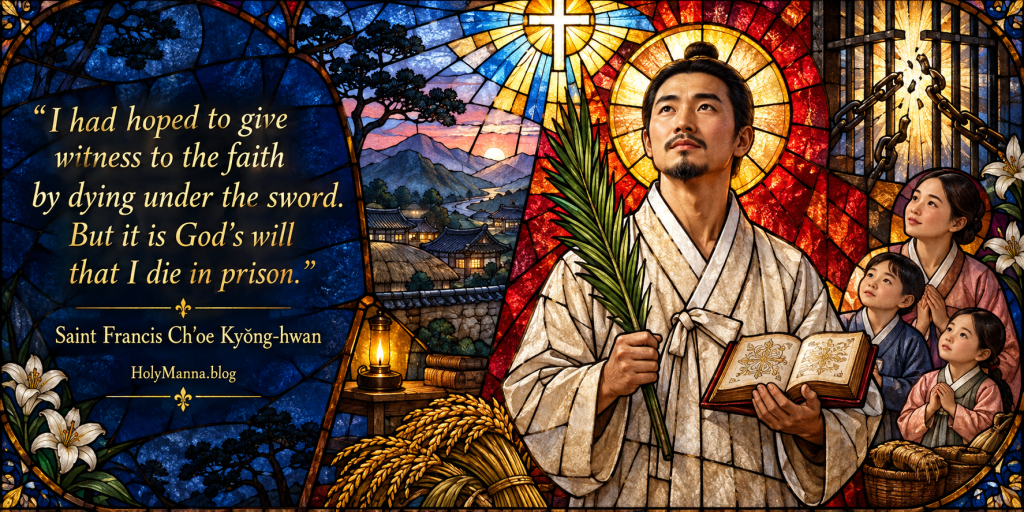
Then came the torture. The records state that his flesh was pierced with spikes and that he was beaten with more than three hundred blows. He did not yield. He did not curse his tormentors. He spent his strength encouraging the Catholics imprisoned with him. As his body failed, he knew he was dying, and he said to his fellow Christians words that the Korean Church has treasured ever since: “I had hoped to give witness to the faith by dying under the sword. But it is God’s will that I die in prison.” A few hours later, on September 12, 1839, Francis Ch’oe Kyŏng-hwan breathed his last. The official Korean biography gives his age as thirty-five, while other Catholic reference works give thirty-four; the difference reflects the traditional Korean way of counting age against the Western way, and both agree on his birth in 1805. His death lacked the public drama of the executioner’s blade, and he knew it, and he accepted it. The Catechism teaches that martyrdom is the supreme witness given to the truth of the faith, borne even unto death, by which the martyr endures death through an act of fortitude, as CCC 2473 teaches. The Church has always judged that Francis’s death under torture in that prison was martyrdom in the fullest sense. Saint Paul’s words in The Second Letter to Timothy fit him perfectly: “I have competed well; I have finished the race; I have kept the faith” (2 Tm 4:7).
His family drank from the same cup. His wife Mary, imprisoned with her children, watched their youngest son starve to death in her arms. Under that unimaginable weight, her mother’s heart broke, and she agreed to apostatize to save her remaining children. Almost immediately she regretted it, withdrew her apostasy, and returned to her chains. She was beheaded at Tanggogae outside Seoul at the age of thirty-nine. The sources preserve a genuine conflict about the date: the Korean bishops’ biography of Francis gives December 29, 1839, while the Danggogae shrine itself and the wider body of records place her martyrdom on January 31, 1840, among the final executions of the Gihae persecution, and the 1840 date is the better supported. Her moment of weakness, repented and reversed at the cost of her life, delayed her cause for generations, but the Church finally beatified her on August 16, 2014. There is a tenderness in that story that no invented tale could match. The Church does not canonize people who never stumbled; she canonizes people who got back up.
The Grave at Dambaegol
No individual miracles after death are recorded under Francis’s own name in the historical sources, and this should be stated plainly rather than embellished. Because he died as a martyr, his canonization within the company of the 103 Korean Martyrs did not require an attested miracle, for the Church has always held, as CCC 2473 reflects, that martyrdom itself is the supreme witness. Yet if a miracle is God’s power working visibly through a saint’s legacy, then Francis’s afterlife is full of it, and it wears his son’s face.
His four surviving sons were not executed, but they suffered on, becoming exiled beggars in the aftermath of the persecution. The eldest, Thomas, was still studying in Macau when word reached him that his father had been martyred and his mother beheaded. He pressed on. On April 15, 1849, Thomas Ch’oe Yang-ŏp was ordained a priest at the cathedral in Shanghai, becoming the second native Korean priest in history, and in December of that year he slipped back into his homeland. One of his first acts was to pray at his father’s grave at Dambaegol, near Anyang, close to the mountain where the family had farmed and prayed. Then he went to work. For twelve consecutive years he traveled roughly 2,800 kilometers every year, on foot over mountain paths, visiting more than 120 hidden Catholic villages, hearing confessions, offering Mass, and strengthening a persecuted people. Korean Catholics call him the shepherd on the road and the martyr of sweat, and he is sometimes styled the Saint Paul of Korea. He wore himself out, contracted typhoid, and died on June 15, 1861, at the age of forty. Pope Francis declared him Venerable on April 26, 2016, and in March 2026 the Vatican’s medical experts confirmed healings attributed to his intercession, advancing his cause toward beatification. Those attested healings, formally under examination in his son’s cause, are the closest thing to documented posthumous miracles flowing from this family’s witness, and they belong to the son rather than the father; that distinction is kept here deliberately.
The places of the family’s passion have become places of pilgrimage. The Catholic Holy Place of Surisan in Anyang, embracing the old village and the Dambaegol grave site, was formally designated a pilgrimage site in the Jubilee year 2000, preserving the memory of the early Korean church and the family’s suffering. In Seoul’s Yongsan district, the Danggogae Martyrs’ Shrine marks the hill where Mary Yi Sŏng-rye and nine companions were martyred, nine of whom are now canonized saints. Korean Catholics stream to these shrines, and the canonization of the 103 martyrs by Pope John Paul II at Yŏido in Seoul on May 6, 1984, before an immense crowd, remains one of the defining moments in the history of Asian Christianity. The Church in Korea, born of lay converts and watered by the blood of people like Francis, today numbers in the millions, and it has never forgotten that a tobacco farmer from Mount Suri helped hold the door open. The Catechism teaches that the communion of saints means exactly this exchange of spiritual goods, that the saints in heaven fix the whole Church more firmly in holiness and do not cease to intercede for those on earth, as CCC 946 through CCC 948 and CCC 956 teach.
What a Farmer’s Faith Asks of You
It would be easy to file Francis Ch’oe Kyŏng-hwan under distant heroism, the kind of sanctity that belongs to another century and another continent. Resist that. Almost everything about his life maps onto yours. He lived surrounded by people whose faith had gone lukewarm, and instead of drifting with them, he made deliberate, costly choices to protect the fire in his own household. He accepted a real drop in wealth and status for the sake of his family’s soul. He turned his home into a school of prayer. He had no credentials, no platform, and no permission slip from importance, and he evangelized anyway, at his kitchen table, after work. When public catastrophe came, he did not hoard; he gave, to fellow believers and to strangers alike. And when the final test arrived, he discovered that decades of small faithfulness had quietly built in him the strength for one great fidelity.
The Catechism insists that all the faithful, whatever their state in life, are called to the fullness of Christian life and to the perfection of charity, as CCC 2013 teaches. Francis is what that paragraph looks like with dirt under its fingernails. So let his life interrogate yours gently. What is your Mount Suri, the deliberate choice you may need to make so that your faith and your family’s faith can actually breathe? Who in your life is waiting, without knowing it, for you to open your home and your Bible the way Francis opened his? When you suffer setbacks that are smaller than a prison but still real, do you meet them as interruptions of God’s plan or as the unexpected shape of it, the way Francis accepted dying without the sword? Practical steps follow naturally from his example. Establish one fixed time of prayer in your home each day, even ten minutes, and guard it the way Francis guarded his night classes. Choose one work of mercy this month that costs you actual money or actual time, directed at someone who cannot repay you. Speak reverently of priests and pray for them by name, remembering the layman who would not mock a bishop’s vestments even to spare his own flesh. And when your faith wavers under pressure, remember Blessed Mary Yi Sŏng-rye, who fell once under a weight none of us can imagine, got back up, and went home to God anyway.
Engage With Us!
The story of Saint Francis Ch’oe Kyŏng-hwan belongs to the whole Church, and that includes you, so share your thoughts and reflections in the comments below. HolyManna.blog exists for exactly this kind of conversation, and your experience of living the faith in ordinary circumstances may be the encouragement another reader needs today. To help the discussion along, here are some questions to pray with and respond to.
- Francis left comfort and prosperity so that his family could practice the faith without compromise; what one concrete change could you make this month to put God more firmly at the center of your home?
- Francis taught the faith at night, without any formal training, using the books he had; what is one way you could share your faith this week with the knowledge and resources you already possess?
- During the persecution, Francis gave his money to imprisoned Christians and poor unbelievers alike; who is one person outside your circle whom you could serve without expecting anything in return?
- Francis hoped to die under the sword but accepted God’s will that he die in prison; where in your life is God asking you to surrender your preferred script and trust His instead?
- Blessed Mary Yi Sŏng-rye repented of her moment of weakness and returned to Christ at the cost of her life; is there a failure in your own past that God is inviting you to stop hiding and bring to Him in the Sacrament of Reconciliation?
Whatever your answers, do not let this saint remain a stranger. Ask his intercession for your family, your parish, and every Christian living under persecution today. Live your faith the way Francis lived his, steadily, generously, and without embarrassment, and do everything, from the smallest chore to the hardest sacrifice, with the love and mercy that Jesus taught us.
Saint Francis Ch’oe Kyŏng-hwan, pray for us!
Follow us on YouTube, TikTok, Instagram and Facebook for more insights and reflections on living a faith-filled life.

 Holy Manna!
Leave a comment