Saturday of the Twenty-Third Week in Ordinary Time – Lectionary: 442
Two Cups on the Table
Picture a dinner invitation in ancient Corinth. The venue is a banquet hall attached to a pagan temple, the meat on the table has just come from the altar of Apollo, and half the guest list belongs to the local church. That awkward evening is the real situation behind today’s readings, and it raises a question that has never gone out of style. Where does a believer’s deepest loyalty actually live?
The Church gives September 12th, Saturday of the 23rd Week in Ordinary Time, a set of readings built around two powerful images: a cup and a foundation. In 1 Corinthians 10, Saint Paul tells the Corinthians that the Eucharistic cup is a real participation in the Blood of Christ, which is exactly why it cannot be shared with the table of demons. Psalm 116 answers with the joyful resolve of the worshiper who takes up “the cup of salvation” and pays his vows before all the people. Then, in The Gospel of Luke, Jesus finishes his Sermon on the Plain with figs, brambles, and two houses in a flood, warning that calling him “Lord, Lord” means nothing unless obedience follows.
The central theme uniting all three readings is undivided communion. What a person receives at the Lord’s table must become the foundation of an entire life. Communion is not a symbol to admire but a participation that transforms, and participation always shows itself in fruit. Today’s liturgy asks every reader the same question the Corinthians faced over dinner. Which cup, and which foundation, is really holding up your life?
First Reading — 1 Corinthians 10:14-22
One Cup, One Body, No Compromise
Corinth in the middle of the 1st century was the kind of city where compromise felt like common sense. Rebuilt by Julius Caesar in 44 BC as a Roman colony, it controlled two harbors and an endless stream of sailors, merchants, and money. Its skyline bristled with temples to Apollo, Aphrodite, and Asclepius, and those temples were not merely houses of worship; they were the banquet halls, business clubs, and social calendars of the city. Meat from pagan sacrifices ended up on dinner tables everywhere. Writing from Ephesus around the year 56, Saint Paul addresses believers who wondered whether attending those temple banquets was really a big deal. His answer, given only about 25 years after the Resurrection and before the Gospels were written down, stands among the earliest surviving witnesses to the Church’s faith in the Eucharist, and it anchors the day’s theme of undivided communion.
1 Corinthians 10:14-22
My beloved ones, avoid idolatry.
I am speaking as to sensible people;
judge for yourselves what I am saying.
The cup of blessing that we bless,
is it not a participation in the Blood of Christ?
The bread that we break,
is it not a participation in the Body of Christ?
Because the loaf of bread is one,
we, though many, are one Body,
for we all partake of the one loaf.Look at Israel according to the flesh;
are not those who eat the sacrifices participants in the altar?
So what am I saying?
That meat sacrificed to idols is anything?
Or that an idol is anything?
No, I mean that what they sacrifice,
they sacrifice to demons, not to God,
and I do not want you to become participants with demons.
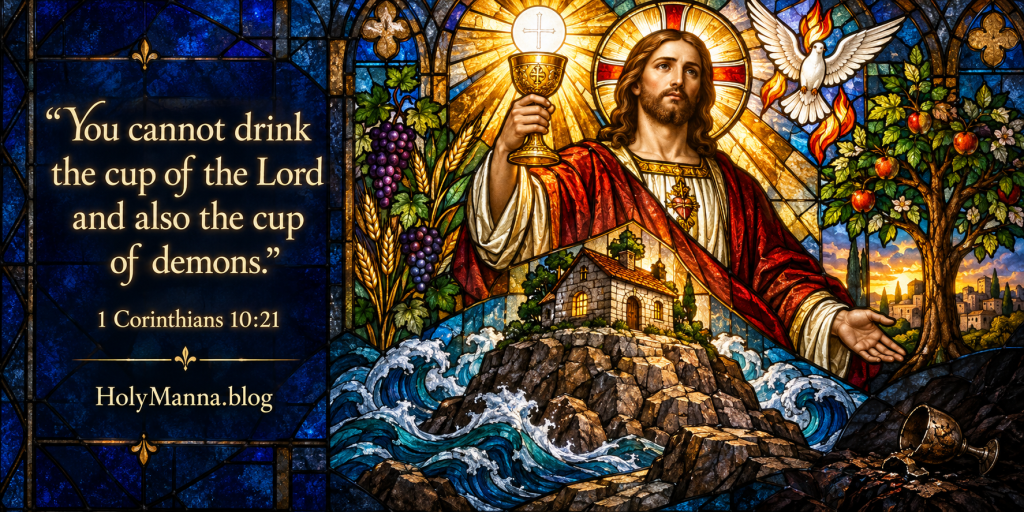
You cannot drink the cup of the Lord and also the cup of demons.
You cannot partake of the table of the Lord and of the table of demons.
Or are we provoking the Lord to jealous anger?
Are we stronger than him?
Detailed Exegesis
Verse 14: “My beloved ones, avoid idolatry.”
Paul opens with tenderness and urgency in the same breath. He is not scolding strangers; he is warning people he loves. The Greek verb carries the sense of continual flight, so the command is to keep running from idolatry the way Joseph fled temptation in Egypt. Idolatry is treated not as an antique problem but as a live danger for baptized believers.
Verse 15: “I am speaking as to sensible people; judge for yourselves what I am saying.”
Paul appeals to reason rather than demanding blind obedience. The Catholic tradition has always insisted that faith and reason work together, and Paul models that confidence here. He lays out the logic of the Eucharist and trusts his readers to reach the honest conclusion on their own.
Verse 16: “The cup of blessing that we bless, is it not a participation in the Blood of Christ? The bread that we break, is it not a participation in the Body of Christ?”
The cup of blessing was the name given to the third cup of the Passover meal, the very cup Jesus took at the Last Supper. The key word is the Greek koinonia, meaning real participation or communion. Paul is not describing a symbol or a fond memory. To receive the Eucharist is to share truly in the Body and Blood of the risen Lord.
Verse 17: “Because the loaf of bread is one, we, though many, are one Body, for we all partake of the one loaf.”
Here is the social miracle of the Eucharist. One loaf makes one Body out of many people who would otherwise have little in common: Jew and Greek, slave and free, rich and poor. Communion with Christ creates communion with one another, which is why the Church calls the Eucharist the source and summit of the Christian life.
Verse 18: “Look at Israel according to the flesh; are not those who eat the sacrifices participants in the altar?”
Paul points to the peace offerings of the Old Covenant, described in Leviticus, in which worshipers ate a portion of what had been offered to God. Eating the sacrifice meant sharing in the altar and in the God worshiped there. Sacred meals have always created real bonds, never neutral ones.
Verse 19: “So what am I saying? That meat sacrificed to idols is anything? Or that an idol is anything?”
Paul heads off a misunderstanding before it forms. He had already agreed earlier in the letter that idols have no real existence and that there is only one God. The statue of Apollo is stone, and the meat is only meat. The danger lies somewhere else entirely.
Verse 20: “No, I mean that what they sacrifice, they sacrifice to demons, not to God, and I do not want you to become participants with demons.”
Behind empty idols stand real spiritual powers. Paul echoes Deuteronomy 32:17, where Israel is accused of sacrificing to demons rather than to God. The same koinonia that unites believers to Christ at his table can, in pagan worship, entangle them with darkness. Worship is never a neutral act.
Verse 21: “You cannot drink the cup of the Lord and also the cup of demons. You cannot partake of the table of the Lord and of the table of demons.”
This is the thunderclap of the passage. The issue is not etiquette but allegiance. A heart cannot pledge itself fully at two altars, and pretending otherwise empties both gestures of their meaning. The table of the Lord asks for the whole person, because it gives the whole Christ.
Verse 22: “Or are we provoking the Lord to jealous anger? Are we stronger than him?”
Paul closes with an allusion to Deuteronomy 32:21. God’s jealousy in Scripture is not petty insecurity but covenant love, the rightful exclusivity of a bridegroom toward his bride. Testing that love by flirting with other gods is not sophistication. It is folly dressed up as freedom.
Teachings
The Catechism of the Catholic Church builds directly on this passage when it teaches that “the Eucharist makes the Church. Those who receive the Eucharist are united more closely to Christ” (CCC 1396), a paragraph that quotes today’s very verses as its foundation. Saint John Chrysostom, preaching on this text in his Homilies on First Corinthians, put it with unforgettable simplicity: “For what is the bread? The Body of Christ. And what do they become who partake of it? The Body of Christ: not many bodies, but one body.” Saint Augustine drew out the same mystery for his congregation in Sermon 272, telling communicants, “Be what you see; receive what you are.” On the other side of the coin, the Catechism warns that “Idolatry consists in divinizing what is not God” (CCC 2113), and it names the modern candidates plainly, listing power, pleasure, money, and even the state. The early Church took Paul’s either/or with complete seriousness. Many martyrs died precisely because they refused to drop a pinch of incense on a pagan altar, a gesture their neighbors considered harmless civic politeness. They understood that whoever receives what Saint Ignatius of Antioch called “the medicine of immortality” in his Letter to the Ephesians cannot also recline at the table of demons.
Reflection
Few people today are tempted by statues of Apollo, but every age sets its own tables. A career that quietly demands worship, a phone that receives the first attention of every morning, money that dictates every decision, an ideology that outranks the Gospel: these are the banquet halls of the modern world. The examination is simple and searching. Whatever consistently receives the sacrifice of time, love, and trust is functioning as a god. A practical step is to name one competing table honestly this week and to withdraw from it in some concrete way, then to bring that renunciation to Sunday Mass and unite it interiorly to the offering of the chalice. What table competes hardest with the Lord’s table in your life right now? When you receive Communion on Sunday, does your Monday look like it?
Responsorial Psalm — Psalm 116:12-13, 17-18
The Only Way to Repay a Gift Too Big
Psalm 116 is the thanksgiving song of someone who has been pulled back from the edge of the grave. It belongs to the collection known as the Egyptian Hallel, Psalms 113 through 118, which Jewish families sang during the Passover meal. The Gospels record that Jesus and the apostles sang a hymn after the Last Supper, and tradition identifies that hymn with these psalms, which means these words were very likely on the lips of Jesus on the night before he died. In ancient Israel this psalm accompanied the todah, the sacrifice of thanksgiving, a joyful offering in which the rescued worshiper shared a sacred meal with family and friends in God’s presence. Today’s refrain, drawn from verse 17, gathers the whole prayer into a single line about offering a sacrifice of praise, and it answers Saint Paul’s warning perfectly. The alternative to the cup of demons is not an empty hand. It is a lifted cup.
Psalm 116:12-13, 17-18
R. (17) To you, Lord, I will offer a sacrifice of praise.How shall I make a return to the LORD
for all the good he has done for me?
The cup of salvation I will take up,
and I will call upon the name of the LORD.R. To you, Lord, I will offer a sacrifice of praise.
To you will I offer sacrifice of thanksgiving,
and I will call upon the name of the LORD.
My vows to the LORD I will pay
in the presence of all his people.R. To you, Lord, I will offer a sacrifice of praise.
Detailed Exegesis
Verse 12: “How shall I make a return to the LORD for all the good he has done for me?”
This is gratitude doing honest math. No one can repay God, and the psalmist knows it. The question is not a negotiation but an overflow, the instinct of a heart that has been rescued and refuses to shrug it off as luck.
Verse 13: “The cup of salvation I will take up, and I will call upon the name of the LORD.”
The stunning answer to the unpayable debt is not to give something to God but to receive even more from him. In the todah ritual, the worshiper lifted a cup of wine in thanksgiving before God and the assembly. The Church has always heard in this verse a prophecy of the Eucharistic chalice, the true cup of salvation, taken up at every Mass. Receiving well is itself the return.
Verse 17: “To you will I offer sacrifice of thanksgiving, and I will call upon the name of the LORD.”
The Greek word for thanksgiving is eucharistia, and the connection is no accident. The todah of Israel finds its fulfillment in the Eucharist, where the Church joins the one perfect sacrifice of praise. Calling on the name of the Lord, repeated twice in today’s verses, keeps the focus on a living relationship rather than on ritual for its own sake.
Verse 18: “My vows to the LORD I will pay in the presence of all his people.”
Biblical gratitude is never private. The psalmist pays his vows publicly, in the assembly, because rescued people owe their story to the community. This anticipates Paul’s teaching that one loaf forms one Body. Thanksgiving, spoken aloud, builds the Church.
Teachings
The Catechism teaches that “The Eucharist, the sacrament of our salvation accomplished by Christ on the cross, is also a sacrifice of praise in thanksgiving for the work of creation” (CCC 1359), and again that “The Eucharist is also the sacrifice of praise by which the Church sings the glory of God in the name of all creation” (CCC 1361). Even the sacrament’s name grows out of this psalm’s world, as CCC 1328 explains when it lists Eucharist among the sacrament’s titles because it is an action of thanksgiving to God, recalling the Jewish blessings that proclaimed God’s works of creation and redemption. What the psalmist glimpsed in the todah meal, a rescued people feasting gratefully in God’s presence, the Church now lives at every altar in the world.
Reflection
Gratitude is a discipline long before it becomes a feeling. A concrete practice is to end each day this week by naming three specific goods received and speaking them aloud to God, then bringing that list to Mass on Sunday and placing it interiorly on the altar at the offertory. Another step is to make thanksgiving public the way the psalmist did, by actually telling another person what God has done. What good has God done for you lately that you have never said out loud? When the chalice is lifted at Mass this Sunday, what will you be taking up along with it?
Holy Gospel — Luke 6:43-49
Storms Are Honest Inspectors
These verses close the Sermon on the Plain, Saint Luke’s account of the great discourse Jesus delivered on level ground to his newly chosen apostles and a vast crowd drawn from Judea, Jerusalem, and the pagan coastlands of Tyre and Sidon. After teaching the Beatitudes, love of enemies, and mercy in judgment, Jesus ends not with a gentle benediction but with a warning wrapped in two images every Galilean understood. Farmers knew that fruit never lies about a tree, and builders knew that the dry, sun-baked wadis of the region could turn into raging torrents in a single storm. A house’s survival depended on whether its builder had done the invisible, exhausting work of digging through soil to bedrock. Jesus applies both images to discipleship, and in doing so he presses the day’s central theme to its point. Communion with him must show itself in fruit, and hearing him must become obedience, or the whole structure is a facade waiting for weather.
Luke 6:43-49
Jesus said to his disciples:
“A good tree does not bear rotten fruit,
nor does a rotten tree bear good fruit.
For every tree is known by its own fruit.
For people do not pick figs from thornbushes,
nor do they gather grapes from brambles.
A good person out of the store of goodness in his heart produces good,
but an evil person out of a store of evil produces evil;
for from the fullness of the heart the mouth speaks.“Why do you call me, ‘Lord, Lord,’ but not do what I command?
I will show you what someone is like who comes to me,
listens to my words, and acts on them.
That one is like a man building a house,
who dug deeply and laid the foundation on rock;
when the flood came, the river burst against that house
but could not shake it because it had been well built.
But the one who listens and does not act
is like a person who built a house on the ground
without a foundation.
When the river burst against it,
it collapsed at once and was completely destroyed.”
Detailed Exegesis
Verse 43: “A good tree does not bear rotten fruit, nor does a rotten tree bear good fruit.”
Jesus argues from nature itself. Fruit is not an accessory a tree chooses; it is the visible expression of what the tree actually is. In the moral life, actions flow from character, and character is shaped by grace working within. Goodness cannot be faked for long, because real goodness must grow from the inside out.
Verse 44: “For every tree is known by its own fruit. For people do not pick figs from thornbushes, nor do they gather grapes from brambles.”
Jesus offers a standard of discernment that cuts through appearances and rhetoric. Words, credentials, and reputations can deceive, but patterns of fruit over time do not. The Church has always applied this test to teachers and movements, and every believer can apply it personally in a regular examination of conscience.
Verse 45: “A good person out of the store of goodness in his heart produces good, but an evil person out of a store of evil produces evil; for from the fullness of the heart the mouth speaks.”
The heart is the hidden warehouse from which every word and deed is eventually shipped. The Catechism calls the heart “the seat of moral personality” (CCC 2517). Speech is the leak that reveals what is stored inside, which makes an honest review of one’s own words a surprisingly accurate spiritual diagnostic.
Verse 46: “Why do you call me, ‘Lord, Lord,’ but not do what I command?”
This may be the most uncomfortable question in the Gospel, because it is aimed squarely at religious people. Calling Jesus Lord is correct doctrine; refusing his commands turns the title into an empty sound. Worship and obedience are meant to be one single act, exactly as Paul argued about the two tables.
Verse 47: “I will show you what someone is like who comes to me, listens to my words, and acts on them.”
Jesus lays out discipleship in three verbs: come, listen, act. Most spiritual failure happens in the gap between the second verb and the third. The invitation is personal, the teaching is clear, and the deciding factor is whether hearing ever becomes doing.
Verse 48: “That one is like a man building a house, who dug deeply and laid the foundation on rock; when the flood came, the river burst against that house but could not shake it because it had been well built.”
Digging deeply is slow, hidden, unglamorous work: daily prayer, regular Confession, Scripture, the sacraments, and small obediences no one applauds. In a striking connection with today’s First Reading, Paul writes just a few verses earlier in that same chapter that the rock which accompanied Israel in the desert was Christ himself, declaring that “the rock was the Christ” (1 Corinthians 10:4). The disciple digs until the whole of life rests on him.
Verse 49: “But the one who listens and does not act is like a person who built a house on the ground without a foundation. When the river burst against it, it collapsed at once and was completely destroyed.”
The frightening detail is that both houses looked identical in good weather. Only the flood exposed the difference between them, and by then it was too late to dig. Storms of suffering, temptation, and loss do not create weak foundations. They simply reveal the foundations that were already there.
Teachings
The Catechism addresses this passage directly in its teaching on prayer: “The prayer of faith consists not only in saying ‘Lord, Lord,’ but in disposing the heart to do the will of the Father” (CCC 2611). It makes the same demand of the moral life: “The Law of the Gospel requires us to make the decisive choice between ‘the two ways’ and to put into practice the words of the Lord” (CCC 1970). Saint James echoes his Master almost word for word: “Be doers of the word and not hearers only, deluding yourselves” (James 1:22). And Saint John of the Cross, the great Doctor of the Church quoted in CCC 1022, compresses the final exam into a single line: “At the evening of life, we shall be judged on our love.” The saints stand as living proof of this Gospel. Their fruit, from hospitals and schools to heroic forgiveness of persecutors, is precisely how the world came to recognize the goodness of the tree that bore them.
Reflection
A practical way to live this Gospel is to leave Mass each week with one command of Jesus chosen for action within 24 hours: forgive that person, make that call, give that alms, speak that truth with love. Another is a nightly review of speech, since the mouth faithfully reports what the heart has stored. Where words trend toward complaint, gossip, or vanity, the storehouse needs restocking through prayer and the sacraments. Digging deep can even be scheduled: 15 minutes of daily Scripture, monthly Confession, and one honest spiritual friendship. Which of Jesus’ commands have you been hearing for years without ever acting on? If a storm hit your life this month, what would it reveal about your foundation?
Lift the Cup, Then Dig
Today’s readings tell one story in three movements. Saint Paul begins it at a crowded Corinthian dinner table, insisting that the Eucharistic cup is a true participation in the Blood of Christ and that no heart can pledge itself at two altars. The psalmist answers with the only sane response to so great a gift, lifting the cup of salvation and offering a sacrifice of praise before all the people. Then Jesus finishes the story beside a flooding river, warning that those who call him Lord while ignoring his commands are building beautiful houses on bare ground.
The thread running through it all is undivided communion. What is received at the table must become the foundation of the house. The Mass is not an interruption of real life; it is the bedrock underneath it, and every Communion is both a gift and a pledge. The good news hiding inside these demanding readings is that no one digs alone. The same Lord who commands obedience also feeds the obedience he commands, placing himself, Body and Blood, into open hands week after week. Grace supplies what gratitude could never repay.
The invitation for this Saturday in Ordinary Time is wonderfully concrete. Go to Mass. Take up the cup of salvation with full attention and a grateful heart. Choose one command of Jesus and act on it before the weekend ends. Then watch, patiently and without fear, as the Master Builder turns an ordinary life into a house that no storm can shake.
Engage With Us!
The conversation does not end when the post does, so please share your reflections in the comments below. A story of grace shared today might be exactly what another reader needs to hear. Here are some questions to pray with this weekend:
- In 1 Corinthians 10:14-22, Saint Paul warns that no one can share both the table of the Lord and the table of demons. What competing table most quietly claims your time, trust, or love, and what is one concrete step you can take this week to walk away from it?
- In Psalm 116:12-13, 17-18, the psalmist answers God’s goodness by taking up the cup of salvation and giving thanks publicly. What has God done for you that you have never thanked him for out loud, and who could you tell about it this week?
- In Luke 6:43-49, Jesus says the house survived the flood because the builder dug deeply and laid its foundation on rock. What would digging deeper look like in your spiritual life this month, whether in prayer, the sacraments, or obedience to one specific command?
- Taking all of today’s readings together, where is God inviting you to move from admiring Jesus to truly participating in him, so that what you receive at his table becomes the foundation of your whole life?
Living faith was never meant to be a performance reserved for good weather. It is a daily choosing of the Lord’s table, a daily word of thanks, and a daily act of obedience, all done with the love and mercy Jesus taught us. Build on him, and the storms will only prove how well the house was made.
Sacred Heart of Jesus, we trust in You!
Immaculate Heart of Mary, pray for us!
Saint Michael the Archangel, defend us in battle!
Follow us on YouTube, TikTok, Instagram and Facebook for more insights and reflections on living a faith-filled life.

 Holy Manna!
Leave a comment