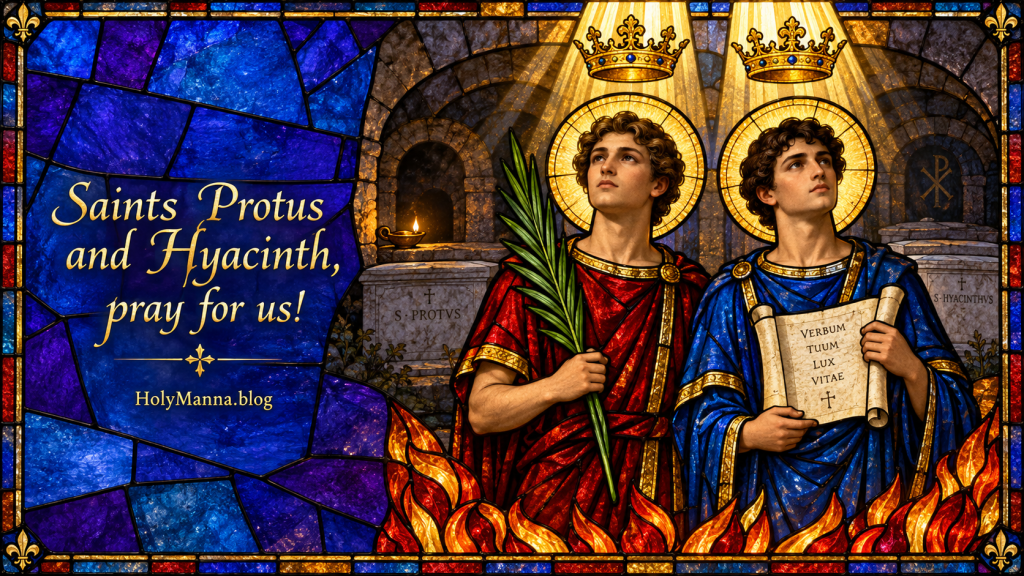
The Brothers in the Catacomb
Every September 11th, the Church quietly speaks two names that most Catholics have never heard: Protus and Hyacinth. There is no basilica bearing their names on postcards, no famous painting hanging in a museum gift shop, no bestselling biography. And yet these two Roman martyrs of the 3rd century hold a distinction shared by almost no one else in the entire history of the Church. When archaeologists opened the catacomb of Basilla on the old Via Salaria in Rome in 1845, they found the tomb of Saint Hyacinth exactly as it had been sealed roughly sixteen centuries earlier, marble slab still in place, original inscription still legible, the charred bones of the martyr still wrapped in the remains of costly fabric. The stone read, in abbreviated Latin, that Hyacinth the martyr was buried on the third day before the Ides of September, which is September 11th. The very date the Church had been keeping all along was carved into the rock, waiting.
That is who Saints Protus and Hyacinth are: witnesses whose testimony was preserved not in libraries but in stone and ash. Pope Saint Damasus I, who governed the Church in the 4th century and made it his mission to honor the tombs of the Roman martyrs, composed an epitaph for the pair and called them brothers. The Church has commemorated them together on September 11th since at least the year 354, when their feast appears in the Depositio Martyrum, one of the oldest liturgical calendars of the Roman Church. They died for Christ, they were buried side by side, and the Church has never once stopped speaking their names. The Catechism teaches that “the Church recognizes the power of the Spirit of holiness within her and sustains the hope of believers by proposing the saints to them as models and intercessors” (CCC 828). Protus and Hyacinth are proposed to the faithful for exactly that reason, as models of a fidelity so complete that fire itself could not erase it.
Servants in the Household of Faith
Honesty demands a clear statement at the outset: almost nothing about the early lives of Protus and Hyacinth can be established as documented history. They lived in the 3rd century, most likely in Rome, and they died during one of the imperial persecutions. The Catholic Encyclopedia places their martyrdom during the persecution of the Emperor Valerian, between the years 257 and 259, while a later narrative tradition names the Emperor Gallienus, who reigned from 260 to 268. The sources conflict on this point, and no one can resolve the question with certainty. What is certain, because Pope Damasus himself wrote it within living memory of the great persecutions, is that they were remembered as brothers, whether brothers by blood or brothers in the bond of faith.
The fuller story of their lives comes from a tradition written down in Italy in the second half of the 5th century, roughly 200 years after their deaths, as part of the Passion narrative of Saint Eugenia. According to this tradition, Protus and Hyacinth were servants, described as chamberlains, in the household of Eugenia, the daughter of a Roman official stationed in Alexandria in Egypt. The tradition holds that the two men were baptized together with Eugenia by the holy bishop Helenus, and that from that moment their lives took a shape the ancient world could not comprehend. Rather than seeking advancement, they gave themselves to the study of Sacred Scripture. Rather than pursuing comfort, they went out and lived for a time among the hermits of the Egyptian desert, where the tradition remembers them as men illustrious for humility and holiness of life. Later, the story continues, they accompanied Eugenia to Rome and entered the service of a noblewoman named Basilla, whom they led to faith in Jesus Christ. This account cannot be verified, and it is presented here as the tradition the Church has received rather than as established fact.
Yet even an unverifiable tradition can carry a true portrait. Strip the story down to its bones and something beautiful remains: two men of low social standing, servants in a world built on status, who found in Baptism a dignity no emperor could grant and no persecutor could revoke. The Catechism teaches that through Baptism the faithful are “freed from sin and reborn as sons of God” and become “members of Christ” who are “incorporated into the Church and made sharers in her mission” (CCC 1213). Whatever the precise details of their conversion, Protus and Hyacinth lived that reality to its absolute end.
A Hidden Life That Prepared for a Public Death
No miracles performed by Protus and Hyacinth during their lifetimes are recorded in any source, and none will be invented here. Their claim on the Church’s memory rests on something the modern world routinely undervalues: perseverance. The tradition describes them doing three things with their years, studying the Word of God, seeking holiness in prayer and asceticism, and quietly drawing others toward Christ. That is the entire program. There is no record of eloquent public preaching, no dramatic confrontations in the forum, no wonders. There is simply the long, hidden work of becoming the kind of men who, when the decisive hour arrived, did not bend.
This is precisely why they matter, and why they deserve to be remembered and emulated. The Church has always understood that martyrdom is not a sudden burst of heroism produced out of nothing. It is the final fruit of a thousand small fidelities. The Catechism teaches that “Martyrdom is the supreme witness given to the truth of the faith: it means bearing witness even unto death” (CCC 2473). A witness must first possess the truth he dies for, and Protus and Hyacinth possessed it the way a laborer possesses a trade, through years of daily practice. Their devotion to Scripture recalls the words of Psalm 119: “I have laid up your word in my heart, that I might not sin against you” (Ps 119:11). When the Roman state finally demanded their souls, it discovered that those souls had already been given away, freely and completely, to Someone else.
Scripture promises exactly this about God’s faithful ones: “The souls of the righteous are in the hand of God, and no torment will ever touch them” (The Book of Wisdom, Wis 3:1). The torments touched their bodies. The archaeology proves that much beyond dispute. But the Church professes with confidence that the torments never touched what mattered.
The Day They Refused
The traditional entry of the Roman Martyrology for September 11th preserves the ancient memory of their final trial: “At Rome, in the Cemetery of Basilla, on the old Salarian Way, the birthday of the Holy Martyrs, Protus and Hyacinth, brothers and eunuchs in the service of the blessed Eugenia, who were arrested in the time of the Emperor Gallienus, on the charge of being Christians and urged to offer sacrifice to the gods. But as they refused, both were most severely scourged and finally, beheaded” (Roman Martyrology, September 11th).
The word “birthday” in that entry is not a mistake. The early Church called the day of a martyr’s death his dies natalis, his birthday into eternal life, because on that day the martyr was born into the presence of God. According to the tradition, the two brothers were seized and brought to a pagan temple, where they were commanded to offer incense to the gods of Rome. It was a small gesture the empire demanded, a pinch of incense on a brazier, and it would have purchased their lives. They refused. They were scourged, and they were killed, and the tradition holds that they went to their deaths together, brothers to the last.
One honest complication must be stated plainly. The written tradition says they were beheaded, but when Saint Hyacinth’s tomb was opened in 1845, it contained ashes and burned bones, clear evidence that he died by fire or that his body was burned. Scholars who studied the tomb concluded that most probably both martyrs suffered death by fire. The narrative details of the Passion account, written 2 centuries after the events, simply cannot be verified, and where the written story and the physical evidence disagree, the honest course is to say so. What no one disputes is the essential fact: these two men were killed for refusing to deny Jesus Christ.
In that refusal they fulfilled, to the letter, the words of the Lord: “Everyone who acknowledges me before men, I also will acknowledge before my Father who is in heaven” (The Gospel of Matthew, Mt 10:32). The Catechism teaches that the martyr “bears witness to Christ who died and rose, to whom he is united by charity” and “endures death through an act of fortitude” (CCC 2473). The empire believed it was erasing two insignificant servants. Instead it was writing their names into the Book of Life, and, as it turned out, into stone.
The Tomb That Waited Sixteen Centuries
The two martyrs were laid to rest together in the cemetery of Basilla on the old Via Salaria, the burial ground later known as the catacomb of Saint Hermes. Their graves became a place of veneration for the Christians of Rome. In the 4th century, a landslide within the catacomb damaged and obstructed the crypt, and Pope Saint Damasus I, the great champion of the Roman martyrs, repaired the tomb, built access for pilgrims, and composed the epitaph in which he named the two men brothers. A portion of that inscription survives to this day.
Then history intervened in a way that would prove providential. In the 9th century, Pope Leo IV undertook a great translation of martyrs’ relics from the decaying catacombs into the safety of the city’s churches. His workers found the grave of Saint Protus and transferred his bones to the church of San Salvatore on the Palatine. But the grave of Saint Hyacinth, likely hidden by the old landslide damage, could not be found. The Church assumed the relics were lost. In reality, the earth itself had become the saint’s reliquary, guarding him undisturbed while empires rose and fell above his head.
On March 21st, 1845, the Jesuit archaeologist Father Giuseppe Marchi, excavating in the catacomb, uncovered a small square niche still sealed by its marble slab. The inscription on the slab read, in abbreviated form, “D P III IDUS SEPTEBR YACINTHUS MARTYR”, that is, buried on the third day before the Ides of September, Hyacinth, martyr. Inside lay the ashes and charred bones of the saint, wrapped in the remains of costly fabric, with traces of what had been laid there in honor. Nearby in the same chamber were found fragments of a carved architrave bearing the words “SEPULCRUM PROTI M”, the tomb of Protus the martyr, confirming that the two had been buried in the same crypt, together in death as in life. Saint Hyacinth is unique among the Roman martyrs in this respect: his grave was found in modern times completely intact, with the original epitaph still in place, silently confirming the very date the Church had celebrated for 1,500 years. The relics of Saint Hyacinth were afterward enshrined in the chapel of the Pontifical Urban College of the Propaganda Fide in Rome, the college that forms missionaries for the whole world, a fitting home for a martyr whose witness crossed centuries. Sources differ on the date of this enshrinement, with the Catholic Encyclopedia recording 1849 and other accounts recording June of 1933, and that conflict is noted here honestly rather than resolved artificially.
No miraculous healings or divine interventions are attributed to Protus and Hyacinth in the historical record, and none will be claimed. Yet the faithful may be forgiven for seeing the hand of Providence in the story of the tomb itself, a witness sealed in the age of persecution and opened in the age of doubt, as if God had kept one piece of evidence in reserve. Their veneration spread far beyond Rome. The Eastern churches honor the two martyrs as well, keeping their memory on December 24th. In the great basilica of Sant’Apollinare Nuovo in Ravenna, the two saints appear in the glittering 6th century mosaic procession of martyrs, shown as two young men carrying the crowns of victory. Their memory even reached the far edge of Europe, where a parish church in Blisland in Cornwall, England, was dedicated under the name of Saint Protus, whose name local speech softened over the centuries into “Saint Pratt.” From a sealed niche in a Roman catacomb to the mosaics of Ravenna to a green corner of Cornwall, the two servants traveled farther in death than they ever did in life.
The Catechism explains why the Church so treasures the memory and the relics of her martyrs: “It is not merely by the title of example that we cherish the memory of those in heaven; we seek, rather, that by this devotion to the exercise of fraternal charity the union of the whole Church in the Spirit may be strengthened” (CCC 957). The bones in the Propaganda chapel are not a museum exhibit. They are a family bond, a physical link between the Church of the catacombs and the Church of today, which are one and the same Church.
What Two Forgotten Servants Can Teach a Distracted Age
It is tempting to file Saints Protus and Hyacinth under ancient history, two names from a world of togas and emperors with nothing to say to a world of smartphones and schedules. That would be a mistake. Their witness lands closer to home than almost any famous saint’s, precisely because they were not famous. They were ordinary men with ordinary jobs who made an extraordinary decision every single day: God first, everything else second.
Consider what their fidelity actually looked like from the inside. No one was writing their biography. No crowds gathered to watch them pray. Their years of studying Scripture, their time of prayer and asceticism, their quiet witness within a household, all of it happened in complete obscurity. And when the test finally came, the world offered them the same bargain it offers you in a hundred smaller ways: just a pinch of incense, just a small compromise, just go along quietly and no one gets hurt. They said no. They said no together, brothers holding each other up, proving that fidelity is rarely a solo achievement. Scripture says of such friendship, “Two are better than one, because they have a good reward for their toil. For if they fall, one will lift up his fellow” (The Book of Ecclesiastes, Eccl 4:9 to 10).
Where in your life is the world asking you for a pinch of incense, a small denial of Christ dressed up as a reasonable compromise? Perhaps it is staying silent about your faith at work because the subject is awkward. Perhaps it is laughing along with mockery of the Church rather than gently speaking the truth. Perhaps it is letting prayer, Scripture, and the Sacraments slide because the calendar is full. The persecutors of the 3rd century demanded apostasy all at once; the modern world prefers to collect it in installments.
The remedy is the same one Protus and Hyacinth used. Build the hidden life now, before the test comes. Read Scripture daily, even 10 minutes, and let the Word of God be laid up in your heart. Go to Confession regularly, because The Catechism teaches that this sacrament restores and strengthens the grace lost through sin (CCC 1468). Find a brother or a sister in the faith, because the Christian life was never designed to be lived alone, and the Church herself is a communion (CCC 946 to 948). Do your ordinary work, in the office, the classroom, the kitchen, as service rendered to God, remembering that these two saints were servants and are now crowned in glory. If your tomb were opened in 1,600 years, what would the evidence say you lived for?
Engage With Us!
The story of Saints Protus and Hyacinth belongs to the whole family of faith, and that includes you. Share your thoughts and reflections in the comments below; your witness might be exactly the encouragement another reader needs today. Here are some questions to pray with and to discuss:
- Protus and Hyacinth are remembered as brothers who stood firm together. Who stands with you in your faith, and who might God be calling you to stand beside?
- The martyrs refused to offer a small pinch of incense to false gods. What small compromises is the world currently asking of you, and how will you respond?
- Their hidden years of Scripture study and prayer prepared them for their final witness. What is one concrete habit you can begin this week to build your own hidden life with God?
- Saint Hyacinth’s tomb silently confirmed the Church’s memory after sixteen centuries. How does the witness of the early martyrs strengthen your confidence in the faith handed down to you?
- The two saints served in obscurity, with no one recording their good deeds. How can you serve Christ faithfully this week in ways no one will ever see or applaud?
The names Protus and Hyacinth were nearly lost to the world, but they were never lost to God, and neither are you. Live this day, and every day, with the courage of the martyrs and the tenderness of the Gospel. Be faithful in the small things, stand firm in the great things, and do everything with the love and mercy that Jesus taught us.
Saints Protus and Hyacinth, pray for us!
Follow us on YouTube, TikTok, Instagram and Facebook for more insights and reflections on living a faith-filled life.


Leave a Reply