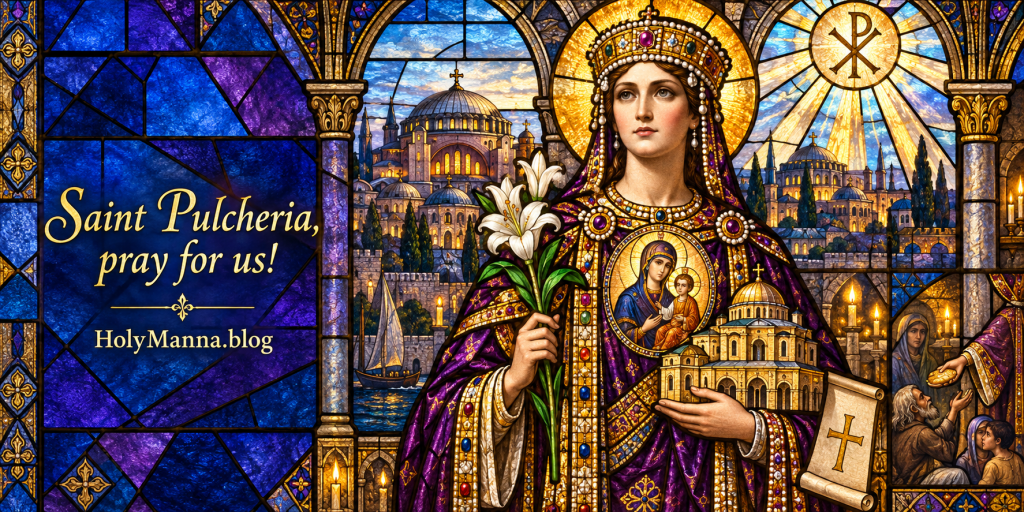
A Teenage Empress Who Steered an Empire To Christ
Some saints change the world from a hermit’s cave. Saint Pulcheria changed it from a throne room, and she did it before she was old enough to be taken seriously by the men around her. Celebrated on September 10th, Pulcheria was Empress of the Eastern Roman Empire, the granddaughter of Theodosius the Great, and one of the most consequential laywomen in the entire history of the Church. At fifteen she became regent of an empire. At about the same age she made a public vow of perpetual virginity and kept it until her death, even through a marriage. In between, she raised an emperor, outlasted palace intrigues that would make a modern political drama look tame, and threw the full weight of the imperial crown behind the two ecumenical councils that gave Christians the words they still use to confess who Jesus Christ is and who His Mother is.
The Roman Martyrology honors her on September 10th with beautiful simplicity: “At Constantinople, Pulcheria, Virgin and Empress, distinguished by her piety and zeal for the True Faith.” Virgin and empress. Those two words almost never sit together in one sentence, and that is exactly why her story matters. The Church venerates her in both East and West, and the fathers of the Council of Chalcedon acclaimed her to her face as a new Saint Helena. When bishops gathered from across the known world start comparing a living woman to the mother of Constantine, something remarkable has happened.
Her life answers a question many believers quietly carry: can a person hold real power, wealth, and influence and still become a saint? Pulcheria’s answer was yes, but only if the power serves Christ rather than the self. The Catechism teaches that “all Christians in any state or walk of life are called to the fullness of Christian life and to the perfection of charity” (CCC 2013). Pulcheria’s walk of life happened to include a diadem. She pursued the perfection of charity anyway.
Born in the Purple, Formed for Heaven
Pulcheria was born in Constantinople on January 19th, 399, into the Theodosian dynasty at the height of its glory and dysfunction. Her grandfather was Theodosius I the Great, the emperor who made Nicene Christianity the faith of the empire. Her father was the Emperor Arcadius, a weak ruler dominated by his court. Her mother was the Empress Aelia Eudoxia, a formidable woman remembered less than fondly by Catholics because of her bitter feud with Saint John Chrysostom, the golden-mouthed Patriarch of Constantinople whom she helped drive into the exile where he died. Pulcheria had an older sister, Flaccilla, who appears to have died young, and three younger siblings: Arcadia, the future emperor Theodosius II, and Marina.
Childhood ended early for all of them. Their mother died in 404, when Pulcheria was five. Their father died in 408, when she was nine. Her little brother Theodosius II, only seven years old, suddenly became emperor of the Eastern Roman Empire under the guardianship of the praetorian prefect Anthemius. For six years the children lived as orphans at the center of the most powerful court on earth, surrounded by officials who saw them as instruments rather than souls.
Then came one of the most astonishing turns in Roman history. On July 4th, 414, the Senate proclaimed the fifteen-year-old Pulcheria Augusta, empress, and she became regent for her thirteen-year-old brother. The teenage girl did not merely hold the title. She governed. The church historian Socrates, writing within her own lifetime, records that she took personal charge of Theodosius’ education, forming him in letters, in royal bearing, and above all in prayer and reverence for the things of God.
Around the time she became Augusta, Pulcheria did something no one expected from a princess whose marriage would have been the most valuable diplomatic prize in the empire. She consecrated her virginity to God publicly and persuaded her sisters Arcadia and Marina to do the same. Socrates and the historian Sozomen describe the result: the imperial palace took on the character of a monastery, with regular hours of prayer, fasting, psalm singing, works of charity, and a household ordered around the worship of God. The Catechism speaks of consecrated virgins as women who, “committed to the holy plan of following Christ more closely, are consecrated to God” and become “a transcendent sign of the Church’s love for Christ” (CCC 922 to 923). Pulcheria lived that sign at the summit of worldly power, where every incentive pushed the other way.
It is fair to note what historians add: her vow also protected her and her sisters from being married off to ambitious men who could threaten her brother’s throne. Grace and prudence are not enemies. Pulcheria seems to have possessed both in abundance, and the Church has never required that a holy decision be politically foolish in order to count as holy.
The Palace That Became a Monastery
For roughly a decade Pulcheria ruled jointly with her brother, and her fingerprints are on much of what made his long reign fruitful. She arranged his marriage to the brilliant Athenais, baptized as Eudocia, in 421. The intellectual flowering of the reign, including the founding of the university of Constantinople and the great legal compilation known as the Theodosian Code, unfolded under the dynasty she stabilized. But her deepest energies flowed toward the Church and the poor.
Sozomen, writing while she lived, records that she built churches, hospitals, and houses for pilgrims, and enriched churches across the empire with gifts. In Constantinople she built three churches in honor of Mary the Mother of God, one of them, raised after the defeat of the Nestorian heresy, described as exceedingly beautiful. Later tradition identifies these with the three greatest Marian shrines of the city, including the famed church at Blachernae; the specific identifications rest on tradition rather than certain documentation, but her Marian building program itself is attested by her contemporaries. She was, in the most literal sense, a builder of the Church.
She also understood something the modern world has forgotten: the bodies of the saints matter, because the body itself is destined for resurrection. In 438 she and her brother had the relics of Saint John Chrysostom, the very bishop their own mother had persecuted, brought home from his place of exile and buried with honor in the Church of the Holy Apostles on January 27th, 438. Think about that act for a moment. Pulcheria publicly honored the man her mother had wronged, and by doing so she healed a schism, since the followers of Chrysostom who had separated over his mistreatment were reconciled to the Church. It was penance, diplomacy, and devotion in a single gesture, a daughter repairing what her mother had broken.
Sozomen also preserves an account of a miraculous character from her lifetime. The relics of the Forty Martyrs of Sebaste, the soldiers frozen to death for Christ on an icy lake, had been lost near Constantinople. According to Sozomen’s history, their resting place was made known to Pulcheria through heavenly revelation, and she had the relics solemnly transferred to a worthy church amid great rejoicing. Sozomen was her contemporary and tells this as fact, but the miraculous revelation itself cannot be independently verified, and it is presented here as the ancient account hands it down. During her ascendancy the relics of Saint Stephen, the first martyr, also arrived in Constantinople in 421, and some scholars believe a famous carved ivory now in Trier depicts Pulcheria herself receiving them at the head of a great procession, though that identification is debated among historians.
Why does any of this matter to a reader today? Because Pulcheria shows what the Catechism calls the witness of life: “The witness of a Christian life and good works done in a supernatural spirit have great power to draw men to the faith and to God” (CCC 2044). She did not preach sermons. She could not celebrate sacraments. She simply used every tool her state in life gave her, wealth, authority, patronage, and reputation, to make Christ visible in her city.
The Empress Against the Heresiarchs
Every saint faces a battle, and Pulcheria’s battles came wearing both miters and court robes. The first great trial arrived in 428, when a monk named Nestorius became Patriarch of Constantinople. Nestorius began attacking the beloved title Theotokos, Mother of God, insisting Mary should be called only the mother of Christ, as if the child she bore were somehow divisible from the eternal Son. The faithful of Constantinople were scandalized, and Pulcheria, whose whole consecrated life was woven around devotion to the Virgin, became his most dangerous opponent.
Nestorius, for his part, despised her. In his own later writing, the Bazaar of Heracleides, he sneered at “a contentious woman, a princess, a young maiden, a virgin” who fought against him. That hostile description, from the heretic’s own pen, is one of the best attested facts of the whole conflict, and it is practically a letter of recommendation. A famous story from an ancient document called the Letter to Cosmas dramatizes their break. As the story goes, Pulcheria approached the sanctuary of the Great Church to receive Holy Communion as was her custom, and Nestorius blocked her path, declaring, “Only priests may walk here.” She answered, “Why? Have I not given birth to God?” And he spat back, “You? You have given birth to Satan!” and drove her from the sanctuary. It is a gripping story, told from the earliest years of the controversy, but the document that preserves it is partisan and its details cannot be verified, so it is offered here as a story rather than as established history.
What is established is the outcome. Pulcheria threw her influence behind Saint Cyril of Alexandria, and in 431 the Council of Ephesus condemned Nestorius and vindicated the Theotokos. The Catechism states the teaching plainly: at Ephesus the Church “confessed that Mary truly became the Mother of God by the human conception of the Son of God in her womb” (CCC 466), and it teaches that Mary is “truly ‘Mother of God’ since she is the mother of the eternal Son of God made man, who is God himself” (CCC 509; see also CCC 495). Every Catholic who has ever prayed the words holy Mary, Mother of God stands in a line of confession that Pulcheria helped defend.
Her second battle was harder, because this time the enemy held the levers of her own palace. In her brother’s later years a eunuch chamberlain named Chrysaphius gained mastery over the pliable Theodosius, and Chrysaphius was the patron of a new heretic, the archimandrite Eutyches, who swung to the opposite error from Nestorius and taught that Christ’s humanity was swallowed up in His divinity, leaving only one nature. Tensions with the Empress Eudocia and the hostility of Chrysaphius squeezed Pulcheria out of influence, and around 447 she withdrew from the court altogether to the Hebdomon outside the city. The woman who had governed an empire at fifteen now lived in quiet prayer, watching heresy advance under her own family’s seal.
The low point came in 449, at the assembly Pope Saint Leo the Great branded a robbery rather than a council, the so-called Robber Synod of Ephesus. There Eutyches was rehabilitated by violence and intimidation, and the holy Patriarch Flavian of Constantinople was so brutally treated that he died soon after. Leo had already written to Pulcheria on June 13th, 449, begging her to act against the new heresy, and he wrote again that October, and again and again, nine further letters in all, because Rome knew exactly who in Constantinople could be trusted with the faith. Leo’s confidence in her, preserved in his correspondence (Leo, Epistles 30, 45, and 79), is its own testimony: when the successor of Peter needed an ally in the East, he wrote to the virgin empress in eclipse.
Pulcheria endured those years the way she had endured everything, with patience, prayer, and readiness. She could not force the hand of Providence. She could only remain faithful and prepared, and that turned out to be enough.
Chalcedon and the New Helena
On July 28th, 450, Theodosius II died suddenly after a fall from his horse, and everything changed in a matter of weeks. Pulcheria, now fifty-one, was proclaimed empress in her own right, the first woman to receive the Roman Empire in her own person in this way. She moved with the decisiveness of someone who had been waiting. Chrysaphius fell and was executed. The remains of the martyred Patriarch Flavian were brought home with honor. Exiled orthodox bishops were recalled. And Pulcheria made a choice that stunned the empire: she married the capable general Marcian, on the publicly stated condition that her vow of virginity be respected, and had him proclaimed Augustus. It was a marriage of thrones, not of bodies, a partnership formed for one purpose above all: to give the true faith an emperor and empress who would defend it.
Together they convened the Council of Chalcedon in 451, the fourth ecumenical council and one of the largest gatherings of bishops the ancient Church ever saw. Guided by the Tome of Pope Leo, the fathers condemned Eutyches and gave the Church her definitive confession of the Incarnation. The Catechism quotes the heart of it: the council confessed “one and the same Christ, Lord, and only-begotten Son, to be acknowledged in two natures, without confusion, change, division, or separation” (CCC 467). Those words are not a museum piece. They are the reason a Catholic can say without blinking that the baby in the manger is God, and that God truly suffered in His humanity on the Cross, and that human nature itself has been carried into the life of the Trinity.
Pulcheria and Marcian attended the council in person for the solemn session at which the definition was ratified, and the acts of the council preserve what happened next. The hundreds of assembled bishops broke into acclamations, hailing Marcian as the “new Constantine” and Pulcheria as the “new Helena.” The comparison was precise. As Helena had stood beside the council age of Nicaea and given the Church the relics of the Cross, so Pulcheria had guarded the faith of Nicaea through two generations of crisis and given the Church Chalcedon. The bishops were not flattering a patroness. They were naming, in front of witnesses and for the permanent record, what the whole Church owed her.
She did not enjoy the triumph long, and it is hard to escape the sense that she did not need to. Having seen the faith secured, Pulcheria spent her final months as she had spent her whole life, in prayer and lavish generosity. She died in July of 453, at the age of fifty-four; some later sources place her death in February of that year, and the exact month cannot be fixed with certainty. What the sources agree on is what she did at the end: she gave away her wealth to the poor and to the Church, so that the richest woman in the Roman world left the world owning nothing. The Catechism could be describing her final act when it teaches that “giving alms to the poor is one of the chief witnesses to fraternal charity: it is also a work of justice pleasing to God” (CCC 2447).
Relics, Shrines, and a Legacy Written into the Creed
Pulcheria’s veneration began almost immediately and has never stopped. She is honored as a saint in the Latin Church and in the Greek and other Eastern Churches alike, one of those rare figures whose sanctity both lungs of the Church breathe together. Her feast stands on September 10th in the Roman Martyrology, where it was inscribed by the great Cardinal Baronius, and on the same date in the Greek Menaia, while some other Eastern calendars keep her memory on August 7th.
Unlike many ancient saints, Pulcheria left behind no widely circulated catalog of posthumous healing miracles, and none will be invented here. Her wonders after death took a different and arguably greater form: the endurance of everything she built. The Marian churches she raised became the beating heart of Constantinople’s devotion to the Mother of God for a thousand years. The shrine at Blachernae, traditionally counted among her foundations, became one of the most celebrated Marian sanctuaries in Christian history, the destination of countless pilgrims and the site where later generations venerated the relic of Our Lady’s robe. A cherished tradition of the East holds that the famous Hodegetria icon of the Virgin, said to have been painted by Saint Luke, was sent from the Holy Land by the Empress Eudocia and received in Constantinople by Pulcheria, who enshrined it. That tradition is ancient and beloved, but it cannot be verified, and it is handed on here as tradition rather than as documented fact.
Her truest relic, though, is recited every time the Church confesses the faith of Ephesus and Chalcedon. When the Catechism teaches that Christ is true God and true man, “without confusion, change, division, or separation” (CCC 467), it hands on a definition that exists in history partly because a consecrated virgin with a crown refused to let it die. Few saints can claim that their fingerprints rest on the dogmatic foundations of the faith itself. Pulcheria can, and the Church has said so out loud since 451.
What a Fifth-Century Empress Says to a Modern Heart
It would be easy to file Pulcheria under interesting history and move on. That would waste her. Her life speaks with uncomfortable directness to anyone living now, in an age obsessed with influence and terrified of commitment.
Consider her vow. At fifteen, holding the most enviable position a woman of her world could hold, she gave the deepest part of herself to God permanently, in public, with no exit clause. The world says keep your options open. Pulcheria closed her options and became free. Jesus promises, “Blessed are the pure in heart, for they shall see God” (The Gospel of Matthew, Mt 5:8), and her purity of heart was not merely bodily; it was a purity of intention that let her wield immense power for decades without being owned by it. What commitment is God inviting you to make without an exit clause?
Consider her patience. She spent roughly three years pushed out of the court she had once ruled, watching heresy triumph and good men die, able to do almost nothing but pray. Most people abandon a calling after three months of apparent failure. She waited on God for three years, stayed ready, and when the door opened she walked through it within weeks and changed the history of the Church. Where in life does God seem to be asking for faithful waiting rather than immediate results?
Consider, finally, her repair of her mother’s sin. Eudoxia persecuted Saint John Chrysostom; Pulcheria brought his relics home in honor and healed the wound. She proves that no one is doomed to repeat the failures of their family, and that a child can become the answer to the harm a parent caused. The Catechism teaches that the Church is “holy, though having sinners in her midst” (CCC 827), and Pulcheria lived inside that mystery, loving a Church her own household had wounded and giving her life to heal it. Is there a wound in your own family history that God might be calling you to help repair rather than merely resent?
Practical imitation of Pulcheria does not require an empire. It might mean ordering a home around prayer the way she ordered a palace, with fixed times for Scripture and the Rosary that the household actually keeps. It might mean defending an unpopular truth of the faith calmly and intelligently at work or online, the way she defended the Theotokos, without rage and without retreat. It might mean giving money away at a level that actually costs something, since she gave away everything. And it certainly means devotion to Mary, Mother of God, because no one loves Christ well who will not honor the Mother He gave from the Cross.
Engage With Us!
Saint Pulcheria’s story stirs up big questions about power, purity, patience, and the defense of the faith, and hearing how it lands in other lives is a gift to everyone here. Please share thoughts, reactions, and personal reflections in the comments below. To help start the conversation, here are some questions to pray with this week:
- Pulcheria consecrated her life to God at fifteen, in the most public way imaginable. What is one concrete, even public, commitment to Christ that could be made this month?
- She used wealth and position to build churches, hospitals, and houses for pilgrims. What resources, whether money, skills, or influence, are sitting unused that God might want redirected toward His Church and His poor?
- She defended the title Mother of God when it was under attack. Which truth of the Catholic faith feels hardest to defend today, and what is one step toward learning to defend it with charity?
- She endured years of exile from influence without abandoning her calling. How does a soul stay faithful and ready during seasons when God seems to be saying not yet?
- She honored the man her own mother had wronged. Who in life might God be inviting toward an act of repair, restitution, or reconciliation?
Saint Pulcheria proves that holiness fits every state in life, from the cloister to the crown, and that a single soul wholly given to God can help carry the faith of the whole Church across a generation of storms. Take her courage into the week ahead. Guard the faith in small things, serve the poor in real things, honor the Mother of God in daily things, and do everything with the love and mercy that Jesus taught us.
Saint Pulcheria, virgin and empress, pray for us!
Follow us on YouTube, TikTok, Instagram and Facebook for more insights and reflections on living a faith-filled life.


Leave a Reply