The Friar Who Would Not Let Go of the Dead
On September 10th, the Church remembers Saint Nicholas of Tolentino, an Augustinian friar from the hill country of central Italy who spent thirty years pouring himself out for one battered little town and, in the process, became one of the most beloved wonder workers in Catholic history. Nicholas never founded an order. He never wrote a theological treatise. He never traveled far from the region where he was born. And yet, when Pope Eugene IV canonized him in 1446, he became the very first saint of the Augustinian Order, and his shrine at Tolentino still draws pilgrims more than seven centuries after his death.
What makes Nicholas so remarkable is not any single dramatic achievement but the quiet, relentless consistency of his charity. Witnesses at the inquiry for his canonization did not primarily describe spectacular deeds. They described a kindly confessor, a prudent counselor, a defender of the poor and the sick, and a man whose prayer seemed to reach heaven with unusual power. A fellow religious summed up his ministry in words that read almost like a litany: “He was a joy to those who were sad, a consolation to the suffering, peace to those at variance, refreshment to those who toiled, support for the poor, and a healing balm for prisoners.”
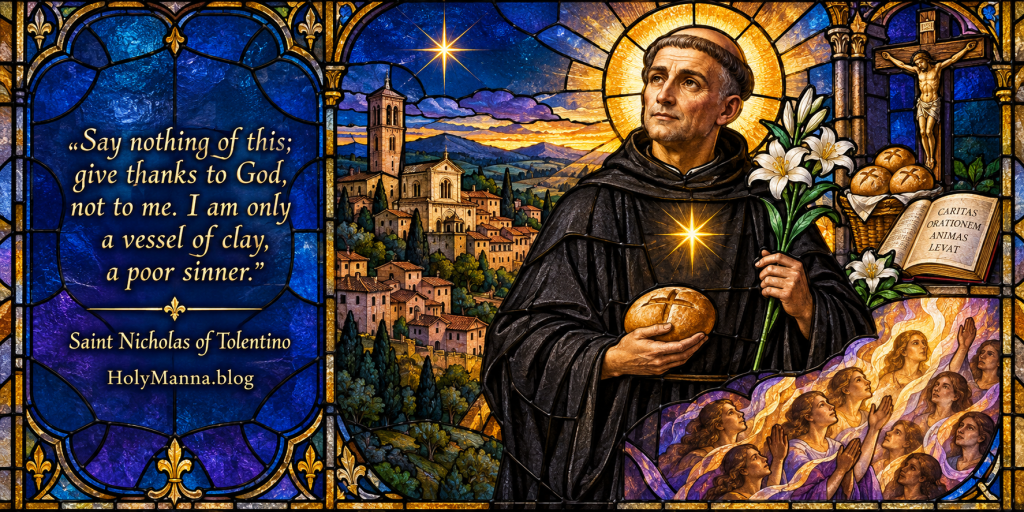
Above all, Nicholas is remembered as the great intercessor for the dead. In 1884, Pope Leo XIII solemnly proclaimed him the Patron Saint of the Souls in Purgatory, giving formal recognition to a devotion that had surrounded the friar since his own lifetime. In art he is shown in the black Augustinian habit with a star on his chest and a lily in his hand, a picture of purity and of light shining in a dark century. His life is a sustained lesson in what the Catechism calls the communion of saints, that exchange of spiritual goods between the Church on earth, the Church being purified, and the Church in glory (CCC 954 to 959).
The Child of a Pilgrimage Promise
Nicholas was born in 1245 in Sant’Angelo in Pontano, a small town in the Marches of Italy near Fermo. Some older reference works, including the 1913 edition of the Catholic Encyclopedia, place his birth around 1246 and his death in 1306, but the dating accepted by the Augustinian Order and by modern scholarship, and observed by the Church, is 1245 to 1305. It is worth naming that discrepancy plainly rather than smoothing it over, because honesty about sources is part of honoring a saint.
His parents are recorded in early accounts under the names Compagnonus de Guarutti and Amata de Guidiani, though scholars caution that these surnames may simply indicate the places their families came from. What the sources agree on is more important than the names. They were devout people of modest means, middle aged and childless, and they wanted a son badly enough to walk a pilgrim’s road for him. They journeyed to the shrine of Saint Nicholas of Myra at Bari, the fourth century bishop whose generosity would one day inspire the figure of Santa Claus, and there they begged God for a child, promising to dedicate him to the Lord’s service. When the prayer was answered, they named the boy Nicholas in thanksgiving.
The child seems to have taken the family story to heart. Tradition holds that by the age of seven he was slipping away to a cave near his home to pray in imitation of the hermits he had seen in the surrounding mountains. That detail comes from early devotional accounts rather than from documentary records, so it should be received as cherished tradition rather than established fact, but it fits everything that came later. Here was a boy who understood, before he could have articulated it, that his life had been asked for and given, and that it therefore belonged to God.
The decisive moment of his youth came when he heard an Augustinian hermit preach. The friar’s theme, according to the accounts of his life, was the passing nature of this world and the surpassing worth of eternity, and the sermon landed on Nicholas like a hand on the shoulder. At about eighteen years of age he entered the Order of Hermits of Saint Augustine, the community known today simply as the Augustinians. Roughly seven years later he was ordained a priest. Even in formation his character showed itself. He was entrusted with feeding the poor at the monastery gate, and he gave away food so freely that the procurator reportedly had to beg the superior to rein in his generosity. The Catechism teaches that “love for the poor is even one of the motives for the duty of working so as to ‘be able to give to those in need’” (CCC 2444, quoting Ephesians 4:28), and Nicholas seems to have grasped that duty by instinct long before he ever read a rule about it.
After ordination he served in several houses of the order throughout the Marches, gaining a reputation as a preacher and confessor. A cherished tradition of the order holds that around 1274 he heard in prayer the voices of angels repeating the words to Tolentino, and that he took the words as a command. Whether or not the vision can be verified, and it cannot, the historical record is clear that around 1275 he received his final assignment to the town of Tolentino, and that he never left it again.
Bread, Mercy, and a City Set Ablaze with Grace
To understand what Nicholas walked into, picture a small Italian city in the late thirteenth century caught in the long civil war between the Guelphs and the Ghibellines, the factions that fought across Italy for the causes of pope and emperor. Tolentino knew street violence, family vendettas, and the slow moral corrosion that comes when neighbors learn to hate each other. Into that wound the Augustinians sent one gentle friar.
Nicholas saw only one remedy for the violence, and it was not a political program. It was preaching. He went out into the streets and spoke, and he kept speaking, giving a discourse nearly every day for the better part of thirty years. His biographer Saint Antonine, the Dominican archbishop of Florence, described the effect: “He spoke of the things of heaven. Sweetly he preached the divine word, and the words that came from his lips fell like flames of fire. Among his hearers could be seen the tears and heard the sighs of people detesting their sins and repenting of their past lives.” The description matches what the Catechism says about the ministry of the Word, that “the Church ‘exists in order to evangelize,’” carrying the Gospel into every corner of human life (CCC 849 to 851, citing Evangelii Nuntiandi).
The pulpit was only half of his apostolate. The other half was the confessional and the doorstep. Witnesses at the canonization inquiry of 1325 emphasized his tireless work as a confessor who was gentle with sinners, a counselor whom people trusted with their tangled lives, and a friend of those the city preferred to forget. He sought out the poor and the sick in the slums of Tolentino, visited prisoners, and gave special attention to those who had drifted from the Church. In an age of factions, he belonged to no faction but Christ, and that very freedom made him a peacemaker. The Catechism teaches that “respect for and development of human life require peace,” and that peace is “the work of justice and the effect of charity” (CCC 2304). Nicholas built that peace one absolved sinner and one reconciled family at a time.
Miracles gathered around him, and he found the attention agonizing. His signature response, preserved in the accounts of his life, became almost a refrain: “Say nothing of this; give thanks to God, not to me. I am only a vessel of clay, a poor sinner.” The phrase deliberately echoes Saint Paul, who wrote, “But we have this treasure in earthen vessels, to show that the transcendent power belongs to God and not to us” (2 Corinthians 4:7). Nicholas understood that a miracle worker who accepts credit has stolen something. The Catechism calls humility the foundation of prayer, teaching that “humility is the foundation of prayer. Only when we humbly acknowledge that ‘we do not know how to pray as we ought,’ are we ready to receive freely the gift of prayer” (CCC 2559).
One of the most tender traditions from his years in Tolentino concerns bread. Nicholas fasted severely, and the story is told that during one long fast he grew dangerously weak, and while at prayer he was instructed to eat bread marked with a cross and dipped in water in order to regain his strength. He obeyed and recovered, and he then began blessing similar small rolls and giving them to the sick while asking the intercession of the Blessed Virgin Mary. Cures were reported, and from this practice arose the Augustinian custom, alive to this day, of blessing and distributing Saint Nicholas Bread. The fuller versions of this story describe a vision of Our Lady herself. It is a beloved tradition of the order, and it cannot be verified as historical fact.
At his canonization, the Church credited Nicholas with some three hundred miracles, including resurrections. Behind that staggering number stands something even more impressive, a man who never once thought the power was his.
The Long War of a Man Who Was Never Martyred
Nicholas did not die a martyr. His battlefield was quieter and, in some ways, longer, because it lasted his whole life. His hardships came in three forms, and each one has something to say to anyone trying to live the faith today.
The first hardship was the city itself. Preaching peace in a town at war meant standing in the crossfire of the Guelph and Ghibelline hatreds without picking a side. Every reconciliation he brokered could be read by someone as a betrayal. Every sermon against vendetta stepped on powerful toes. He persevered not by force of personality but by sheer constancy, showing up in the streets day after day for three decades. There is a hidden heroism in that kind of repetition, the heroism the Catechism describes when it teaches that “the way of perfection passes by way of the Cross. There is no holiness without renunciation and spiritual battle” (CCC 2015).
The second hardship was the battle within and against the enemy of souls. Nicholas embraced severe fasts, long night vigils, and strict poverty, mortifications he maintained almost to the hour of his death. Early accounts also describe direct demonic assaults. One story from the traditions surrounding him says that the devil once beat him with a stick, and that the stick was displayed for years in his church at Tolentino. That story cannot be verified. What can be said with confidence is that his contemporaries experienced him as a man engaged in real spiritual combat and utterly unafraid of it, and that he combined his austerity toward himself with unfailing gentleness toward everyone else. The sources describe an angelic meekness and a guileless simplicity. Severity and sweetness lived in the same soul, which is usually a sign that the severity was aimed in the right direction.
The third hardship was his body. In the final years of his life illness confined Nicholas to bed, and he suffered greatly. The accounts say he rose from that bed only once, and the reason tells the whole story of the man. A person weighed down by a grave sin had come to the monastery refusing to confess to anyone but Nicholas, and so the dying friar got up and heard the confession. Even his deathbed bent toward mercy. A tradition of the order records that in his last days, when a brother asked why he gazed so intently at something no one else could see, Nicholas answered, “I see the Lord my God, beside his most holy Mother and my father Saint Augustine.” That deathbed word comes down through Augustinian tradition rather than through the canonization documents, and it should be received as such. He died at Tolentino on September 10th, 1305, surrounded by his community.
The Arms That Bled and the Souls Set Free
If Nicholas’s life was quiet, his afterlife has been anything but. The devotion that surrounded him in Tolentino spread after his death through Italy, Spain, France, Belgium, and Germany, and in the sixteenth and seventeenth centuries it crossed the ocean into Latin America, carried by Augustinian missionaries. The canonization inquiry opened in 1325, only twenty years after his death, and gathered the testimony of hundreds of witnesses. After long delays caused by the upheavals of the fourteenth century, Pope Eugene IV canonized him in 1446, making him the first saint of the Augustinian Order.
The miracle stories attached to his intercession are among the most vivid in the tradition of the saints, and each of the following should be understood as story and tradition rather than as documented history. It is said that nine passengers on a ship going down at sea called on Nicholas, and that he appeared in the sky wearing the black Augustinian habit, radiating golden light, holding a lily in his left hand, and calming the storm with his right. That story cannot be verified. It is said that he restored to life more than one hundred dead children, including several who had drowned together. That tradition, cherished in Augustinian memory and depicted by painters including Raphael, cannot be verified. It is said that an apparition of the saint once saved the burning palace of the Doge of Venice when a piece of blessed Saint Nicholas Bread was cast into the flames. That story cannot be verified. Another famous tradition reaches back into his lifetime, telling that when the vegetarian friar was served a roasted bird during an illness, he made the sign of the cross over the plate and the bird rose and flew out the window. That story cannot be verified either, though it so captured the Catholic imagination that artists painted it for centuries.
The strangest and most sobering tradition concerns his relics. His body was hidden after his death and was not rediscovered until 1926, but his arms were preserved separately and are venerated at Tolentino in the Chapel of the Holy Arms. For centuries the faithful reported that these arms would exude blood at moments when the Church was in grave danger. This too is tradition, and it cannot be verified, but it expresses something true about how the faithful understood Nicholas, as a saint who never stopped feeling the wounds of the Church he had served.
His shrine, the Basilica of San Nicola in Tolentino, remains a living pilgrimage site. Its great chapel, the Cappellone, is covered in magnificent fourteenth century frescoes of his life, painted within living memory of people who had known him. His cultural reach stretches astonishingly far for a friar who never left the Marches. The Peruvian chronicler Antonio de la Calancha credited Nicholas’s intercession with making possible the permanent Spanish settlement of Potosí, the high altitude city in Bolivia, and towns, parishes, and districts across Latin America and the Philippines carry the name San Nicolás de Tolentino to this day. In 2005, the seven hundredth anniversary of his death, the Vatican itself hosted an exhibition of art celebrating his life and iconography.
Yet the heart of his legacy is not marble or fresco. It is the Holy Souls. The devotion traces to an experience reported from his own lifetime. On a Saturday night, as Nicholas lay in bed, he heard the voice of Fra Pellegrino of Osimo, a deceased friar he had known. Pellegrino revealed that he was in purgatory and begged Nicholas to offer Mass for him and for the other suffering souls, so that they might be set free. With his superior’s permission, Nicholas offered Mass for the next seven days. Then the friar returned in a second vision, giving thanks and assuring Nicholas that a great number of souls had entered the presence of God. This account comes from the early sources of his life and stands behind the Augustinian custom of seven Masses for the faithful departed, though as a private vision it cannot be verified. From that night forward, prayer for the dead became the outstanding mark of his spirituality, and it is why Leo XIII gave him the Holy Souls as his formal patronage in 1884.
Everything in that devotion rests on solid Catholic teaching. The Church teaches that “all who die in God’s grace and friendship, but still imperfectly purified, are indeed assured of their eternal salvation; but after death they undergo purification, so as to achieve the holiness necessary to enter the joy of heaven” (CCC 1030). She has always honored the memory of the dead and offered prayers for them, “above all the Eucharistic sacrifice, so that, thus purified, they may attain the beatific vision of God” (CCC 1032). And she teaches that this exchange runs in both directions, for “our prayer for them is capable not only of helping them, but also of making their intercession for us effective” (CCC 958). Nicholas of Tolentino did not invent any of this. He simply believed it with his whole heart, and lived as if the dead were what the Church says they are, family.
What a Quiet Friar Says to a Loud Age
It would be easy to file Nicholas away as a picturesque medieval figure, all stars and lilies and flying partridges. That would miss him entirely. Strip away the marvels and what remains is a pattern of life that speaks with uncomfortable directness to the present moment.
Nicholas stayed. He was assigned to one unglamorous, conflict ridden town and he remained there for thirty years, doing the same works of mercy over and over. In a culture that treats restlessness as ambition and constantly whispers that real life is somewhere else, his stability is a rebuke and an invitation. What would change if you treated the place where God has planted you, your parish, your block, your family table, as the mission field of a lifetime rather than a waiting room?
Nicholas deflected. Every time praise came near him he pushed it toward God, insisting he was only a vessel of clay. Social media has trained an entire generation to do the opposite, to curate credit and broadcast every good deed. His refrain, say nothing of this, is almost a spiritual discipline made for the age of the humble brag. Our Lord taught, “But when you give alms, do not let your left hand know what your right hand is doing, so that your alms may be in secret; and your Father who sees in secret will reward you” (The Gospel of Matthew 6:3 to 4). When was the last time you did something genuinely good and told no one at all?
Nicholas remembered the dead. This may be his most countercultural gift. The modern world either denies death or sentimentalizes it, but it rarely prays through it. Catholics possess something better, the confident, practical charity of praying for the departed, having Masses offered for them, and trusting the purifying mercy of God described in CCC 1030 to 1032. Praying for the dead is listed among the spiritual works of mercy precisely because it is love that costs something and can never be repaid by its recipient in this life. Who in your own family, living or dead, most needs your prayers tonight, and what is stopping you from offering them?
Nicholas persevered through suffering without spectacle. No martyrdom, no dramatic exile, just decades of fasting, night prayer, difficult people, and finally a long illness borne with patience. Most Christian lives look like that. Holiness for most people will not mean dying for the faith in a single blazing moment but living for it across ten thousand ordinary ones. The friar of Tolentino proves that such a life is enough, and more than enough, to fill heaven with friends.
Engage With Us!
HolyManna.blog would love to hear from you. Share your thoughts and reflections on Saint Nicholas of Tolentino in the comments below, especially if devotion to the Holy Souls has touched your own family. To help start the conversation, here are a few questions to pray with this week.
- Saint Nicholas spent thirty years serving one small town; where is God asking you to practice that kind of patient, rooted faithfulness right now?
- He answered every compliment with the words, say nothing of this; what would it look like for you to do one hidden act of charity this week and keep it entirely between you and God?
- When did you last have a Mass offered for a deceased loved one, and who came to mind as you read about the souls in purgatory?
- Nicholas preached peace in a city divided by factions; is there a divided relationship in your life where God might be calling you to be the peacemaker?
- His parents prayed and sacrificed for years before he was born; how has someone else’s prayer shaped the story of your own faith?
Saint Nicholas of Tolentino shows that a single life, hidden in one corner of the world and poured out in mercy, can echo across seven centuries and reach even beyond the grave. Let his star remind you that no act of love is small, no prayer is wasted, and no soul is forgotten by God. Live this day, and every day, with the love and mercy that Jesus taught us, and let heaven keep the record.
Saint Nicholas of Tolentino, patron of the Holy Souls, pray for us!
Follow us on YouTube, TikTok, Instagram and Facebook for more insights and reflections on living a faith-filled life.


Leave a Reply