Thursday of the Twenty-third Week in Ordinary Time – Lectionary: 440
When Love Stops Keeping Score
There is a moment in every friendship when the ledger disappears. Nobody tracks who paid for coffee last or who texted first, because love has quietly replaced arithmetic. The readings for September 10th, 2026, Thursday of the Twenty-third Week in Ordinary Time, invite the Church into exactly that kind of love, first with God and then with everyone else. The central theme uniting these readings is this: God knows every person completely and loves first, without calculation, and those who are fully known by Him are called to a love that gives up its rights and measures out mercy the way He does, pressed down and overflowing. Saint Paul writes to a young church in Corinth, a wealthy Greek port city crowded with pagan temples, where even the meat in the marketplace carried religious baggage. His answer to their dispute is not a rule but a reordering of the heart, because “Knowledge inflates with pride, but love builds up.” The Psalmist answers with the most intimate prayer in the Psalter, marveling that God has probed him, formed him, and known him from the womb. Then Jesus, preaching on a level stretch of ground in Galilee to disciples and a great crowd, pushes love past every boundary the ancient world recognized, all the way to enemies. Taken together, the readings trace a single movement: being known by God, being humbled by that knowledge, and letting it spill out as mercy toward the brother, the stranger, and even the enemy.
First Reading — 1 Corinthians 8:1b-7, 11-13
When Being Right Is Not Enough
Corinth in the mid-first century was a boomtown, rebuilt by Rome, wealthy, cosmopolitan, and thoroughly pagan. Temples to Aphrodite, Apollo, and the emperor dotted the city, and animal sacrifice was woven into civic life. Meat from those sacrifices ended up in the public market and on dinner tables, which created a genuine crisis of conscience for new Christians. Could a believer eat it? The theologically confident Corinthians said yes, since idols are nothing. Paul agrees with their doctrine but confronts their hearts, and in doing so he gives the Church a permanent lesson on how truth must travel: always in the vehicle of charity. This fits the day’s central theme perfectly, because Paul shows what love without a ledger looks like when it costs something real.
1 Corinthians 8:1b-7, 11-13
Brothers and sisters:
Knowledge inflates with pride, but love builds up.
If anyone supposes he knows something,
he does not yet know as he ought to know.
But if one loves God, one is known by him.So about the eating of meat sacrificed to idols:
we know that there is no idol in the world,
and that there is no God but one.
Indeed, even though there are so-called gods in heaven and on earth
(there are, to be sure, many “gods” and many “lords”),
yet for us there is one God, the Father,
from whom all things are and for whom we exist,
and one Lord, Jesus Christ,
through whom all things are and through whom we exist.But not all have this knowledge.
There are some who have been so used to idolatry up until now
that, when they eat meat sacrificed to idols,
their conscience, which is weak, is defiled.Thus, through your knowledge, the weak person is brought to destruction,
the brother for whom Christ died.
When you sin in this way against your brothers
and wound their consciences, weak as they are,
you are sinning against Christ.
Therefore, if food causes my brother to sin,
I will never eat meat again,
so that I may not cause my brother to sin.
Detailed Exegesis
Verses 1b-3: “Knowledge inflates with pride, but love builds up. If anyone supposes he knows something, he does not yet know as he ought to know. But if one loves God, one is known by him.”
Paul opens by deflating a slogan. The Corinthian elite prided themselves on gnosis, religious knowledge, and Paul concedes they possess it while warning that knowledge alone swells a person like air in a wineskin. Love, by contrast, builds like a mason builds, stone by stone, for the good of the whole house. The stunning reversal comes in the third line: the goal of the spiritual life is not mastering knowledge of God but being known by God. To love God is to be known by Him, and that being known is the foundation the Psalm will celebrate.
Verses 4-6: “So about the eating of meat sacrificed to idols: we know that there is no idol in the world, and that there is no God but one. Indeed, even though there are so-called gods in heaven and on earth (there are, to be sure, many ‘gods’ and many ‘lords’), yet for us there is one God, the Father, from whom all things are and for whom we exist, and one Lord, Jesus Christ, through whom all things are and through whom we exist.”
Here Paul hands the Church one of its earliest creedal confessions. Writing barely twenty-five years after the Resurrection, he places Jesus Christ inside the very definition of the one God of Israel, the Father as source and goal of all things, the Son as the one through whom all things exist. The pagan pantheon is dismissed in a single parenthesis. This verse became a building block for the Church’s later Trinitarian confession at Nicaea, and it grounds the whole moral argument: because there is one Lord through whom all things exist, no Christian exists for himself alone.
Verse 7: “But not all have this knowledge. There are some who have been so used to idolatry up until now that, when they eat meat sacrificed to idols, their conscience, which is weak, is defiled.”
Paul now turns to the converts still haunted by their pagan past. For them, eating sacrificial meat felt like sliding back into idol worship, and acting against that conviction wounded their conscience. Paul does not mock their scruples. He treats the tender conscience of a struggling brother as something sacred.
Verses 11-12: “Thus, through your knowledge, the weak person is brought to destruction, the brother for whom Christ died. When you sin in this way against your brothers and wound their consciences, weak as they are, you are sinning against Christ.”
This is the thunderclap of the passage. The measure of a brother’s worth is not his theological sophistication but the price paid for him: Christ died for that man. To lead him into acting against his conscience is therefore not a social misstep but a sin against Christ Himself, who identifies with the least of His members.
Verse 13: “Therefore, if food causes my brother to sin, I will never eat meat again, so that I may not cause my brother to sin.”
Paul ends with a personal vow of astonishing freedom. He has every right to eat, and he surrenders that right permanently rather than endanger one soul. Rights exist, but love outranks them.
Teachings
The Catechism of the Catholic Church quotes this very passage when teaching how conscience and charity meet. CCC 1789 teaches: “Charity always proceeds by way of respect for one’s neighbor and his conscience: ‘Thus sinning against your brethren and wounding their conscience . . . you sin against Christ.’ Therefore ‘it is right not to . . . do anything that makes your brother stumble.’” Saint John Chrysostom, the golden-mouthed Doctor of the Church, preached on this text in his Homily 20 on First Corinthians and diagnosed the Corinthian problem with surgical precision: “For arrogance is wont to cause divisions: but love both draws together and leads to knowledge.” For Chrysostom, knowledge is not the enemy; knowledge without love is. The Church has lived this teaching in every age, from the early debates over Jewish dietary practice at the Council of Jerusalem, recorded in The Acts of the Apostles, to modern pastoral care for those recovering from occult involvement or addiction, where mature believers gladly limit their own liberty for the sake of the vulnerable.
Reflection
Every believer has a “weaker brother” somewhere in life, a coworker newly sober, a sibling fresh back to the faith, a friend scandalized easily. Paul’s example suggests concrete steps: notice who is watching, ask whether a lawful pleasure could become someone else’s stumbling block, and practice giving up small rights cheerfully, such as a joke, a drink, or a debate victory, when charity asks for it. Is there a freedom in your life that love might be asking you to lay down for someone else’s sake? When you are right about something, do you use that rightness to build others up or to win? Sit with those questions honestly before the Lord this week.
Responsorial Psalm — Psalm 139:1b-3, 13-14ab, 23-24
The God Who Knits and Knows
Psalm 139 is the most intimate poem in the Psalter, a meditation on a God who is not a distant watchmaker but a weaver bent over His loom. Ancient Israel prayed it as a declaration of innocence before the Lord who sees everything, and the Church prays it as the answer to Paul’s promise that “if one loves God, one is known by him.” Today’s refrain, “Guide me, Lord, along the everlasting way,” gathers the whole day into a single petition. Being known by God is not surveillance; it is the safest place in the universe, and the only place from which the Gospel’s radical love becomes possible.
Psalm 139:1b-3, 13-14ab, 23-24
R. (24b) Guide me, Lord, along the everlasting way.
O LORD, you have probed me and you know me;
you know when I sit and when I stand;
you understand my thoughts from afar.
My journeys and my rest you scrutinize,
with all my ways you are familiar.
R. Guide me, Lord, along the everlasting way.
Truly you have formed my inmost being;
you knit me in my mother’s womb.
I give you thanks that I am fearfully, wonderfully made;
wonderful are your works.
R. Guide me, Lord, along the everlasting way.
Probe me, O God, and know my heart;
try me, and know my thoughts;
See if my way is crooked,
and lead me in the way of old.
R. Guide me, Lord, along the everlasting way.
Detailed Exegesis
Verses 1b-3: “O LORD, you have probed me and you know me; you know when I sit and when I stand; you understand my thoughts from afar. My journeys and my rest you scrutinize, with all my ways you are familiar.”
The Hebrew verb for “probed” is the word used for mining precious metal out of rock. God’s knowledge of the soul is not a glance but an excavation, reaching thoughts before they are even spoken. Sitting, standing, traveling, resting: the poet lists the ordinary rhythms of a day to insist that nothing is too small for God’s attention. Where Adam hid from that gaze in Eden, the psalmist stands still beneath it.
Verses 13-14ab: “Truly you have formed my inmost being; you knit me in my mother’s womb. I give you thanks that I am fearfully, wonderfully made; wonderful are your works.”
God knows His creature because He made him, thread by thread, in the hidden workshop of the womb. The knitting image is tender and deliberate, the language of craftsmanship rather than accident. Every human life, from its first moment, is a work of God still on the loom, which is why the Church has always read this verse as a charter of human dignity.
Verses 23-24: “Probe me, O God, and know my heart; try me, and know my thoughts; See if my way is crooked, and lead me in the way of old.”
The psalm’s boldest move comes at its end. The poet does not merely accept God’s searching knowledge; he requests it. This is the prayer of a soul that has stopped hiding, inviting God to audit the heart and straighten whatever is crooked. It is the interior posture required before anyone can love an enemy.
Teachings
The Catechism anchors its defense of unborn life in this psalm. CCC 2270 teaches: “Human life must be respected and protected absolutely from the moment of conception. From the first moment of his existence, a human being must be recognized as having the rights of a person, among which is the inviolable right of every innocent being to life.” Saint Augustine, the Doctor of Grace, opened his Confessions with the same discovery the psalmist made, that the heart is only at home under God’s knowing gaze: “Thou hast made us for Thyself, and our heart is restless until it repose in Thee.” The Church likewise teaches in CCC 27 that “The desire for God is written in the human heart, because man is created by God and for God; and God never ceases to draw man to himself.” Being probed by God, then, is not a threat but a homecoming.
Reflection
Modern life trains people to curate an image, filtered, cropped, and captioned. Psalm 139 invites the opposite: five unfiltered minutes a day before the God who already knows everything. Try praying verse 23 slowly each night this week as an examination of conscience, asking God to show one crooked place in the day and one wonderful work He accomplished. What would change in your prayer life if you truly believed God’s total knowledge of you was tender rather than threatening? Where are you still hiding from the One who knit you together?
Holy Gospel — Luke 6:27-38
Mercy, Pressed Down and Overflowing
Saint Luke sets this teaching on a level stretch of ground, the Sermon on the Plain, where Jesus has just called the Twelve and now addresses disciples and a great crowd drawn from Judea, Jerusalem, and the pagan coastlands of Tyre and Sidon. In the honor-and-shame culture of the ancient Mediterranean, relationships ran on strict reciprocity: gifts obligated repayment, insults demanded answer, and enemies deserved enmity. Into that world Jesus speaks the most countercultural command ever uttered, love of enemies, and grounds it not in strategy but in the character of God Himself, who “is kind to the ungrateful and the wicked.” Here the day’s theme reaches full flower: those known and loved by God must love without a ledger.
Luke 6:27-38
Jesus said to his disciples:
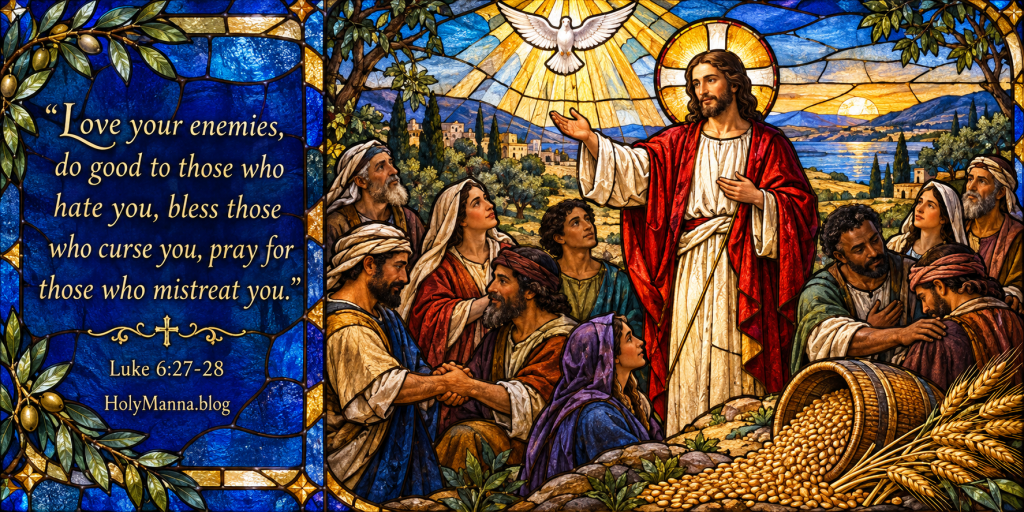
“To you who hear I say, love your enemies,
do good to those who hate you, bless those who curse you,
pray for those who mistreat you.
To the person who strikes you on one cheek,
offer the other one as well,
and from the person who takes your cloak,
do not withhold even your tunic.
Give to everyone who asks of you,
and from the one who takes what is yours do not demand it back.
Do to others as you would have them do to you.
For if you love those who love you,
what credit is that to you?
Even sinners love those who love them.
And if you do good to those who do good to you,
what credit is that to you?
Even sinners do the same.
If you lend money to those from whom you expect repayment,
what credit is that to you?
Even sinners lend to sinners,
and get back the same amount.
But rather, love your enemies and do good to them,
and lend expecting nothing back;
then your reward will be great
and you will be children of the Most High,
for he himself is kind to the ungrateful and the wicked.
Be merciful, just as also your Father is merciful.“Stop judging and you will not be judged.
Stop condemning and you will not be condemned.
Forgive and you will be forgiven.
Give and gifts will be given to you;
a good measure, packed together, shaken down, and overflowing,
will be poured into your lap.
For the measure with which you measure
will in return be measured out to you.”
Detailed Exegesis
Verses 27-28: “To you who hear I say, love your enemies, do good to those who hate you, bless those who curse you, pray for those who mistreat you.”
Jesus stacks four commands in descending order of distance: love, do good, bless, pray. Love here is agape, the deliberate willing of another’s good, not a feeling. The sequence moves from disposition to deed to word to worship, leaving no corner of life where enmity may nest. Praying for a persecutor is the final surrender of the grudge.
Verses 29-30: “To the person who strikes you on one cheek, offer the other one as well, and from the person who takes your cloak, do not withhold even your tunic. Give to everyone who asks of you, and from the one who takes what is yours do not demand it back.”
These vivid images teach a heart free from retaliation and possession. The blow to the cheek was an insult to honor, and Jesus tells His disciples to absorb the insult rather than escalate it, exactly as He would do in His Passion. The cloak and tunic represent a person’s last securities, and detachment from them proves that a disciple’s treasure lies elsewhere.
Verse 31: “Do to others as you would have them do to you.”
The Golden Rule appears in negative form in earlier teachers, who said not to do what you hate. Jesus alone states it positively, making self-love the launching pad for active goodness toward everyone, including those who will never repay it.
Verses 32-34: “For if you love those who love you, what credit is that to you? Even sinners love those who love them. And if you do good to those who do good to you, what credit is that to you? Even sinners do the same. If you lend money to those from whom you expect repayment, what credit is that to you? Even sinners lend to sinners, and get back the same amount.”
Three times Jesus asks the same devastating question. Reciprocal love is mere commerce; even those far from God manage it. The word translated “credit” is charis, grace. Christian love must carry the surplus of grace, going where repayment is impossible.
Verses 35-36: “But rather, love your enemies and do good to them, and lend expecting nothing back; then your reward will be great and you will be children of the Most High, for he himself is kind to the ungrateful and the wicked. Be merciful, just as also your Father is merciful.”
The motive is finally revealed: family resemblance. Children of the Most High act like their Father, whose kindness rains on the ungrateful. Mercy is the Father’s signature, and verse 36 is the summary sentence of the entire sermon.
Verse 37: “Stop judging and you will not be judged. Stop condemning and you will not be condemned. Forgive and you will be forgiven.”
Jesus does not forbid moral discernment; He forbids the seat of condemnation, which belongs to God alone. The promises attached are sobering, because the standard applied to others becomes the standard applied to oneself.
Verse 38: “Give and gifts will be given to you; a good measure, packed together, shaken down, and overflowing, will be poured into your lap. For the measure with which you measure will in return be measured out to you.”
The closing picture comes straight from the grain market, where an honest seller pressed the grain down, shook the container to settle it, and let it overflow into the fold of the buyer’s garment. God is that seller, and generosity is the container a disciple hands Him. A thimble receives a thimbleful; an open lap receives a flood.
Teachings
The Catechism teaches in CCC 1825: “Christ died out of love for us, while we were still ‘enemies.’ The Lord asks us to love as he does, even our enemies, to make ourselves the neighbor of those farthest away, and to love children and the poor as Christ himself.” On forgiveness, CCC 2844 teaches: “Christian prayer extends to the forgiveness of enemies, transfiguring the disciple by configuring him to his Master.” Saint Cyril of Alexandria, Doctor of the Church, preached on this very passage in his Sermon 29 from his Commentary on Luke, explaining that Christ appeals to the natural law of self-love as the measure of conduct: “Shew thyself, He says, to others such as thou wishest them to be towards thee.” The Church has seen this Gospel lived heroically across history, from the first martyr Saint Stephen praying for his killers in The Acts of the Apostles, to Saint Maria Goretti’s deathbed forgiveness of her attacker in 1902, to Saint John Paul II visiting his would-be assassin in prison in 1983.
Reflection
Enemy is a strong word, but everyone has someone: the relative who wounded the family, the colleague who took the credit, the stranger online who lives to provoke. Jesus offers a practical staircase this week. First, stop rehearsing the offense. Second, pray for that person by name, briefly and daily, even through gritted teeth. Third, look for one concrete good to do or one blessing to speak. Who came to mind the moment you read the words love your enemies? What measure are you currently using with the people closest to you, and would you want it measured back?
The Open Lap and the Overflowing Grain
The readings for September 10th tell one story from three angles. Paul shows a love so strong it surrenders its rights, refusing meat forever rather than wound a brother for whom Christ died. The Psalmist shows the source of that strength, a soul so at home under God’s gaze that it begs, “Probe me, O God, and know my heart.” And Jesus throws the doors open entirely, commanding a love that blesses cursers, lends without ledgers, and measures out mercy the way the Father does, packed together, shaken down, and overflowing. The lesson is wonderfully simple and lifelong in the living: God knows each soul first, forms it first, and loves it first, even while it stands among His enemies, and everything He asks is only an invitation to join the family business of mercy. The world runs on reciprocity; the Kingdom runs on grace. So here stands the invitation for today. Go to Mass and receive the One who turned His cheek and gave His cloak and His life. Spend five unfiltered minutes before the God who knits every heart together and let Him do His gentle auditing. Then think of the person easiest to avoid and put one small act of love in motion, a prayer, a kind word, a debt quietly forgiven. Hand God an open lap instead of a thimble, and watch what He pours. The measure given is the measure returned, and the Father, who is kind even to the ungrateful, never lets Himself be outdone in generosity.
Engage With Us!
Reflections from readers are one of the great joys of this community, so please share your thoughts, experiences, and prayers in the comments below. To help spark that conversation, here are some questions drawn from today’s readings.
- In 1 Corinthians 8:1b-7, 11-13, Saint Paul vows to give up a lawful freedom forever rather than wound a weaker brother. What right or freedom might God be inviting you to lay down for the sake of someone else’s soul?
- In Psalm 139:1b-3, 13-14ab, 23-24, the psalmist asks God to probe his heart and know his thoughts. What keeps you from praying that verse with full honesty, and what might change if you did?
- In Luke 6:27-38, Jesus commands His disciples to love their enemies and to be merciful as the Father is merciful. Who is the hardest person in your life to love right now, and what is one concrete step you could take toward them this week?
- Taken together, today’s readings proclaim that God knows every heart completely and loves without calculation. How does being fully known and fully loved by God free you to love others without keeping score?
However the Lord is speaking to you today, do not let it stay on the page. A life of faith is built one small surrender at a time, one prayer for an enemy, one act of quiet generosity, one honest moment under God’s loving gaze. Go and do everything this day with the love and mercy Jesus taught us, and He will fill your lap to overflowing.
Sacred Heart of Jesus, we trust in You!
Immaculate Heart of Mary, pray for us!
Saint Michael the Archangel, defend us in battle!
Follow us on YouTube, TikTok, Instagram and Facebook for more insights and reflections on living a faith-filled life.

 Holy Manna!
Leave a comment