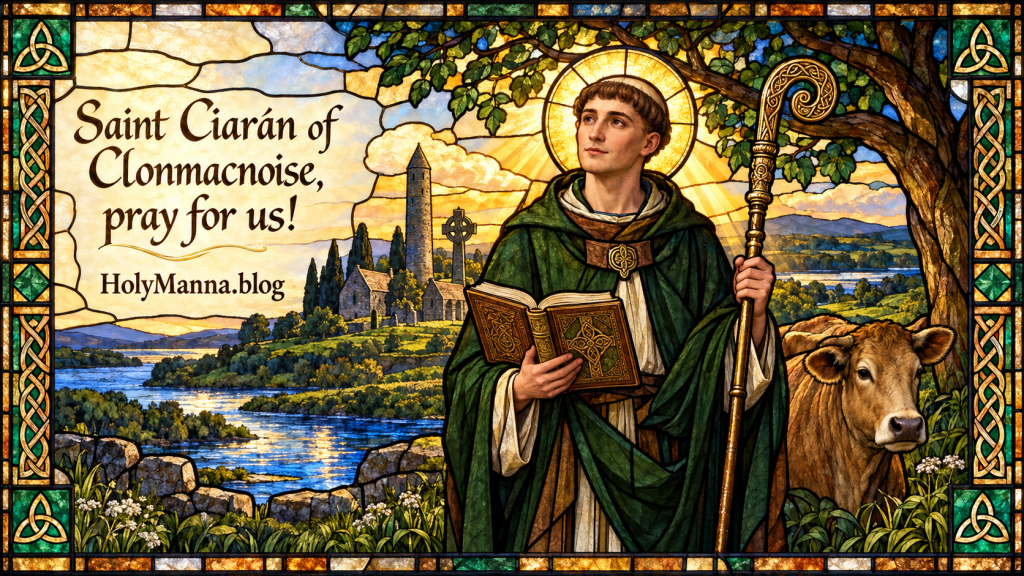
The Carpenter’s Son Who Built a City for God
Some saints are given 80 years to leave their mark on the world. Saint Ciarán of Clonmacnoise was given roughly 33, and with them he changed the spiritual landscape of Ireland forever. Celebrated on September 9th, Ciarán was a carpenter’s son from the west of Ireland who became a monk, a priest, an abbot, and the founder of Clonmacnoise, one of the most influential monasteries in the history of the Church in Europe. He is counted among the Twelve Apostles of Ireland, that remarkable generation of 6th century monastic founders formed at the school of Saint Finnian of Clonard, a group that also included Saint Columba of Iona and Saint Brendan the Voyager.
What makes Ciarán so striking is the disproportion between the length of his life and the size of his legacy. He governed his great foundation for only about seven months before a plague took him. Yet from that brief planting grew a monastic city that educated Ireland for a thousand years, produced some of the most treasured manuscripts and high crosses in Christian art, and became the burial place of kings. His story is a living illustration of what Jesus taught: “Amen, amen, I say to you, unless a grain of wheat falls to the ground and dies, it remains just a grain of wheat; but if it dies, it produces much fruit” (The Gospel of John, Jn 12:24). One important note before the story begins: this Ciarán, called “the Younger,” must not be confused with Saint Ciarán of Saighir, called “the Elder,” an earlier bishop honored on March 5th. The two are mixed up constantly online, and several famous animal stories that belong to the Elder are wrongly attached to the Younger. This post keeps to the traditions of Clonmacnoise’s founder alone.
Born in the House of a Carpenter
Ciarán was born around the year 512, with some sources placing his birth closer to 516, in the province of Connacht in the west of Ireland, in territory that lies within present-day County Roscommon. Tradition places his birthplace at Fuerty. His father was named Beoit, a traveling carpenter and maker of chariots, and his mother was named Darerca. From his father’s trade came the name by which Ireland would remember him, Ciarán mac an tSaeir, which means “Ciarán, son of the carpenter.” For a Christian reader, the echo is impossible to miss. The Son of God Himself was known in Nazareth as the carpenter’s son, as The Gospel of Matthew records when the crowds asked, “Is he not the carpenter’s son?” (Mt 13:55). God saw fit to raise from that humble workshop household a father of monks.
His medieval Life, the traditional account of his story, says that he was baptized and first instructed in the faith by a holy priest named Justus. The same traditional accounts tell that Ciarán had several brothers and sisters, and that some of his siblings also gave their lives to God in religious service. As a boy he worked as a cowherd for his family, watching the cattle in the fields while turning over his lessons in his mind. The traditional accounts attach early signs of holiness and small wonders to his boyhood; these come from his Life rather than from documented history, and they are told as tradition. What the sources agree on is the shape of the young man who emerged: a boy of deep prayer, unusual gentleness, remarkable generosity, and a burning hunger for learning.
That hunger led him east. As a young man, Ciarán set out for the monastic school of Saint Finnian at Clonard, in the modern County Meath, the greatest center of Christian formation in Ireland at that time. Tradition says he drove a dun cow before him on the journey, a gift that would pay for his keep at the school, and that humble cow would become one of the most famous animals in Irish Christian memory. At Clonard, Ciarán studied Scripture alongside the men later honored as the Twelve Apostles of Ireland, and his place among them was never questioned. The Catechism teaches that “Ignorance of the Scriptures is ignorance of Christ” (CCC 133, quoting Saint Jerome), and the whole culture of Clonard was built on that conviction. Ciarán drank it in completely.
One story from his Clonard years reveals his heart better than any list of achievements. It is preserved in his medieval Lives and is told here as tradition. While the students were working through The Gospel of Matthew, a fellow student named Ninnidh arrived without a book and asked Ciarán to lend him his copy. Ciarán handed it over at once, even though he himself had only read halfway through. When examination came, he knew only half of the Gospel, and his classmates teased him with the nickname “Ciarán Half-Matthew.” The tradition records that Saint Finnian corrected them, declaring that the young man would not be Ciarán Half-Matthew but rather Ciarán of half of Ireland, because half of the country would one day be his in grace and influence. The exact words vary between versions of the Life, and the episode cannot be verified as documented history, but it is a treasured tradition. Whether or not the conversation happened just so, the prophecy proved astonishingly close to the truth, because in later centuries it was said that half the monasteries of Ireland followed the rule associated with Clonmacnoise.
The Making of a Founder
After Clonard, Ciarán continued his formation in the school of hardship and holiness that was the Irish island monastery. He traveled west to the Aran Islands, to the windswept monastery of Saint Enda on Aranmore, where the monastic life was lived with legendary austerity on bare rock at the edge of the ocean. There Ciarán became Enda’s most famous disciple, and there he was ordained a priest. The Church has always understood this kind of formation as a response to the Lord’s call to leave everything for His sake, and the Catechism describes the consecrated life as a way of being “more intimately consecrated to divine worship” and given over to the good of the whole Church (CCC 916).
The traditional accounts tell of a vision that set the course of the rest of his life. In the story, Ciarán and Enda both beheld a great fruitful tree growing beside a stream in the very center of Ireland, a tree whose branches sheltered the entire island and whose fruit fed multitudes. Enda interpreted the vision for his disciple, telling him that he himself was that tree, that all of Ireland would be sheltered by the grace in him, and that he must go to the center of the country and found his church on the banks of a stream. This vision comes from the medieval Lives and cannot be verified as historical fact, so it is told here as the tradition it is. Yet as a spiritual image it could hardly be more accurate, because the monastery Ciarán founded did become a sheltering tree for the faith and learning of a whole nation.
Obedient to that call, Ciarán left Aran and journeyed toward the heart of Ireland. He spent time with Saint Senan on Scattery Island in the Shannon estuary, and along the way he founded two monastic communities of his own. On Inis Ainghin, known today as Hare Island in Lough Ree, he settled for more than 3 years, leading a small community of monks in prayer and work. But the vision pressed him onward. Around the year 544, Ciarán and a small band of companions, numbered at eight or ten in the sources, came down the River Shannon to a lonely grassy ridge on the eastern bank called Ard Tiprait, the Height of the Spring, in what is now County Offaly, at the natural crossroads where the Shannon met the great east-to-west ridgeway of Ireland. Ciarán looked at that empty ridge and saw what God saw.
His Life preserves the words he spoke to his companions there, and they are the most famous words attached to his name: “Here then we will stay, for many souls will go to heaven hence, and there will be a visit from God and from men forever on this place” (Life of Saint Ciarán, as recorded in The Catholic Encyclopedia). According to the Catholic Encyclopedia, he laid the foundation of Clonmacnoise on January 23rd, 544, and saw the first buildings completed by May 9th of that year. Other respected sources place the founding in 548, and the medieval annals themselves disagree, so both dates are noted here honestly. What no source disputes is what happened at that founding. A young nobleman named Diarmait, son of Cerball, helped Ciarán set the first post of the first church with his own hands, and the saint promised him that he would one day be High King of Ireland. Diarmait did indeed become High King, and he endowed the young monastery generously. That story of the first post comes from the traditional accounts and is told as tradition.
The wonders attributed to Ciarán’s lifetime center on his boundless charity. The most beloved is the story of the dun cow, the same animal he had driven to Clonard as a boy. Tradition holds that this one cow gave enough milk to supply the whole community, so that no one who came to the monastery went without. The story cannot be verified, and it is told here as the cherished tradition it is. Another tradition from his boyhood tells of a fox that grew tame with him and would carry his psalter, until its wild nature got the better of it and it began to gnaw the leather covers. That story likewise cannot be verified, and it is told as tradition. His four surviving medieval biographies record numerous other wonders, healings, and acts of provision worked through his prayers. What shines through all of them, and what the historical record does support, is a man whose generosity was so extreme that it unsettled the people around him. He gave away food, books, and goods to anyone in need, and he served his brothers as the least among them. The Church teaches that “The works of mercy are charitable actions by which we come to the aid of our neighbor in his spiritual and bodily necessities” (CCC 2447), and Ciarán’s whole life reads like a commentary on that sentence. He is worth remembering and emulating precisely because he shows that greatness in the Kingdom is measured by what a person gives away, not by what a person keeps.
Seven Months to Build Forever
Ciarán was never martyred, and his hardships were of a quieter, longer kind. He knew poverty from birth. He knew the teasing of classmates and the misunderstanding of peers. He knew the physical brutality of 6th century monastic life, the cold of Aran, the labor of clearing ground and raising timber churches with his own hands, the constant fasting, the long night vigils. He left home, then left Clonard, then left Aran, then left Inis Ainghin, obeying a call that kept demanding he surrender each place and community he had come to love. Anyone who has had to walk away from something good in order to follow something God was asking knows the particular ache of that obedience.
A strange and sobering tradition also survives in the old accounts, told here as tradition and not as verified fact. It says that some of the other saints of Ireland, seeing the astonishing grace at work in the young founder, grew envious and prayed for his early death, with Saint Columba alone refusing to join them. The story cannot be verified, and it reads today as the medieval storytellers’ way of wrestling with why God would take such a man so young. It is uncomfortable precisely because it admits that even holy people can struggle with envy, which the Catechism teaches “refers to the sadness at the sight of another’s goods” and names as a capital sin (CCC 2539).
The historical reality behind the mystery was a pandemic. In the 540s, the great plague that had swept the Mediterranean world reached Ireland, and the annals record that it carried off many of the leading saints and scholars of that generation. Around seven months after founding Clonmacnoise, Ciarán was seized by the sickness. He was roughly 33 years old, the age at which tradition holds that the Lord Himself was crucified, and generations of Irish Christians have pondered that parallel with awe. The traditional account of his death is tender and unforgettable, and it is told here as the tradition his Life preserves. Knowing the end was near, he asked his monks to carry him outside and lay him on the bare ground. He looked up at the open heaven and spoke of the way upward being steep and hard. When his grieving disciples pressed him, the tradition says he confessed a holy fear of God’s judgment, the fear of a man who had never once presumed on his own goodness. Then, having received the Body and Blood of the Lord, he died on September 9th, in 544 according to some sources and in 549 according to others. The conflicting death dates mirror the conflicting founding dates and are noted honestly.
One more deathbed tradition deserves telling, because it captures the man completely. It is said that Ciarán instructed his followers that when he died they should leave his bones on the hillside as the bones of a stag are left in the sun, and that they should attend instead to keeping his spirit and his example alive. This story cannot be verified, and it is told as tradition. His monks, understandably, did not obey that instruction. They buried him with love at Clonmacnoise, where a small ancient oratory called Temple Ciarán traditionally marks his grave to this day. For the Christian, none of this is morbid. The Catechism teaches that “the Christian meaning of death is revealed in the light of the Paschal mystery of the death and Resurrection of Christ in whom resides our only hope” (CCC 1681), and Saint Paul’s cry, quoted in the Catechism at CCC 1010, could stand as the caption of Ciarán’s short life: “For to me to live is Christ, and to die is gain” (Philippians, Phil 1:21).
The Tree That Sheltered a Nation
If the measure of a founder is what grows from his planting, then few saints in the history of the Church can match Ciarán of Clonmacnoise. The lonely ridge by the Shannon became a monastic city. Within a few centuries, Clonmacnoise held a cathedral, numerous churches, round towers, workshops, guest houses, and schools, and it drew students from across Ireland and from continental Europe. By the 9th century it stood among the greatest centers of learning in the Christian world. It was said that more than half the monasteries of Ireland followed the severely ascetic rule associated with Ciarán’s tradition, a claim that echoes Finnian’s old prophecy about half of Ireland belonging to the boy who gave away his Gospel book. Scholarship at Clonmacnoise reached even the court of Charlemagne, for tradition connects Alcuin of York, the great scholar and imperial adviser, with Colcu the Wise of Clonmacnoise, to whom he wrote letters and sent gifts from himself and from the emperor.
From the scriptorium of Clonmacnoise came treasures of faith and culture. The monastery’s annalists kept records that remain foundational for Irish history. Around the year 1100, monks there produced the manuscript known as Lebor na hUidre, the Book of the Dun Cow, the oldest surviving manuscript written in the Irish language, which preserves some of the most important early Irish literature. Its name comes from one of the most remarkable relic traditions in Ireland. The hide of Ciarán’s beloved dun cow, the cow of the Clonard journey and the miraculous milk, was preserved at Clonmacnoise for centuries as a relic, and tradition held that anyone who died resting upon it would obtain eternal life, so that the dying were laid upon it. Tradition further held that the famous manuscript was written upon that very hide. These traditions cannot be verified, and they are told here as the traditions they are. Rightly understood, such customs belong to the Church’s long instinct of honoring the tangible things connected to the holy ones of God; the Catechism teaches that the religious sense of the Christian people has always found expression in forms of piety such as “the veneration of relics, visits to sanctuaries, pilgrimages, processions” and similar devotions (CCC 1674), even while the Church directs all such piety toward Christ.
Wonders were attributed to Ciarán long after his death, and the medieval annals record them as acts of the saint defending his own. The most startling appears under the year 846, when Feidlimid, a powerful king who had plundered the church lands of Ciarán, was said to have been visited by the saint himself, who gave him a thrust of his crozier, leaving the king with an internal wound from which he did not recover. This story from the annals cannot be verified, and it is told as tradition. Across the centuries the faithful also sought healings at Clonmacnoise through the saint’s intercession, and the traditions of cures connected to his relics and to the dun cow’s hide, though they cannot be verified, testify to the confidence of generations that Ciarán still cared for his people. That confidence is soundly Catholic. The Catechism teaches of the saints in glory that “They do not cease to intercede with the Father for us, as they proffer the merits which they acquired on earth through the one mediator between God and men, Christ Jesus” (CCC 956).
Clonmacnoise endured raids by Vikings and by warring Irish kings, burnings, plunderings, and rebuildings, for roughly a thousand years. Kings sought burial in its holy ground; the traditions say that some 50 kings were laid to rest there, and Rory O’Connor, the last High King of Ireland, was buried there in 1198. The magnificent Cross of the Scriptures, carved around the year 900 and standing today among the finest high crosses in existence, proclaimed the Gospel in stone to pilgrims who could not read. The monastery finally fell in 1552, when English forces from the garrison at Athlone plundered and wrecked it during the upheavals of the Reformation era. Yet even ruin could not end Ciarán’s city. The Crozier of Clonmacnoise, a masterwork of Irish metalwork associated with the successors of the saint, is preserved in the National Museum of Ireland. Every year on September 9th, pilgrims still gather at Clonmacnoise for the saint’s feast, walking among the churches, crosses, and round towers on the ridge above the Shannon. And on September 30th, 1979, during the first papal visit to Ireland ever made, Pope Saint John Paul II stopped at Clonmacnoise, where 20,000 people gathered among the ruins to pray with the successor of Peter on the ground where Ciarán had promised that there would be a visit from God and from men forever.
What a Short Life Says to a Busy One
Ciarán’s story lands differently once it becomes clear how little time he had. He did not know he would die at 33. He simply gave everything he had, in the place God put him, for as long as God gave him. That is a piercing word for anyone in their 20s, 30s, or 40s who quietly assumes there will always be more time for prayer, for generosity, for answering the call that keeps tugging. Ciarán teaches that a life’s fruitfulness is not measured by its length but by its surrender. Jesus promised, “Well done, good and faithful servant. Since you were faithful in small matters, I will give you great responsibilities. Come, share your master’s joy” (The Gospel of Matthew, Mt 25:21), and Ciarán was faithful in the small matters of cows and books and timber posts, and God built a city out of them.
His generosity offers a second lesson. The boy who handed over his only Gospel book, half-read, because a brother needed it, became the man whose monastery fed and taught half a nation. How easy is it to cling to possessions, to time, to knowledge, to comfort, and to call the clinging prudence? Ciarán’s instinct ran the other way, and the Catechism confirms that instinct when it teaches that “Love for the poor is incompatible with immoderate love of riches or their selfish use” (CCC 2445). Practical steps follow naturally from his example. A person can lend and give books, skills, and time without keeping score. A family can practice hospitality that costs something real. A young professional can treat expertise the way Ciarán treated his Gospel of Matthew, as something on loan from God for the good of others. A student can consecrate study itself to Christ, remembering that at Clonard and Clonmacnoise, scholarship was prayer.
Ciarán’s holy fear at the hour of death offers a third lesson, and perhaps the deepest. Here was a man of extraordinary sanctity who still approached judgment with humility, trusting not in his achievements but in God’s mercy. That is not anxiety; that is realism joined to hope. The Catechism teaches that “The Church who has borne the Christian sacramentally in her womb during his earthly pilgrimage accompanies him at his journey’s end” (CCC 1683), and Ciarán, laid on the bare earth with his eyes on heaven, surrounded by his brothers, shows what it looks like to die well because one has lived given away. When the noise of the week quiets down, what would remain of this day if it turned out to be one of the last? What is one thing being held back from God right now, a talent, a relationship, a decision, that He is asking to be handed over like a half-read book?
Engage With Us!
The community at HolyManna.blog would love to hear from you. Share your thoughts and reflections on Saint Ciarán of Clonmacnoise in the comments below, especially if you have ever visited the ruins at Clonmacnoise or walked the pilgrim paths of Ireland. To help spark that conversation, consider these questions:
- Ciarán gave away his only copy of the Gospel of Matthew when a classmate needed it. What possession, gift, or comfort might God be asking you to hand over for the good of someone else this week?
- Ciarán died only about seven months after founding Clonmacnoise, yet his work bore fruit for a thousand years. How does his story challenge the way you think about success, timelines, and leaving results in God’s hands?
- The tradition of the fruitful tree shows a life rooted in one place and sheltering many. Where has God planted you right now, and who is meant to find shelter in your branches?
- Ciarán faced death at roughly 33 with humility and holy fear, trusting in God’s mercy rather than his own accomplishments. What would it change in your daily choices to live with eternity honestly in view?
- Pilgrims still gather at Clonmacnoise every September 9th, and Pope Saint John Paul II prayed there in 1979. Is there a holy place, near or far, that God might be inviting you to visit as a pilgrim rather than a tourist?
Saint Ciarán’s whole life was a short, bright offering, poured out without reserve on the banks of the Shannon. Let his example stir up courage to stop postponing holiness. Live this day, and every day, as a gift already given back to God, and do everything, the studying and the working and the giving and the resting, with the love and mercy that Jesus taught us.
Saint Ciarán of Clonmacnoise, pray for us!
Follow us on YouTube, TikTok, Instagram and Facebook for more insights and reflections on living a faith-filled life.


Leave a Reply