Memorial of Saint Peter Claver, Priest – Lectionary: 439
When the King Asks for Everything
Some days the Church hands her children readings that comfort, and some days she hands them readings that rearrange the furniture of the heart. Wednesday, September 9th, 2026, the Memorial of Saint Peter Claver, is the second kind of day. The central theme uniting these readings is the great reversal of the Kingdom of God: because this world in its present form is passing away, the disciple is invited to hold every fading thing with open hands and to stake absolutely everything on the King who remains. Saint Paul tells the Corinthians that the time is running out, so possessions, plans, and even tears must be held loosely. The psalmist sings a royal wedding song in which the bride is told to forget her people and her father’s house because the King now desires her beauty. Then Jesus, standing on a level place in Galilee, calmly turns the world’s scoreboard upside down: the poor, the hungry, the weeping, and the hated are the blessed ones, while the rich, the full, the laughing, and the flattered receive a solemn warning. The Church places these words on the feast of a Jesuit who took them literally. Peter Claver, a Spaniard who could have enjoyed a comfortable academic life, spent four decades on the wharves of Cartagena serving enslaved Africans and signed himself the slave of the slaves forever. His life is proof that the great reversal is not poetry. It is a way to live, and it leads to joy.
First Reading — 1 Corinthians 7:25-31
An Apostle’s Honest Advice for Hearts Stretched Between Two Worlds
Corinth in the mid-first century was a boomtown, a wealthy Roman port on the narrow isthmus of southern Greece, famous for commerce, ambition, and moral chaos. The young church there had written to Paul with practical questions about marriage, celibacy, and daily life, and this passage belongs to his patient answer, composed around the year 56 while he ministered in Ephesus. Paul openly distinguishes between what he has received as a command from the Lord and what he offers as his own trustworthy apostolic judgment, and the Holy Spirit saw fit to preserve that candor in inspired Scripture. His counsel flows from one burning conviction, that the time is short and the present form of this world is dissolving like morning fog. That conviction is exactly where this reading meets the day’s central theme, because Paul is not despising marriage, money, or joy. He is teaching interior freedom, the art of using the world without being owned by it.
1 Corinthians 7:25-31
Brothers and sisters:
In regard to virgins, I have no commandment from the Lord,
but I give my opinion as one who by the Lord’s mercy is trustworthy.
So this is what I think best because of the present distress:
that it is a good thing for a person to remain as he is.
Are you bound to a wife? Do not seek a separation.
Are you free of a wife? Then do not look for a wife.
If you marry, however, you do not sin,
nor does an unmarried woman sin if she marries;
but such people will experience affliction in their earthly life,
and I would like to spare you that.I tell you, brothers, the time is running out.
From now on, let those having wives act as not having them,
those weeping as not weeping,
those rejoicing as not rejoicing,
those buying as not owning,
those using the world as not using it fully.
For the world in its present form is passing away.
Detailed Exegesis
Verse 25: “In regard to virgins, I have no commandment from the Lord, but I give my opinion as one who by the Lord’s mercy is trustworthy.” Paul answers a question the Corinthians themselves raised about those consecrated to virginity. Jesus had given no explicit command on this point, so Paul offers apostolic guidance, and his humility is striking. He credits even his own trustworthiness to the Lord’s mercy, modeling how every teacher in the Church speaks not from personal brilliance but from grace.
Verse 26: “So this is what I think best because of the present distress: that it is a good thing for a person to remain as he is.” The “present distress” likely refers to the hardships pressing on Christians in Corinth, read in the light of the end times. Paul’s counsel is stability. Frantic changes of state rarely come from God, an insight the Church’s spiritual masters, including Saint Ignatius of Loyola, would echo for centuries.
Verse 27: “Are you bound to a wife? Do not seek a separation. Are you free of a wife? Then do not look for a wife.” Paul honors the permanence of the marriage bond even while commending celibacy. Vocation is not an escape hatch. The married are called to holiness precisely inside their marriage, and the unmarried are invited to consider whether their freedom might itself be a calling.
Verse 28: “If you marry, however, you do not sin, nor does an unmarried woman sin if she marries; but such people will experience affliction in their earthly life, and I would like to spare you that.” Here is pastoral realism. Marriage is good and holy, yet it multiplies earthly cares, from providing for a family to grieving for a spouse. Paul speaks like a father who wants to spare his children unnecessary suffering, not like a rigorist condemning human love.
Verse 29: “I tell you, brothers, the time is running out. From now on, let those having wives act as not having them.” The Greek pictures time being drawn in like a sail furled before landing. The voyage is ending. Paul’s startling phrase does not mean husbands should neglect their wives, which would contradict his own teaching elsewhere. It means no earthly relationship, however precious, can take the place that belongs to God alone.
Verse 30: “Those weeping as not weeping, those rejoicing as not rejoicing, those buying as not owning.” Sorrow, celebration, and commerce all continue, yet the Christian engages each one with a heart anchored beyond them. Tears do not become despair and purchases do not become possession, because everything is received on loan from God.
Verse 31: “Those using the world as not using it fully. For the world in its present form is passing away.” Paul does not say the world is evil. He says its present form, its structures, fashions, markets, and empires, is dissolving. Creation itself awaits transformation, so wisdom means investing in what survives the change: faith, hope, and charity.
Teachings
The Catechism cites this very passage when it explains why some renounce marriage for God. CCC 1619 teaches, “Virginity for the sake of the kingdom of heaven is an unfolding of baptismal grace, a powerful sign of the supremacy of the bond with Christ and of the ardent expectation of his return, a sign which also recalls that marriage is a reality of this present age which is passing away.” Consecrated virginity, lived from the apostolic age to today, is therefore a walking sermon on this reading. Every religious sister, monk, and celibate priest silently announces that the wedding feast of heaven is real. Saint John Chrysostom, the golden-mouthed Doctor of the Church, preached through this chapter in his Homilies on First Corinthians and insisted that Paul demands detachment of the heart rather than departure from the world, since a spouse or a merchant can be freer interiorly than a hermit who still clings to his opinions. Saint Peter Claver lived this reading in Jesuit vows of poverty, chastity, and obedience, trading the settled life available to an educated Spaniard for a harbor full of suffering strangers, because he believed the world’s present form was passing and souls were not.
Reflection
This reading invites a quiet inventory. What would change tomorrow if the time really were short? Paul is not asking anyone to abandon responsibilities but to loosen the white-knuckled grip on things that cannot last. A concrete way to begin is to give one possession away this week, not a castoff but something still loved, and to notice what that small surrender does to the heart. Another is to delay one unnecessary purchase and give the money to the poor. A third is to bring every anxiety about the future into ten minutes of silent prayer, handing each one to God by name. Which possession, plan, or relationship do you grip so tightly that God could not remove it without a fight? If Christ returned this year, what would you be glad you had done with your time? Where is God inviting you to use the world without letting the world use you?
Responsorial Psalm — Psalm 45:11-12, 14-17
A Royal Wedding Song That Still Sings of Christ and His Bride
Psalm 45 is unique in the Psalter, a wedding song composed by the sons of Korah for the marriage of a Davidic king, complete with a radiant bride, golden garments, and a joyful procession into the palace. Israel treasured it long after the monarchy fell because the people sensed it pointed beyond any earthly throne, and the New Testament confirms that instinct. The Letter to the Hebrews quotes this very psalm and applies it directly to Christ, the Son whose throne stands forever. Following that lead, the Fathers of the Church, especially Saint Augustine in his exposition of this psalm, read the king as Christ and the bride as the Church, called out of every nation to belong wholly to her Lord. The Lectionary places these verses beside 1 Corinthians 7 with obvious purpose. The command at the psalm’s center, to forget one’s people and father’s house, is the same holy detachment Paul commends, only sung in the language of love rather than argued in the language of counsel. Leaving everything behind sounds like loss until the psalm reveals the reason: the King himself desires the beauty of the soul.
Psalm 45:11-12, 14-17
R. (11) Listen to me, daughter; see and bend your ear.
Hear, O daughter, and see; turn your ear,
forget your people and your father’s house.
So shall the king desire your beauty;
for he is your lord, and you must worship him.
R. Listen to me, daughter; see and bend your ear.
All glorious is the king’s daughter as she enters;
her raiment is threaded with spun gold.
In embroidered apparel she is borne in to the king;
behind her the virgins of her train are brought to you.
R. Listen to me, daughter; see and bend your ear.
They are borne in with gladness and joy;
they enter the palace of the king.
The place of your fathers your sons shall have;
you shall make them princes through all the land.
R. Listen to me, daughter; see and bend your ear.
Detailed Exegesis
Verse 11: “Hear, O daughter, and see; turn your ear, forget your people and your father’s house.” The court poet addresses the princess arriving for her wedding, urging her to release her old identity. The words echo God’s call to Abraham in Genesis 12 to leave land and kindred. Every baptized soul hears the same summons, to let grace define who one finally is.
Verse 12: “So shall the king desire your beauty; for he is your lord, and you must worship him.” The promise follows the surrender. When the soul turns fully toward God, He delights in the beauty His own grace has placed there. The mention of worship signals that this king is more than a monarch, which is precisely why the Church reads the psalm of Christ, the Bridegroom who alone deserves adoration.
Verse 14: “All glorious is the king’s daughter as she enters; her raiment is threaded with spun gold.” The bride’s splendor is described at the moment of entrance, a picture the tradition applies to the Church and to every soul clothed in sanctifying grace. The gold threading recalls the wedding garment of the Gospel parables, woven by God rather than purchased by the wearer.
Verse 15: “In embroidered apparel she is borne in to the king; behind her the virgins of her train are brought to you.” The bride does not walk alone. Her train of virgin companions evokes the consecrated souls who accompany the Church through history, the very vocation Paul discusses in the day’s first reading. Holiness is always processional, never solitary.
Verse 16: “They are borne in with gladness and joy; they enter the palace of the king.” Detachment ends not in deprivation but in a feast. The procession that began with forgetting the father’s house ends inside the palace, an image the Book of Revelation completes with the wedding supper of the Lamb. Joy is the final word of the spiritual life.
Verse 17: “The place of your fathers your sons shall have; you shall make them princes through all the land.” The bride who forgot her father’s house receives a household greater than the one she left. What she surrendered in the past God repays in fruitfulness. The Church has always seen here her own spiritual motherhood, raising up children in every land who reign with Christ.
Teachings
The Catechism gathers this ancient bridal imagery into its teaching on the Church. CCC 796 states, “The unity of Christ and the Church, head and members of one Body, also implies the distinction of the two within a personal relationship. This aspect is often expressed by the image of bridegroom and bride.” The same paragraph calls the Church “the spotless bride of the spotless Lamb.” Saint Augustine, preaching on Psalm 45 to his people in North Africa, taught that the daughter told to forget her father’s house is the Church drawn from the nations, commanded to abandon her former idols and customs so that the true King might delight in her. The soul at Baptism was claimed by this King, and the whole of Christian life is the bridal procession toward His palace. Saint Peter Claver understood the procession included the forgotten. The men and women he met in the holds of slave ships had been violently torn from their people and their fathers’ houses, and Claver spent his life showing them that the King of Psalm 45 desired their beauty too, baptizing them into the very bride this psalm celebrates.
Reflection
The psalm asks for a costly forgetting, not of the people who deserve love, but of the attachments that compete with God. For one person the “father’s house” is an old grudge treated like an inheritance. For another it is a family expectation, a career script, or a comfortable sin that feels like home. A practical step this week is to name that one attachment honestly in prayer and to ask the Lord for the freedom to walk out of that house. Another is to imitate the bride’s companions by accompanying someone else toward God, perhaps inviting a friend to Mass or praying with a family member who is struggling. What is the “father’s house” that keeps you from belonging entirely to Christ? Do you truly believe the King desires the beauty of your soul, even on your worst day? Who is walking in your train, and who is helping you walk toward the palace of the King?
Holy Gospel — Luke 6:20-26
The Sermon on the Plain and the Great Reversal of the Kingdom
Saint Luke sets this scene with care. Jesus has just spent the night in prayer, chosen the Twelve at daybreak, and come down to a stretch of level ground where a great crowd presses in to hear Him and be healed. Standing at eye level with the poor, He raises His eyes toward His disciples and begins the Sermon on the Plain. Where The Gospel of Matthew records eight beatitudes spoken on a mountain, Luke records four blessings answered by four woes, and his versions are strikingly concrete. Matthew’s “poor in spirit” becomes simply “you who are poor.” The pattern is the great reversal already sung by Mary in her Magnificat, where the mighty are cast down and the lowly lifted up, and promised by Isaiah to the poor and brokenhearted. This Gospel is the beating heart of the day’s theme, because it announces which investments survive the passing of this world’s present form.
Luke 6:20-26
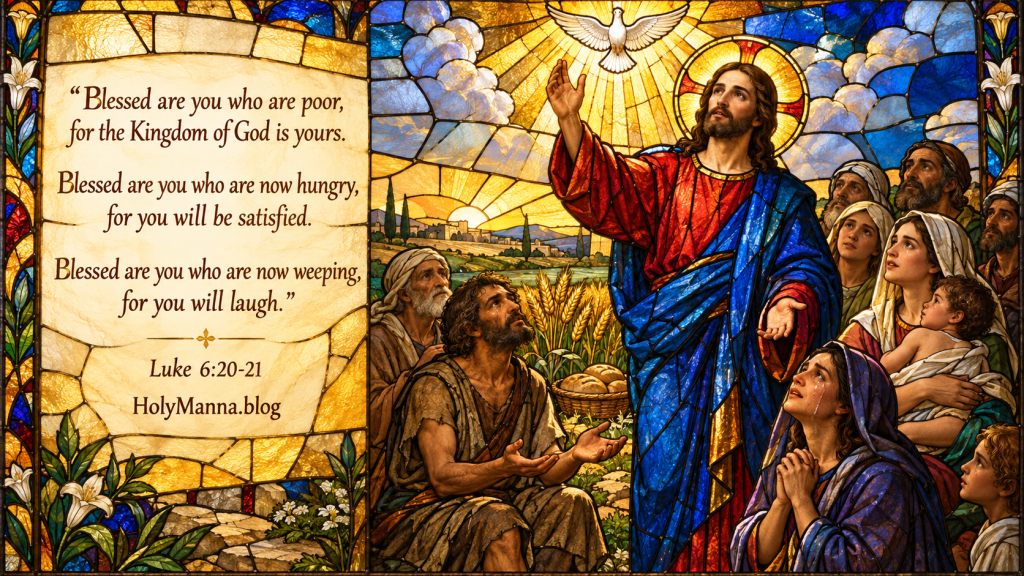
Raising his eyes toward his disciples Jesus said:“Blessed are you who are poor,
for the Kingdom of God is yours.
Blessed are you who are now hungry,
for you will be satisfied.
Blessed are you who are now weeping,
for you will laugh.
Blessed are you when people hate you,
and when they exclude and insult you,
and denounce your name as evil
on account of the Son of Man.Rejoice and leap for joy on that day!
Behold, your reward will be great in heaven.
For their ancestors treated the prophets
in the same way.But woe to you who are rich,
for you have received your consolation.
But woe to you who are filled now,
for you will be hungry.
Woe to you who laugh now,
for you will grieve and weep.
Woe to you when all speak well of you,
for their ancestors treated the false
prophets in this way.”
Detailed Exegesis
Verse 20: “Raising his eyes toward his disciples Jesus said: ‘Blessed are you who are poor, for the Kingdom of God is yours.’” Jesus looks at real faces, not abstractions, and speaks in the second person. The first blessing is in the present tense. The Kingdom is not merely promised to the poor someday; it belongs to them now, because their empty hands are already open to receive God.
Verse 21: “Blessed are you who are now hungry, for you will be satisfied. Blessed are you who are now weeping, for you will laugh.” The little word “now” carries the theology. Hunger and tears are temporary states inside a story God is still writing. The satisfaction and laughter to come are the true condition of the redeemed, glimpsed at every Eucharist where the hungry are fed.
Verse 22: “Blessed are you when people hate you, and when they exclude and insult you, and denounce your name as evil on account of the Son of Man.” The fourth blessing is the longest and the sharpest. Jesus does not bless rudeness or self-inflicted rejection; the hatred must come “on account of the Son of Man.” Exclusion and slander awaited Luke’s first readers, and forms of the same treatment await faithful Christians in every age.
Verse 23: “Rejoice and leap for joy on that day! Behold, your reward will be great in heaven. For their ancestors treated the prophets in the same way.” The command is astonishing, not merely to endure persecution but to leap for joy in it. Rejection for Christ is a family resemblance, placing the disciple in the company of Jeremiah, Elijah, and every prophet who paid for the truth.
Verse 24: “But woe to you who are rich, for you have received your consolation.” The woes are not curses but laments, the grief of a lover watching souls settle for less. The rich have “received” their consolation the way a customer receives a receipt. The transaction is complete, unless the heart lets go of its riches and reaches for God.
Verse 25: “But woe to you who are filled now, for you will be hungry. Woe to you who laugh now, for you will grieve and weep.” Fullness and laughter are not sins, but a fullness that needs nothing from God and a laughter that mocks eternity are dead ends. The reversal cuts both directions. Those who feast on the passing world will find themselves empty exactly when it passes.
Verse 26: “Woe to you when all speak well of you, for their ancestors treated the false prophets in this way.” The final woe may be the most searching for the modern soul, formed to chase approval and applause. Universal praise is a warning light, because the false prophets earned it by telling comfortable lies. Fidelity to Christ eventually costs some measure of popularity.
Teachings
The Catechism teaches in CCC 1716 that “The Beatitudes are at the heart of Jesus’ preaching,” and in CCC 2544 that “The precept of detachment from riches is obligatory for entrance into the Kingdom of heaven.” On this exact Gospel, CCC 2546 says, “The Beatitudes reveal an order of happiness and grace, of beauty and peace. Jesus celebrates the joy of the poor, to whom the Kingdom already belongs,” and CCC 2547 continues, “The Lord grieves over the rich, because they find their consolation in the abundance of goods,” quoting Saint Augustine: “Let the proud seek and love earthly kingdoms, but blessed are the poor in spirit for theirs is the Kingdom of heaven.” Saint Ambrose, in his Exposition of the Gospel of Luke, matched Luke’s four beatitudes to the four cardinal virtues, teaching of Matthew’s eight and Luke’s four that “those eight are contained in these four, and in these four those eight.” For Ambrose, blessed poverty is justice, blessed hunger is temperance, blessed weeping is prudence, and blessed endurance of hatred is fortitude. Saint Peter Claver turned this Gospel into a biography. Arriving in Cartagena in 1610, he met the slave ships for roughly 40 years with food, medicine, and the Gospel, and is credited with baptizing an estimated 300,000 enslaved Africans. At his final vows in 1622 he signed himself “Petrus Claver, aethiopum semper servus,” Peter Claver, slave of the slaves forever, gladly accepting the contempt of slave traders and polite society. Canonized by Pope Leo XIII in 1888, he now knows the laughter promised to those who wept with the weeping.
Reflection
An honest reader eventually asks which column describes his or her own life, the blessings or the woes. The question is not meant to condemn but to redirect. One concrete response is to spend time this week with people who are materially poor, not as a project but as a friendship, the way Claver learned names and shared meals on the docks. Another is to fast from one comfort, a favorite food, an app, or an indulgent purchase, and let the small hunger become a prayer for those whose hunger is not optional. A third is to say one true, faithful thing this week even where it will not be popular, and to receive any pushback with quiet joy instead of resentment. Which of the four blessings is hardest for you to believe, and which of the four woes hits closest to home? Whose approval do you crave so much that it edits what you are willing to say about Jesus? What would it look like for you to rejoice, genuinely, the next time faithfulness costs you something?
The Wealth That Cannot Pass Away
Taken together, these readings tell one story in three voices. Paul furls the sails and announces that the voyage through this world is nearly over, so nothing on deck should be gripped too tightly. The psalmist watches a bride leave her father’s house forever and walk, radiant and unafraid, into the palace of a King who desires her beauty. Then Jesus stands on a level place, looks His disciples in the eye, and calmly reads out the Kingdom’s ledger, where the poor are rich, the weeping will laugh, and the applause of the world counts for nothing. This is the great reversal, and it is not a threat. It is an invitation to stop investing in a market that is closing and to start investing in the only Kingdom that endures. Saint Peter Claver heard that invitation as a young Jesuit and answered it on the wharves of Cartagena, one baptism, one bandaged wound, one learned name at a time, until 300,000 souls had been welcomed into the bridal procession of Psalm 45. Heaven now holds his reward, great and unrepeatable, exactly as Jesus promised in verse 23. The same invitation arrives today, wrapped in ordinary circumstances: a possession to release, an attachment to leave behind, a poor neighbor to love, an unpopular truth to speak with a smile. Let this be the day the grip loosens and the procession begins. The King is waiting at the palace doors, the feast is prepared, and everything worth keeping is already inside.
Engage With Us!
Please share reflections in the comments below. This community grows stronger every time someone tells the honest story of how God’s Word landed in a real life, so no thought is too small to offer.
- In 1 Corinthians 7:25-31, Paul urges believers to live “as not,” holding marriages, tears, joys, and purchases with open hands because the world in its present form is passing away. What is one concrete area of your life where God is inviting you to loosen your grip this week?
- In Psalm 45:11-12, 14-17, the bride is told to forget her people and her father’s house so the King may delight in her beauty. What old attachment, habit, or identity is your “father’s house,” and what would it take to walk out of it toward Christ?
- In Luke 6:20-26, Jesus blesses the poor, the hungry, the weeping, and the hated, and laments over the rich, the full, the laughing, and the flattered. Which blessing or woe describes your life right now, and how will you respond to it before this week ends?
- All three readings proclaim the great reversal of the Kingdom, the truth that only what is given to God survives the passing of this world. If you truly believed the reversal, what is the first thing you would change tomorrow morning?
Keep walking the road of faith with courage and a light heart. Every small surrender, every hidden act of mercy, and every unpopular kindness is gold thread in the wedding garment. Live this day the way Saint Peter Claver lived his, doing everything with the love and mercy Jesus taught us, and the King Himself will meet the procession at the door.
Sacred Heart of Jesus, we trust in You!
Immaculate Heart of Mary, pray for us!
Saint Michael the Archangel, defend us in battle!
Follow us on YouTube, TikTok, Instagram and Facebook for more insights and reflections on living a faith-filled life.


Leave a Reply