The Birthday Heaven Waited For
Every family has that one birthday that gets circled on the calendar before all the others. The Church has three. The liturgical calendar celebrates the earthly birth of only three people: Jesus on December 25th, St. John the Baptist on June 24th, and the Blessed Virgin Mary on September 8th. Every other saint is honored on the day of death, the day of birth into eternal life. These three are different, because each of these three births was already part of God’s saving plan before the first cry was heard.
The Feast of the Nativity of the Blessed Virgin Mary, kept each year on September 8th, celebrates the day the Mother of the Redeemer entered the world. It falls exactly nine months after December 8th, the Solemnity of the Immaculate Conception, so the calendar itself tells the story: the child conceived without sin in the womb of her mother is now born into human history. The Church opens the Mass of the day with a burst of joy: “Let us celebrate with joy the Nativity of the Blessed Virgin Mary, for from her rose the Sun of Justice, Christ our God” (Entrance Antiphon, Roman Missal).
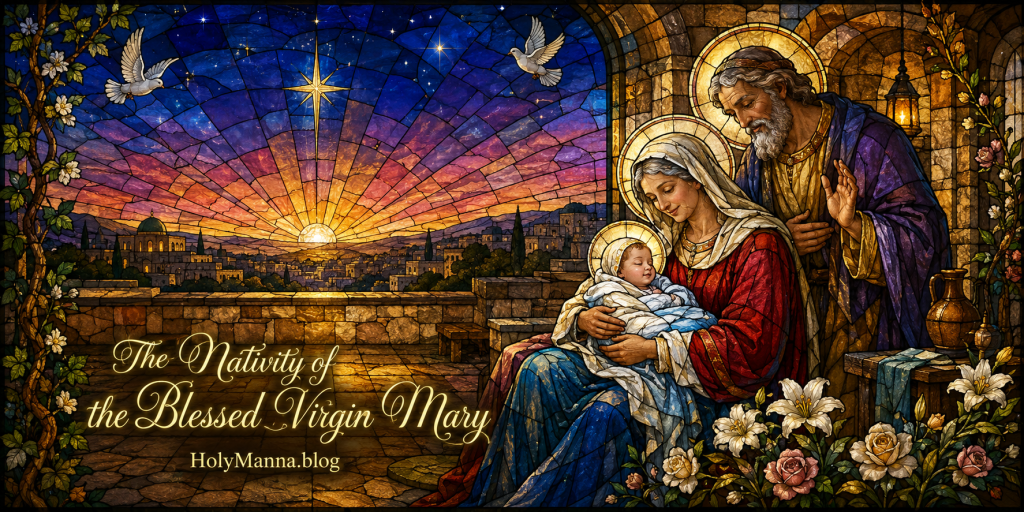
That image explains everything. Mary’s birth is the dawn. The sun has not yet risen, but the sky has begun to glow, and everyone watching knows the night is ending. Pope St. Paul VI captured it in Marialis Cultus, where he described this feast as “the hope of the entire world and the dawn of salvation” (Marialis Cultus, 7). On the General Roman Calendar the celebration holds the rank of Feast, and in places where the Nativity of Mary is the patronal title, it is kept with even greater solemnity. Wherever it is celebrated, the meaning is the same. God had promised a Savior since Eden, and on this day the world finally held the woman who would say yes.
From Jerusalem’s Quiet Corner to the Streets of Rome
Scripture is silent about the birth of Mary, so the feast did not begin with a Bible verse. It began with a place. In Jerusalem, just north of the Temple Mount near the Pool of Bethesda, early Christians venerated a site believed to be the home of Mary’s parents and the place of her birth. A basilica rose there, known as the Basilica of St. Mary where she was born, and the church standing on that spot today is the Church of St. Anne. The dedication of that Jerusalem church, celebrated on September 8th, is the most likely root of the feast’s date.
The celebration itself appears in the Christian East between the 5th and 6th centuries; sources differ on the precise starting point, and honesty requires saying so. What is certain is that by around the year 550 the great hymn writer Romanos the Melodist bears witness to it, and hymns for the feast appear in Jerusalem chant collections from the mid 6th century. Devotion to the birth of the Mother of God grew especially fast after the Council of Ephesus in 431, which solemnly affirmed her title Theotokos, Mother of God (CCC 495).
From Jerusalem and Constantinople the feast traveled west. It reached Rome by the late 7th century, around the pontificate of Pope Sergius I, who reigned from 687 to 701. Sergius, a pope of Eastern heritage, gave the feast a distinctly Roman splendor by prescribing a solemn procession that wound through the city from the church of Sant’Adriano al Foro to the great Marian basilica of Santa Maria Maggiore. Picture torchlight, chant, and the whole city walking to honor a birthday. From Rome the feast spread through the West, taking particularly deep root in France. In 1243 Pope Innocent IV enriched the celebration with an octave, eight full days of rejoicing, which remained on the calendar until the liturgical simplifications of the 1950s.
One charming account deserves mention with a clear label. An old story, not substantiated by historical evidence, tells of a man who heard angels singing on the night of September 8th and asked the reason; they answered that they rejoiced because the Virgin was born that night. It is a story, not history, yet it reflects what the Church truly believes: heaven had reason to sing.
The Daughter Promised from the Beginning
Since this feast commemorates a birth rather than an apparition, its foundations rest on Scripture and sacred Tradition, and they run all the way back to the garden. After the fall, God spoke to the serpent the words the Church calls the first gospel: “I will put enmity between you and the woman, and between your seed and her seed” (Genesis 3:15). From that moment, salvation history became a long wait for a woman and her child (CCC 489). The prophets sharpened the promise. Isaiah foresaw a shoot springing from the stump of Jesse (Isaiah 11:1), and Micah pointed to Bethlehem and to “the time when she who is in travail has brought forth” (Micah 5:3), a prophecy the Church reads at Mass on this very feast.
The Gospel of the day is one many Catholics secretly dread hearing read aloud: the genealogy of Jesus in The Gospel of Matthew 1:1-16, 18-23, that long chain of difficult names. Yet the chain is the whole point. Generation after generation, through patriarchs and kings, exiles and unknowns, saints and public sinners, God kept weaving His plan, until the line arrives at “Jacob the father of Joseph the husband of Mary, of whom Jesus was born, who is called Christ” (Matthew 1:16). Mary’s birth is where the whole genealogy was heading. Preaching on this genealogy, Pope Benedict XVI observed that the surprising women within it, foreigners and sinners among them, reveal the universality of salvation, since it is not human works that redeem the world but the Lord who gives true life.
The names of Mary’s parents, Joachim and Anne, come not from Scripture but from the apocryphal Protoevangelium of James, a 2nd century writing the Church has never accepted as inspired. Tradition drawn from that text describes an elderly, childless couple who begged God for a child and received the answer to every prayer Israel had ever prayed. The Church retains the names and honors Sts. Joachim and Anne on July 26th, while treating the surrounding narrative as tradition rather than certified history. Even the location of Mary’s birth is held by competing traditions, with Jerusalem near the Pool of Bethesda and Nazareth both claimed; the Jerusalem tradition shaped the feast. The Fathers, meanwhile, preached the meaning rather than the logistics. St. Andrew of Crete, whose discourse on this Nativity the Church still reads in the Liturgy of the Hours, saw in Mary’s birth the hinge between the two covenants, writing that “the fulfillment of the law is Christ himself” (Oratio 1), the one toward whom every letter of the old law had been leaning, and whose coming this newborn girl silently announced.
The Dawn of Salvation
What makes the birth of one little girl in an obscure corner of the Roman world worth a universal Feast? The Catechism answers with breathtaking scope. From all eternity, God chose a daughter of Israel to be the mother of His Son (CCC 488). Mary’s existence was never an accident or an afterthought; she was willed, prepared, and awaited. The Catechism teaches that throughout the Old Covenant, the mission of many holy women prepared for hers, from Eve through Sarah, Hannah, and so many mothers who conceived against all hope, and that Mary “stands out among the poor and humble of the Lord” (CCC 489, citing Lumen Gentium 55).
Her birth also displays the most singular grace ever given to a creature. The Church teaches that Mary was redeemed from the moment of her conception, and Blessed Pope Pius IX defined the dogma in 1854 in Ineffabilis Deus: by a singular grace and privilege of almighty God, and by virtue of the merits of Jesus Christ, Mary was “preserved immune from all stain of original sin” (CCC 491). This means the baby born on the day this feast celebrates was already full of grace, the first fruit of her Son’s redemption applied in advance (CCC 492). What December 8th celebrates invisibly in the womb of Anne, September 8th celebrates visibly in the world (CCC 490, 493).
The Catechism adds a quiet, beautiful line about the years before the Annunciation: “The Holy Spirit prepared Mary by his grace” (CCC 722). Her birth begins that preparation in earnest. Chapter VIII of Lumen Gentium, the Second Vatican Council’s great treatment of Mary, presents her as inseparably united to her Son’s saving work, and St. John Paul II built on this in Redemptoris Mater, teaching that Mary precedes the whole People of God on the pilgrimage of faith. Her nativity is therefore the Church’s own prehistory. The Liturgy of the Hours sings on this day that through the Virgin born of David’s seed, the salvation of the world has been revealed to believers, and the Collect of the Mass asks that this feast bring deeper peace to those for whom her Son’s birth was the dawning of salvation. Rank matters here too: the Church assigns this day the liturgical rank of Feast precisely because it belongs to the unfolding of the mystery of Christ Himself.
Walking Where Devotion Leads
A feast this old has gathered centuries of devotion around it, and much of that devotion has feet. Pilgrims in Jerusalem still descend into the crypt of the Church of St. Anne, the serene Crusader era church near the Pool of Bethesda, where tradition venerates the birthplace of the Virgin. The church is famous for its long echo, and pilgrims who sing a Marian hymn there describe the sound lingering like a lullaby. In Rome, the faithful can walk the route of Pope Sergius’ ancient procession to Santa Maria Maggiore, the oldest church in the West dedicated to the Mother of God.
Milan offers something unique. Its magnificent cathedral, the Duomo, is dedicated to Mary at her Nativity, so September 8th is the patronal feast of one of the largest churches on earth. Milan is also home to the tender devotion of Maria Bambina, the Child Mary, centered on a much loved wax image of the infant Mary kept by the Sisters of Charity, a congregation so identified with the devotion that they are popularly called the Sisters of Maria Bambina. Praying before an image of Mary as a newborn has drawn countless hearts to wonder at the humility of God’s plan.
In southern India, the Basilica of Our Lady of Good Health in Vailankanni concludes a nine day festival on September 8th that draws millions of pilgrims of many faiths. The origin traditions of that shrine describe appearances of Our Lady centuries ago; these accounts have received no formal judgment from the Holy See, and like all private revelation they are non-binding on the faithful (CCC 67), yet the shrine itself stands in full communion and was raised to the rank of minor basilica. Elsewhere, the feast carries harvest devotions: an older form of the Roman Ritual includes a blessing of seed grains for the winter planting, and in French wine country the day is kept as Our Lady of the Grape Harvest, when growers bring their best clusters to the church for a blessing. Novenas leading to September 8th remain a beloved way to keep the feast, nine days of prayer mirroring the nine months from conception to birth.
One Birthday, a World of Celebrations
Few feasts show the genius of Catholic culture like this one, because the whole world throws the party differently. Malta may celebrate hardest of all. There September 8th is Il-Vitorja, Victory Day, a national public holiday recalling the end of the Great Siege of 1565 on the Nativity of Mary, a deliverance the Maltese have always credited to her intercession, with later wartime deliverances folded into the same gratitude. Towns such as Senglea, Naxxar, Mellieħa, and Xagħra on Gozo keep the Nativity as their patronal festa with processions, band clubs, fireworks, and a famous rowing regatta in the Grand Harbour.
In Cuba, September 8th belongs to Our Lady of Charity of El Cobre, the beloved patroness of the nation, whose small image, according to tradition, was found at sea by three humble workers in the early 17th century. Her shrine in the hills near Santiago de Cuba overflows on this day. In Spain, Asturias honors Our Lady of Covadonga, tied to the memory of the battle that tradition holds began the Reconquista, while the tiny nation of Andorra keeps its national holiday on the feast of Our Lady of Meritxell. Among the Mangalorean Catholic community of India, the day is kept as Monthi Fest, a gorgeous blend of Marian devotion and harvest thanksgiving: children shower flowers on the image of the infant Mary, new grain is blessed and mixed into a family meal, and scattered relatives come home to eat together.
Even the rhythms of rural Europe once turned on this date. In Alpine regions, September 8th traditionally opened the driving down of cattle from the high summer pastures, the animals garlanded with flowers and bells for the descent, and old custom in central Europe held that the swallows left for the south on Our Lady’s birthday. In medieval England the day was simply Marymas. Different continents, different customs, one conviction: when Mary was born, something changed for everyone.
Letting Her Story Shape Yours
Here is the striking thing about the Nativity of Mary: nobody noticed it. No star stopped over the house of Joachim and Anne. No shepherds came. By every earthly measure it was an ordinary birth in an ordinary family, and yet the Church calls it the dawn of salvation. That should change the way you look at your own unnoticed beginnings. The prayer you started praying this year, the habit you quietly began, the child you are raising, the conversion nobody else can see yet: God specializes in hidden beginnings that carry enormous futures.
Mary’s birth also preaches patience. Tradition presents Joachim and Anne as a couple who waited long years for a child, and Israel had waited centuries for her. If you are in a season of waiting, this feast belongs especially to you. God’s delays are not God’s absence; the genealogy read at Mass on this day proves that He was working through every generation, including the messy ones.
There are simple, concrete ways to keep the feast. Go to Mass on September 8th if your schedule allows, since a Feast of Our Lady is worth rearranging a Tuesday. Pray the Joyful Mysteries of the Rosary and linger on how much joy God hides inside small domestic scenes. Wish Our Lady a happy birthday out loud; children understand this feast instantly, and a birthday cake for Mary has catechized more little Catholics than many a lecture. Consider beginning a Marian consecration or renewing one. Call your own mother or grandmother, because a feast rooted in Joachim and Anne is also a feast of grandparents and family lines. Above all, imitate the newborn Mary in the one thing a baby does perfectly: receive. She began her life entirely as a gift from God, and holiness begins the moment you let yourself be loved first.
Engage With Us!
The conversation does not end here, so share thoughts and reflections in the comments below; stories of how this feast is celebrated in different families and cultures are especially welcome.
- What “hidden beginning” in your own life might God be preparing for a purpose you cannot yet see?
- Joachim and Anne waited years for their prayers to be answered. How do you keep faith alive during long seasons of waiting?
- Which cultural celebration of Mary’s Nativity, from Malta’s Il-Vitorja to India’s Monthi Fest, most inspires you, and why?
- How could you make September 8th a real celebration in your home this year?
- Mary received everything from God before she gave anything back. Where is God inviting you simply to receive His grace?
May the birthday of the Blessed Virgin fill every home with the same quiet joy that filled the house of Joachim and Anne. Keep seeking, keep praying, and keep growing together in faith under the guidance of our Blessed Mother, whose birth reminds the world that God’s greatest works often begin small.
Most Blessed Virgin Mary, pray for us!
Follow us on YouTube, TikTok, Instagram and Facebook for more insights and reflections on living a faith-filled life.


Leave a Reply