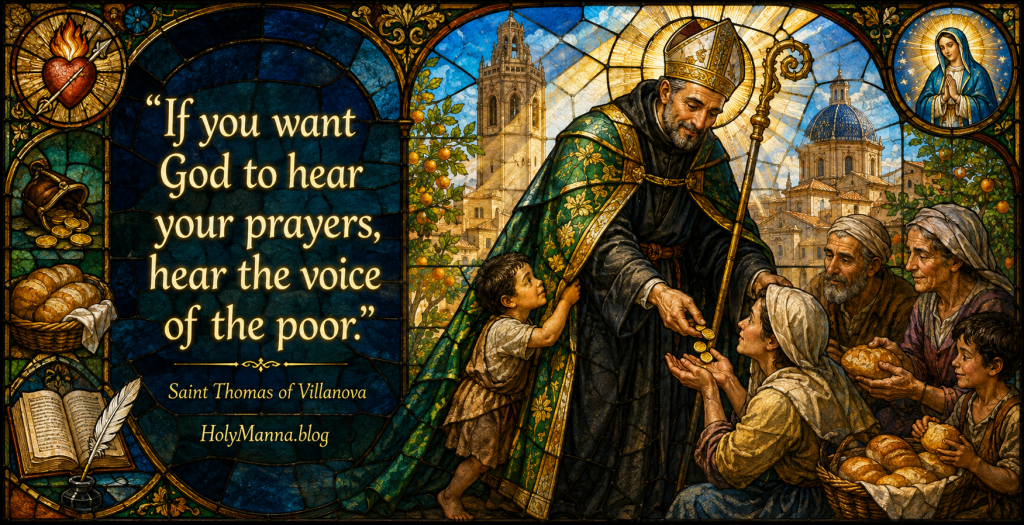
The Beggar Bishop Who Gave Away Everything
Some saints dazzle from a distance. Saint Thomas of Villanova is the kind of saint who gets close, looks a person in the eye, and quietly hands over his own coat. Born in Spain in 1486 or 1488, this Augustinian friar became one of the most brilliant preachers of his century, a counselor to the most powerful emperor in Europe, and, very much against his will, the Archbishop of Valencia. Yet history does not remember him primarily for his intellect or his influence. It remembers him by the names his own people gave him: the “Father of the Poor,” the “Almsgiver,” the “Beggar Bishop,” and the “Model of Bishops.” He fed hundreds of people at his door every single day. He raised the orphans of his city as if they were his own children. He gave away two-thirds of the income of one of Spain’s wealthiest dioceses and mended his own worn habit by hand rather than buy a new one.
The Church holds him up as a living illustration of what she teaches about love for the poor. The Catechism declares that the works of mercy are charitable actions by which Christians come to the aid of their neighbor in his spiritual and bodily necessities, and that giving alms to the poor is one of the chief witnesses to fraternal charity (CCC 2447). Thomas did not merely perform works of mercy; he structured his entire life, his household, and his diocese around them. Canonized in 1658, he is today the patron of Villanova University in the United States, of Genzano di Roma in Italy, and of several towns in the Philippines, including Miagao in Iloilo, whose magnificent fortress church bears his name. In 2016, the bishops of Spain formally approved a petition asking that he be declared a Doctor of the Universal Church, a cause that remains open. Nearly five centuries after his death, the Beggar Bishop still has something to say.
A Miller’s Son Formed by Open Hands
Thomas was born Tomás García Martínez in the small town of Fuenllana, in the old Diocese of Toledo in Spain, to Alonso Tomás García and Lucía Martínez Castellanos. Catholic sources differ on the year of his birth; the Vatican gives 1486 while the Catholic Encyclopedia gives 1488, and honest biography holds both possibilities open. His family came from the nearby town of Villanueva de los Infantes, and following the custom of his time, he took his surname from that town. That is how a boy named García became known to history as Thomas “of Villanova.”
Before Thomas ever read a word of theology, he studied generosity at his own dinner table. His father was a miller, and every Friday he gave away in alms all the meal he had earned at the mill, on top of a daily dole of bread. On great feast days he added wood, wine, and money, and he loaned money and seed to poor farmers so they could plant again. When his father died, his mother Lucía kept the family tradition alive, continuing the alms and supplying poor young women of the neighborhood with clothing and money so they could live in dignity. The old lessons of the Roman Breviary for his feast recount that as a boy Thomas more than once stripped off his own clothing to cover someone who had none. That detail comes to us through liturgical tradition rather than through documentary records, but anyone who knows how the man ended his life will find it entirely believable.
His mind proved as remarkable as his heart. At fifteen he entered the University of Alcalá, one of the intellectual powerhouses of Renaissance Spain, and by 1509 he had earned the title of Master in Logic, Physics, and Metaphysics. He soon held a chair in arts, logic, and philosophy, and among his students were scholars who became famous in their own right, including Domingo de Soto. What makes this all the more striking is a detail his biographers love to repeat: Thomas struggled with a poor memory his entire life. He compensated with relentless study, clarity of thought, and prayer. The prestigious University of Salamanca offered him its chair of natural philosophy, the kind of position an ambitious academic spends a career chasing. Thomas declined it. Instead, in 1516, he knocked on the door of the Augustinian friars in Salamanca. He professed his vows the following year, was ordained a priest in 1518, and celebrated his first Mass at Christmas of that year. Academic success had not satisfied him. He wanted God. The Catechism teaches that all Christians are called to the fullness of Christian life and to the perfection of charity (CCC 2013), and Thomas heard that call with unusual clarity. He walked away from worldly honor at the exact moment it was being offered to him.
The Preacher Who Emptied His Own Pockets First
Within the Augustinian Order, Thomas rose quickly, not because he sought advancement but because his brothers kept handing it to him. He taught scholastic theology at the Salamanca convent, served as prior in several cities, and was twice elected prior provincial, first of Andalusia and Castile together in 1527 and later of Castile alone. During that second term, in 1533, he sent the first band of Augustinian missionaries across the Atlantic to establish the Order in Mexico. The friar with the poor memory helped launch the evangelization of the New World.
His preaching filled the great pulpits of Spain. In Valladolid, the Emperor Charles V heard him and made him his court preacher and a councilor of state. A famous story holds that the emperor, astonished by his preaching, exclaimed, “This monsignor can move even the stones!” That exclamation is a beloved story attached to his life rather than a documented quotation, and it cannot be verified. What is documented is that the master of half of Europe held Thomas’s judgment in high esteem and corresponded with him extensively, and that Thomas, near the end of his life, had the emperor’s letters to him destroyed, apparently guarding confidences to the last.
His words on charity, preserved in his sermon collections, still land like a hammer on the conscience. He told the wealthy of his day, “If you want God to hear your prayers, hear the voice of the poor. If you wish God to anticipate your wants, provide those of the needy without waiting for them to ask you. Especially anticipate the needs of those who are ashamed to beg. To make them ask for alms is to make them buy it.” Notice the delicacy in that last line. Thomas understood that poverty wounds not only the body but the dignity, and that true charity protects a person from the humiliation of asking. He preached generosity as the world’s best investment: “What great profit you gain from God when you are generous! You give a coin and receive a kingdom; you give bread from wheat and receive the Bread of Life; you give a transitory good and receive an everlasting one.” He also preached the virtue that made his own greatness safe: “Humility is the mother of many virtues because from it, obedience, fear, reverence, patience, modesty, meekness and peace are born.”
He lived every word of it. He gave away the inheritance he received from his parents. Catholic tradition recounts that he sold his own mattress and gave the money to the poor, keeping the same rough habit he had received as a novice. The Catholic Encyclopedia states plainly that the instances of his supernatural gifts are numberless, recording his power of healing the sick, the multiplication of food, the redressing of grievances, his ecstasies, and his conversions of sinners. Later in life, he was known to be caught up in ecstatic prayer during the celebration of Holy Mass. The specific details of individual healings and multiplications were gathered in the processes for his beatification rather than in narratives that survive independently, so they are best received the way the Church received them, as the testimony of those who knew him, examined and judged credible. What no one disputed, then or now, is that God’s grace moved through this man in ways his neighbors could see and touch and eat.
The Bishop Who Did Not Want the Job
Here is where the story turns, and where Thomas shows us something rare. Twice the emperor tried to make him a bishop, and twice Thomas said no. He declined the See of Granada outright, wanting nothing to do with power or prestige. Then, on August 5th, 1544, he was nominated Archbishop of Valencia, a wealthy and important see that had not had a resident bishop in nearly a hundred years. It was a diocese in spiritual ruins, and Thomas refused it too. The emperor would not be refused a second time. He pressured Thomas’s religious superior, who commanded him under his vow of obedience to accept. Thomas obeyed. The Catechism teaches that the evangelical counsels, including obedience, are proposed to every disciple and that religious profession binds one to follow Christ more nearly (CCC 915), and Thomas let that vow carry him where his own will never would have gone. Tradition adds a detail that captures the man perfectly: he made the journey to his consecration and his new diocese in his old habit and battered hat, and when he was led to his episcopal throne, he pushed aside the silk cushions and kissed the ground with tears. These details come from the traditional accounts of his life and the old liturgical lessons, and while they cannot all be independently verified, they are of a piece with everything documented about him.
He entered Valencia on January 1st, 1545, its eighth archbishop, and found exactly the wreckage a century of absentee bishops produces: clergy who did not teach, abuses that had calcified into custom, and a huge population of Moriscos, converts from Islam, who had received almost no real formation in the faith. Thomas went to work like a man who knew he had little time. Within weeks he opened a visitation of the entire diocese, going out to see the state of every parish for himself, and he forbade his officials to accept so much as a gift while conducting it. He convoked a synod, the first Valencia had seen in many years, to confront entrenched abuses directly. He founded a college for the sons of newly converted Moriscos so the next generation would actually know Christ, established colleges for young clerics and for poor students, rebuilt the general hospital of Valencia after fire destroyed it, and fought to abolish the underground prisons of his day. In 1547 he ordained a young man named Louis Bertrand, who would become a great missionary saint in South America. When the cathedral chapter presented him with a large sum to furnish his episcopal palace in a manner befitting his rank, he thanked them warmly and sent the money to the hospital. He reportedly said the money would serve God better there, and his residence stayed bare.
The hardships of his episcopate were not the dramatic persecutions of the martyrs. They were the grinding, unglamorous sufferings of a reformer: resistance from comfortable clergy, the sheer scale of a neglected diocese, the delicate and painful question of the Moriscos, and his own failing health. He bore one more hidden cross as well. He was expected at the Council of Trent, the great reforming council of the Church, and his counsel was sought for it, but his duties and his health kept him in Valencia, and he contributed through others what he could not deliver in person. Yet the Catechism reminds us that bishops, as successors of the apostles, are given the office of teaching, sanctifying, and governing precisely as shepherds who serve (CCC 886, CCC 896), and historians of the Church note that Thomas accomplished in Valencia, a full decade early, the very renewal of episcopal life that Trent would demand of the whole Church. He reformed before reform was required. He simply looked at Christ, looked at his people, and closed the distance.
And always, beneath the administration, the poor. His palace gate stood open every day. Four to five hundred people daily received a meal at his hands. He appointed almoners in every district of the city with standing orders to seek out the respectable poor who were too ashamed to beg. He restocked the shops of ruined tradesmen and bought tools for workmen so they could earn their bread with dignity rather than depend on handouts. He personally took in the orphans and abandoned infants of Valencia and paid for their care. Two-thirds of the revenues of his archdiocese, year after year, went to the poor. The Catechism teaches that love for the poor is part of the Church’s constant tradition, inspired by the Gospel of the Beatitudes and by the example of Jesus in His poverty and His concern for the poor (CCC 2444), and that the demands of justice must be satisfied first of all, lest anyone offer as a gift of charity what is already owed in justice (CCC 2446). Thomas grasped that distinction in his bones. He was not being extravagant. He was paying a debt.
The Man Who Died Owing Nothing but Love
In August of 1555, Thomas was struck with angina pectoris, and he knew the end was near. His response was utterly in character: he ordered all his remaining money distributed to the poor, and then gave direction that his few possessions follow it. A cherished tradition of his final days recounts that when a poor man came to the door, Thomas gave away the very bed he was dying on, asking only to borrow it back until God took him, and that he died on a bed that no longer belonged to him. This story is told throughout Augustinian and Catholic tradition, and Augustinian sources speak of his personal poverty reaching the point of dying on a borrowed bed, but the precise details cannot be verified. On September 8th, 1555, the feast of the Nativity of the Blessed Virgin Mary, to whom he had a tender devotion, Mass was celebrated in his room. After Communion, at the end of the Mass, he breathed his last, praying the words of the psalm that Christ Himself prayed from the Cross, “Into your hands, O Lord, I commend my spirit” (Psalm 31:6; Luke 23:46). He was buried, at his own request, in his old Augustinian habit, in the convent church of Our Lady of Help outside the city walls.
His remains were later solemnly translated to the Cathedral of Valencia, where they are enshrined and venerated to this day. The Church encourages the veneration of the relics of the saints as an expression of the faithful’s love and communion with them (CCC 1674, CCC 957), and Valencia has never stopped loving its Beggar Bishop. Miracles were attributed to his intercession after his death, and accounts of them were examined in the processes that led to his glorification. Old engravings preserved from the centuries after his death depict a woman on the point of death cured through his posthumous intercession and a sick woman healed through proximity to his relics. The specific circumstances of these cures are not documented in detail in accessible sources, so they are shared here as the tradition of his cult, and they cannot be independently verified. What is beyond dispute is the Church’s judgment on the man himself. Pope Paul V beatified him on October 7th, 1618, giving him at that time the titles “Almsgiver,” “Father of the Poor,” and “Model of Bishops,” and Pope Alexander VII canonized him on November 1st, 1658.
His impact rippled outward in remarkable ways. The same Alexander VII commissioned none other than Gian Lorenzo Bernini, the greatest artist of the age, to build the pontifical parish church of Castel Gandolfo, the papal summer residence, and dedicated it to Saint Thomas of Villanova. The Spanish master Murillo painted him repeatedly, most famously in Saint Thomas of Villanova Giving Alms, now in Seville, an image so central to Murillo’s heart that the subject became one of his signatures. Across the ocean, Spanish missionaries carried his name to the Philippines, where towns such as Miagao in Iloilo took him as patron and raised in his honor a golden fortress church now recognized among the great Baroque churches of the world. In 1842, Augustinian friars in Pennsylvania founded a college under his patronage, and Villanova University carries his name and his mission of uniting mind and heart to this day. His sermons, including the celebrated Sermón del amor de Dios, are still studied, and the Church continues to weigh the petition of the Spanish bishops that this preacher of charity be numbered among the Doctors of the Church. The Roman Martyrology commemorates him on September 8th, the day he went home to God on Our Lady’s birthday.
What the Beggar Bishop Asks of You
It would be easy to admire Thomas from a safe distance, to file him away as a beautiful extremist whose life has nothing to do with a mortgage, a commute, and a grocery budget. That would be a mistake, because the logic of his life scales to any size. Thomas did not start by giving away an archdiocese. He started as a child watching his father empty the mill’s earnings into the hands of the hungry, and he simply never stopped believing that what he had was given to him for others. The Catechism teaches that the goods of creation are destined for the whole human race and that ownership makes every owner a steward of Providence, charged with making those goods fruitful and communicating their benefits to others, first of all to family and then to those in need (CCC 2402, CCC 2404). Thomas is what that paragraph looks like with a heartbeat.
Consider his almoners, sent out to find the people too ashamed to ask. Who in your life is quietly struggling and would never say so? A coworker drowning after a job loss, a young mother running on empty, an elderly neighbor rationing dignity along with everything else. Thomas would say: do not make them ask. Anticipate. Show up with the meal, the gift card, the offer of help, before the request has to be spoken, because charity that waits to be begged for has already charged a price.
Consider also his obedience. Thomas accepted the one thing he truly did not want, the miter of Valencia, because his vow bound him, and God turned that unwanted assignment into the renewal of an entire local Church. What is the responsibility you have been avoiding because it feels too heavy, too thankless, or too far from the life you planned? Sometimes the will of God arrives looking like an obligation. Thomas teaches that saying yes anyway is not the death of freedom but the door to fruitfulness.
Finally, consider his humility about his own limits. The professor with the bad memory, the bishop who never made it to Trent, the reformer who could not fix everything, still became a saint, because holiness is not built from talent but from love. Start small this week. Set aside a fixed portion of income for the poor before anything else is spent, the way his father set aside the Friday flour. Learn the name of one person who serves or begs where you regularly walk. Examine one comfort that could be simplified so that someone else can simply live. If Saint Thomas of Villanova audited your budget and your calendar, what would he say they reveal about your heart?
Engage With Us!
The story of Saint Thomas of Villanova is a story about what happens when a person actually believes that the poor are Christ in disguise, and HolyManna.blog would love to hear what it stirred in you. Share your thoughts and reflections in the comments below, whether this saint is an old friend or a brand new companion on your journey.
Here are some questions to pray with and to discuss:
- Saint Thomas gave to the poor before they had to ask. What is one concrete way you could anticipate a need this week instead of waiting to be asked?
- Thomas refused honors twice but accepted a burden under obedience, and God made it fruitful. Where might God be asking you to accept something you would rather refuse?
- His father’s Friday almsgiving formed a saint. What habits of generosity are you modeling for the people who watch your life?
- Thomas struggled with a poor memory yet became a celebrated teacher. How does his example challenge the excuses you make about your own limitations?
- If two-thirds is too much to give, what percentage of your time, talent, or treasure could you honestly consecrate to the works of mercy this month?
Saint Thomas of Villanova spent his whole life proving that no one is ever made poorer by generosity, because the God who gave everything cannot be outgiven. Take his witness with you into this week. Open your hands a little wider, let go a little sooner, and do everything, from the grandest sacrifice to the smallest kindness, with the love and mercy that Jesus taught us.
Saint Thomas of Villanova, Father of the Poor, pray for us!
Follow us on YouTube, TikTok, Instagram and Facebook for more insights and reflections on living a faith-filled life.


Leave a Reply