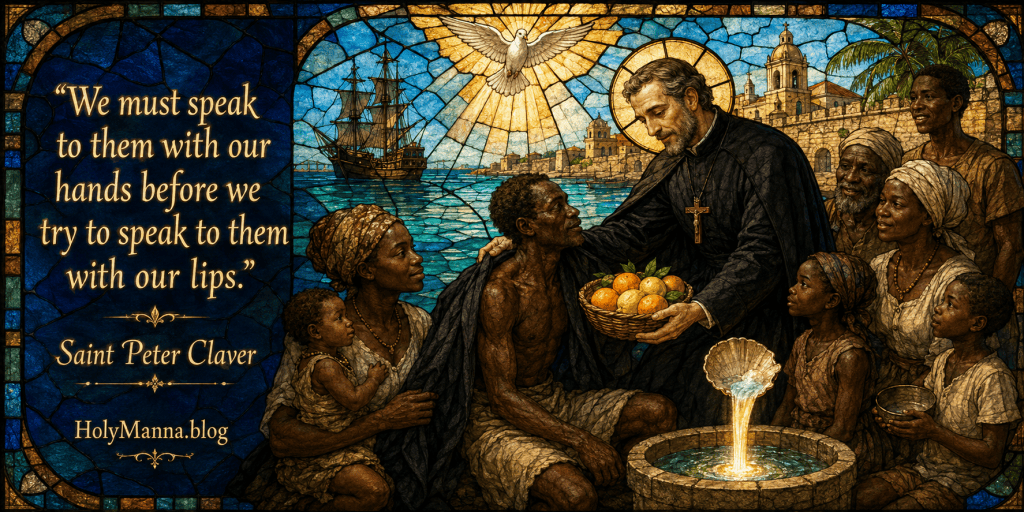
The Slave of the Slaves
Some saints thunder from pulpits. Some write volumes that shape the mind of the Church for centuries. And some simply climb down into the dark, reeking hold of a slave ship with a basket of oranges, and stay there. Saint Peter Claver, whose memorial the Church celebrates on September 9th, belongs to that last kind. He was a Spanish Jesuit priest who spent forty-four years in the port city of Cartagena, in present-day Colombia, at the very center of the transatlantic slave trade. There he made himself, in his own written words, “aethiopum semper servus,” the slave of the Africans forever, and he kept that vow with a fidelity that astonished even his enemies.
The Church has never forgotten what he did. Pope Pius IX beatified him on July 20th, 1850, and Pope Leo XIII canonized him on January 15th, 1888, on the same day as his old friend and spiritual mentor, Saint Alphonsus Rodriguez. In 1896 Leo XIII went further and declared Peter Claver the special heavenly patron of all missionary work among Black peoples. He is also honored as a patron of enslaved persons, of the Republic of Colombia, of race relations, and of ministry to African Americans, and he is commonly invoked as a patron of seafarers. It is widely reported that Leo XIII said of him, “No life, except the life of Christ, has moved me so deeply as that of Saint Peter Claver.” That remark comes down to us as a reported saying of the pope rather than a formal document, but it captures exactly why the Church holds this man up. In an age that treated human beings as cargo, Peter Claver treated cargo as human beings, and in doing so he lived out what the Church teaches in CCC 1700, that the dignity of the human person is rooted in his creation in the image and likeness of God. His life is a standing rebuke to every ideology that has ever tried to sort humanity into the valuable and the disposable.
A Farm Boy From Catalonia and the Doorkeeper Who Changed His Life
Peter Claver was born on June 26th, 1580, in the small village of Verdú, in Catalonia, Spain, into a devout and reasonably prosperous farming family. Some sources give his birth year as 1581, but 1580 is the date preserved in the Church’s own liturgical biography, and it is the one this post follows. His childhood was marked early by loss. He was about thirteen years old when his mother died, and his brother James died shortly afterward. Grief has a way of either hardening a heart or hollowing out a space in it for God, and in Peter’s case it seems to have done the latter.
In 1596 he began studies in arts and letters at the University of Barcelona, where he was noted for both his intelligence and his piety. It was there, still a student, that he wrote a sentence in the notebook he would keep for the rest of his life, a sentence that reads now like a prophecy: “I must dedicate myself to the service of God until death, on the understanding that I am like a slave.” He had no idea yet what shape that sentence would take. In 1602, at the age of twenty, he entered the Society of Jesus at Tarragona.
After his novitiate, the young Jesuit was sent to study philosophy at the college in Palma, on the island of Majorca. And here God arranged one of those quiet meetings that alter the history of souls. The doorkeeper of the college was an elderly lay brother named Alphonsus Rodriguez, a widower who had lost his wife and children before entering religious life, and who had spent decades answering the door with heroic humility. Alphonsus was no ordinary porter. He was a mystic with piercing insight into spiritual things, and he saw something in the earnest young Catalan student. Again and again he urged Peter toward the missions of the New World, toward the souls waiting in the Spanish colonies. Peter listened. He heard in the old doorkeeper’s words the call of God, and he volunteered for the mission of New Granada. In one of the loveliest symmetries in the history of the Church, the student and the doorkeeper were canonized together on the same day, nearly three centuries later.
Peter Claver arrived in Cartagena in 1610 and completed his theological studies in the New World. He was ordained to the priesthood in Cartagena in 1616, though a few sources place his ordination a year earlier. He would never see Spain again. The port city that received him would receive everything he had, down to the last tremor of his broken body.
The Man Who Met the Ships
To understand what Peter Claver did, the reader has to understand what Cartagena was. It was one of the two great slave ports of the Spanish Empire. Roughly a thousand enslaved Africans arrived every month, some ten thousand a year, seized from Angola, the Congo, and the coasts of West Africa. Nearly a third of those loaded onto the ships died during the Atlantic crossing, and the dead were simply thrown overboard. This trade continued in open defiance of the Church; Pope Paul III had condemned the enslavement of peoples decades before, and the condemnations were repeated, and the merchants did not care. The Catechism states the Church’s judgment on this evil without softening it, teaching in CCC 2414 that the seventh commandment forbids acts or enterprises that lead to the enslavement of human beings, to their being bought, sold, and exchanged like merchandise, in disregard for their personal dignity.
Peter Claver could not end the trade. He was one priest. What he could do was be there, and he was there with a totality that still staggers the imagination. An older Jesuit, Father Alonso de Sandoval, had pioneered the ministry to the arriving Africans, and Peter learned from him and then surpassed him in sheer physical presence. When a slave ship was sighted entering the harbor, Peter would go out to meet it, often boarding before it even docked, descending into holds thick with disease and terror, carrying food, medicine, brandy, lemons, and tobacco. He assembled a team of seven interpreters, one of whom spoke four African dialects, so that the frightened captives could hear words of comfort in their own tongues. He baptized the dying and the newborn on the spot. For the rest, he began patient instruction in the faith, using pictures of Our Lord suffering on the Cross, teaching them that they had been redeemed at the price of God’s own Blood, that they possessed a dignity and worth no slaver could take from them.
The best window into this ministry is a letter Peter himself wrote to his superior in 1627, a letter the Church now places in the Office of Readings for his memorial. It begins: “Yesterday, May 30, 1627, on the feast of the Most Holy Trinity, numerous blacks, brought from the rivers of Africa, disembarked from a large ship. Carrying two baskets of oranges, lemons, sweet biscuits, and I know not what else, we hurried toward them.” He describes the sick lying naked on wet ground and in puddles of mud, and what he and his companion did next: they took off their own cloaks, built a platform to lift the dying out of the muck, gathered live coals to warm two men who were nearly frozen in death, and wrapped the sick in the very garments off their backs. Then comes the sentence that defines his whole apostolate: “This was how we spoke to them, not with words but with our hands and our actions.” His biographers also record a saying he would repeat, transmitted through Butler’s Lives of the Saints and the testimony gathered for his cause: “We must speak to them with our hands before we try to speak to them with our lips.” That saying is preserved as something Claver said rather than something he wrote, but it agrees perfectly with the letter that survives in his own hand.
The fruit of this ministry was almost beyond counting. Over roughly forty years, it is estimated that Peter Claver personally instructed and baptized around three hundred thousand people, and that he heard the confessions of more than five thousand enslaved persons in a single year. That famous figure of three hundred thousand is a traditional estimate arising from the testimony of his contemporaries rather than a modern statistical count, and it is honest to say so, but even the most cautious reading leaves an apostolate of astonishing scale. And it matters why he did it. The Church teaches in CCC 1257 that God has bound salvation to the sacrament of Baptism, and Peter believed that with his whole soul. He was not distributing a ritual. He was opening Heaven.
In 1622, at his solemn profession, he made his purpose permanent. Signing the profession document in Latin, as was the custom, he added a phrase after his name that has become his title in the memory of the Church: “Petrus Claver, aethiopum semper servus,” Peter Claver, slave of the Africans forever. That signature survives. It was not rhetoric. It was a vow, and he kept it.
Nor did his charity stop at the harbor. Each spring he traveled to the mines and plantations to visit those who had been sold inland, refusing the comfortable hospitality of the owners when he could and lodging in the slave quarters instead. He served Cartagena’s two hospitals, one for general patients and one for lepers and for those afflicted with the agonizing disease called Saint Anthony’s Fire. He prepared condemned prisoners for a holy death. He preached in the city square, gave missions to sailors, traders, Muslims, and English Protestants passing through the port, and became known simply as the Apostle of Cartagena. During his lifetime, those who knew him attributed to him miracles, prophetic statements, and the gift of reading hearts, and many of the stories concern his nursing of the sick in conditions that no one else, black or white, could endure. A tradition handed down from the testimony gathered after his death holds that the worn cloak he continually wrapped around the sick and the dying became an instrument of healing for those it touched. It is a beautiful story, told and retold in Cartagena for centuries, but the individual healings attributed to the cloak cannot be verified, and it is presented here as tradition rather than established fact.
Faithful to the End
Peter Claver was not martyred, but the reader should not imagine that his path was smooth. His hardships were long, grinding, and came from every direction, including from within the Church. The wealthy class of Cartagena was scandalized by him. Fashionable ladies refused to enter churches where he had gathered the Africans, considering the buildings defiled. The slave merchants despised him as a threat to business. Most painfully, even some of his own superiors and fellow clergy denounced him, accusing him of profaning the sacraments by giving them to people who, in the blasphemous language of the day, almost did not have souls. Against all of it he simply persisted, humble, silent, and immovable, living a rigorous life of prayer and severe penance. The Catechism teaches in CCC 1935 that every form of discrimination affecting the fundamental rights of the person must be curbed and eradicated as incompatible with God’s design, and Peter Claver was living that teaching two and a half centuries before the paragraph was written, at real personal cost.
Then his body gave out. In 1650, while preaching a jubilee among the Africans along the coast, he fell gravely ill and was recalled to the Jesuit residence in Cartagena, where a plague epidemic soon struck. Peter was one of the first attacked. He received the last sacraments and, against expectation, survived, but he emerged a broken man, partially paralyzed, tormented by pain and by a trembling in his limbs that never left him. And here the story turns almost unbearably sad. For the last four years of his life, the man who had nursed thousands lay largely forgotten in his cell. The young man assigned to care for him neglected him. The city that owed him everything scarcely noticed he was still alive. He could manage only short visits to the hospital or to friends. He complained of none of it. Those who did visit found him serene, convinced that his sins deserved worse than his sufferings. He lived just long enough to welcome the priest sent to succeed him in his mission, and one can only imagine the joy of handing on that torch. On September 8th, 1654, the feast of the Nativity of the Blessed Virgin Mary, Peter Claver died.
Then, in death, the city’s conscience woke. The magistrates who had frowned on his work for decades ordered him buried at public expense with great pomp. The civil authorities and clergy who had criticized him united in his praise. And in the detail that says the most, the enslaved Africans and the native peoples of the region arranged a Requiem Mass of their own for the man who had belonged to them.
The Shrine in Cartagena and a Vast Spiritual Family
Veneration of Peter Claver began at his tomb and never stopped. His cause advanced through the sworn testimony of those who had known him, including his own interpreters, gathered within a few years of his death, which is why his life is unusually well documented for a saint of his era. Miracles attributed to his intercession were examined by the Church in the processes leading to his beatification in 1850 and his canonization in 1888, for as CCC 828 teaches, in canonizing certain of the faithful the Church proclaims that they practiced heroic virtue and lived in fidelity to God’s grace, and she gives them to believers as intercessors. In Cartagena, stories of healings and favors obtained through his intercession have circulated among the faithful from his death to the present day. These popular accounts are part of the living devotion of the city, and they are shared here as the traditions they are; apart from the miracles formally examined by the Church for his causes, they cannot be individually verified.
His body rests today beneath the high altar of the Iglesia de San Pedro Claver in Cartagena, the church and Jesuit complex that bear his name, where pilgrims can venerate his relics in the very city where he labored. The room where he died is preserved there. The shrine remains one of the great pilgrimage sites of South America, and the saint’s presence saturates the old city.
His impact reaches far beyond one church. The Congress of the Republic of Colombia declared September 9th the national Day of Human Rights in his honor, a remarkable thing: a modern republic anchoring its celebration of human rights to the feast of a Catholic priest. In the United States, Peter Claver became a beloved patron of Black Catholics, and in 1909 the Knights of Peter Claver was founded in his name, growing into the largest historically Black Catholic lay organization in the country. He is the patron of the Dioceses of Lake Charles and Shreveport in Louisiana. Parishes, schools, and missions across Africa, the Americas, and beyond carry his name, and the Church continues to invoke him in her ongoing work against racism, remembering that, as CCC 1934 teaches, all persons, created in the image of the one God and endowed with the same rational soul, have the same nature and the same origin and enjoy an equal dignity.
What a Basket of Oranges Can Teach the Modern Heart
It is tempting to admire Peter Claver from a safe distance, the way one admires a mountain. But the whole point of the communion of saints, as CCC 956 teaches, is that the saints do not merely inspire from afar; they intercede for the faithful and show them the concrete path. So it is worth asking what his path actually was, because it turns out to be walkable.
Peter Claver did not end slavery. He did not write a treatise against it. He was not a legislator or a revolutionary, and honesty requires admitting that he worked within a system he could not overthrow. What he did was refuse, every single day for forty-four years, to let that system decide for him who mattered. Whatever the empire said, when Peter climbed into that hold, the person in front of him was Christ. He took the Lord’s words in The Gospel of Matthew with terrifying literalness: “Amen, I say to you, whatever you did for one of these least brothers of mine, you did for me” (Mt 25:40). The Catechism echoes this in CCC 2447, teaching that the works of mercy are charitable actions by which we come to the aid of our neighbor in his spiritual and bodily necessities, feeding the hungry, clothing the naked, visiting the sick. Peter’s sanctity was built out of exactly those unglamorous materials: oranges, lemons, a cloak, a basin of wine for washing wounds, a hand held in the dark.
There is a lesson here about evangelization that the modern world badly needs. Peter’s converts did not come to baptism because he won arguments. They came because he loved them first, visibly, physically, at cost to himself, and only then spoke. His own rule, speak with the hands before the lips, is a complete missionary method in ten words. Who in your life has stopped listening to words about God, and what would it look like to speak to them with your hands instead?
There is also a lesson about perseverance in humiliation. Peter was mocked by the rich, obstructed by merchants, and doubted by his own brothers in the Church, and then he spent four years dying in a neglected room. He did not receive the consolation of seeing his work honored. If you have ever done the right thing and been resented for it, or served faithfully and been forgotten, you are standing on ground Peter Claver knows well. When your faithfulness goes unnoticed or even punished, do you serve on, or do you quietly withdraw? And there is finally a lesson about vows. Peter wrote one sentence under his name in 1622 and then spent thirty-two years making it true. In a culture of soft commitments and easy exits, his signature asks a hard question. What have you promised God, and what would it cost to keep that promise the way Peter kept his?
Practically, the reader can begin small this week. Choose one person the world overlooks, someone elderly and alone, someone new to the country, someone sick, someone whom it is socially costly to befriend, and serve that person with your hands before your lips. Bring the meal. Sit at the bedside. Learn the name. Do it again next week. That is the entire Claverian program, and it is available to everyone.
Engage With Us!
Saint Peter Claver has a way of unsettling comfortable faith, and that is a grace worth talking about. Please share your thoughts and reflections in the comments below; this community grows when readers speak honestly about where a saint’s life has touched their own. To help the conversation begin, here are some questions to pray with and respond to.
- Peter Claver signed himself the slave of the Africans forever. What one commitment could you make, and keep, that would place you permanently at the service of someone the world undervalues?
- He insisted on speaking with his hands before his lips. Where have words about your faith failed, and what concrete act of mercy could speak more clearly?
- Peter endured criticism from within the Church itself and stayed both faithful and charitable. How do you respond when doing right earns you resentment rather than praise?
- He spent his last four years forgotten in a small room after a lifetime of service. What does his serenity in neglect teach you about where your sense of worth truly rests?
- The Catechism teaches in CCC 1934 that all people share one origin and one equal dignity. Is there any person or group you have quietly exempted from that truth in your own heart?
Take these questions to prayer, take one of them to the comments, and above all take them into the week ahead. The harbor of Cartagena belongs to history, but the ships still come in, in a thousand hidden forms, carrying people the world has decided not to see. Go meet them. Carry something sweet in your hands. Speak first with your actions, and let every word that follows be full of the love and mercy that Jesus taught us.
Saint Peter Claver, pray for us!
Follow us on YouTube, TikTok, Instagram and Facebook for more insights and reflections on living a faith-filled life.

 Holy Manna!
Leave a comment