Feast of the Nativity of the Blessed Virgin Mary – Lectionary: 636
The Morning Star Rises Before the Sun
Every sunrise is announced by a softer light that comes first. On September 8th, 2026, the Church celebrates the Feast of the Nativity of the Blessed Virgin Mary, the birthday of the girl through whom the Sun of Justice would enter the world. It is one of only three birthdays the liturgy keeps, alongside the Nativity of Jesus on December 25th and the birth of John the Baptist on June 24th, because these three births belong directly to the story of our salvation. The feast is ancient. Eastern Christians were celebrating it by the sixth century, in connection with the church built in Jerusalem on the site traditionally identified as Mary’s birthplace, and Rome adopted it by the seventh century, when Pope Sergius I led candlelit processions through the city in her honor. The central theme uniting today’s readings is this: Mary’s birth is the quiet dawn of God’s eternal plan. Micah points to a mother in Bethlehem’s shadow centuries before she arrives. St. Paul unveils the eternal logic behind it all, that God foreknew, predestined, called, justified, and glorified those he loves. The psalmist sings the joy of a heart that trusts God’s mercy. And Matthew lays out forty-two generations of patriarchs, kings, exiles, and unexpected women, all funneling toward one sentence: “Jacob the father of Joseph, the husband of Mary. Of her was born Jesus who is called the Christ.” Nothing about a baby girl born to an aging couple in Galilee looked historic. Heaven knew better. St. Andrew of Crete, preaching on this feast in the eighth century, taught that “the present festival, the birth of the Mother of God, is the prelude, while the final act is the fore-ordained union of the Word with flesh.” Today the prelude begins.
First Reading (Option 1) — Micah 5:1-4a
A Promise Too Big for a Town Too Small
Micah prophesied in Judah in the eighth century before Christ, a contemporary of Isaiah, while the Assyrian war machine devoured the nations around him. He came from Moresheth, a small country town, and he had a small-town prophet’s suspicion of capital cities and their corrupt courts. Into a moment of national terror, God speaks through him a promise attached not to mighty Jerusalem but to tiny Bethlehem, the village where David had once been the overlooked youngest son (1 Samuel 16). On the Nativity of Mary, the Church hears this oracle with special tenderness, because hidden inside it stands a mother.
Micah 5:1-4a
The LORD says:
You, Bethlehem-Ephrathah,
too small to be among the clans of Judah,
From you shall come forth for me
one who is to be ruler in Israel;
Whose origin is from of old,
from ancient times.
(Therefore the Lord will give them up, until the time
when she who is to give birth has borne,
And the rest of his brethren shall return
to the children of Israel.)
He shall stand firm and shepherd his flock
by the strength of the LORD,
in the majestic name of the LORD, his God;
And they shall remain, for now his greatness
shall reach to the ends of the earth;
he shall be peace.
Detailed Exegesis
Verse 1: “You, Bethlehem-Ephrathah, too small to be among the clans of Judah, From you shall come forth for me one who is to be ruler in Israel; Whose origin is from of old, from ancient times.”
God delights in choosing what the world overlooks. Ephrathah was the ancient clan name of the region around Bethlehem, tying the promise to David’s own family line. The ruler’s origin “from of old” carries a double sense the Church has always cherished: he comes from the ancient Davidic promise, and, read in the fullness of revelation, the Son’s origin is truly eternal. This is the verse the chief priests and scribes quote to Herod when the magi arrive asking where the Messiah is to be born (Matthew 2:6).
Verse 2: “(Therefore the Lord will give them up, until the time when she who is to give birth has borne, And the rest of his brethren shall return to the children of Israel.)”
Here is the reason this reading belongs to today’s feast. Israel’s waiting has a face and a deadline: a woman who is to give birth. Micah does not name her, yet the Church, reading the Old Testament in the light of Christ, recognizes in this expectant mother a prophetic silhouette of Mary. The Catechism teaches that among the poor and humble of the LORD who carried Israel’s hope through the centuries, “the purest figure among them is Mary” (CCC 64). History itself, Micah says, is on hold until she arrives.
Verse 3: “He shall stand firm and shepherd his flock by the strength of the LORD, in the majestic name of the LORD, his God; And they shall remain, for now his greatness shall reach to the ends of the earth.”
The coming ruler is a shepherd king in the mold of David, but greater. He rules by the LORD’s own strength rather than military power, and his reach is universal, extending to the ends of the earth. Jesus fulfills this image completely when he calls himself the Good Shepherd (John 10:11).
Verse 4a: “he shall be peace.”
Micah does not say the ruler will negotiate peace or enforce peace. He will be peace, in his very person. St. Paul echoes this exactly: “For he is our peace” (Ephesians 2:14).
Teachings
The Catechism explains that God formed his people through the prophets “in the hope of salvation, in the expectation of a new and everlasting Covenant intended for all” (CCC 64), and that this hope was carried especially by the humble and the small. Micah’s oracle is a perfect case study, since it locates the world’s salvation in a village too insignificant to count among Judah’s clans. The Fathers loved this reversal. St. Andrew of Crete, in the discourse the Church still reads in the Office of Readings for this very feast, taught that Mary’s birth stands “at the frontier where types and symbols give way to reality, and the old is replaced by the new.” In her, the centuries of prophetic shadow, including Micah’s veiled mother, step into daylight. The historical record adds a lovely footnote: when the Church later set the date for the feast of the Immaculate Conception, she counted nine months backward from September 8th to December 8th, letting Mary’s birthday anchor the calendar of her earliest life.
Reflection
Micah’s message lands close to home for anyone who has ever felt too small to matter. God’s habit is to plant his greatest works in overlooked places: Bethlehem, Nazareth, an unrecorded birthday in an unremarkable family. Consider one hidden, faithful act you can offer God this week without anyone noticing, such as a quiet sacrifice, an unadvertised prayer, or a kindness done in secret. Where in your life do you feel too small for God to use? What would change if you believed that your hidden faithfulness is exactly the soil where God prefers to work?
First Reading (Option 2) — Romans 8:28-30
The Eternal Blueprint Behind a Baby Girl
St. Paul wrote his letter to the Romans around the year 57, introducing himself to a church he had not yet met and laying out the Gospel with more theological depth than anywhere else in his letters. In these three verses, often called the golden chain, Paul pulls back the curtain on eternity and shows the unbroken sequence of God’s saving love. The Church proclaims this text on Marian feasts because Mary is the golden chain’s most radiant proof, the creature foreknown and prepared from all eternity for her role.
Romans 8:28-30
Brothers and sisters:
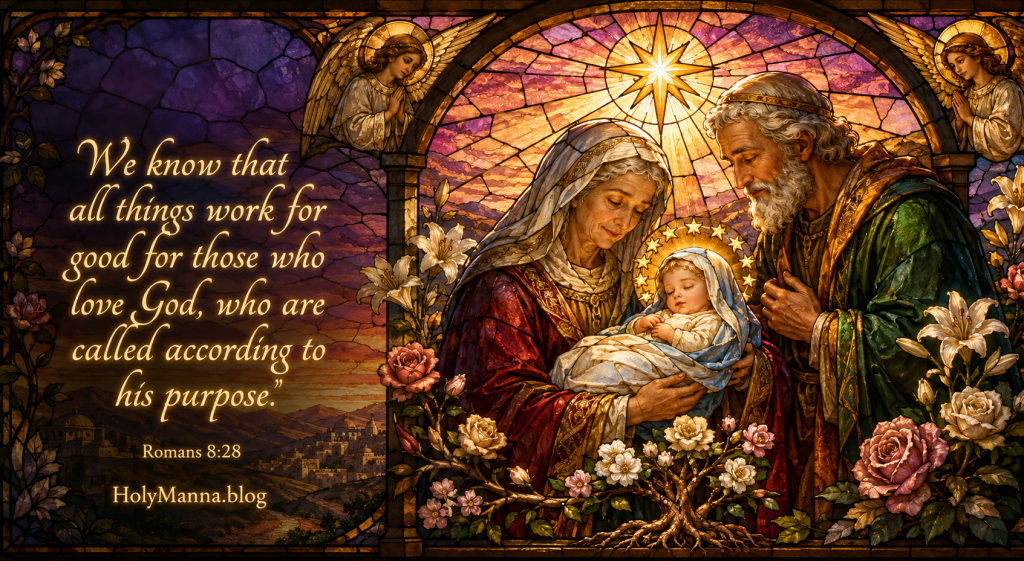
We know that all things work for good for those who love God,
who are called according to his purpose.
For those he foreknew he also predestined
to be conformed to the image of his Son,
so that he might be the firstborn
among many brothers.
And those he predestined he also called;
and those he called he also justified;
and those he justified he also glorified.
Detailed Exegesis
Verse 28: “We know that all things work for good for those who love God, who are called according to his purpose.”
Paul does not say all things are good. Exile, scandal, and sorrow fill the genealogy Matthew will read today. Paul says all things work for good, meaning God’s providence weaves even evil and suffering into his saving design for those who love him. The Catechism affirms this when it teaches that in his eternal plan of predestination, God “includes in it each person’s free response to his grace” (CCC 600).
Verse 29: “For those he foreknew he also predestined to be conformed to the image of his Son, so that he might be the firstborn among many brothers.”
The destination of God’s plan is not a place but a resemblance. Every Christian is destined to look like Jesus. No mere creature ever achieved that conformity more perfectly than Mary, who was so shaped to her Son that the Catechism can say “from all eternity God chose for the mother of his Son a daughter of Israel” (CCC 488). Her birth today is that eternal choice arriving in time.
Verse 30: “And those he predestined he also called; and those he called he also justified; and those he justified he also glorified.”
Notice that even glorification stands in the past tense. So certain is God’s fidelity that Paul speaks of the finish line as already crossed. The chain has no missing links, because every link is forged by God himself.
Teachings
The Catechism places this exact passage at the opening of its treatment of the universal call to holiness (CCC 2012) and immediately draws the conclusion: “All Christians in any state or walk of life are called to the fullness of Christian life and to the perfection of charity” (CCC 2013, quoting Lumen Gentium 40). Predestination in Catholic teaching is never fatalism. God’s foreknowledge embraces human freedom rather than erasing it, which is why Mary’s free yes at the Annunciation matters so much (Luke 1:38). Her birth on this feast is the necessary first chapter of that yes. A girl had to be born, nursed, taught to pray the psalms, and raised in Israel’s hope before she could one day answer an angel. God’s eternal plan is patient enough to include diapers and childhood.
Reflection
This reading is oxygen for anyone walking through a season that makes no sense. The promise is not that everything will feel good, but that nothing is wasted in the hands of God. Try this concrete practice: at the end of each day this week, name one difficult thing and hand it explicitly to God’s providence in a single sentence of prayer. Do you actually believe God is working your current struggle toward good, or do you only believe it about other people’s struggles? What would surrender look like for you this week, in one specific decision?
Responsorial Psalm — Psalm 13:6
The Lament That Learned to Sing
Psalm 13 begins as one of the rawest laments in the Psalter, with the psalmist crying out four times, “How long?” Yet the Lectionary gives the Church only its final verse, the moment the lament breaks open into trust and song. The refrain comes from Isaiah 61:10, a verse the liturgical tradition loves to place on the lips of Mary, because it anticipates her own Magnificat.
Psalm 13:6
R. (Isaiah 61:10) With delight I rejoice in the Lord.
Though I trusted in your mercy,
let my heart rejoice in your salvation.
R. With delight I rejoice in the Lord.
Let me sing of the LORD, “He has been good to me.”
R. With delight I rejoice in the Lord.
Detailed Exegesis
Refrain: “With delight I rejoice in the Lord.”
Drawn from Isaiah 61:10, where the prophet exults that God has clothed him with a robe of salvation, this refrain becomes Mary’s voice on her birthday. Her whole life would be one long rejoicing in God her savior (Luke 1:47).
Verse 6: “Though I trusted in your mercy, let my heart rejoice in your salvation. Let me sing of the LORD, ‘He has been good to me.’”
Trust comes first, and joy follows. The psalmist does not rejoice because circumstances improved; the psalm never says the crisis ended. He rejoices because he chose to trust God’s mercy, in Hebrew hesed, God’s covenant loyalty, and joy grew from that soil. The final line is a testimony: “He has been good to me.” Generations of Israel could sing that line, and on this feast the whole Church sings it, because in giving us Mary, God has been good to us all.
Teachings
The Catechism teaches that Mary stands at the summit of Israel’s poor and humble ones, in whom “after a long period of waiting the times are fulfilled in her, the exalted Daughter of Sion, and the new plan of salvation is established” (CCC 489, quoting Lumen Gentium 55). This psalm verse compresses that entire history of waiting into two lines. St. Bernard of Clairvaux, Doctor of the Church, taught that praise of the Mother never diminishes the Son: “Let us not imagine that we obscure the glory of the Son by the great praise we lavish on the Mother; for the more she is honored, the greater is the glory of her Son.” Rejoicing on Mary’s birthday is simply rejoicing in what God has done.
Reflection
Joy in the Christian life is less a mood than a decision to remember. Start a simple practice this week: write down one line each night completing the sentence “He has been good to me because…” By Saturday you will hold a small psalm of your own. When was the last time you rejoiced in God’s goodness out loud? What is one mercy from this past year that you have never actually thanked God for?
Holy Gospel — Matthew 1:1-16, 18-23
Forty-Two Generations and One Unrepeatable Girl
Matthew opens his Gospel the way a Jewish reader would expect a book about the Messiah to open, with a genealogy proving descent from Abraham and David. He structures it in three movements of fourteen generations, from Abraham to David, from David to the Babylonian exile, and from the exile to Christ, and commentators have long noted that fourteen is the numerical value of David’s name in Hebrew letters. This is not a phone book. It is a theological drumroll, and today’s feast celebrates the girl who stands at its final beat.
Matthew 1:1-16, 18-23
The Book of the genealogy of Jesus Christ,
the son of David, the son of Abraham.Abraham became the father of Isaac,
Isaac the father of Jacob,
Jacob the father of Judah and his brothers.
Judah became the father of Perez and Zerah,
whose mother was Tamar.
Perez became the father of Hezron,
Hezron the father of Ram,
Ram the father of Amminadab.
Amminadab became the father of Nahshon,
Nahshon the father of Salmon,
Salmon the father of Boaz,
whose mother was Rahab.
Boaz became the father of Obed,
whose mother was Ruth.
Obed became the father of Jesse,
Jesse the father of David the king.David became the father of Solomon,
whose mother had been the wife of Uriah.
Solomon became the father of Rehoboam,
Rehoboam the father of Abijah,
Abijah the father of Asaph.
Asaph became the father of Jehoshaphat,
Jehoshaphat the father of Joram,
Joram the father of Uzziah.
Uzziah became the father of Jotham,
Jotham the father of Ahaz,
Ahaz the father of Hezekiah.
Hezekiah became the father of Manasseh,
Manasseh the father of Amos,
Amos the father of Josiah.
Josiah became the father of Jechoniah and his brothers
at the time of the Babylonian exile.After the Babylonian exile,
Jechoniah became the father of Shealtiel,
Shealtiel the father of Zerubbabel,
Zerubbabel the father of Abiud.
Abiud became the father of Eliakim,
Eliakim the father of Azor,
Azor the father of Zadok.
Zadok became the father of Achim,
Achim the father of Eliud,
Eliud the father of Eleazar.
Eleazar became the father of Matthan,
Matthan the father of Jacob,
Jacob the father of Joseph, the husband of Mary.
Of her was born Jesus who is called the Christ.Now this is how the birth of Jesus Christ came about.
When his mother Mary was betrothed to Joseph,
but before they lived together,
she was found with child through the Holy Spirit.
Joseph her husband, since he was a righteous man,
yet unwilling to expose her to shame,
decided to divorce her quietly.
Such was his intention when, behold,
the angel of the Lord appeared to him in a dream and said,
“Joseph, son of David,
do not be afraid to take Mary your wife into your home.
For it is through the Holy Spirit
that this child has been conceived in her.
She will bear a son and you are to name him Jesus,
because he will save his people from their sins.”
All this took place to fulfill
what the Lord had said through the prophet:Behold, the virgin shall be with child and bear a son,
and they shall name him Emmanuel,which means “God is with us.”
Detailed Exegesis
Verse 1: “The Book of the genealogy of Jesus Christ, the son of David, the son of Abraham.”
Matthew’s opening words in Greek, biblos geneseos, deliberately echo the book of Genesis. A new creation begins. Jesus is presented at once as heir of David’s throne and of Abraham’s blessing for all nations (Genesis 12:3).
Verses 2 through 6: “Abraham became the father of Isaac, Isaac the father of Jacob, Jacob the father of Judah and his brothers. Judah became the father of Perez and Zerah, whose mother was Tamar. Perez became the father of Hezron, Hezron the father of Ram, Ram the father of Amminadab. Amminadab became the father of Nahshon, Nahshon the father of Salmon, Salmon the father of Boaz, whose mother was Rahab. Boaz became the father of Obed, whose mother was Ruth. Obed became the father of Jesse, Jesse the father of David the king.”
Three women interrupt the rhythm of fathers: Tamar, who conceived through deception after being wronged (Genesis 38), Rahab, a Gentile from Jericho (Joshua 2), and Ruth, a Moabite widow (Ruth 1-4). Each entered the messianic line through circumstances no one would have scripted. Matthew includes them on purpose, preparing his readers for a fourth surprising mother whose motherhood would scandalize her neighbors.
Verses 7 through 11: “David became the father of Solomon, whose mother had been the wife of Uriah. Solomon became the father of Rehoboam, Rehoboam the father of Abijah, Abijah the father of Asaph. Asaph became the father of Jehoshaphat, Jehoshaphat the father of Joram, Joram the father of Uzziah. Uzziah became the father of Jotham, Jotham the father of Ahaz, Ahaz the father of Hezekiah. Hezekiah became the father of Manasseh, Manasseh the father of Amos, Amos the father of Josiah. Josiah became the father of Jechoniah and his brothers at the time of the Babylonian exile.”
The fourth woman is named only as “the wife of Uriah,” a phrase that keeps David’s sin with Bathsheba in full view (2 Samuel 11). The royal line then descends through saints like Hezekiah and Josiah and through monsters like Manasseh, ending in national catastrophe. God’s promise survives even exile.
Verses 12 through 16: “After the Babylonian exile, Jechoniah became the father of Shealtiel, Shealtiel the father of Zerubbabel, Zerubbabel the father of Abiud. Abiud became the father of Eliakim, Eliakim the father of Azor, Azor the father of Zadok. Zadok became the father of Achim, Achim the father of Eliud, Eliud the father of Eleazar. Eleazar became the father of Matthan, Matthan the father of Jacob, Jacob the father of Joseph, the husband of Mary. Of her was born Jesus who is called the Christ.”
For forty generations the verb has been “became the father of.” At verse 16 the pattern shatters. Joseph is not called the father of Jesus but the husband of Mary, and the Greek makes the break explicit: of her, and her alone, was born the Christ. The entire genealogy exists to arrive at this woman.
Verse 18: “Now this is how the birth of Jesus Christ came about. When his mother Mary was betrothed to Joseph, but before they lived together, she was found with child through the Holy Spirit.”
Jewish betrothal was legally binding marriage, though the bride had not yet moved into her husband’s home. Matthew tells the reader immediately what Joseph does not yet know: this child is the work of the Holy Spirit.
Verse 19: “Joseph her husband, since he was a righteous man, yet unwilling to expose her to shame, decided to divorce her quietly.”
Joseph’s righteousness is not cold legalism but justice wedded to mercy. He refuses to shame the woman he loves even in a situation he cannot understand.
Verse 20: “Such was his intention when, behold, the angel of the Lord appeared to him in a dream and said, ‘Joseph, son of David, do not be afraid to take Mary your wife into your home. For it is through the Holy Spirit that this child has been conceived in her.’”
The angel addresses Joseph as “son of David,” because through Joseph’s legal fatherhood Jesus enters the royal line. Adoption by a father of David’s house makes the genealogy count.
Verse 21: “She will bear a son and you are to name him Jesus, because he will save his people from their sins.”
The name Jesus, in Hebrew Yeshua, means “the LORD saves.” Naming the child is a father’s act, and Joseph’s obedience gives the Savior his saving name.
Verses 22 and 23: “All this took place to fulfill what the Lord had said through the prophet: Behold, the virgin shall be with child and bear a son, and they shall name him Emmanuel, which means ‘God is with us.’”
Matthew cites Isaiah 7:14. The virgin’s child is not merely sent by God; he is God with us in person.
Teachings
The Catechism teaches that “the Gospel accounts understand the virginal conception of Jesus as a divine work that surpasses all human understanding and possibility” (CCC 497), and that the One Mary conceived “was none other than the Father’s eternal Son, the second person of the Holy Trinity. Hence the Church confesses that Mary is truly ‘Mother of God’ (Theotokos)” (CCC 495). St. John Chrysostom, preaching through this genealogy in his Homilies on Matthew, taught that Christ deliberately took a family tree containing sinners, foreigners, and scandal, because he came not to be embarrassed by our history but to redeem it. A note of honesty the readers of this blog will appreciate: Scripture never names Mary’s parents. The names Joachim and Anne come from the apocryphal second-century Protoevangelium of James, and while the Church venerates her parents under those traditional names, that source remains apocryphal tradition rather than Scripture.
Reflection
Every family tree has branches nobody brags about, and Jesus chose to have one too. Whatever your family history holds, it is not a disqualification from God’s plan; Matthew’s genealogy proves it can be the very road God travels. This week, pray by name for one difficult person in your family line, living or deceased. Then imitate Joseph in one concrete way by protecting someone’s reputation instead of discussing their failure. Which person in your family history do you need to entrust to God’s mercy? When have you seen God bring good out of a chapter of your story you once wished you could delete?
A Birthday Gift the Whole World Received
Today the Church throws a birthday party, and the gift goes to the guests. Micah promised that history itself was waiting for “she who is to give birth.” Paul revealed the eternal chain of love, stretching from God’s foreknowledge to glory, on which that promise hung. The psalmist taught the song that fits the day: “With delight I rejoice in the Lord.” And Matthew unrolled forty-two generations of patriarchs, kings, foreigners, sinners, and saints, all so that one verse could land like sunrise: “Of her was born Jesus who is called the Christ.” The Nativity of Mary teaches something quietly revolutionary about how God works. He does not begin salvation with thunder. He begins it with a newborn girl in an obscure family, unnoticed by every historian of her age, foreknown by God from all eternity. St. Andrew of Crete called this feast the joyful prelude to the union of God and man, and a prelude is exactly what every believer’s hidden faithfulness can be. The invitation of this feast is simple and concrete. Honor the Mother, and she will lead you to the Son, for that has been her only occupation since Cana: “Do whatever he tells you” (John 2:5). Pray a Rosary today for the intention you have been carrying longest. Thank God for the people, known and unknown, who form the genealogy of your own faith. And trust that the same providence that guarded a promise through exile and scandal for forty-two generations is guarding your story too. The God who prepared Mary from eternity is preparing you for something as well. Happy birthday, Blessed Mother, and blessed be the fruit of your womb.
Engage With Us!
The reflections above are only half the conversation, and the comments below are where the other half happens. Share what struck you from today’s readings, how you celebrate Our Lady’s birthday, or what God’s providence has been teaching you lately. To help you pray with today’s Scriptures, here are some questions to take to heart:
- In Micah 5:1-4a, God chooses tiny Bethlehem for his greatest work. Where is God asking you to trust that your smallness is not an obstacle to his plan?
- In Romans 8:28-30, St. Paul promises that all things work for good for those who love God. What present difficulty do you need to consciously place inside God’s providence this week?
- In Psalm 13:6, trust in God’s mercy blossoms into song. What specific goodness of God can you sing about today, even before your circumstances change?
- In Matthew 1:1-16, 18-23, Jesus embraces a family history full of grace and scandal alike. How does Christ’s willingness to enter a wounded family line change the way you see your own?
- Taking all the readings together, Mary’s birth shows God’s eternal plan dawning quietly in time. What quiet beginning in your life right now might God intend as the prelude to something far greater?
Faith is not lived in grand gestures alone but in daily trust, hidden fidelity, and small acts of love that God has foreknown from eternity. Live this day with the joy of the psalmist and the obedience of Joseph, and do everything with the love and mercy Jesus taught us.
Sacred Heart of Jesus, we trust in You!
Immaculate Heart of Mary, pray for us!
Saint Michael the Archangel, defend us in battle!
Follow us on YouTube, TikTok, Instagram and Facebook for more insights and reflections on living a faith-filled life.


Leave a Reply