The Night the Church Was Born Again in Košice
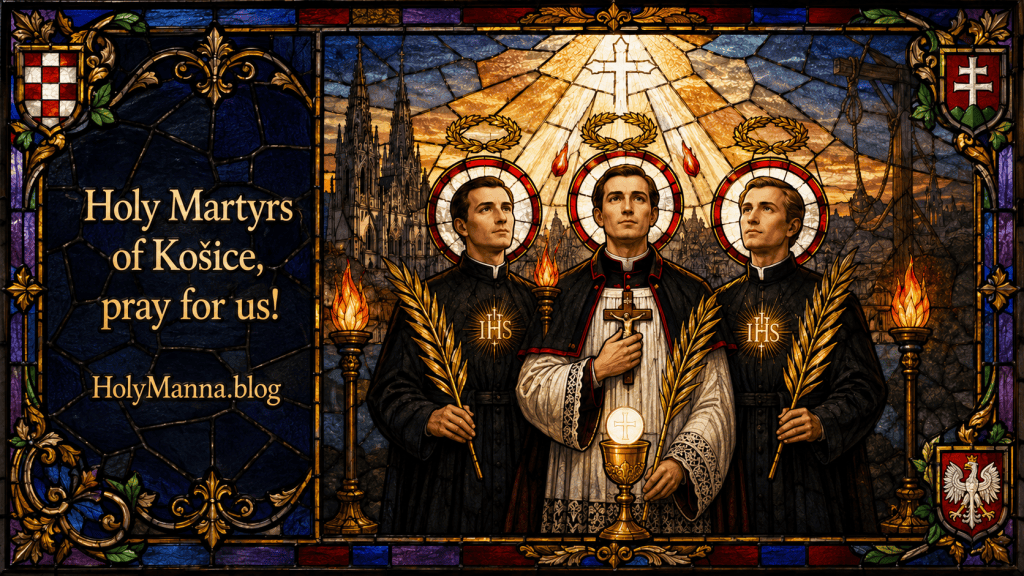
Most saints come to the calendar one at a time. On September 7th, the Church gives you 3 at once, and she insists on keeping them together, because they were never apart in the moment that mattered. Saint Mark Križin was a Croatian, a canon of the primatial cathedral of Esztergom. Saint Stephen Pongrácz was a Hungarian nobleman’s son from Transylvania who had become a Jesuit. Saint Melchior Grodziecki was a Pole from Silesia, also a Jesuit. In 1619 all 3 were serving a small, frightened Catholic community in the Calvinist city of Košice, in what is now eastern Slovakia. When the city fell to the forces of the Calvinist prince Gabriel Bethlen, the 3 priests were seized, tortured through a single night to force them to renounce the Catholic faith and the Pope, and killed when they refused. None of them was older than 37.
Saint John Paul II canonized them on Slovak soil on July 2nd, 1995, and he put his finger on the thing that makes them stand out. He said in his homily at Košice, translated from the Italian, that the three new Saints belonged to three different nations, but they shared the same faith and, sustained by it, they were able to face even death united. That is the whole story in one sentence. Three peoples who have spent a great deal of history quarreling with one another are bound together in heaven by 3 men who chose Christ over survival on the same night.
Of the 3, only Saint Melchior Grodziecki holds a formally documented patronage: the Diocese of Bielsko-Żywiec in Poland, which includes his native Cieszyn, honors him as one of its patrons. Saint Mark and Saint Stephen hold no formally documented patronage, although churches and parishes bear their names.
Sons of Three Kingdoms
Mark Križin was born around 1588 at Križevci, a town in the Diocese of Zagreb in Croatia, to a family of the Croatian nobility. Some Croatian sources give 1589, and the discrepancy is honestly unresolved. He was sent to the Jesuits for his schooling at Vienna and then at Graz, where he earned a doctorate in philosophy and joined the Marian Sodality. At Graz one of his teachers was a young Jesuit named Peter Pázmány, who would later become Cardinal-Primate of Hungary and the driving force behind the Catholic revival in that kingdom. From 1611 to 1615 Mark studied theology in Rome at the Collegium Germanicum et Hungaricum, attending the Roman College that is today the Gregorian University. The college archives still hold a document in which he recorded, in his own hand, that he was Croatian by nationality. He was ordained in Rome. After 2 years of parish ministry back home in the Diocese of Zagreb, his old professor Pázmány called him north to direct the seminary at Trnava and made him a canon of Esztergom. The cathedral chapter of Esztergom was living in exile at Trnava at the time, because the Turks held Esztergom itself. Early in 1619 the chapter gave Mark a very unglamorous job: administering the estates of a former Benedictine abbey at Krásna, just outside Košice. That assignment placed him exactly where God wanted him.
Stephen Pongrácz was born around 1582 at Alvinc Castle in Transylvania, in the town now called Vințu de Jos in Romania. The Vatican gives 1582; other sources say 1583 or 1584. His family belonged to the Hungarian nobility, and the Pope would later observe that he walked away from the prospects of a brilliant worldly career to preach the Gospel. He studied at the Jesuit college in Cluj, entered the Society of Jesus at Brno in Moravia in 1602, did his philosophy in Prague and his theology in Graz, and after ordination was sent to the Jesuit college at Humenné in what is now Slovakia as prefect of studies and, above all, as a preacher.
Melchior Grodziecki was born around 1584 at Cieszyn in Silesia, a Polish town on the Olza river, into a noble Polish family with deep Church connections. His uncle John Grodziecki was Bishop of Olomouc and the founder of the Jesuit novitiate at Brno. Melchior was schooled by the Jesuits at Vienna and entered that very novitiate at Brno in 1603, one year after Stephen Pongrácz. The 2 young men met there, and the friendship formed in the novitiate would end at a common grave. Melchior studied philosophy and theology at Prague and was ordained there in 1614. The Vatican’s own biography of him admits, with refreshing honesty, that he was less brilliant in academic subjects than in the classroom, where he showed real gifts as a teacher, especially with boys from the poor families of Prague.
There is no dramatic conversion story for any of the 3. They were baptized as infants, formed in Jesuit schools, and simply said yes, step by step, to a vocation that led them into danger. That is worth pausing over. The Catechism reminds you that the way of perfection passes by way of the Cross. There is no holiness without renunciation and spiritual battle (CCC 2015). For these 3 men, the battle was mostly ordinary: study, obedience, teaching, preaching, administration. The extraordinary part came at the end, and it was possible only because of the ordinary part.
Shepherds for a Flock Without a Church
To understand why 3 priests from 3 countries ended up in the same house in Košice, you have to understand the world they lived in. In 1618 the Thirty Years’ War broke out. Bohemian Protestant nobles rebelled against the Catholic Habsburg emperor and expelled the Jesuits from Bohemia and Moravia. Melchior Grodziecki was one of those expelled, and he made his way through Moravia into the Kingdom of Hungary, which then included all of present-day Slovakia. In 1619 Gabriel Bethlen, the Calvinist Prince of Transylvania, joined the war against the emperor.
Košice was a Calvinist stronghold. The Catholic minority there had been stripped even of its churches. The Catholic royal governor, Andrew Dóczy, asked the Jesuits for priests who could care for this scattered flock, and he housed them in the royal residence in the city. Stephen Pongrácz came as chaplain to the imperial Hungarian troops and to the handful of Hungarian-speaking Catholic civilians. Melchior Grodziecki came as chaplain to the governor’s Polish and Bohemian mercenaries and to the Slovak-speaking faithful. Mark Križin, living nearby on the abbey estates at Krásna, joined them in the city and worked alongside them.
Look at what that arrangement means. In a city hostile to their faith, with no church building, 3 priests speaking Hungarian, Polish, Slovak, and Croatian were quietly offering Mass, hearing confessions, and preaching to anyone who would listen. The Vatican biography notes that Stephen’s activity in particular provoked the anger of the Calvinist majority. He was not hiding. He was doing his job.
The Church teaches that the priest is configured to Christ the Head and Shepherd in a way that goes beyond function. The Catechism explains that the sacrament of Holy Orders configures the recipient to Christ by a special grace of the Holy Spirit, so that he may serve as Christ’s instrument for his Church (CCC 1581). The Martyrs of Košice took that seriously. No miracles are recorded from their lifetimes, and this post will not invent any. What is recorded is fidelity: the daily, unspectacular work of shepherding a flock that most of the city wished did not exist. Saint John Paul II made the point beautifully when he said of Saint Mark that in the image of the Good Shepherd, in the moment of danger Mark of Križevci did not abandon his flock, as a hireling would have done, but remained in the service of the people of God. Jesus himself gave the standard: I am the good shepherd. A good shepherd lays down his life for the sheep (John 10:11).
That is why these 3 are worth remembering and worth imitating. They were not looking for martyrdom. They were looking for souls. Martyrdom found them because they refused to leave.
The Night of September 7th
In early September 1619 Bethlen’s general, George Rákóczi, marched on Košice. The imperial governor was betrayed by his own mercenaries, and the Calvinist townspeople handed him over to Rákóczi together with his 3 priest guests. The Vatican dates the handover to September 5th; the Archdiocese of Zagreb places Rákóczi’s arrival on September 3rd. The exact day of the arrest is uncertain, but the sequence is not.
The head of the city council, a man named Reyner, egged on by the Calvinist preacher Alvinczi, demanded the death of every Catholic in the city. To their credit, the majority of the Calvinist citizens refused to countenance a general massacre. But the death of 3 priests was something everyone could agree to. The priests were held for days without food, and the Archdiocese of Zagreb records that they were offered church estates if they would renounce the Catholic faith and the Pope. They declined.
A saying of Saint Mark from his interrogation has been preserved by the Archdiocese of Zagreb, drawn from the accounts of the martyrdom and translated here from the Croatian: I am so devoted to my faith, the true faith, that I am ready at any moment to give even my life for it. Those words were about to be tested.
On the night of September 7th the torture began. The Vatican account is unflinching, and it deserves to be read as it was written. The soldiers of Rákóczi carried out the work in the presence of Alvinczi and Reyner. The purpose was not simply to kill but to break, to force a public renunciation of Catholicism that could be used against the whole Catholic community. Mark was burned with torches and, after the first round of torture, beheaded. Melchior was stripped, beaten, tortured further, and then beheaded a little later. Stephen suffered longest. He was mutilated, hung head down from a beam, and burned with torches until his body was torn open. Believed dead, he was thrown the next morning with the bodies of his 2 companions into a cesspit outside the house. He was not dead. He lived about 20 more hours in that pit, and the Vatican biography records that he prayed the entire time. For this reason many sources date his death to September 8th, while the Church keeps all 3 together on September 7th.
The Catechism defines what happened in that house with precision: Martyrdom is the supreme witness given to the truth of the faith: it means bearing witness even unto death. The martyr bears witness to Christ who died and rose, to whom he is united by charity (CCC 2473). Notice that the Church does not call it a tragedy. She calls it a witness, and she does so because Jesus promised it would be one: Everyone who acknowledges me before others I will acknowledge before my heavenly Father. But whoever denies me before others, I will deny before my heavenly Father (Matthew 10:32 to 33). The Church has never treated that promise as optional. All however must be prepared to confess Christ before men and to follow him along the way of the Cross, amidst the persecutions which the Church never lacks (CCC 1816).
In his canonization homily, Saint John Paul II said he could almost hear the martyrs speaking the words of Saint Paul that the liturgy had just proclaimed: What will separate us from the love of Christ? Will anguish, or distress, or persecution, or famine, or nakedness, or peril, or the sword? (Romans 8:35). And the answer Paul gives is the answer Stephen Pongrácz gave, praying in the dark for 20 hours: For I am convinced that neither death, nor life, nor angels, nor principalities, nor present things, nor future things, nor powers, nor height, nor depth, nor any other creature will be able to separate us from the love of God in Christ Jesus our Lord (Romans 8:38 to 39).
The Pope also did something remarkable in that homily. He named the 24 Lutheran faithful who were killed at Prešov a few decades later, and he said the Church honors them and everyone who accepted suffering and death for the sake of conscience. He did not paper over the fact that the Košice martyrs died at Christian hands in a Christian civil war. He held it up as a reason for the Catholic majority and the Hungarian minority in Slovakia to seek reconciliation, and he called the canonization an ecumenical event. The Church teaches that Christ always gives his Church the gift of unity, but the Church must always pray and work to maintain, reinforce, and perfect the unity that Christ wills for her (CCC 820). The blood of Košice is not a grudge to be nursed. It is a wound Christ wants healed.
A Countess, a Cesspit, and 400 Years of Relics
The murders shocked the city, Protestants included. Bethlen nonetheless forbade any funeral. The bodies were eventually removed from the pit and buried secretly with the council’s grudging consent. It took 6 months and the persistence of a noblewoman, Countess Catherine Pálffy, wife of the Palatine Sigismund Forgách, to win permission for an honorable burial.
The Archdiocese of Zagreb preserves a story about how she did it. It is said that Bethlen was hosting a banquet in the very palace where the priests had been tortured, and that the Countess agreed to dance with the prince at that banquet on one condition: that the 3 priests be buried with the highest honors. Bethlen, the story goes, gave in. It is a wonderful account of a laywoman using every weapon she had to honor the martyrs, but it rests on tradition rather than documented record, and it cannot be verified.
What can be verified is what happened next. Cardinal Pázmány, Mark’s old teacher and now Primate of Hungary, opened a canonical investigation into the martyrdom almost immediately, gathered testimony, and in 1628, on behalf of all the bishops of the kingdom, petitioned Pope Urban VIII to permit public veneration. In 1636 the bodies were translated to Trnava. The relics rest today in the Ursuline Church of Saint Anne in Trnava, with portions venerated at the Basilica of Esztergom in Hungary and in Košice itself, where the Premonstratensian Church of the Holy Trinity stands on the site of the royal house in which they died.
The cause moved slowly for reasons that had nothing to do with doubt about the martyrdom and everything to do with the chaos of Central European history. It was formally reopened in 1859. Saint Pius X beatified the 3 in Rome on January 15th, 1905. A few online sources give January 1st, but the Vatican’s own record confirms the 15th. Saint John Paul II canonized them at Košice on July 2nd, 1995, during his Apostolic Pilgrimage to Slovakia, with the bishops of Central Europe and official delegations from Croatia, Poland, and Hungary present. One widely copied English source dates the canonization to September 2nd; the Vatican’s record and the Pope’s own General Audience of July 5th, 1995 confirm July 2nd.
No healing miracles are attributed to the Martyrs of Košice in the Vatican’s biographies, and none were required. The Church does not demand a miracle for the beatification of a martyr, because martyrdom is itself the witness. This is not a lesser form of sanctity. The Catechism teaches that by canonizing some of the faithful, i.e., by solemnly proclaiming that they practiced heroic virtue and lived in fidelity to God’s grace, the Church recognizes the power of the Spirit of holiness within her and sustains the hope of believers by proposing the saints to them as models and intercessors (CCC 828). The martyrs of Košice are proposed as both.
Their cultural footprint has grown in the last century. In 1937 Archbishop Aloysius Stepinac of Zagreb dedicated a new parish in the city to Blessed Mark, as he then was. In Križevci, the church of Saint Ladislaus received Mark as co-patron, and since 1969, when Cardinal Franjo Šeper celebrated the 450th anniversary of the martyrdom there, the feast has been kept with a full week of celebrations and pilgrimages to his hometown. In Cieszyn, a tradition dating to the beatification year of 1905 sees Polish and Czech Catholics process each September with Saint Melchior’s relics across the Friendship Bridge over the Olza, which for most of the 20th century was an international border. A saint who died for unity now literally carries his people across a frontier. In 2019, for the 400th anniversary, a team of anthropologists from Comenius University and international forensic specialists reconstructed the faces of all 3 martyrs from their skulls. They found injuries to the head and neck consistent with the historical accounts, though they could not identify a single cause of death and concluded that the 3 were so brutalized that they died slowly. After 4 centuries, science confirmed what the Church had always said.
What Košice Asks of You
It is easy to admire the Martyrs of Košice from a safe distance. It is harder to notice how ordinary their courage was before it became heroic. None of them set out to be a martyr. They set out to be good priests, good teachers, good shepherds of a flock that had no building to gather in. Their sanctity was built in seminary classrooms, in the Jesuit novitiate at Brno, in the account books of an abbey estate, in the barracks where Melchior heard the confessions of Polish mercenaries. When the night came, they had nothing left to decide. They had already decided, a thousand small times.
The Catechism calls the saints your companions, not merely your examples. It is not merely by the title of example that we cherish the memory of those in heaven; we seek, rather, that by this devotion to the exercise of fraternal charity the union of the whole Church in the Spirit may be strengthened (CCC 957). That means Mark, Stephen, and Melchior are interested in your life. They know what it is to be a religious minority in a place that thinks your faith is foolish or dangerous. They know what it is to be offered comfort in exchange for silence.
Where in your daily life are you quietly offered the equivalent of a church estate for keeping your faith to yourself? It may not look like an estate. It may look like a promotion, a friendship, an easy peace at the dinner table. The martyrs did not shout. They simply would not say the thing that was false.
Who is in your flock? Not everyone has a parish assignment, but everyone has people who depend on their faithfulness: a spouse, children, a friend who is drifting, a coworker who watches how you handle pressure. Jesus said no one has greater love than this, to lay down one’s life for one’s friends (John 15:13). Laying down a life usually happens in installments.
Which nation, party, or tribe do you find hardest to see as a brother in Christ? Three men from 3 peoples who had every historical reason to distrust one another shared a house, a mission, and a grave. Saint John Paul II turned their canonization into a plea for Slovaks and Hungarians to live in mutual respect. You can begin closer to home, with the person whose politics or background makes you roll your eyes. The martyrs’ unity was not a feeling. It was a shared Eucharist and a shared refusal to deny it.
In practical terms, there are 3 things you can borrow from Košice this week. Say a prayer for a persecuted Christian somewhere in the world each morning, by name if you can find one, because the Church of the martyrs is not a museum. Go to confession, because the martyrs faced death with clean souls and you should not face Monday without one. And find one place this week to acknowledge Christ before others in a way that costs you something small, because service of and witness to the faith are necessary for salvation (CCC 1816), and the habit of small witness is what makes great witness possible.
The Psalmist sang that dear in the eyes of the LORD is the death of his devoted (Psalm 116:15). The Book of Revelation shows you where that road ends, in the great multitude of those who have washed their robes and made them white in the blood of the Lamb (Revelation 7:14). Saint John Paul II opened his homily at Košice with exactly that verse, explaining why the ancient Te Deum calls the martyrs a white-robed army even though the Church vests in red to honor them. Red is what the world sees. White is what God sees. On September 7th, you are invited to see both.
Engage With Us!
The story of the Martyrs of Košice is a story about ordinary priests who became extraordinary witnesses because they refused to abandon the people God had given them. Share your thoughts and reflections in the comments below. What struck you most about Mark, Stephen, and Melchior? Have you ever visited Trnava, Košice, Križevci, or Cieszyn, or do you have a family connection to one of these 3 nations? Your story might be exactly what another reader needs to hear.
Here are some questions to help you go deeper:
- Saint Mark stayed with his flock in Košice when he could have retreated to the safety of Trnava. Where is God asking you to stay when it would be easier to leave?
- Saint Stephen prayed for nearly a day in a cesspit after being left for dead. What does his perseverance in prayer teach you about praying through suffering that seems pointless?
- Saint Melchior was, by the Vatican’s own account, not the most brilliant student, but he was a gifted teacher of poor boys. How does his story challenge the idea that holiness requires exceptional talent?
- The martyrs were offered church estates in exchange for renouncing the Pope. What comforts or advantages are you tempted to accept in exchange for a quieter faith?
- Saint John Paul II turned this canonization into a call for reconciliation between peoples. Is there a person or group you need to stop seeing as an enemy and start seeing as a brother or sister in Christ?
- Three priests from 3 nations shared one faith and one death. How can your parish or family become a place where differences are gathered into unity rather than division?
The Martyrs of Košice did not have a church building, a sympathetic government, or a guarantee of safety. They had the Eucharist, each other, and a decision they had already made. That is enough for you too. Go and live your faith openly, forgive the people who have made your life harder, care for the flock God has entrusted to you, and do all of it with the love and mercy that Jesus taught, so that when your own night comes, whatever form it takes, there will be nothing left to decide.
Holy Martyrs of Košice, pray for us!
Follow us on YouTube, TikTok, Instagram and Facebook for more insights and reflections on living a faith-filled life.

 Holy Manna!
Leave a comment