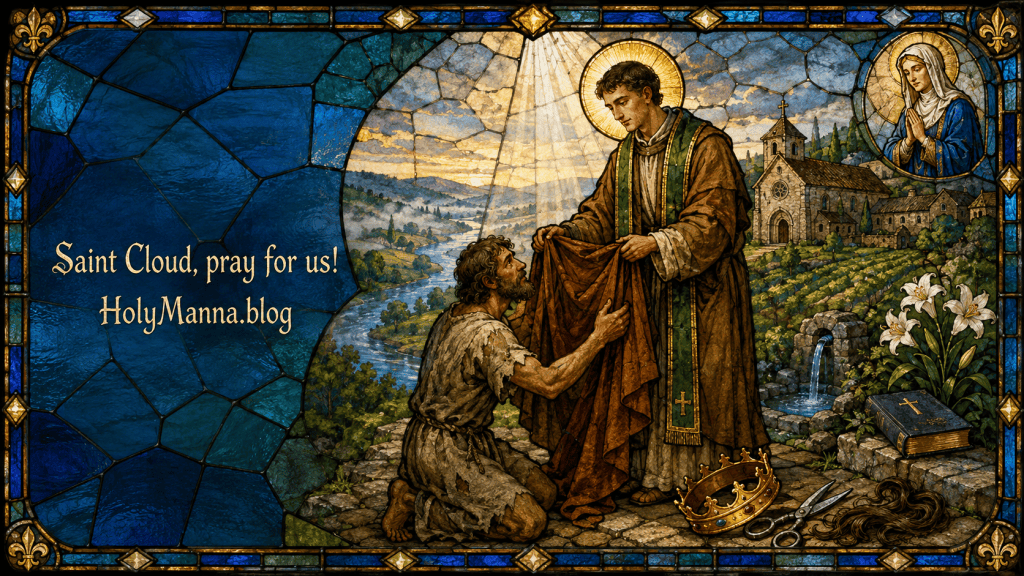
A Crown Left on the Floor
Every September 7th the Church remembers a man who could have been a king and chose to be a priest instead. Saint Clodoald, known in France and the English speaking world simply as Saint Cloud, was born into the most powerful family in Western Europe in the year 522. His grandfather was Clovis, the first Catholic king of the Franks. His grandmother was Saint Clotilde, the queen whose prayers helped bring Clovis to the font. By blood and by law, Clodoald had a claim to a throne. By the time he was 8 years old, that claim had cost his 2 brothers their lives, and it nearly cost him his own.
What makes his story stay with people fifteen centuries later is not a dramatic conversion or a martyr’s death. It is a decision. Faced with a family that killed for crowns, Clodoald walked away from the crown. He cut off the long hair that marked a Merovingian prince, gave away his inheritance, and disappeared into a hermit’s cell. When people found him anyway, he served them, and when Paris asked for him, he was ordained a priest. When his fame grew again, he slipped down the Seine to a fishing village called Nogent and built a church there, and that village has carried his name ever since. The 2004 Roman Martyrology sums him up in a single sentence, rendered here from the Latin: In the village of Nogent in the district of Paris, likewise in France, Saint Clodoald, priest, who, born of royal stock and taken in by his grandmother Saint Clotilde after his father and brothers had been killed, spurned an earthly kingdom and became a cleric.
Saint Cloud is the patron of the Diocese of Saint Cloud, Minnesota, which takes its name from the city, which takes its name from the French town, which takes its name from him. That chain of names running from a Frankish hermitage to central Minnesota is a small picture of what the Catechism means when it says that by canonizing some of the faithful, i.e., by solemnly proclaiming that they practiced heroic virtue and lived in fidelity to God’s grace, the Church recognizes the power of the Spirit of holiness within her and sustains the hope of believers by proposing the saints to them as models and intercessors (CCC 828).
Born into the House of Clovis
When Clovis died in 511, his kingdom was divided among his 4 sons. The second of them, Chlodomer, received Orléans, and it was to Chlodomer and his wife Guntheuc that Clodoald was born in 522, the youngest of 3 boys after Theudovald and Gunthar. The family’s Catholic faith was still young. Clovis had been baptized only a generation earlier, and the Frankish kings had learned the Gospel without unlearning their old appetite for conquest and vengeance. Chlodomer was killed in 524, when Clodoald was about 2 years old, fighting the Burgundians at Vézeronce.
The 3 orphaned princes were taken in by their grandmother, Saint Clotilde, who had retired to Paris and given herself to prayer and works of charity. Their mother Guntheuc was married off to their uncle Clotaire. Gregory of Tours writes that Clotilde loved the boys openly, and that this affection became the seed of a tragedy. Her surviving sons, Childebert, king of Paris, and Clotaire, king of Soissons, feared that she meant to make the boys kings of their father’s lands, and they wanted those lands for themselves. Around the year 531 the 2 kings lured the children out of their grandmother’s care, and in the space of an afternoon 2 of them were dead. That story belongs to the section on hardships below.
Clodoald was about 8 years old. Loyal men got him out of Paris, and later tradition says he was hidden for a time in Provence. Somewhere in those hidden years the boy made the decision that defines him. Gregory of Tours, writing within living memory of the events, tells it in a few plain words, rendered here from the Latin: Clodoald, however, was saved by the help of brave men. Despising an earthly kingdom, he gave himself to the Lord, and cutting his hair with his own hand he became a cleric; persevering in good works, he departed this life a priest.
The detail about the hair is the whole story in miniature. Among the Franks the long, unshorn hair of the royal house was the sign of the right to rule. To shear a Merovingian was to strip him of his claim; that is precisely why his uncles had offered scissors as an alternative to a sword. Clodoald took the scissors to himself. He gave the crown away with his own hands, and in doing so he lived out the question Jesus puts to every disciple: What profit would there be for one to gain the whole world and forfeit his life? (Matthew 16:26). The Catechism teaches that Jesus enjoins his disciples to prefer him to everything and everyone, and bids them “renounce all that [they have]” for his sake and that of the Gospel (CCC 2544). For most people that renunciation is a matter of small daily preferences. For Clodoald it was a kingdom.
The Hermit Everyone Kept Finding
The later lives of the saint describe the years that followed as a search for hiddenness that kept failing. Tradition says that when Clodoald came of age he placed himself under the direction of a recluse named Severinus who lived near Paris. This detail comes from later sources rather than from the earliest Carolingian Life, and it is best held as tradition. What the sources agree on is that Clodoald became a hermit, and that the people of the region would not leave him alone. They came for counsel, for prayers, and for healing, and they went home talking.
One story from this period became so attached to him that it is the way artists have painted him ever since. A poor man came to the hermit’s cell in the cold, and Clodoald gave him his own cloak. As he did so, a light from heaven shone about him, and those who saw it spread the word that God had marked the young prince as his own. The story is told in the later lives of the saint and in the devotional books sold to pilgrims at his shrine, and it echoes the famous cloak of Saint Martin, to whom Clodoald is said to have dedicated his church. It cannot be verified from the earliest sources.
Whether or not the light was seen, the charity was real, and it was the pattern of his life. The Catechism explains that the works of mercy are charitable actions by which we come to the help of our neighbor in his spiritual and bodily necessities (CCC 2447), and it lists clothing the naked among the first of them. According to Butler and the later lives, Clodoald gave his entire inheritance away, some to churches and the rest to the poor. A man who has given a beggar his only cloak has no trouble giving a bishop a village.
The people of Paris eventually asked their bishop for something more than a hermit. At their earnest request, Eusebius, Bishop of Paris, ordained Clodoald a priest in the year 551. The one who had refused the throne of Orléans accepted the yoke of the altar. The Catechism teaches that in the ordained ministry it is Christ himself who is present to his Church as Head of his Body, Shepherd of his flock, high priest of the redemptive sacrifice, Teacher of Truth (CCC 1548). For a few years Clodoald served the Church of Paris, preaching and offering the Mass in the city where his brothers were buried and where his uncle still reigned.
Then he did what he always did when the honors gathered. He left. He went down the Seine to Nogent, a settlement of farmers and fishermen about 6 miles below the city, and there he built a church and a monastery. Men who feared for their souls in the world joined him and made him their superior. He taught them more by example than by word, and he went out among the country people to instruct them in the faith. He gave Nogent and everything attached to it to the Church of Paris, so that the place would belong to the bishop and not to a prince. The Carolingian epitaph on his tomb, rendered here from the Latin, preserved the memory: Chlodoald, sprung from the illustrious line of kings, consecrates this tomb with his holy limbs. Forbidden to hold the scepter of the perishing kingdom, he strove to build this basilica for God, and gave it to be held by right of the mother church, so that it might belong to the bishop of the city of Paris.
He died at Nogent about the year 560, in his late 30s, on what appears to have been September 7th. Tradition says he foresaw the day of his death; that detail comes from later accounts and cannot be verified. By 592, barely a generation later, the martyrology used at Auxerre already listed him among the saints for September 7th with a title that captures the paradox of his life, rendered here from the Latin: At Paris, in the village of Nogent, Saint Clodoald, king and confessor. The Church remembered him as a king precisely because he had refused to be one.
Scissors or a Sword
Saint Cloud was not a martyr. He died in his bed, surrounded by his monks, and no sword ever touched him. But he carried a wound that most martyrs never had to bear, and it is impossible to understand his holiness without looking at it directly. The wound was his own family.
Gregory of Tours tells the story in the eighteenth chapter of the third book of his History of the Franks, and it is one of the most harrowing pages in early medieval literature. Childebert and Clotaire sent word to Clotilde that they wished to see their nephews and raise them to the kingship, and the delighted grandmother sent the 3 children to them. The uncles then sent a nobleman named Arcadius back to Clotilde carrying a pair of scissors in one hand and a naked sword in the other. She was to choose: the boys could be shorn and reduced to commoners, or they could be killed.
Gregory records that Clotilde, overwhelmed with grief and not weighing what she said, answered that if the boys were not to be raised to the kingdom, she would rather see them dead than shorn. Arcadius did not wait for her to reconsider. He hurried back and reported that the queen had approved the killing. Clotaire seized the eldest boy, Theudovald, who was 10, threw him to the ground, and stabbed him under the arm. Gunthar, who was 7, fell at Childebert’s feet and begged his uncle to save him so that he would not die like his brother. Childebert wept and asked Clotaire to spare the child. Clotaire answered that Childebert had begun this and was now backing out, and that if he did not push the boy away he would die in his place. Childebert pushed the child away, and Clotaire killed him. The servants and tutors were slaughtered as well, and the 2 kings divided their brother’s kingdom. Clotilde placed the small bodies on a bier and carried them with psalms and bitter weeping to the church of Saint Peter in Paris, where she buried them.
Out of that afternoon the third child was carried, alive, by men brave enough to defy 2 kings. The Catechism teaches that by recalling the commandment, “You shall not kill,” our Lord asked for peace of heart and denounced murderous anger and hatred as immoral (CCC 2302). Clodoald grew up knowing exactly what murderous anger looks like when it wears a crown. He had every worldly reason to nurse a grievance, gather an army when he came of age, and take back what was his. Instead he took the scissors his uncles had offered his grandmother and used them on himself.
The hardship of that choice is easy to underestimate. He was renouncing not only power but the chance to avenge his brothers and reclaim his father’s house. Scripture is blunt about where vengeance belongs: Beloved, do not look for revenge but leave room for the wrath; for it is written, “Vengeance is mine, I will repay, says the Lord” (Romans 12:19). The Catechism draws the line all the way to its end: In the Sermon on the Mount, the Lord recalls the commandment, “You shall not kill,” and adds to it the proscription of anger, hatred, and vengeance. Going further, Christ asks his disciples to turn the other cheek, to love their enemies (CCC 2262). Clodoald did not merely refrain from vengeance; he lived as a priest in a city ruled by the man who had killed his brothers, offering Mass and preaching mercy under Childebert’s roof. Some later accounts say that the uncles repented of their crime during his ministry. That cannot be verified, and Gregory does not say it, but a murderer who watches his victim’s brother give away his cloak has been handed a mirror.
There were other, quieter hardships. Clodoald wanted solitude and never quite got it. He fled to a cell and crowds followed. He returned to Paris and was received with public joy, which for a man of his temperament was its own kind of trial. The Catechism describes the pattern honestly: The way of perfection passes by way of the Cross. There is no holiness without renunciation and spiritual battle (CCC 2015). For Clodoald the renunciation was of a crown, and the battle was against the bitterness that could have consumed the rest of his life.
Miracles at the Tomb and the Town That Took His Name
Clodoald was buried in the church he had built at Nogent, and almost at once people began to come. The Chronicle of Fredegar, written about a century after his death, says of him, in words rendered here from the Latin, that the Lord judged him worthy to show his power at his tomb. Saint Bede’s martyrology mentions him in the 8th century, and around the year 1000 the monk Aimoin speaks of his numerous miracles. The village grew into a town around the tomb, and by the 8th century the community of clergy serving it was already called by his name. Novigentum had become Saint-Cloud.
The pilgrimage that developed there lasted more than twelve hundred years. Pilgrims came for healing of sores, boils, and scrofula. The clergy kept a small bone from the saint’s finger in a crystal reliquary, and by dipping it into water from the fountain near the church they made what was called the water of Saint Cloud, which the sick drank or used to wash their wounds. A great pilgrimage took place on September 7th and through its octave, with a fair that drew crowds of Parisians out to the hillside, and a second feast on May 8th recalled the translation of his relics. In 1585 the church was hung with 18 paintings of his life, and in 1606 a confraternity was founded. Guidebooks printed for pilgrims in 1647 and 1696 describe an incredible crowd on his feast and state that miracles were still occurring at the tomb. None of these healings was recorded in detail, and none can be individually verified, but the testimony to them runs unbroken from the 7th century to the 17th.
The relics themselves had an eventful history. During the Norman siege of Paris in 885 and 886 the body was carried into the city for safety. On April 20th, 1376, because of the miracles and the number of pilgrims, Bishop Aimery de Magnac had the sarcophagus opened and the bones transferred to a place of honor near the high altar. In 1428 the canons commissioned a jeweled shrine of gilt copper, and on July 12th, 1444, after a time of refuge in Paris, it was carried home in a general procession from Notre-Dame. In 1567 Huguenots sacked the marble tomb, but the sarcophagus and its ancient epitaph survived.
The end came with the Revolution. The old collegiate church, near collapse, was demolished in 1788, and Queen Marie-Antoinette laid the first stone of a new one. Construction stopped in January 1791. That same year revolutionaries burned the relics of Saint Cloud and destroyed his tomb. Only 2 fragments escaped. A schoolteacher saved one, which was exposed for veneration again on June 12th, 1848. A man who had carried the shrine in processions saved a vertebra from the fire; on September 5th, 1863, it was authenticated and placed with a portion of the saint’s shroud in the new church of Saint-Clodoald, which stands today. The Catechism teaches that the religious sense of the Christian people has always found expression in the veneration of relics, visits to sanctuaries, pilgrimages, processions (CCC 1674), and few shrines illustrate that instinct better than a town that kept a hermit’s bones through Vikings, thieves, Huguenots, and Jacobins.
The name traveled farther than the bones. The royal Château de Saint-Cloud, built above the church, was a residence of French kings and emperors until it burned in 1870, and its name crossed the Atlantic to towns in Minnesota, Wisconsin, and Florida. When the Diocese of Saint Cloud was erected in Minnesota on September 22nd, 1889, it took the saint as its patron, and its Latin title to this day is the Diocese of Saint Clodoald. In May 1922 Bishop Joseph Busch traveled to Saint-Cloud in France for the 14th centenary of the saint’s birth, and he returned with a relic of the saint and a copy of the town’s statue of him. Both are now enshrined in the Cathedral of Saint Mary in St. Cloud, Minnesota, where Catholics on the American prairie venerate a Frankish prince who never knew the continent existed. The Catechism explains why that makes sense: It is not merely by the title of example that we cherish the memory of those in heaven; we seek, rather, that by this devotion to the exercise of fraternal charity the union of the whole Church in the Spirit may be strengthened (CCC 957).
What to Do with a Wound
Most people reading this will never be offered a throne. But almost everyone has been handed something that looks like Clodoald’s inheritance: a family wound, a betrayal by someone who was supposed to protect them, a grievance with a legitimate claim attached. The question his life asks is not whether you have been wronged. It is what you are going to do with the scissors.
The saint’s first lesson is that renunciation can be an act of freedom rather than defeat. Clodoald did not lose the kingdom; he gave it away. The Catechism teaches that the beatitude we are promised confronts us with decisive moral choices. It invites us to purify our hearts of bad instincts and to seek the love of God above all else (CCC 1723). Saint Paul put the same truth in his own life story: I even consider everything as a loss because of the supreme good of knowing Christ Jesus my Lord (Philippians 3:8). What is the crown you are still holding onto, the status or the grievance or the plan for your own life, that God may be inviting you to lay down freely before it is taken from you?
The second lesson is about forgiveness that goes further than feelings. Clodoald did not stage a reconciliation scene with his uncles. He simply lived as a priest in their kingdom and let mercy do its slow work. Jesus does not ask his disciples to pretend the wound is not there; he asks them to pray through it: But I say to you, love your enemies, and pray for those who persecute you (Matthew 5:44). The Catechism is honest that this is not in our power, and that the heart which gives itself to the Holy Spirit turns injury into compassion and purifies the memory in transforming the hurt into intercession (CCC 2843). Is there someone whose name you could begin to place in your prayers this week, not because the hurt has healed, but because prayer is how it begins to?
The third lesson is that a hidden life is still a fruitful life. Clodoald spent years in a cell, and the people came anyway. He built no platform; he built a church for God and gave it to the bishop. The Catechism teaches that all Christians in any state or walk of life are called to the fullness of Christian life and to the perfection of charity (CCC 2013). Holiness does not require an audience. It requires a cloak, a poor man, and the willingness to hand one to the other. Jesus promised that whatever you did for one of these least brothers of mine, you did for me (Matthew 25:40). What is the cloak in your life, the thing you could give this week that would actually cost you something?
A practical way to walk with Saint Cloud is to pick 1 act of renunciation and 1 act of mercy for the week of his feast. Give something away that you would rather keep. Pray by name for someone you would rather not think about. Serve where nobody will see. And if an old wound aches while you do it, remember the orphan in Paris and the psalm sung over his brothers’ bodies: Even if my father and mother forsake me, the LORD will take me in (Psalm 27:10).
Engage With Us!
Saint Cloud’s story touches something that many families carry quietly. Share your thoughts and reflections in the comments below, and consider these questions as you go.
- Clodoald cut off his own hair rather than let his uncles do it. Where in your life could a free renunciation, made on your own terms, be more powerful than clinging to something until it is taken from you?
- The saint served as a priest in the very city ruled by the man who murdered his brothers. What would it look like for you to live faithfully in a place or a family where you have been deeply wronged, without fleeing or seeking revenge?
- Every time Clodoald sought solitude, people found him and asked for help. How do you respond when your plans for quiet or rest are interrupted by someone who needs you?
- He gave away a kingdom and a cloak with the same hand. Which is harder for you to give, the big things or the small daily ones, and why?
- Pilgrims sought healing at his tomb for twelve centuries, and his relics survived even the fires of the Revolution. What does the persistence of that devotion say to you about the communion of saints and your own place in it?
Saint Cloud shows that the kingdom of God is not something to be seized; it is something received with open hands, and open hands are hands that have let go. May you find the courage this week to lay down whatever crown you have been clutching, to forgive the ones who wounded you, and to hand your cloak to the poor man at your door. Do everything, as Jesus taught us, with love and with mercy, and trust that the Lord who took in an orphaned prince will take you in as well.
Saint Cloud, pray for us!
Follow us on YouTube, TikTok, Instagram and Facebook for more insights and reflections on living a faith-filled life.

 Holy Manna!
Leave a comment