Monday of the Twenty-third Week in Ordinary Time – Lectionary: 437
Fresh Dough and Open Hands
Anyone who has ever baked bread knows that a pinch of yeast disappears into the dough and then quietly takes over everything. That hidden power is the image St. Paul reaches for on Monday, September 7th, the Monday of the Twenty-third Week in Ordinary Time, and it turns out to be the key that unlocks all three readings.
The central theme of the day is that genuine holiness is not a pose but a purity that clears out what corrupts and heals what is withered. In the First Reading, Paul confronts a Corinthian church so proud of its freedom that it has stopped grieving over open sin, and he calls the community back to the unleavened bread of sincerity and truth. The Responsorial Psalm sings of a God who takes no delight in wickedness and cannot let the arrogant stand in His sight, yet who becomes the joy of those who take refuge in Him. In the Gospel, Jesus heals a man’s withered hand under the hostile eyes of scribes and Pharisees who are keeping the sabbath in every external detail while plotting destruction in their hearts.
Every one of these texts exposes the same counterfeit. There is a religion that boasts, watches, and schemes, and there is a faith that repents, heals, and does good. The Corinthians confuse tolerance with love. The Pharisees confuse rule-keeping with righteousness. Both have let the old yeast spread. The readings arrive in the ordinary rhythm of Year II, when the Church works through 1 Corinthians alongside the sabbath controversies of Luke 6, and the pairing is providential. Christ the Paschal Lamb has already been sacrificed. The feast is already underway. The only question left is whether the dough will be fresh and the hands will be open.
First Reading — 1 Corinthians 5:1-8
A Scandal in Corinth and the Surgery of Love
Corinth in the middle of the first century was a wealthy Roman port with a reputation for moral looseness. Paul had founded the church there around AD 50 to 51, as Acts 18 records, and now writes from Ephesus a few years later. After four chapters on factions and pride, he turns in chapter 5 to a public scandal. A man in the community is living with his father’s wife, meaning his stepmother, a union forbidden in Leviticus 18:8, cursed in Deuteronomy 27:20, and prohibited by Roman law as well. This is why Paul can say such immorality was not found even among the pagans.
What shocks him more than the sin is the community’s reaction. They are not mourning but boasting, as if tolerance proved their maturity. Paul’s response is firm, public, and deeply pastoral, ending in one of the most beautiful Passover meditations in the New Testament, and it anchors the day’s theme by showing what the old yeast costs to clear out.
1 Corinthians 5:1-8
Brothers and sisters:
It is widely reported that there is immorality among you,
and immorality of a kind not found even among pagans–
a man living with his father’s wife.
And you are inflated with pride.
Should you not rather have been sorrowful?
The one who did this deed should be expelled from your midst.
I, for my part, although absent in body but present in spirit,
have already, as if present,
pronounced judgment on the one who has committed this deed,
in the name of our Lord Jesus:
when you have gathered together and I am with you in spirit
with the power of the Lord Jesus,
you are to deliver this man to Satan
for the destruction of his flesh,
so that his spirit may be saved on the day of the Lord.Your boasting is not appropriate.
Do you not know that a little yeast leavens all the dough?
Clear out the old yeast, so that you may become a fresh batch of dough,
inasmuch as you are unleavened.
For our Paschal Lamb, Christ, has been sacrificed.
Therefore, let us celebrate the feast,
not with the old yeast, the yeast of malice and wickedness,
but with the unleavened bread of sincerity and truth.
Detailed Exegesis
Verse 1: It is widely reported that there is immorality among you, and immorality of a kind not found even among pagans: a man living with his father’s wife.
This is common knowledge, not rumor. The Greek word for immorality, porneia, covers a range of sexual sin, and “living with” suggests an ongoing arrangement rather than a single lapse.
Verse 2: And you are inflated with pride. Should you not rather have been sorrowful? The one who did this deed should be expelled from your midst.
The community’s pride is the deeper wound. Sorrow here is the recognition that a brother is in mortal danger. The remedy is separation from the community, an act the Church will later call excommunication.
Verse 3: I, for my part, although absent in body but present in spirit, have already, as if present, pronounced judgment on the one who has committed this deed,
Paul exercises apostolic authority across distance. His judgment carries full weight within the assembly, and the decision has already been rendered.
Verse 4: in the name of our Lord Jesus: when you have gathered together and I am with you in spirit with the power of the Lord Jesus,
The action takes place in the liturgical assembly, gathered in the name and power of Jesus, echoing Matthew 18:18-20, where what the Church binds on earth is bound in heaven. Discipline in the Church is never merely human.
Verse 5: you are to deliver this man to Satan for the destruction of his flesh, so that his spirit may be saved on the day of the Lord.
This is the hardest verse and also the most hopeful. To deliver someone to Satan means to place him outside the protection of the Church and back into the world the devil rules, as Ephesians 2:2 describes. Paul uses the same formula in 1 Timothy 1:20, whom I have handed over to Satan to be taught not to blaspheme. The destruction of the flesh most likely means the breaking of a sinful way of life. The purpose clause governs everything: that his spirit may be saved.
Verse 6: Your boasting is not appropriate. Do you not know that a little yeast leavens all the dough?
Paul introduces the yeast image he repeats in Galatians 5:9, A little yeast leavens the whole batch of dough. In Scripture leaven usually symbolizes hidden corruption. One tolerated sin does not stay contained.
Verse 7: Clear out the old yeast, so that you may become a fresh batch of dough, inasmuch as you are unleavened. For our Paschal Lamb, Christ, has been sacrificed.
Pastoral instruction becomes Passover theology. Before the feast, every Jewish household removed all leaven, as Exodus 12:15 commands. The Corinthians already are unleavened by baptism and must become what they are, because Christ, the Lamb foretold in Isaiah 53:7 and announced in John 1:29, has already been sacrificed.
Verse 8: Therefore, let us celebrate the feast, not with the old yeast, the yeast of malice and wickedness, but with the unleavened bread of sincerity and truth.
The Christian life is a perpetual Passover. The old yeast is malice and wickedness; the unleavened bread is sincerity and truth. The Greek word for sincerity, eilikrineia, was popularly understood as something judged pure when held up to sunlight, and what is true in the light of Christ can be celebrated without shame.
Teachings
The Catechism explains why Paul cannot let the matter rest. CCC 2284 teaches: Scandal is an attitude or behavior which leads another to do evil. The person who gives scandal becomes his neighbor’s tempter. He damages virtue and integrity; he may even draw his brother into spiritual death. Scandal is a grave offense if by deed or omission another is deliberately led into a grave offense. Tolerated public sin teaches everyone watching that the Gospel does not change lives.
Paul’s sentence is the seed of excommunication. CCC 1463 states: Certain particularly grave sins incur excommunication, the severest ecclesiastical penalty, which impedes the reception of the sacraments and the exercise of certain ecclesiastical acts, and for which absolution consequently cannot be granted, according to canon law, except by the Pope, the bishop of the place or priests authorized by them. The Code of Canon Law classifies excommunication among the medicinal penalties, ordered toward the offender’s return, exactly as Paul’s purpose clause makes clear. St. John Chrysostom, in his fifteenth homily on this letter, reads it the same way, observing that Paul speaks of the destruction of the flesh rather than the soul and that the whole severity of the sentence is ordered toward healing, the way a physician cuts in order to cure. That summary paraphrases the homily rather than quoting it.
The Passover image opens onto the Eucharist. CCC 613 teaches: Christ’s death is both the Paschal sacrifice that accomplishes the definitive redemption of men, through “the Lamb of God, who takes away the sin of the world”, and the sacrifice of the New Covenant, which restores man to communion with God by reconciling him to God through the “blood of the covenant, which was poured out for many for the forgiveness of sins.” Every Mass is the feast Paul describes, and every Mass asks whether the old yeast has been cleared out.
Reflection
Paul describes a temptation every believer faces: boasting about being open-minded while quietly letting corruption spread.
Start with the household search. Before Passover, families went room by room with a lamp looking for leaven. Take fifteen minutes this week and do the same with your own life. Where is there a habit, a relationship, or a hidden compromise that you have stopped grieving over? Bring it to Confession, the surest way to clear out the old yeast.
If a friend is walking into serious sin, silence is not love. Jesus taught in Matthew 18:15, If your brother sins against you, go and tell him his fault between you and him alone. If he listens to you, you have won over your brother. Is there someone you love enough to tell the truth to?
Finally, remember why. Christ the Paschal Lamb has been sacrificed, and the feast is underway. What would it look like to live this week as a celebration, with sincerity and truth as your bread?
Responsorial Psalm — Psalm 5:5-7, 12
A Morning Prayer Before the Holy One
Psalm 5 is a morning prayer. Verse 4 speaks of pleading before God at dawn, and the whole psalm has the feel of someone standing at the threshold of a new day surrounded by enemies who lie and scheme. The superscription attributes it to David, and verse 8 mentions bowing toward the holy temple, so the psalm was prayed in the presence of the sanctuary. It belongs to the family of individual laments, and its refrain in today’s liturgy, drawn from verse 9, asks God to lead the psalmist in His justice.
The verses chosen for today’s Mass do two things. Verses 5 through 7 describe what God is not, or rather what cannot stand in His presence: wickedness, arrogance, falsehood, bloodshed, and deceit. Verse 12 describes what does stand in His presence: those who take refuge in Him and love His name. The psalm is the perfect bridge between Paul’s demand for sincerity and truth and the Gospel’s contrast between the Healer and the schemers. It reminds the Church that God’s holiness is not a rulebook but a living purity that simply cannot coexist with deceit.
Psalm 5:5-7, 12
R. Lead me in your justice, Lord.
For you, O God, delight not in wickedness;
no evil man remains with you;
the arrogant may not stand in your sight.
You hate all evildoers.
R. Lead me in your justice, Lord.
You destroy all who speak falsehood;
The bloodthirsty and the deceitful
the LORD abhors.
R. Lead me in your justice, Lord.
But let all who take refuge in you
be glad and exult forever.
Protect them, that you may be the joy
of those who love your name.
R. Lead me in your justice, Lord.
Detailed Exegesis
Verse 5: For you, O God, delight not in wickedness; no evil man remains with you;
The psalm begins its confession not with human effort but with the nature of God. He takes no pleasure in wickedness. The phrase “remains with you” suggests dwelling as a guest, and the point is that evil cannot lodge in God’s house. This is the theological foundation for everything Paul says about clearing out leaven.
Verse 6: the arrogant may not stand in your sight. You hate all evildoers.
Arrogance is singled out, which is striking given that Paul’s complaint against Corinth was precisely that they were inflated with pride. The strong language of hatred is a Hebrew idiom of total opposition. God is not indifferent to evil, and the Church has always read such verses as describing His opposition to sin rather than any lack of love for the sinner He longs to heal.
Verse 7: You destroy all who speak falsehood; The bloodthirsty and the deceitful the LORD abhors.
Two sins are named together, bloodshed and deceit, and both appear in today’s Gospel, where men who claim to guard the Law lie in wait to accuse and then plot violence. The psalmist is not gloating. He is confessing that lies and violence have no future before God.
Verse 12: But let all who take refuge in you be glad and exult forever. Protect them, that you may be the joy of those who love your name.
The psalm turns. The alternative to arrogance is refuge; the alternative to deceit is love of God’s name. The reward is not merely safety but joy, and the joy is God Himself. This is the celebration Paul describes, the feast of sincerity and truth, sung in the key of the Psalter.
Teachings
St. Augustine, in his Expositions on the Psalms, reads Psalm 5 as the prayer of the Church, the one who receives the inheritance, and he takes the verses about God’s hatred of evildoers as a description of divine justice that never cancels divine mercy. His argument, summarized rather than quoted, is that God hates the sin precisely because He loves the sinner and desires to heal him, and that the deceitful man is one who has become divided within himself, saying one thing and living another.
The Catechism grounds the psalm’s concern for truth in the very being of God. CCC 2465 teaches: The Old Testament attests that God is the source of all truth. His Word is truth. His Law is truth. His “faithfulness endures to all generations.” Since God is “true,” the members of his people are called to live in the truth. This is why falsehood cannot stand in His sight. CCC 2468 describes the virtue the psalm celebrates: Truth as uprightness in human action and speech is called truthfulness, sincerity, or candor. Truth or truthfulness is the virtue which consists in showing oneself true in deeds and truthful in words, and in guarding against duplicity, dissimulation, and hypocrisy. The word sincerity appears here exactly as it does in Paul, and the vices listed, duplicity and hypocrisy, are exactly what Jesus confronts in the synagogue.
The Catechism is equally clear about the opposite. CCC 2482 defines it plainly: A lie consists in speaking a falsehood with the intention of deceiving. And CCC 1033 explains why the psalmist can say that no evil man remains with God: We cannot be united with God unless we freely choose to love him. But we cannot love God if we sin gravely against him, against our neighbor or against ourselves. The exclusion of the wicked from God’s presence is not arbitrary. It is the natural consequence of a freedom that has refused love.
Reflection
This psalm is uncomfortable if read as a list of people God rejects. It becomes a gift if read as a mirror. When you examine your speech over the last few days, how much of it was fully true, and how much was shaded to protect your image? Deceit rarely starts with dramatic lies. It starts with small evasions, half-answers, and silences that let a false impression stand.
Try praying this psalm as it was written, in the morning. Before the day begins, before the first message is answered, name the places where arrogance or deceit tend to creep in and ask God to lead you in His justice. The refrain of today’s Mass is a request, not a boast. It admits that nobody finds the straight path alone.
Then claim verse 12. Refuge is available. Joy is promised. What would change in your relationships if you decided that God Himself, and not the approval of others, would be your joy?
Holy Gospel — Luke 6:6-11
Healing Under Hostile Eyes
This scene is the second of two sabbath controversies that St. Luke places back to back. Just before it, the disciples pluck grain on the sabbath and Jesus declares that the Son of Man is lord of the sabbath. The Greek of verse 6 literally says “on another sabbath,” tying the two episodes together. Now the setting moves into a synagogue, and the stakes rise, because the scribes and Pharisees are no longer merely objecting. They are watching for evidence.
Rabbinic teaching of the period, later recorded in the Mishnah, allowed sabbath healing when a life was in danger. A withered hand was not life-threatening, so by their reckoning the man could wait until sundown. That is the trap. Luke, traditionally identified as the physician of Colossians 4:14, alone notes that it was the right hand, the working hand for greeting, blessing, and earning a living. Jesus refuses to hide. He calls the man into the open, asks a question that turns the accusation inside out, and heals him with a word. The only ones doing evil on that sabbath are the ones defending it, which is the day’s theme in a single scene: pride and hypocrisy versus faith that heals and does good.
Luke 6:6-11
On a certain sabbath Jesus went into the synagogue and taught,
and there was a man there whose right hand was withered.
The scribes and the Pharisees watched him closely
to see if he would cure on the sabbath
so that they might discover a reason to accuse him.
But he realized their intentions
and said to the man with the withered hand,
“Come up and stand before us.”
And he rose and stood there.
Then Jesus said to them,
“I ask you, is it lawful to do good on the sabbath
rather than to do evil,
to save life rather than to destroy it?”
Looking around at them all, he then said to him,
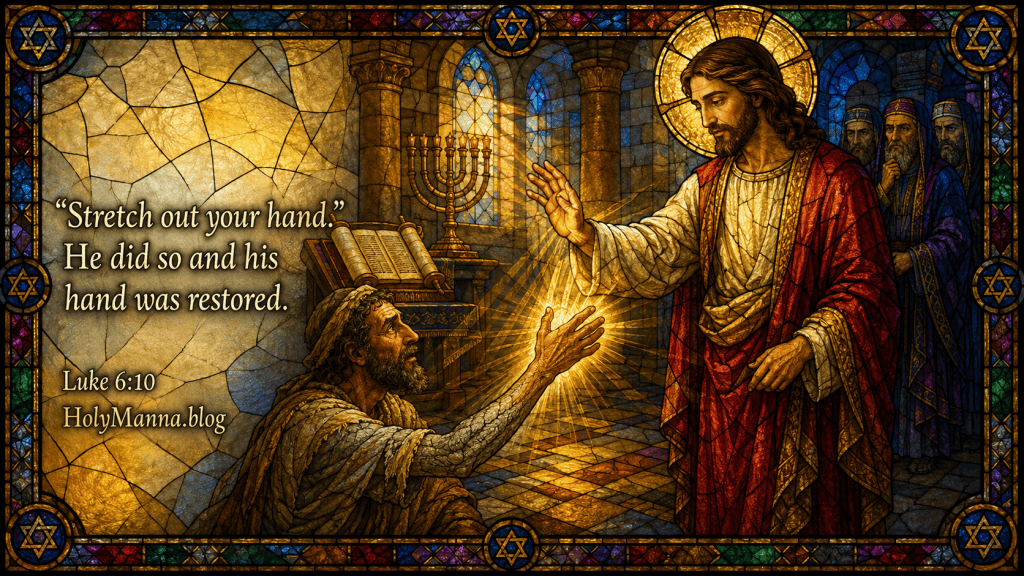
“Stretch out your hand.”
He did so and his hand was restored.
But they became enraged
and discussed together what they might do to Jesus.
Detailed Exegesis
Verse 6: On a certain sabbath Jesus went into the synagogue and taught, and there was a man there whose right hand was withered.
Jesus is doing what He always does on the sabbath, teaching in the synagogue, which shows His reverence for the day. The man is unnamed and silent, asking for nothing. His need is visible to everyone, and Luke’s precision about the right hand underlines how much he has lost.
Verse 7: The scribes and the Pharisees watched him closely to see if he would cure on the sabbath so that they might discover a reason to accuse him.
The verb for watching closely carries a sense of hostile surveillance. The scribes and Pharisees are present at worship, yet their hearts are building a case. The psalm’s warning about the deceitful comes to life. They already assume Jesus will heal, which is itself an admission of His power.
Verse 8: But he realized their intentions and said to the man with the withered hand, “Come up and stand before us.” And he rose and stood there.
Jesus knows their thoughts, a recurring sign in Luke of His divine insight. Instead of healing quietly, He makes the man stand in full view. Mercy will not be done in secret as though it were shameful. The man’s rising is itself an act of faith, since he is now exposed to the same hostile eyes.
Verse 9: Then Jesus said to them, “I ask you, is it lawful to do good on the sabbath rather than to do evil, to save life rather than to destroy it?”
The question reframes everything. The sabbath was given as a memorial of creation in Exodus 20:8-11 and of liberation from slavery in Deuteronomy 5:12-15. A day rooted in God’s life-giving work cannot forbid good. The second half of the question is pointed: to refuse good when it is possible is already a kind of evil, and the ones plotting destruction are in the room.
Verse 10: Looking around at them all, he then said to him, “Stretch out your hand.” He did so and his hand was restored.
The parallel in Mark 3:5 records that this look was one of anger and grief at their hardness of heart. Jesus performs no action that could be called work. He speaks, the man obeys, and the hand is restored. The healing comes through a command that requires cooperation, a pattern that runs through the whole spiritual life.
Verse 11: But they became enraged and discussed together what they might do to Jesus.
Luke’s word suggests a fury bordering on madness. A man has just been healed before their eyes, and their response is rage. Mark 3:6 adds that they conspired with the Herodians. The sabbath meant for saving life ends with a plot to destroy it.
Teachings
The Catechism cites this very episode when it explains the sabbath. CCC 2173 teaches: The Gospel reports many incidents when Jesus was accused of violating the sabbath law. But Jesus never fails to respect the holiness of this day. He gives this law its authentic and authoritative interpretation: “The sabbath was made for man, not man for the sabbath.” With compassion, Christ declares the sabbath for doing good rather than harm, for saving life rather than killing. The sabbath is the day of the Lord of mercies and a day to honor God. “The Son of Man is lord even of the sabbath.”
The Catechism also explains why doing good belongs to the day. CCC 2172 states: God’s action is the model for human action. If God “rested and was refreshed” on the seventh day, man too ought to “rest” and should let others, especially the poor, “be refreshed.” For Christians this passes to Sunday. CCC 2186 teaches: Sunday is traditionally consecrated by Christian piety to good works and humble service of the sick, the infirm, and the elderly. St. John Paul II developed the same idea in his apostolic letter Dies Domini, describing Sunday as a day on which the Eucharist overflows into charity, so that rest from work becomes freedom for mercy.
St. Ambrose, in his Exposition of the Gospel of Luke, offers a spiritual reading of the command to stretch out the hand. In his interpretation, paraphrased here, the hand withered by greed and withholding is healed when it is stretched out toward the poor, toward the neighbor in need, and toward God in prayer. The remedy Christ prescribes in the synagogue is the remedy He prescribes for everyone: open the hand.
The plot that closes the reading is also explained. CCC 574 observes: From the beginning of Jesus’ public ministry, certain Pharisees and partisans of Herod together with priests and scribes agreed together to destroy him. And CCC 1503 reveals what the watchers missed: Christ’s compassion toward the sick and his many healings of every kind of infirmity are a resplendent sign that “God has visited his people” and that the Kingdom of God is close at hand. The healing was not a violation. It was a visitation.
Reflection
Everyone in this story has a place: the man called into the open, the watchers who came to worship carrying a grudge, and Jesus, who refuses to let fear of accusation stop Him from doing good.
Begin with the withered hand. What part of your capacity to give, to forgive, or to serve has quietly dried up, and what would it cost to stretch it out in front of others? Healing in this Gospel required standing up in public. Sometimes the first stretch is an apology, a phone call, or a confession that has been put off for months.
Then examine the watchers. It is possible to attend Mass every Sunday while keeping a file of everyone else’s failures. Is there anyone you have been watching in order to accuse rather than in order to help?
Finally, follow Jesus into Sunday. Choose one act of good this Sunday that costs something: visit someone who is sick, call someone who is lonely, feed someone who is hungry. If Jesus asked you whether it is lawful to do good on the Lord’s Day, what would your calendar answer?
Unleavened, Restored, and Sent
The readings for September 7th tell one story from three angles. In Corinth, a community full of pride has let a single scandal spread like yeast through the dough, and Paul calls them back to sorrow, to discipline offered for the sake of salvation, and to the feast of sincerity and truth that Christ the Paschal Lamb has already made possible. In Psalm 5, a believer rises at dawn and confesses that arrogance and deceit cannot stand before God, while those who take refuge in Him are given nothing less than God Himself as their joy. In a Galilean synagogue, Jesus stands a wounded man in the open, asks whether the sabbath exists for good or for evil, and restores a withered hand while the guardians of the Law plot His death.
The counterfeit is the same in every reading. It is the religion that boasts about tolerance, that hides deceit behind respectability, that keeps every rule while refusing to do good. The real thing is also the same. It grieves over sin, clears out what corrupts, tells the truth, stretches out the hand, and celebrates the feast without fear.
Christ has already been sacrificed. The old yeast has already been declared powerless. The hand has already been commanded to stretch out. What remains is the response of a free heart on an ordinary Monday: a lamp carried through the rooms of the soul, a truth spoken plainly, a hand opened toward the poor, and a life lived as a celebration of the Lamb. The feast is set. The bread is fresh. The Lord of the sabbath is waiting to do good.
Engage With Us!
Share your reflections in the comments below and let the HolyManna community learn from your walk with the Lord this week.
- In 1 Corinthians 5:1-8, St. Paul warns that a little yeast leavens all the dough and calls the community to celebrate the feast with sincerity and truth. What old yeast is the Lord asking you to clear out of your life or your community, and what would celebrating the feast honestly look like for you this week?
- In Psalm 5:5-7, 12, the psalmist confesses that the arrogant and the deceitful cannot stand in God’s sight, while those who take refuge in Him rejoice. Where do you need to exchange self-reliance or a shaded version of the truth for genuine refuge in God?
- In Luke 6:6-11, Jesus tells the man to stretch out his withered hand in front of everyone, and the scribes and Pharisees respond with rage. Which do you relate to more right now, the man who must risk exposure to be healed or the watchers with an accusation ready, and what is Jesus inviting you to do about it?
- All three readings expose a counterfeit holiness that boasts, hides, and schemes, and reveal a true holiness that grieves, tells the truth, and does good. What is one concrete way you can choose the real thing over the counterfeit before next Sunday?
Living a life of faith is not about looking flawless before others. It is about letting the Lamb who was sacrificed clear out the old yeast, letting the God who abhors deceit lead in His justice, and letting the Lord of the sabbath restore what has withered. Go into this week doing everything with the love and mercy Jesus taught, and let every open hand be a small celebration of the feast.
Sacred Heart of Jesus, we trust in You!
Immaculate Heart of Mary, pray for us!
Saint Michael the Archangel, defend us in battle!
Follow us on YouTube, TikTok, Instagram and Facebook for more insights and reflections on living a faith-filled life.


Leave a Reply