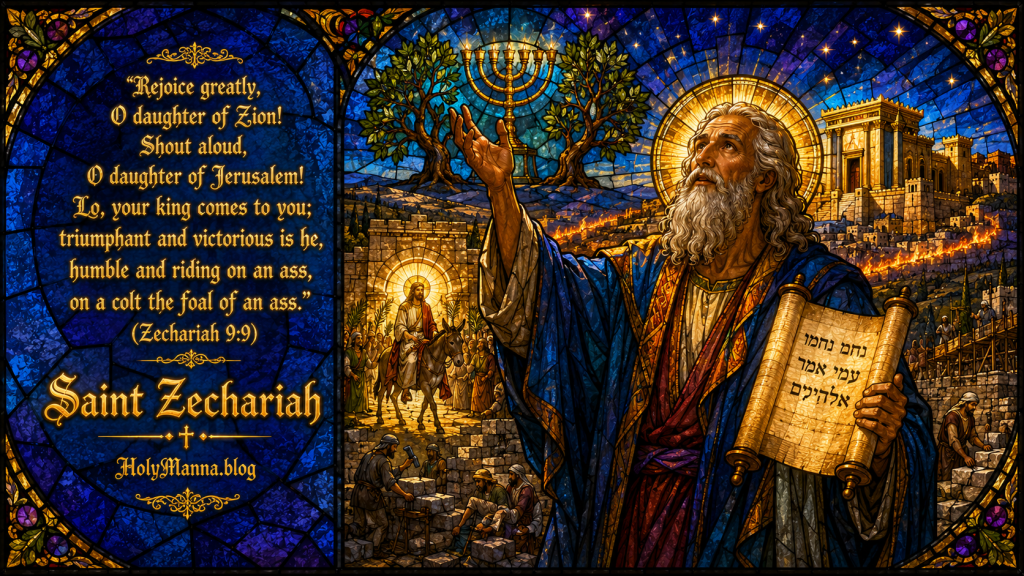
The Prophet Who Saw the Humble King
On September 6, the Roman Martyrology commemorates Saint Zechariah the prophet, the eleventh of the Twelve Minor Prophets and the traditional author of the Book of Zechariah. Right away, an important distinction needs to be made, because the name Zechariah belongs to more than one holy figure in Scripture. This is not Zechariah the priest, the father of Saint John the Baptist, whom the Church honors on September 23 together with Saint Elizabeth. Nor is this Zechariah the son of Jehoiada, the priest stoned to death in the temple court in 2 Chronicles 24. The saint of this day is the Old Testament prophet who preached to the exiles returning from Babylon around 520 BC, whose words stirred a weary people to rebuild the Temple of the Lord, and whose prophecies the Church hears fulfilled every single Palm Sunday.
That last point deserves to sink in. Every year, when the faithful raise their palm branches and the priest proclaims that the King comes “humble and riding on an ass”, the Church is praying the words of this very prophet from Zechariah 9:9. The current edition of the Roman Martyrology commemorates him precisely for this, honoring the prophet who foretold that the people would return from exile to the land of promise and who brought them the message of the king of peace, a message that Christ the Lord wondrously fulfilled by his triumphal entry into the holy city of Jerusalem.
The veneration of an Old Testament figure as a saint may surprise some readers, but it is deeply traditional. The Catechism teaches that the patriarchs, prophets, and certain other figures of the Old Testament have been and always will be honored as saints in all the Church’s liturgical traditions (CCC 61). Zechariah was never canonized in the modern sense, because no Old Testament saint was; his veneration is ancient, woven into the liturgical memory of the Church from her earliest centuries. He holds his place in the Martyrology as a commemoration rather than a feast on the General Roman Calendar, a quiet remembrance for a prophet whose whole ministry was about quiet, faithful beginnings.
Born in Exile, Called Home
Everything historically certain about Zechariah comes from Scripture itself. His book opens by identifying him as “Zechariah the son of Berechiah, son of Iddo, the prophet” (Zech 1:1), and the Book of Ezra names him alongside Haggai as one of the two prophets whose preaching carried the returned exiles through the rebuilding of the Temple (Ezra 5:1; Ezra 6:14). The Book of Nehemiah lists a Zechariah as head of the priestly house of Iddo (Neh 12:16), and on this basis the tradition of the Church has always understood him to be of priestly descent, a man who was both priest and prophet, standing in the line of Jeremiah and Ezekiel before him.
His story begins in one of the darkest chapters of Israel’s history. In 587 BC, the Babylonians destroyed Jerusalem, burned the Temple to the ground, and carried the people into exile. Zechariah was almost certainly born in Babylon during that captivity, a child of a generation that had never seen the land of promise except in the songs and tears of their parents. Then, in 538 BC, the decree of Cyrus of Persia allowed the exiles to go home, and Zechariah’s family joined the caravan that returned to Judah under Zerubbabel the governor and Joshua the high priest.
What the returning exiles found broke their hearts. Jerusalem lay in ruins. The Temple was a heap of scorched stones. The land was poor, the harvests were thin, and hostile neighbors opposed every attempt to rebuild. The people laid a foundation for a new Temple and then, worn down by opposition and discouragement, simply stopped. For nearly two decades the foundation sat there, a monument to good intentions abandoned.
Into that paralysis, God sent his word. In the second year of King Darius, 520 BC, just two months after the prophet Haggai began preaching, “the word of the LORD came to Zechariah” (Zech 1:1). His call was not a conversion in the way later saints experienced conversion, for he was raised within the covenant people; it was a summons that deepened and consecrated everything his priestly formation had prepared him for. And the very first message God gave him remains one of the most tender invitations in all of Scripture: “Return to me, says the LORD of hosts, and I will return to you” (Zech 1:3). The Catechism teaches that through the prophets, God forms his people in the hope of salvation and in the expectation of a new and everlasting covenant intended for all (CCC 64). Zechariah’s whole ministry is that teaching in action. Some traditions describe him as a young man when this call came, a reading drawn from Zechariah 2:4, while the older edition of the Roman Martyrology pictures him returning from Chaldea in his old age. The sources genuinely differ on this point, and honesty requires saying so rather than forcing them to agree.
Visions in the Night and a Temple Rising
Scripture records no healings or wonders worked by Zechariah’s hands. His miracle was of a different kind. Within four years of his first oracle, a people who had given up finished the house of God. The Second Temple was completed and dedicated in 515 BC, and the Book of Ezra states plainly that the elders of the Jews built and prospered “through the prophesying of Haggai the prophet and Zechariah the son of Iddo” (Ezra 6:14). A discouraged community rediscovered its purpose because one man kept speaking the word of God. That is worth remembering by anyone who doubts that words offered in faith can move stones.
The engine of his preaching was a series of eight visions received in a single night, filling the first six chapters of his book. He saw horsemen patrolling the earth and reporting that the nations were at rest while Jerusalem still waited for mercy. He saw four horns, the powers that had scattered Judah, and four smiths sent to strike them down. He saw a man with a measuring line, and heard that Jerusalem would one day overflow its walls, for the Lord himself would be “a wall of fire round about” her (Zech 2:5). He heard the Lord’s fierce tenderness for his people: “he who touches you touches the apple of his eye” (Zech 2:8).
The fourth vision is one of the most moving pictures of mercy in the Old Testament. Zechariah sees Joshua the high priest standing before the angel of the Lord, dressed in filthy garments, with Satan at his right hand to accuse him. And God does not entertain the accusation. “Remove the filthy garments from him… Behold, I have taken your iniquity away from you, and I will clothe you with rich apparel” (Zech 3:4). Sinful, ashamed, accused, and then clothed anew by pure grace: it is hard to read that scene and not think of the confessional. Then came the vision of the golden lampstand flanked by two olive trees, and with it the sentence that has steadied believers for twenty five centuries: “Not by might, nor by power, but by my Spirit, says the LORD of hosts” (Zech 4:6). To a people embarrassed by their modest rebuilding project, God added a gentle rebuke that doubles as a promise: “Who has despised the day of small things?” (Zech 4:10).
But Zechariah matters most because of what he saw far beyond his own century. The Catechism teaches that the coming of God’s Son to earth was an event of such immensity that God willed to prepare for it over centuries, arousing in the hearts of the pagans a dim expectation of this coming and announcing it through the prophets (CCC 522). Few prophets announced it more precisely. Zechariah foresaw a king unlike any the world expected: “Rejoice greatly, O daughter of Zion! Shout aloud, O daughter of Jerusalem! Lo, your king comes to you; triumphant and victorious is he, humble and riding on an ass, on a colt the foal of an ass” (Zech 9:9). The Gospel of Matthew quotes these words directly as Jesus enters Jerusalem on Palm Sunday (Mt 21:4 to 5), and the Catechism teaches that Jesus’ entry into Jerusalem manifested the coming of the kingdom that the Messiah King, welcomed by the children and the humble of heart, was about to accomplish, not by ruse or violence but by the humility that bears witness to the truth (CCC 559).
The prophecies keep coming, and they read like an outline of Holy Week written five hundred years early. Zechariah speaks of a shepherd valued at “thirty shekels of silver” cast into the treasury (Zech 11:12 to 13), the very price Judas took to betray the Lord (Mt 26:15). He hears God say, “Strike the shepherd, that the sheep may be scattered” (Zech 13:7), words Jesus applied to himself and his apostles on the night he was betrayed (Mt 26:31). And most piercing of all, he foresees a day of grace and supplication when “they shall look on him whom they have pierced” and mourn as one mourns for an only child (Zech 12:10), the prophecy Saint John saw fulfilled as the soldier’s lance opened the side of the crucified Christ (Jn 19:37). The Church reads these connections with confidence because she reads the two Testaments as one book with one divine author, discerning in God’s works of the Old Covenant prefigurations of what he accomplished in the fullness of time in his incarnate Son (CCC 128), for the Old Testament retains its permanent value and has never been revoked (CCC 121). Alongside the pierced one, Zechariah saw what that piercing would open: “On that day there shall be a fountain opened for the house of David and the inhabitants of Jerusalem to cleanse them from sin and uncleanness” (Zech 13:1). Christians have always heard in that fountain the waters of Baptism flowing from the wounded side of Christ.
Prophet to a Weary People
Zechariah’s hardships were not the sword and the arena of later martyrs. They were the slower trials of speaking hope to people who had stopped believing in their own future, and it would be a mistake to think those trials light. The community he served was poor, small, and surrounded. The Book of Ezra records how the peoples of the land discouraged the builders, hired counselors against them, and pressed accusations before the Persian court (Ezra 4:4 to 5), and how the governor Tattenai arrived to interrogate the elders about who had authorized their work (Ezra 5:3). Every course of stones on the Temple wall was laid under suspicion and threat.
Nor was discouragement the only enemy. Zechariah had to confront the harder problem that ruined the first Temple: hearts that performed religion while ignoring justice. When a delegation arrived asking whether the fasts of the exile should continue, God’s answer through Zechariah cut straight past ritual to conversion: “Render true judgments, show kindness and mercy each to his brother, do not oppress the widow, the fatherless, the sojourner, or the poor” (Zech 7:9 to 10). He reminded the people that their fathers had made their hearts “like adamant” against that very word (Zech 7:12), and exile was the harvest. A prophet who says such things to his own neighbors does not win easy popularity. Yet he never let the warning smother the promise. He gave the people one of the loveliest pictures of restored Jerusalem in all of Scripture, a city so safe that “old men and old women shall again sit in the streets of Jerusalem” and “the streets of the city shall be full of boys and girls playing” (Zech 8:4 to 5).
Was Zechariah martyred? The most reliable ancient tradition says no. The early Christian work known as the Lives of the Prophets records that he died in peace at an advanced age and was buried near the prophet Haggai, and the older edition of the Roman Martyrology follows this, stating that he returned from Chaldea in his old age and lies buried near Haggai. A competing tradition arose from the words of Jesus in The Gospel of Matthew, which speak of “Zechariah the son of Barachiah, whom you murdered between the sanctuary and the altar” (Mt 23:35). Because the prophet’s father was named Berechiah, some ancient readers concluded that the prophet himself was slain in the Temple. Most Catholic commentators, however, understand Jesus to be referring to Zechariah the son of Jehoiada, whose stoning in the temple court is recounted in 2 Chronicles 24:20 to 22, with the naming reflecting a conflation of the two figures that was already common. The tradition that the prophet Zechariah died a martyr cannot be verified, and the Church’s Martyrology does not present him as one. What can be said with confidence is that he persevered to the end of a long ministry, and that perseverance in gray, unglamorous faithfulness is its own crown.
A Serf’s Dream and a Tomb Beside Haggai
The veneration of Zechariah after his death is ancient, and it comes with one of the more remarkable relic stories of the early Church. The fifth century church historian Sozomen, writing in his Ecclesiastical History, recounts that around the year 415, during the reign of the pious emperor Theodosius II, the relics of the prophet Zechariah were discovered at Caphar-Zechariah, a village in the territory of Eleutheropolis in Palestine. According to the story, the prophet appeared in a dream to a serf named Calemerus, a man Sozomen frankly describes as hard and unjust toward his neighbors, and directed him to dig at a precise spot in a garden. There Calemerus found a double coffin, wood within lead, and beneath the coffin the body of the prophet, which Sozomen reports was found wonderfully preserved despite the centuries, clothed in a white garment. At the prophet’s feet lay the body of a child arrayed in royal ornaments, a detail that puzzled everyone until, Sozomen says, an ancient Hebrew writing outside the canon of Scripture was produced to explain it. It is a vivid and genuinely early account, recorded by a serious historian within living memory of the event. Yet the identification of the body as Zechariah the minor prophet has been questioned since antiquity, and elements of the story seem colored by the ancient confusion among the several Zechariahs of Scripture. This story cannot be verified.
Pilgrims to the Holy Land have long venerated the prophet’s memory on the Mount of Olives, where a catacomb known as the Tomb of the Prophets is held by tradition to be the resting place of Haggai, Zechariah, and Malachi, the last three of the Minor Prophets. The tradition echoes the ancient report that Zechariah was buried beside Haggai, though the identification of the site cannot be verified. Visitors to Jerusalem will also encounter a striking rock-cut monument in the Kidron Valley popularly called the Tomb of Zechariah, but Jewish tradition associates that monument with Zechariah the son of Jehoiada, and it should not be confused with the burial place of the prophet.
His deepest impact after death, though, is not carved in rock but sung in the liturgy. Every Palm Sunday the whole Catholic world takes up his prophecy of the humble king. Every celebration of the Passion echoes his thirty pieces of silver, his stricken shepherd, his pierced one, his opened fountain. Artists have honored him accordingly; Michelangelo painted the prophet Zechariah in a place of extraordinary prominence in the Sistine Chapel, directly above the entrance wall, an old man absorbed in his book, as if still searching his own visions for the King they promised. The Eastern churches commemorate him as well, keeping his memory on February 8. Few figures so obscure in life have been given so loud a voice in the Church’s worship.
The Day of Small Things
Zechariah’s life speaks with almost embarrassing directness to the present moment. He preached to people who felt they had arrived too late, that the glory days belonged to an earlier generation, that their resources were too small and their ruins too large. Anyone who has looked at their own spiritual life, their family, their parish, or their culture and quietly concluded that rebuilding is hopeless already knows the mood of Jerusalem in 520 BC. Into exactly that mood God spoke: “Return to me, says the LORD of hosts, and I will return to you” (Zech 1:3). The Catechism teaches that Christ’s call to conversion continues to resound in the lives of Christians, and that this second conversion is an uninterrupted task for the whole Church (CCC 1428). Returning is not a one-time event. It is the daily rhythm of a Catholic life, and the sacrament of Reconciliation is where the filthy garments come off and the clean ones go on, just as Zechariah saw happen to Joshua the high priest.
His great sentence is a permanent examination of conscience: “Not by might, nor by power, but by my Spirit, says the LORD of hosts” (Zech 4:6). How much of daily anxiety comes from acting as though everything depends on personal strength, cleverness, and control? Zechariah does not counsel passivity; the man spent his ministry getting a building project finished. He counsels dependence, work done with hands open to grace rather than fists clenched around outcomes. And his question to the embarrassed builders remains a question for every believer tempted to despise modest beginnings: “Who has despised the day of small things?” (Zech 4:10). A rosary prayed in the car, a Mass attended on a random Tuesday, one honest confession, one kind word to the coworker nobody likes: these are foundation stones, and heaven does not despise them. Which small, faithful practice, begun this week, would God multiply over a lifetime?
Finally, Zechariah teaches how to recognize the true King. The world in every age expects power to arrive on a warhorse, and God keeps arriving on a donkey. The prophet foresaw a people of the humble and the lowly who await their Messiah in poverty of spirit, the hidden hope the Catechism calls the People of the poor (CCC 716). Emulating Zechariah means practicing that kind of vision: looking for Christ in humility, in the Eucharistic host that seems so small, in the neighbor who seems so ordinary, in the pierced one upon whom the world still looks. Where might the humble King be entering daily life quietly, waiting to be welcomed with palms rather than overlooked?
Engage With Us!
Saint Zechariah spent his life convincing discouraged people that God was not finished with them, and his words still carry that power today. Share your thoughts and reflections in the comments below; your experience of rebuilding, returning, and trusting God in the day of small things may be exactly the encouragement another reader needs. Consider these questions as a starting point:
- What “ruined temple” in your life, a habit of prayer, a relationship, a commitment, has been waiting years for you to resume building?
- When you hear the words “Return to me, and I will return to you,” what is the first step of return that comes to mind, and what has been delaying it?
- Where are you relying on might and power in a situation that God is inviting you to surrender to his Spirit?
- Zechariah saw the high priest’s filthy garments replaced by grace rather than condemnation. How might that image change the way you approach the sacrament of Reconciliation?
- This Palm Sunday, when you hear Zechariah’s prophecy of the humble King proclaimed, what will you ask Jesus for as he enters your Jerusalem?
The prophet who once steadied a weary remnant now cheers on every soul laying small stones in faith. Do not despise the day of small things in your own life. Return to the Lord daily, lean on his Spirit rather than your own strength, and welcome the humble King wherever he chooses to enter. And in everything, at home, at work, and in the quiet rebuilding only God sees, act with the love and mercy that Jesus taught us.
Saint Zechariah, pray for us!
Follow us on YouTube, TikTok, Instagram and Facebook for more insights and reflections on living a faith-filled life.


Leave a Reply