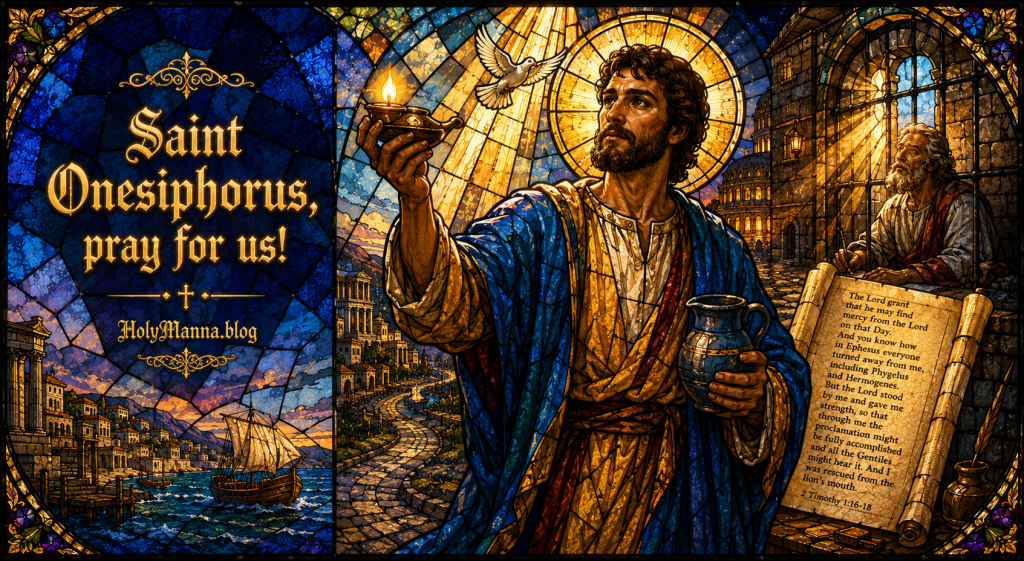
The Friend Who Showed Up
Some saints left behind monasteries, theological masterpieces, and miracle accounts that fill entire volumes. Saint Onesiphorus, commemorated by the Church on September 6, left behind four verses of Scripture. Yet those four verses, written by Saint Paul from a Roman prison near the end of his life, have carried the memory of this quiet Ephesian layman across nearly two thousand years, and they contain one of the most tender tributes any friend has ever received. Paul, abandoned by nearly everyone he had counted on, wrote to Timothy: “The Lord give mercy to the house of Onesiphorus: because he hath often refreshed me, and hath not been ashamed of my chain: But when he was come to Rome, he carefully sought me, and found me” (2 Timothy 1:16 to 17).
The name Onesiphorus means “profit-bringer” in Greek, the one who brings benefit, and rarely has a name fit a man so perfectly. He appears in the Martyrologium Romanum on September 6, where the Church commemorates him in words drawn straight from Saint Paul: the man who refreshed the Apostle at Ephesus, who was not ashamed of his chain, and who journeyed to Rome, sought him diligently, and found him. Later tradition also honors him as a martyr, and Christians of both East and West have venerated him for centuries as one of the earliest heroes of the faith.
Onesiphorus matters because he shows what holiness looks like when it has no spotlight. He preached no recorded sermon. He worked no recorded miracle. Not a single word of his own survives. What survives is what he did, and what he did was show up for a suffering brother when showing up was dangerous, costly, and unrewarded. The Catechism teaches that “all Christians in any state or walk of life are called to the fullness of Christian life and to the perfection of charity” (CCC 2013). Onesiphorus reached that fullness not through extraordinary gifts but through extraordinary fidelity, and that is precisely why every ordinary believer should know his name.
An Ephesian Household in the First Generation of Faith
Almost nothing is documented about the early life of Onesiphorus. Scripture does not record his birthplace, his parents, his trade, or the moment of his conversion. What Scripture does establish is that he was a Christian of Ephesus, the great port city of Asia Minor, and that he was the head of a household, since Paul twice sends greetings and blessings to “the household of Onesiphorus” (2 Timothy 4:19). A household in the ancient world meant far more than a nuclear family; it embraced wife, children, relatives, servants, and dependents, all under the care of one man. Onesiphorus was responsible for many souls, and the way Paul speaks of his household suggests that it was a believing one, an early example of what the Church would later call the family as “a domestic church” (CCC 1656).
His conversion almost certainly belongs to the great Ephesian mission described in The Acts of the Apostles, chapter 19, when Paul spent roughly three years in the city, preaching daily until, as Saint Luke records, all the residents of Asia heard the word of the Lord. Paul reminds Timothy, who knew Ephesus intimately, of everything Onesiphorus had done there: “and in how many things he ministered unto me at Ephesus, thou very well knowest” (2 Timothy 1:18). The most natural reading is that Onesiphorus was among Paul’s own converts or close collaborators during those years, a man whose service was so constant and so public that Timothy needed no reminder of it. That reading is an inference from Scripture rather than an explicit statement, and honesty requires saying so, but it is the inference the text itself invites.
A separate and much later thread of tradition adds color that cannot be confirmed. The second century apocryphal writing known as The Acts of Paul and Thecla tells of a man named Onesiphorus living in Iconium who, hearing that Paul was approaching the city, went out along the road with his wife Lectra and his sons to meet the Apostle and welcome him into his home. In that story, Onesiphorus had never seen Paul in the flesh and recognized him only from a description, which is how the ancient world received its most famous portrait of the Apostle: “a man little of stature, thin-haired upon the head, crooked in the legs, of good state of body, with eyebrows joining” (The Acts of Paul and Thecla). It is a vivid and charming story, and it shows how deeply the memory of Onesiphorus as the great host and helper of Paul had entered Christian imagination. Yet the work is apocryphal, Tertullian records that the presbyter who composed it was removed from office for doing so, and there is no way to establish that the Onesiphorus of Iconium in this tale is the historical Onesiphorus of Ephesus. This story cannot be verified.
Eastern Christian tradition further counts Onesiphorus among the seventy disciples sent out by the Lord in The Gospel of Luke, chapter 10, and remembers him as bishop of Colophon in Asia Minor and later of Corinth, with some older sources naming the see as Coronia instead. These traditions are ancient and venerable, but they rest on no contemporary documentation, and they too cannot be verified.
The Ministry of Refreshment
No miracles are recorded of Onesiphorus during his lifetime, and it would dishonor him to invent any. His greatness lies elsewhere, in a form of sanctity that Scripture documents with unusual precision: the sanctity of presence.
The setting is Paul’s final imprisonment in Rome, most likely during the persecution unleashed by Nero in the mid sixties of the first century. This was not the relatively comfortable house arrest described at the end of The Acts of the Apostles, where Paul received visitors freely. This time Paul writes as a condemned man awaiting execution, and the letter trembles with abandonment. “Thou knowest this, that all they who are in Asia are turned away from me: of whom are Phigellus and Hermogenes” (2 Timothy 1:15). Later in the same letter he adds that Demas had deserted him for love of this present world, and that at his first defense no one stood by him. The greatest missionary in the history of the Church sat in chains, and the churches he had planted went silent.
Into that silence walked Onesiphorus. Consider what each phrase of Paul’s tribute actually cost. He “hath often refreshed me”: the Greek verb carries the sense of cooling and reviving, like fresh air breaking into a stifling room, and the word “often” means this was no single gesture but a sustained campaign of visits, provisions, encouragement, and companionship. He “hath not been ashamed of my chain”: in Roman society, association with a condemned prisoner brought social disgrace and, under Nero, real legal danger, since befriending an enemy of the state could make a man a suspect himself. Paul, who wrote to the Romans “For I am not ashamed of the gospel” (Romans 1:16), found in Onesiphorus a layman who was not ashamed of the Gospel’s prisoner. And “he carefully sought me, and found me”: Rome held perhaps a million people, prisoners were deliberately hard to trace, and asking too many questions about an enemy of Caesar was itself perilous. The searching took time, money, courage, and stubborn love. He kept knocking on doors until one of them opened onto Paul’s cell.
This is precisely the pattern of mercy that Our Lord promises to reward at the judgment: “I was in prison, and you came to me” (The Gospel of Matthew 25:36). The Catechism teaches that “the works of mercy are charitable actions by which we come to the aid of our neighbor in his spiritual and bodily necessities” (CCC 2447), and it lists visiting the imprisoned among the corporal works of mercy. Onesiphorus performed that work not once but habitually, in two cities, across many years, for the most dangerous prisoner in the Empire. The reader should remember him and emulate him because he proves that the raw material of sainthood is available to absolutely everyone. Not everyone can preach to nations. Everyone can refuse to abandon a suffering friend.
Chains, Wild Horses, and a Costly Fidelity
Scripture documents the risks Onesiphorus embraced; tradition tells of the price he ultimately paid. The two must be carefully distinguished.
What is documented is the danger itself. Every visit to Paul’s cell placed Onesiphorus within reach of the same imperial machinery that would soon behead the Apostle. Nero’s persecution was arbitrary and savage, and Christians in Rome were being executed as public entertainment. A provincial visitor persistently seeking access to a high profile Christian prisoner was volunteering for scrutiny that most believers, including apparently the whole Roman church at Paul’s first hearing, dared not risk. Whatever else can be said of Onesiphorus, Scripture itself establishes that he walked willingly and repeatedly into the shadow of martyrdom. His hardship was the slow, grinding kind: the fear managed daily, the reputation spent, the household left behind in Ephesus while he served in Rome.
What tradition adds is a martyr’s death. Earlier editions of the Roman Martyrology, the Church’s official register of saints as it stood before the 2004 revision, recounted that Onesiphorus, a disciple of the Apostles, was seized in the region of the Hellespont together with a companion named Porphyrius, that both were severely scourged by order of a proconsul named Hadrian, and that they were then bound to wild horses and dragged until they died. The traditional site of this martyrdom is Parium, a coastal city on the Hellespont not far from ancient Troy. Christians of the East preserve the same account and honor the two martyrs together.
Honesty requires several flags here. The dating is contested: one strand of tradition places the martyrdom under the Emperor Domitian toward the end of the first century, while another places the death of a martyr of this name in the same region between roughly the years 102 and 114, under Trajan. The current 2004 edition of the Martyrologium Romanum is more reserved still; it commemorates Onesiphorus on September 6 solely in the words of Scripture, as the man who refreshed Paul and sought him out in Rome, and it makes no mention of martyrdom at all. The martyrdom account is therefore a tradition, ancient and widely received, but it cannot be verified. What needs no verification is the disposition it describes, because Scripture already shows a man who had counted the cost of loyalty to Christ’s prisoner and paid it gladly. Whether God asked of him the final installment at Parium, the down payment was made in Rome.
The Prayer That Echoes Through the Centuries
No miracles are recorded through the intercession of Saint Onesiphorus after his death, no relics are enshrined in a great basilica, and no famous pilgrimage bears his name. It would be false to claim otherwise. And yet few obscure saints have had a greater quiet impact on Catholic theology and prayer, because of a single haunting detail in Paul’s letter.
Read the passage again with care. Paul prays for mercy upon “the house of Onesiphorus”, and at the letter’s close he greets “the household of Onesiphorus”, but he never greets the man himself. For Onesiphorus personally, Paul offers instead a prayer directed toward eternity: “The Lord grant unto him to find mercy of the Lord in that day” (2 Timothy 1:18), “that day” being, in Paul’s vocabulary, the day of judgment. Since antiquity, many readers have drawn the natural conclusion: Onesiphorus had died between his ministry to Paul and the writing of the letter, and Paul was praying for the soul of his departed friend. If that reading is correct, then 2 Timothy 1:18 preserves one of the earliest recorded Christian prayers for a dead believer, written by an Apostle under divine inspiration. Honesty requires noting that Scripture never states outright that Onesiphorus had died, and some interpreters, particularly those uncomfortable with prayer for the dead, resist the inference. The inference remains strong, but it is an inference, and the reader deserves to know the difference.
What is certain is that the practice this verse suggests stands at the heart of Catholic faith. Already in the Old Testament, Judas Maccabeus offered sacrifice for fallen soldiers, and Scripture comments: “It is therefore a holy and wholesome thought to pray for the dead, that they may be loosed from sins” (2 Maccabees 12:46). The Catechism teaches that “from the beginning the Church has honored the memory of the dead and offered prayers in suffrage for them” (CCC 1032), and it adds concerning the faithful departed that “our prayer for them is capable not only of helping them, but also of making their intercession for us effective” (CCC 958). The communion of saints means that death does not sever the bonds of charity between believers (CCC 946 to 948). Onesiphorus refreshed Paul in his chains; Paul, in turn, refreshed Onesiphorus with prayer that reached beyond the grave. Each man served the other on a different side of death, and the Church has been imitating both of them ever since.
His veneration endured in both halves of Christendom. The Latin Church has long commemorated him on September 6, where he still stands in the 2004 Martyrologium Romanum. The Byzantine East honors him on September 7 and again among the seventy disciples, and he appears in the great illuminated Menologion of the Emperor Basil II, depicted among the companions of the Apostles. The traditions that make him a bishop of Colophon and later of Corinth, mentioned earlier, shaped his memory in the East, though they cannot be verified. His truest monument, however, is neither icon nor calendar entry but the canon of Scripture itself, where his name is proclaimed aloud whenever 2 Timothy is read at Holy Mass, a layman’s kindness made part of the inspired Word of God until the end of time.
Refreshing People in an Age of Disappearing
The world of Onesiphorus was full of people turning away. Phygelus and Hermogenes turned away. Demas turned away. An entire province turned away. The modern world has made turning away easier still; a friendship can now be ended by simply ceasing to answer, a suffering person can be quietly muted, and a difficult season in someone’s life can be waited out from a safe distance. Against all of that stands this one Ephesian householder who bought passage on a ship, crossed the sea, and knocked on doors in a hostile capital until he found his friend in chains.
The application is direct. Somewhere in every life there is a person in some kind of prison: a hospital room, a season of grief, a struggle with sin, a stretch of unemployment, a mental health battle, a loneliness that no one has bothered to notice. Onesiphorus teaches that the Christian response is not a sympathetic thought but a diligent search. He sought Paul carefully, the text says, and found him. Who in your life right now would take real effort to seek out, and what has been stopping you? The saint also teaches shamelessness of the right kind. He was not ashamed of a chain that made others cross the street. Is there a suffering or unpopular person you have quietly kept your distance from because association felt costly?
His witness extends to the dead as well. If Paul’s prayer for Onesiphorus is the pattern, then love does not fall silent at the grave. Praying for deceased parents, grandparents, friends, and even forgotten souls, especially by having Masses offered for them, continues exactly the exchange of refreshment that this saint’s story models (CCC 1032). When did you last pray by name for someone who has died? And his household offers one more lesson: holiness in him was not a private achievement but something that blessed everyone under his roof, so that Paul could invoke mercy on the whole house because of one man’s fidelity. A single family member who quietly decides to show up for people can reorient an entire home toward Christ. What would change in your household if you became its Onesiphorus?
Engage With Us!
Saint Onesiphorus never expected to be remembered, and that is exactly why he is worth remembering. Share your thoughts and reflections in the comments below; stories of a friend who refreshed you in a hard season, or of a time when showing up cost something, would encourage every reader here. To go deeper, consider these questions:
- Paul names the people who abandoned him and the one man who did not. Which list would the people in your life place you on, honestly, and why?
- Onesiphorus refreshed Paul “often,” not once. What is one concrete, repeatable act of presence you could commit to this month for someone who is struggling?
- He was “not ashamed” of Paul’s chain. Where does human respect currently keep you from standing openly with Christ or with one of His suffering members?
- Paul prayed that Onesiphorus would find mercy “in that day.” Which departed souls has God placed in your care, and how will you pray for them this week?
- No words of Onesiphorus survive, only his deeds. If your words all vanished and only your actions remained, what would they say about your faith?
The saints prove that heaven is not reserved for the famous. It is reserved for the faithful, and fidelity is built one visit, one prayer, and one unashamed act of love at a time. Go and be someone’s refreshment this week. Seek out the person everyone else has stopped seeking, stay when staying is uncomfortable, and pray for the living and the dead with equal confidence, doing everything with the love and mercy that Jesus taught us.
Saint Onesiphorus, pray for us!
Follow us on YouTube, TikTok, Instagram and Facebook for more insights and reflections on living a faith-filled life.


Leave a Reply