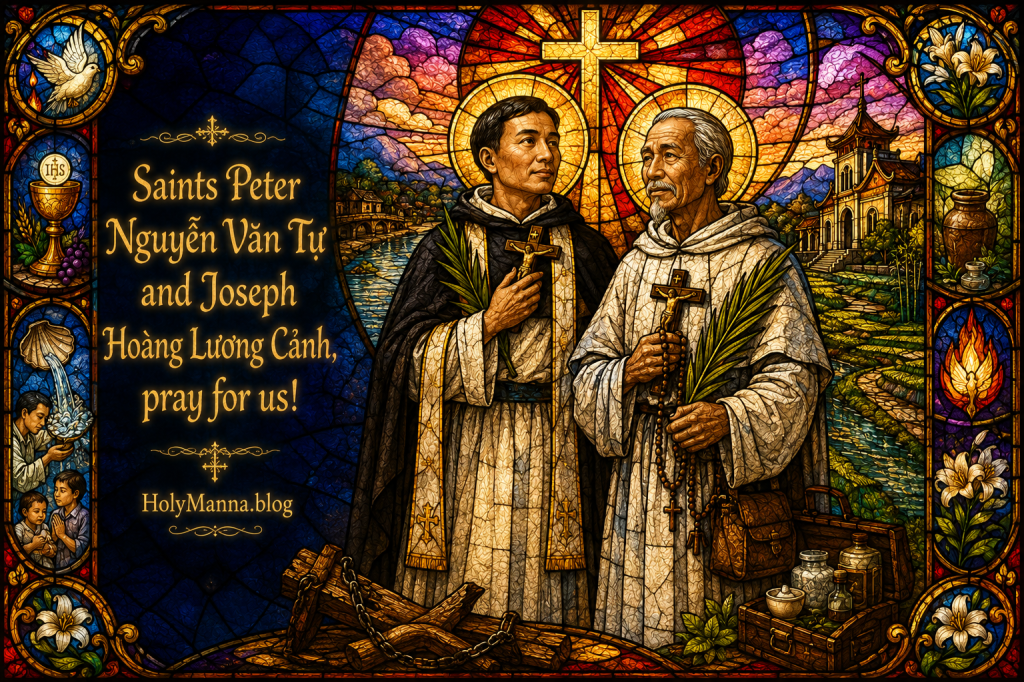
When the Rice Fields Held a Hidden Church
On the morning of September 5, 1838, two men walked out of the prison of Bắc Ninh in northern Vietnam wearing the white of Saint Dominic. The first was a priest of forty-two, tall, composed, holding a small crucifix he had kissed countless times in his cell. The second was a village doctor of about seventy-five, bent under the wooden cangue locked around his neck, cradling a crucifix of his own. The younger man was Father Peter Nguyễn Văn Tự, a priest of the Order of Preachers. The older man was Joseph Hoàng Lương Cảnh, a lay physician, a Dominican tertiary, and the elected head of his little Christian community. Before the sun was high, both had been beheaded at the execution ground of Cổ Mễ, and heaven had received two of the most luminous witnesses of the Church in Vietnam.
The Church honors them together because they died together, a priest and a layman, a shepherd and one of his flock, joined in a single confession of faith. The Roman Martyrology for September 5th commemorates “the holy martyrs Peter Nguyễn Van Tự, priest of the Order of Preachers, and Joseph Hoang Luong Canh, physician, who were beheaded in hatred of the Christian name.” Pope Leo XIII beatified them on May 27, 1900, and Pope Saint John Paul II canonized them on June 19, 1988 among the 117 Martyrs of Vietnam, whose collective feast falls on November 24th. The Catechism teaches why the Church treasures such deaths: “Martyrdom is the supreme witness given to the truth of the faith: it means bearing witness even unto death” (CCC 2473). Everything else in their story is a commentary on that single sentence.
A Boy of Ninh Cường and an Old Healer of Thổ Hà
Peter Nguyễn Văn Tự was born around 1796 in the village of Ninh Cường in Nam Định province, in the region of northern Vietnam then called Tonkin, a land where the Gospel had taken root in the seventeenth century and had been watered by persecution ever since. His family gave him to the Church while he was still a boy. He lived in the parish house, showed unusual diligence in both work and study, and won the trust of his superiors. At about thirty years of age, in 1826, he was ordained a priest, and within months he asked to enter the Order of Preachers, the Dominicans who had long served the missions of eastern Tonkin. He made his religious profession in January 1827; the surviving records differ on whether the exact day was the fourth or the fourteenth of that month. For roughly twelve years he poured himself out for the faithful of one parish after another. The witnesses gathered for his cause spoke of a priest of remarkable charity whose life was a continuous prayer, a man the faithful could always find, as the accounts put it, in intimate conversation with God and wholeheartedly in love with his priesthood.
Joseph Hoàng Lương Cảnh belonged to the generation before him. He was born about 1763 in the village of Vạn near Bắc Ninh; some registries place his birth as late as 1765, and the sources do not fully agree. He spent his life in the neighboring village of Thổ Hà, a settlement of potters and rice farmers on the banks of the Cầu River. As a boy he was formed by an elderly priest, Father Huy, who taught him both the life of virtue and the art of traditional medicine. Cảnh married a devout Catholic woman from Thọ Bá, and the two encouraged one another in holiness within an ordinary family home. He became a thầy lang, a traditional healer, famous for his gentleness, for family remedies that served especially women and children, and for one habit that tells you everything about the man: he treated the poor for free. His neighbors so trusted him that they elected him trùm họ, the lay head of the Thổ Hà Christian community, and he bound himself more deeply to the Church by professing as a member of the Third Order of Saint Dominic. Those who knew him said that prayer was like his breathing. Whenever his hands were free, the Rosary was in them.
Neither man experienced a dramatic conversion, and that is worth pausing over. Their stories are not about a single blinding moment but about fidelity deepened year after year, the boy who stayed in the parish house, the healer who kept praying between patients. The Catechism calls this the universal vocation to holiness, in which all the faithful, “by leading a morally good life,” as the Church teaches of the laity’s witness, sanctify the world from within (CCC 898, CCC 2013). Long before either man faced a sword, both had already given their lives away.
Medicine for the Body, Baptism for the Soul
Father Tự’s greatness during life was the hidden greatness of a missionary priest under persecution. Emperor Minh Mạng, who reigned from 1820 to 1841, had outlawed the Christian faith, and the priests of Tonkin lived like hunted men, celebrating the sacraments in garden hideouts, moving by night, sheltered by families who risked everything to keep them. The Catechism explains what those families understood in their bones: the priest is not merely a religious functionary but acts “in persona Christi Capitis”, in the person of Christ the Head, so that through him Christ himself teaches, forgives, and feeds his people (CCC 1548). To hide a priest was to hide the sacraments themselves. In early 1838 his superiors sent Father Tự to the parish of Kẻ Mốt, also called Đức Trai, where the head of the parish, a man named Quang, concealed him in a dense garden of banana and betel ringed by bamboo. When danger pressed closer, a widow named Thảo took him in with words the accounts have preserved: “Come in and stay, Father; I would rather die than abandon you.”
Doctor Cảnh’s greatness was equally quiet and, in its way, even more striking, because he was a layman with a family, a practice, and every excuse to keep his head down. Instead he made his medicine an apostolate. Because his remedies served the dying, and especially dying infants, he was often the last person to reach a child before death, and there, again and again, he did what the Church has always taught any of the faithful may do in necessity: he baptized. The Catechism teaches that “in case of necessity, anyone, even a non-baptized person, with the required intention, can baptize”, because God wills the salvation of all (CCC 1256, CCC 1261). The old healer of Thổ Hà carried eternal life in his medicine bag. His care for the sick poor was a living page from the Church’s teaching on the works of mercy, which are “charitable actions by which we come to the aid of our neighbor in his spiritual and bodily necessities” (CCC 2447). Healing bodies, baptizing souls, leading his community in prayer, he shows what the Catechism means when it says the laity are called to be the Church’s presence in the middle of ordinary life (CCC 899).
No miracles in the strict sense are recorded of either man during his lifetime. Their wonder was of another kind, the daily miracle of grace made visible in perseverance, and it prepared them for the hour when God would ask for everything.
The Cross They Would Not Trample
In 1838 the persecution reached both men within days of each other. Because everyone in Kẻ Mốt was Catholic, the mandarins reasoned that a priest must be hidden there, and on June 29, 1838 soldiers surrounded the village. They found rosaries, images, and vestments, but not the priest. Under beatings, a local physician named Ninh broke and revealed where Father Tự was hidden, and two men of the village completed the betrayal with a lie, luring the priest from his shelter with the promise of a safer refuge. In the first days of July he was seized along with his catechist, Dominic Bùi Văn Úy, who had built the hiding place and slept above it, hoping the soldiers would take him first. When his captors offered to release him for silver, Father Tự refused: “God has granted me the grace of confessing Him; I will not flee again.”
That same July, in Thổ Hà, a village notable named Hương Bích, jealous of the love the people bore their old parish head, secretly denounced Cảnh for sheltering priests. Knowing nothing of the accusation, the doctor received a call to treat a sick baby and baptize it. He knew perfectly well what such an errand could cost in a time of persecution, and he went anyway, to save a soul. Soldiers seized him at the Thổ Hà ferry landing, locked the cangue on his seventy-five-year-old neck, and marched him to the Bắc Ninh prison, where he was chained alongside Father Tự, the catechist Úy, three other parish heads, and a layman.
What followed over the next two months is one of the most fully documented confessions of faith in the records of the Vietnamese Martyrs, preserved in the contemporary report of Bishop Marti and the testimonies of the cause. The mandarins’ method was always the same: step over the crucifix and go free. On July 12, 1838 the prisoners were lined up before the image of the crucified Lord. Several, worn down by fear and the lash, stepped over it. The old doctor knelt down and kissed it. Father Tự embraced it and declared: “I am a priest; I will never trample upon the Cross, for it is the sign God chose for the redemption of mankind. If the mandarin releases me, I live; if not, I am ready to die.” His words echo the faith of the Church, which confesses that by his Cross “Jesus substituted his obedience for our disobedience” and won the redemption of mankind precisely there (CCC 615, CCC 617). Back in the prison, the priest reminded his fellow captives of the Lord’s own warning in The Gospel of Matthew: “Whoever denies me before men, I also will deny before my Father who is in heaven” (Mt 10:33). He urged them to fast and to beg God for strength with tears.
The interrogations turned into catechism lessons. Asked why he would not obey the emperor, Father Tự gave his famous answer of the three fathers: “I revere God as the Father above, the king as the father in the middle, and my parents as the father below. I cannot obey my own father in order to harm the king, and I cannot offend the Father above, who is God, for the sake of the king.” Asked why Catholics do not make food offerings to their ancestors, he answered that he had honored his parents with devoted care while they lived, but that the soul is spiritual and needs no food, and he gently turned the question back on the judge. The account records that the mandarin could not help laughing with admiration and ordered tea served to his prisoner.
The old doctor matched his priest word for word. Urged sweetly to save himself because of his age, he answered: “I thank the mandarins for offering to release me, but as for abandoning the faith and stepping over the Holy Cross, that cannot be. I have kept the faith since I was small; now the mandarins tell me to abandon it, and that is absolutely impossible. Even if I must suffer a hundred thousand pains from beatings, or must die, I willingly accept it all.” He compared the apostates who denounced priests to Judas selling his Master, and he retold for the court the arrest of Jesus from The Gospel of John, how the Lord said “I am he” and the soldiers fell to the ground (Jn 18:5 to 6). Commanded to pray aloud so the court could hear, the old man prayed for the very men judging him, asking Jesus, the true and straight way, to grant peace and health to the king and the mandarins and to make the king wise in loving his people. The astonished governor demanded to know why he would pray for his tormentors. His reply was the whole Sermon on the Mount in one breath: “The Lord teaches us to love those who do us harm!” He was living the command of The Gospel of Matthew, “Love your enemies and pray for those who persecute you” (Mt 5:44), the charity the Catechism calls the fulfillment of the new commandment (CCC 1825, CCC 2844). Then he made a request that stunned the court: “Let the mandarin give me the same sentence as Father Tự; that would make me overjoyed.”
The provincial judges proposed death by strangulation for the two and lesser penalties for their companions. Minh Mạng found this too gentle. On September 2, 1838 the emperor decreed: “The religious leader Nguyễn Văn Tự and the catechist leader Hoàng Lương Cảnh are to be beheaded immediately.” The sentence reached Bắc Ninh on September 4. Father Tự arranged for a fellow priest, Father Phương, to be smuggled into the prison; the jailer admitted him, saying he trusted that a Catholic priest would not betray him. The two priests heard one another’s confessions, and Father Tự received the Body of Christ as food for his last journey. He gave away his remaining money to his fellow prisoners.
On the morning of September 5, 1838, Father Tự put on the white habit of Saint Dominic. When the guards asked about it, he told them: “This is the habit I have had the honor of wearing; its white color signifies the purity that those in the Order hold dear. And this is the Cross the king commanded me to trample; I did not, and for that I bear the sentence of death. I desire to hold this Cross as I die.” A placard carried before him proclaimed, in the persecutors’ words: “Nguyễn Văn Tự, of Nam Định province, followed the Gia-tô religion, a false religion, and caused much harm; questioned, he confessed everything, and therefore we carry out his death sentence.” Behind him came the old doctor in his tertiary habit, cangue on his neck, crucifix in his hands. Along the road his children and grandchildren pressed close, calling out that they loved him and begging him to pray for them when he reached heaven. He turned and answered softly: “I ask God to bless you and to increase the faith of your mother and of all you children and grandchildren. Live the faith well; that is all I hope for.” Earlier that morning a jailer who had grown fond of him offered him tea for strength; he thanked the man and declined: “I no longer care for food or drink; I only long to follow my father to the execution ground and die to bear witness to the Lord.”
At Cổ Mễ, while the crowd gathered, Father Tự was permitted to stand on a small platform, and he preached Jesus Christ to Christians and non-Christians alike for about an hour, crying out at one point: “Today God has granted me a singular grace; may He be praised forever, and for my part I thank Him with all my heart and all my mind.” A Catholic named Hải Thạc, who would later die for the faith himself, laid down cushions so the martyrs’ blood would fall on them. The two knelt in prayer. A single stroke took the head of the old physician. The priest, tall even on his knees, bowed his head to help the executioner, and the head fell at the second blow and was tossed three times into the air according to custom. It was over. Or rather, as the Church believes, it had just begun, for “precious in the sight of the Lord is the death of his saints” (Psalm 116:15).
Blood in the Dust and Relics by the River
What happened next says as much about these martyrs as the deaths themselves. The crowd, Christian and non-Christian together, surged forward to soak cloths in their blood and to tear scraps from the white habits, carrying them home for healing and protection. The instinct was ancient and deeply Catholic; the Church has always venerated the relics of the martyrs as a form of piety that extends the liturgy into the devotion of the people (CCC 1674).
The beatification-era testimonies gathered by the diocese report signs surrounding Father Tự’s death: that the sky suddenly darkened and three rolls of thunder sounded as he reached the execution ground; that a flock of sparrows gathered above the place as his head fell; that a handkerchief soaked in his blood was found to bear three images, of the priest, of the executioner, and of the place of execution; that a young pagan boy, sick for years with a stomach ailment, was healed after drinking water mixed with a few drops of the martyr’s blood; and that a soldier tormented by an evil spirit was freed when the executioner’s sword was laid against him. These stories come from the testimonies of the cause, and they are told here as the tradition hands them down; they cannot be independently verified today.
The authorities ordered both bodies buried at the execution ground to prevent veneration, and even that failed. The faithful ransomed Father Tự’s body and carried it to the chapel of Nghĩa Vũ. On the second night after the execution, some non-Christian villagers dug up the old doctor’s body and sold it to the Catholics of Thổ Hà for thirty-six quan, and his own people buried him at their chapel. Today the relics of Saint Peter Tự rest in the parish church of Trung Lai in Việt Yên district, and the relics of Saint Joseph Cảnh in the chapel church of Hương La in Tử Nê parish, both within the Diocese of Bắc Ninh, which counts twelve of the 117 canonized Vietnamese Martyrs as its own and receives pilgrims at these shrines, especially during jubilee years of the martyrs. The diocese’s house of formation for seminarians bears the name of Saint Peter Tự, so that every future priest of Bắc Ninh literally grows up in his house. When Pope Saint John Paul II canonized the 117 Martyrs of Vietnam in 1988, these two names were written into the calendar of the universal Church, and with the whole company of Vietnamese martyrs they stand at the spiritual heart of Vietnamese Catholic identity at home and across the diaspora. The Catechism teaches that the witness of the saints is not a museum piece but a living communion: the saints “do not cease to intercede with the Father for us” (CCC 956), and their friendship strengthens the pilgrim Church still on the road (CCC 957).
What a Priest and a Doctor Teach Everyday Believers
These two men were not spiritual athletes in training for martyrdom. They were a parish priest who loved his people and an old doctor who loved his patients, and the sword found them simply being what they already were. That is the lesson, and it lands on every state of life at once.
Father Tự shows what it means to treasure what God entrusts. He would not trample the Cross because he knew what it was: not a piece of wood but the sign of the price of your salvation (CCC 617). He wore his habit to his execution because belonging to Christ was not one part of his life; it was his life. When was the last time you let the crucifix on your wall actually confront you, rather than decorate the room? His care to make his confession and receive the Eucharist before dying preaches without a word about how you might prepare for any trial, since the sacraments are, as the Church teaches, powers that go forth from the Body of Christ to heal and strengthen the faithful (CCC 1116).
Saint Joseph Cảnh may speak even more directly to ordinary life. He was a husband, a professional, a volunteer leader in his parish, the kind of man who might today run a free clinic on Saturdays and lead the Rosary on Wednesdays. His holiness was assembled from small fidelities: remedies given without charge, a baptism at a deathbed, prayers that never stopped. When the crisis came, the habits held. He kissed what he was ordered to trample, and he prayed for the men sharpening the sword. Who in your life is hardest to pray for, and what would it cost you, honestly, to pray for that person tonight? His farewell to his grandchildren, asking only that they live the faith well, is a last will and testament any parent or grandparent could adopt word for word. If you had one sentence to leave the people you love, would the faith be in it?
Consider a few concrete ways to let these martyrs shape the week ahead. Keep a crucifix where you will see it daily, and let it recall Father Tự’s words that it is the sign God chose to redeem mankind. Imitate the doctor by putting a skill you already have at the free service of someone who cannot repay you, since the works of mercy are the family business of every baptized person (CCC 2447). Pray by name for someone who has wronged you, in obedience to The Gospel of Matthew and in the company of an old man who did it under the shadow of the sword (Mt 5:44). And if your courage feels small, remember that theirs was not self-generated either; the Catechism insists that martyrdom is a grace, borne by those who cling to Christ in charity (CCC 2473, CCC 1808). The same grace is offered to you, sized to your own daily battles.
Engage With Us!
The stories of Saints Peter Nguyễn Văn Tự and Joseph Hoàng Lương Cảnh are meant to be pondered together, so share your thoughts and reflections in the comments below; your witness may be exactly what another reader needs today. As you pray with these two martyrs of Vietnam, consider the following questions and let them lead you deeper.
- Father Tự said that being arrested for the faith was a grace from God. Where in your own life might a hardship, seen through the eyes of faith, actually be a hidden grace?
- Saint Joseph Cảnh went to baptize a dying child knowing it could cost him his life. What act of mercy have you been postponing because of what it might cost you?
- Both men refused to step over the crucifix even once. What small, repeated compromises threaten to become your way of stepping over the Cross?
- The old doctor prayed aloud for the king and the mandarins who condemned him. Who is the one person you most need to begin praying for by name this week?
- Cảnh’s last words asked his family only to live the faith well. What would it look like for your household to take that one sentence as its rule of life?
Take heart from these two friends of God, the priest in white and the healer with the Rosary always in his hands. Their courage was built in ordinary days, out of prayer, mercy, and stubborn love for the Cross, and yours can be too. Live this day, and every day, with the love and mercy that Jesus taught us, and do everything, from your work to your smallest kindness, for the glory of God and the good of the people He places in your path.
Saints Peter Nguyễn Văn Tự and Joseph Hoàng Lương Cảnh, pray for us!
Follow us on YouTube, TikTok, Instagram and Facebook for more insights and reflections on living a faith-filled life.


Leave a Reply