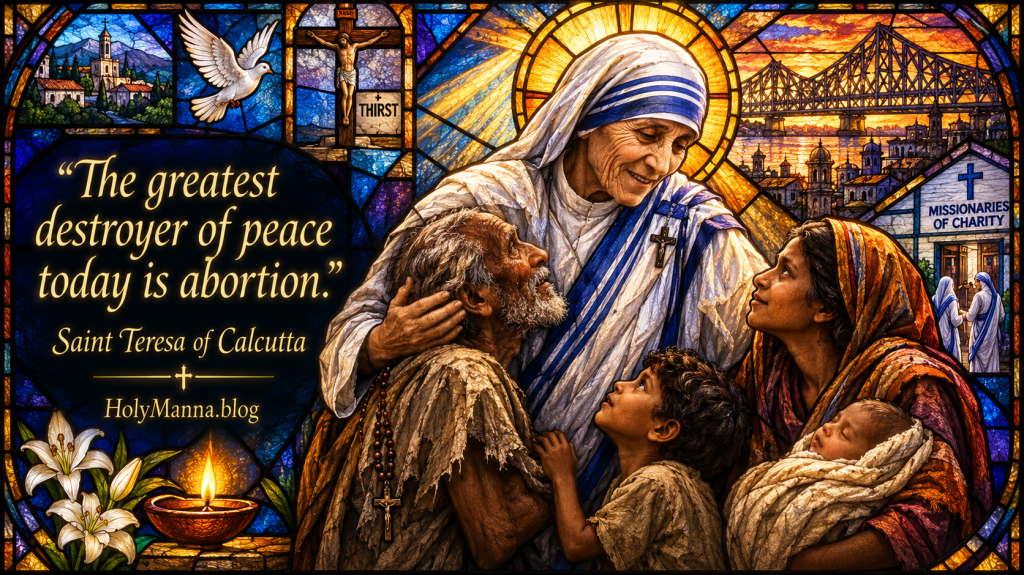
A Small Woman Who Made Mercy Visible
Some saints feel distant, separated from the modern world by centuries of history. Saint Teresa of Calcutta is not one of them. Millions of people alive today remember watching her on the news, a tiny woman under five feet tall, wrapped in a white sari with three blue stripes, lifting the dying out of the gutters of Calcutta with her own hands. When Pope Francis canonized her on September 4, 2016, during the Jubilee of Mercy, he acknowledged how close she still feels to the faithful, remarking in his homily that her holiness is so near and so tender that the Church would continue to call her, spontaneously and affectionately, “Mother Teresa.”
Her feast is celebrated on September 5, the anniversary of her death in 1997, and she stands as one of the most compelling witnesses to the Gospel in the entire twentieth century. She took the words of Jesus in The Gospel of Matthew with complete seriousness: “Truly, I say to you, as you did it to one of the least of these my brethren, you did it to me” (Mt 25:40). For her, this was not a metaphor or a pious sentiment. It was a literal description of reality. The man dying alone in the street was Jesus. The abandoned child was Jesus. The leper no one would touch was Jesus. The Catechism teaches exactly this when it says that Jesus makes active love toward the poor the condition for entering His kingdom and that in the poor and suffering the Church recognizes the image of her founder (CCC 544, CCC 2449).
She is the foundress of the Missionaries of Charity, a Nobel Peace Prize laureate, and the co-patroness of the Archdiocese of Calcutta, a title formally conferred on her in 2017. Yet the deepest reason to know her is not the fame or the awards. It is the secret she carried for fifty years, a secret that makes her one of the most surprising and consoling saints the Church has ever raised to the altars.
An Albanian Girl Named Flower Bud
Saint Teresa was born Anjezë Gonxhe Bojaxhiu on August 26, 1910, in Skopje, a city then under the Ottoman Empire and today the capital of North Macedonia. Her family was Albanian and devoutly Catholic in a region where Catholics were a small minority. Her middle name, Gonxhe, means “flower bud” or “rosebud” in Albanian, a tender detail for a girl who would one day blossom into one of the Church’s greatest flowers of charity. She was baptized the very next day, August 27, and for the rest of her life she considered her baptismal day her true birthday, the day she was born into the life of grace. That instinct was profoundly Catholic. The Catechism teaches that Baptism is the basis of the whole Christian life, the gateway to life in the Spirit, and the door which gives access to the other sacraments (CCC 1213).
Her father, Nikollë Bojaxhiu, was a merchant and a civic-minded man involved in local affairs. He died suddenly in 1919 when Agnes was about eight years old. A story persists that he was poisoned by political opponents because of his Albanian patriotism. It is told in many accounts of her life, but it has never been proven and cannot be verified. What is certain is that his death plunged the family into hardship, and that her mother, Dranafile, known as Drana, rose to the occasion with heroic faith. Drana started a small business, raised Agnes and her siblings Aga and Lazar in fervent piety, and regularly opened her table to the poor of Skopje. When her children asked who the strangers at dinner were, she told them the poor were their own people. Agnes learned the Gospel first at her mother’s table.
The family worshiped at Sacred Heart parish, served by the Jesuits, and young Agnes threw herself into parish life, singing in the choir and joining the sodality of the Blessed Virgin Mary. Around the age of twelve she felt the first stirrings of a call to give her life to God, and through the sodality she heard letters from Jesuit missionaries serving in Bengal, India. The seed was planted. By eighteen she was certain. In September 1928 she said goodbye to her mother and sister and traveled to the Loreto Sisters, the Institute of the Blessed Virgin Mary, at Rathfarnham near Dublin, to learn English, the language the sisters used in India. She would never see her mother or her sister again in this life. She sailed for India and arrived in January 1929, made her novitiate in Darjeeling in the foothills of the Himalayas, and took the name Teresa after Saint Thérèse of Lisieux. She chose the little Thérèse deliberately, the saint of the little way, who taught that holiness is found in doing small things with extraordinary love, a doctrine the Church holds up as a model of confident abandonment to God’s merciful love (CCC 2011).
She made her first vows in 1931 and her final profession on May 24, 1937, after which she was called Mother Teresa, following the custom of the Loreto sisters. For almost twenty years she taught geography and catechism at Saint Mary’s School for girls in the Entally district of Calcutta, eventually becoming its principal. She loved the work and the students, and she later said that she was one of the happiest nuns in Loreto. God, however, was preparing something more.
The Train to Darjeeling and the Thirst of Christ
Everything changed on September 10, 1946. Mother Teresa boarded the train from Calcutta to Darjeeling for her annual retreat, and somewhere on that journey she received what she would always call her call within a call. In the depths of her soul she encountered the thirst of Jesus on the Cross, His burning thirst for love and for souls, and she understood that He was asking her to leave the security of the convent and serve Him in the poorest of the poor while living among them. In the interior words she recorded in her letters, later published in Mother Teresa: Come Be My Light, Jesus pleaded with her: “Come, be My light.” The Missionaries of Charity keep September 10 as Inspiration Day to this very hour.
She obeyed, but not impulsively. Here is a detail worth savoring: this world-famous foundress moved only with the permission of the Church. She spent nearly two years under obedience, corresponding with her archbishop and awaiting the required permissions, before she was allowed to step outside her convent. The Catechism reminds the faithful that no charism, however extraordinary, is exempt from being submitted to the Church’s shepherds, whose office is to test all things and hold fast to what is good (CCC 801). Her patience under authority is itself a lesson for anyone who has ever felt certain that God wants something and chafed at waiting.
On August 17, 1948, she put on for the first time the white cotton sari with a blue border that would become known throughout the world, chosen because it resembled the dress of the poorest Indian women. She took an intensive course in basic medical care with the Medical Mission Sisters in Patna, and in December 1948 she walked into the slums of Calcutta. She had no money, no institution, and no plan beyond trust. She began by gathering slum children in the open air in the Motijhil quarter and scratching Bengali letters in the dirt with a stick. That was the first school of the Missionaries of Charity: mud for a blackboard, the ground for desks.
Her former students from Saint Mary’s began to join her. On October 7, 1950, the feast of the Holy Rosary, Archbishop Ferdinand Périer erected the Missionaries of Charity as a religious congregation in the Archdiocese of Calcutta. To the three traditional vows of poverty, chastity, and obedience, the sisters added a fourth vow, wholehearted free service to the poorest of the poor. The Church teaches that the profession of the evangelical counsels within a stable state of life recognized by the Church is one intimate way of being consecrated to God and contributing to the saving mission of the Church (CCC 915, CCC 916), and Mother Teresa’s fourth vow sharpened that consecration to a fine point aimed directly at Christ in His most distressing disguise.
The works multiplied with astonishing speed. In 1952 she opened Nirmal Hriday, the home for the dying, in a former pilgrim hostel beside the Kali temple at Kalighat, so that men and women picked up off the streets could die clean, cared for, and loved, having seen a human face smile at them at least once. In 1955 came Shishu Bhavan, a home for orphaned and abandoned children. Then came Shanti Nagar, the Town of Peace, for those suffering from leprosy, whom she and her sisters touched and bandaged without fear. In 1965 Pope Saint Paul VI granted the congregation the Decree of Praise, raising it to pontifical right, and the first foundation outside India opened in Venezuela that same year. Brothers followed in 1963, a contemplative branch in 1976, priests in 1984, and an army of lay Co-Workers around the world. By the time of her death, her congregation numbered nearly four thousand sisters serving in more than six hundred foundations in one hundred and twenty three countries.
Regarding miracles during her lifetime, honesty requires care. Mother Teresa was not known as a wonder-worker in the manner of some saints; no formally investigated miracles are attributed to her earthly ministry. Those who knew her spoke instead of a different kind of daily marvel, provisions and donations arriving at the exact hour of need, and doors opening that should have stayed shut. She insisted that the real miracle was grace itself, the transformation of the dying who departed this world in peace, loved and wanted at the last. Perhaps the most documented public marvel of her life came in 1982, when she walked into the siege of Beirut during a ceasefire, crossed between the warring sides, and helped evacuate thirty seven children trapped in a front-line hospital. The world’s cameras recorded it. She simply said the children needed her.
The Long Dark Night and the Critics at the Gate
If Saint Teresa’s public life was luminous, her interior life was, by her own testimony, an experience of prolonged darkness that ranks among the most extraordinary in the history of Christian spirituality. Shortly after she began her work in the slums, the intimate sense of union with Jesus that had carried her through the call of 1946 simply vanished. For roughly fifty years, with only brief interruptions, she felt no consolation in prayer, no felt presence of God, only silence, emptiness, and an ache of longing. The world learned of this only after her death, when her letters were published in Come Be My Light. In one of them she wrote words that stop the heart: “If I ever become a Saint, I will surely be one of ‘darkness.’ I will continually be absent from Heaven, to light the light of those in darkness on earth.”
This was not a loss of faith. It was faith in its purest, most heroic form, belief and love persevering without a single drop of felt reward. Her spiritual directors came to understand this darkness as a mysterious sharing in the thirst and abandonment of Jesus on the Cross and in the desolation of the poor she served, who feel unwanted and unloved. The Church has a name for this territory. The Catechism teaches that dryness belongs to the life of prayer, the moment when the heart is separated from God with no taste for thoughts and feelings, and that this is the hour of naked faith cleaving to Jesus in His agony and His tomb (CCC 2731). Saint John of the Cross mapped this dark night centuries before; Saint Teresa of Calcutta lived it on a scale few have. For anyone who has ever prayed into what feels like a void, she is proof that the silence of God is not the absence of God, and that fidelity in darkness may be the highest praise a soul can offer.
Her exterior hardships were real as well. She began her mission with five rupees and total insecurity, begging for food and medicine for her people. She endured the early suspicion of neighbors at Kalighat who resented a Catholic nun beside their temple, suspicion that dissolved when they saw her sisters caring for the dying whom no one else would touch. She endured heart attacks in 1983 and 1989, a pacemaker, malaria, and broken bones, and through it all she kept traveling, kept founding, kept picking people up off the streets.
She also endured the modern form of persecution, public attack. In her final years, critics, most famously the journalist Christopher Hitchens, accused her of keeping poor medical standards in her homes, of accepting donations without scrutiny, and above all of her unbending defense of Catholic teaching on human life. It is true that her homes were not hospitals and never claimed to be; they were places for the destitute to be loved. It is true that she was a sign of contradiction, most visibly when she stood before the powerful of the world at the Nobel ceremony and in Washington and named abortion as the greatest destroyer of peace, pleading for the unborn child. In her Nobel lecture in 1979 she declared plainly that “the greatest destroyer of peace today is abortion,” because it is a war against the child. She said this to a room full of dignitaries, without apology, because the Catechism’s teaching was her own: human life must be respected and protected absolutely from the moment of conception (CCC 2270). She was not martyred, but she bore the world’s mockery and her own inner crucifixion with the same serene smile. When she received the Nobel Peace Prize, she asked that the celebratory banquet be cancelled and the money given to the poor, and it was.
She stepped down as superior general in March 1997, worn out at last, and on September 5, 1997, at the Motherhouse in Calcutta, her heart finally stopped. India, a nation overwhelmingly not Catholic, gave her a state funeral. The poor wept in the streets for their mother.
Two Healings and a Tomb That Draws the World
Saint John Paul II, who loved her and met with her often, waived the customary five-year waiting period and opened her cause of canonization in 1999, barely two years after her death. What followed were two reported healings that the Church, after exhaustive medical and theological scrutiny, judged to be miracles worked by God through her intercession. The Catechism explains why the Church canonizes at all: by solemnly proclaiming that certain faithful practiced heroic virtue and lived in fidelity to God’s grace, the Church recognizes the power of the Spirit of holiness within her and sustains the hope of believers by giving them models and intercessors (CCC 828).
The first healing occurred on September 5, 1998, the first anniversary of her death. Monica Besra, a young mother in West Bengal, was gravely ill with a large abdominal tumor. Sisters of the Missionaries of Charity prayed for her and placed on her abdomen a medal that had touched the body of Mother Teresa. Monica later testified that she saw a light come from the image and that she awoke to find the mass gone. Doctors who examined the case could not explain how so large a growth disappeared so completely and so quickly. The Vatican recognized the healing as a miracle in 2002, and on October 19, 2003, World Mission Sunday, Saint John Paul II beatified her before an immense crowd in Saint Peter’s Square. Honesty requires noting that some physicians publicly disputed the healing, arguing that her medical treatment could account for it, and early reports quoted her husband denying a miracle, though he later said he had been misquoted. The Church weighed the evidence, including the testimony of doctors, and judged otherwise. The elements of this story that rest on private testimony, such as the light Monica saw, cannot be independently verified, and that is stated here plainly.
The second healing came on December 9, 2008, in Santos, Brazil. Marcilio Haddad Andrino, a young mechanical engineer, was dying of a viral brain infection that had produced multiple abscesses and severe hydrocephalus, a buildup of fluid in the brain. Treatments had failed, and he had fallen into a coma. His wife, Fernanda, newly married to him, had been given a relic prayer card of Blessed Teresa and begged her intercession relentlessly. As Marcilio was taken for a last-resort emergency surgery, Fernanda poured out her prayers, asking Mother to cure her husband if it was God’s will. When the surgeon returned to the room, Marcilio was awake, free of pain, and asking what was going on. Scans in the following days showed the abscesses and fluid receding in a way no physician could explain. Within months he returned to work, and the couple, who had been told his condition and treatment would likely leave them childless, went on to have children. Pope Francis approved the miracle in December 2015, and on September 4, 2016, with Marcilio and Fernanda present in Saint Peter’s Square, he canonized her before hundreds of thousands of pilgrims, praising her in his homily as a generous dispenser of divine mercy who bowed down before those who were spent and left to die on the side of the road, seeing in them their God-given dignity.
Devotion to her now spans the globe. Her tomb at the Motherhouse on A.J.C. Bose Road in Kolkata is a place of continual pilgrimage, visited by Catholics, Hindus, Muslims, and unbelievers alike, a plain white slab often decorated with flower petals spelling out words of Scripture. The Memorial House dedicated to her stands in her native Skopje, and both North Macedonia and Albania honor her as a national daughter; the international airport of Tirana bears her name. In 2017 she was proclaimed co-patroness of the Archdiocese of Calcutta, binding her forever to the city whose name she carried into sainthood. Her white sari with its three blue stripes remains one of the most recognized images of holiness on earth, and every chapel of her Missionaries of Charity displays beside the crucifix the two words from The Gospel of John that unlocked her whole life, the cry of Jesus from the Cross: “I thirst” (Jn 19:28).
One caution belongs to any honest account of her legacy. The beloved poem known as “Do It Anyway,” which urges the reader to forgive, be kind, and do good regardless of ingratitude, is often printed under her name. She did not write it. It is an adaptation of “The Paradoxical Commandments” composed by Kent M. Keith in 1968, and it hung on the wall of her children’s home in Calcutta, which is how the misattribution spread. She loved those words and lived them, but they were not hers, and her own congregation has confirmed as much. Likewise, several sayings widely attributed to her, such as doing small things with great love or being called to faithfulness rather than success, capture her spirit but cannot be verified as her verbatim words, so they are best quoted as reflections of her spirituality rather than as direct quotations.
Love in the Concrete
What does a modern person, scrolling past headlines of suffering every single day, actually do with the life of Saint Teresa of Calcutta? The temptation is to admire her from a distance, to file her away as a spiritual superhero whose vocation has nothing to do with an ordinary schedule of work, family, and exhaustion. She would have rejected that completely. Her entire message was that the call she followed is, in its essence, addressed to every baptized person. The Catechism teaches that the works of mercy are charitable actions by which the faithful come to the aid of their neighbor in his spiritual and bodily necessities, and that giving alms to the poor is one of the chief witnesses to fraternal charity (CCC 2447). It also teaches something startling: that the Eucharist commits the communicant to the poor, and that receiving the Body and Blood of Christ truly means recognizing Christ in the poorest, His brethren (CCC 1397). Saint Teresa simply believed that, all the way down.
Start close to home, the way she always advised. Who in your own house, your own workplace, your own parish is starving, not for bread, but for attention, patience, or forgiveness? Loneliness, she insisted, is the poverty of the modern West, and it lives on your street. Visit the relative everyone finds difficult. Sit with the coworker eating alone. Answer the text you have been avoiding. None of that is glamorous, and all of it is Kalighat in miniature.
Learn from her darkness. When your prayer feels empty and God seems silent, do you conclude that something is broken, or can you believe that fidelity in dryness is itself a gift you can offer Him? She kept her holy hour before the Blessed Sacrament daily for decades while feeling nothing. Her perseverance teaches that feelings are not the measure of faith, and that showing up for prayer on the gray days may be worth more than a hundred consolations.
Imitate her smallness. She did not set out to fix global poverty; she picked up one person, then the next, then the next. What is the one person, the one act of mercy, directly in front of you today? Begin there, and let God worry about the scale.
Engage With Us!
Saint Teresa of Calcutta still speaks, and this community would love to hear how she speaks to you. Share your thoughts, your stories, and your reflections in the comments below, whether she has been part of your faith for years or you are meeting her for the first time today. To help the conversation begin, here are a few questions to pray with.
- Saint Teresa saw Jesus in every suffering person she met. Who is the person in your daily life that you find hardest to see Him in, and what is one concrete way you could serve that person this week?
- She endured fifty years of interior darkness while remaining faithful to prayer. How do you respond when God feels silent, and what would it look like to keep your own holy hour anyway?
- She began with five rupees and a stick in the dirt. What small work of mercy have you been postponing because it feels too insignificant to matter?
- Her fourth vow was wholehearted free service to the poorest of the poor. What would a personal fourth vow look like in your state of life?
- The words “I thirst” shaped her entire spirituality. What do you think Jesus thirsts for in you right now?
However these questions land in your heart, do not let this saint remain a poster on a wall. Take one step today, small, hidden, and real, toward the person nearest you who is unwanted or unloved. Live your faith out loud through quiet acts of mercy, and do everything, absolutely everything, with the love and mercy that Jesus taught us.
Saint Teresa of Calcutta, pray for us!
Follow us on YouTube, TikTok, Instagram and Facebook for more insights and reflections on living a faith-filled life.


Leave a Reply