Saturday of the Twenty-second Week in Ordinary Time – Lectionary: 436
The Open Hand and the Clenched Fist
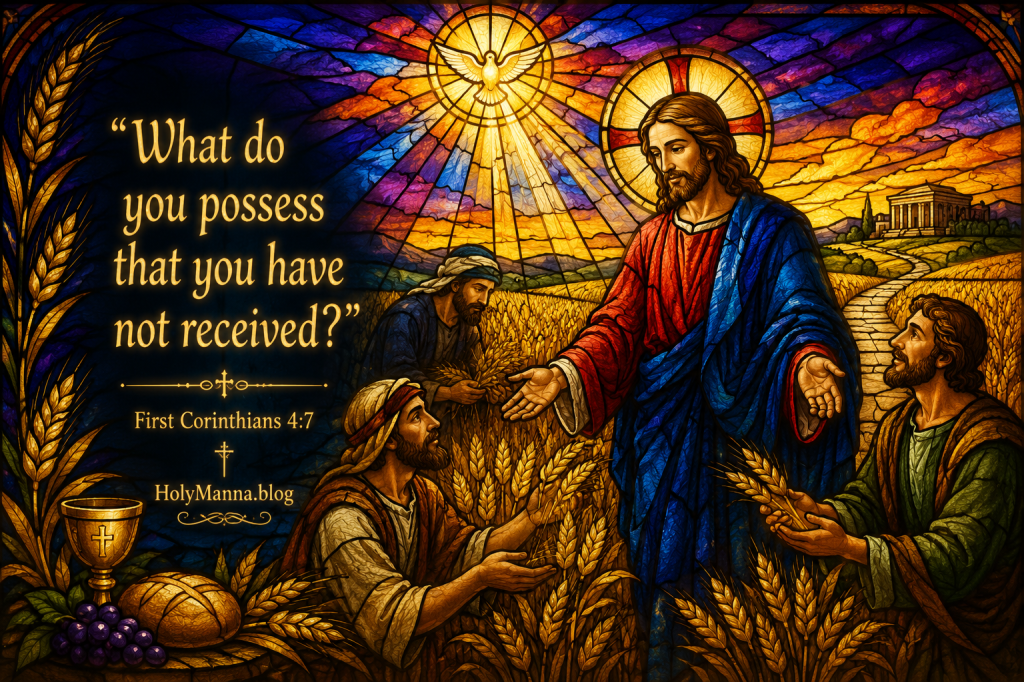
There are really only two postures a soul can take before God. One is the clenched fist, gripping talents, achievements, and even faith itself as personal property. The other is the open hand, ready to receive. Today’s readings for Saturday of the Twenty-second Week in Ordinary Time draw that contrast with startling clarity. In the First Reading, Saint Paul confronts a Corinthian church swollen with spiritual pride and asks the question that would echo through centuries of Catholic theology, “What do you possess that you have not received?” The Responsorial Psalm answers with the posture God blesses, for Psalm 145 sings that the Lord is near to all who call upon him in truth, fulfilling the desires of those who fear him. Then the Gospel shows the Giver himself walking through a grain field on the sabbath, defending his hungry disciples against men who had turned God’s gift of rest into a cage. Corinth was a boomtown of the ancient Mediterranean, obsessed with status and patronage, and the Pharisees of Jesus’s day had built an elaborate fence of human regulations around the Law of Moses. Both cultures, in their own way, had forgotten that everything, wisdom, food, the sabbath itself, comes from the hand of a generous Father. The Church places these readings side by side to teach one liberating truth: grace cannot be earned, hoarded, or weaponized. It can only be received with gratitude. Where in your own life has the fist quietly closed around what was always a gift?
First Reading — 1 Corinthians 4:6b-15
Kings Without a Crown, Fathers Without Honor
Paul wrote this letter from Ephesus around the year 56 to a church he had personally founded in Corinth, a wealthy Roman port city where social climbing was practically a civic sport. The Corinthians had carried that culture into the sanctuary, dividing into rival fan clubs behind Paul, Apollos, and Cephas, and boasting of their spiritual gifts as though they had manufactured them. In this passage, Paul reaches the boiling point of his argument, deploying irony sharp enough to draw blood, then softening into the tenderness of a father. The passage fits today’s theme perfectly because it names the disease, pride, and prescribes the cure, grateful humility.
1 Corinthians 4:6b-15
Brothers and sisters:
Learn from myself and Apollos not to go beyond what is written,
so that none of you will be inflated with pride
in favor of one person over against another.
Who confers distinction upon you?
What do you possess that you have not received?
But if you have received it,
why are you boasting as if you did not receive it?
You are already satisfied; you have already grown rich;
you have become kings without us!
Indeed, I wish that you had become kings,
so that we also might become kings with you.For as I see it, God has exhibited us Apostles as the last of all,
like people sentenced to death,
since we have become a spectacle to the world,
to angels and men alike.
We are fools on Christ’s account, but you are wise in Christ;
we are weak, but you are strong;
you are held in honor, but we in disrepute.
To this very hour we go hungry and thirsty,
we are poorly clad and roughly treated,
we wander about homeless and we toil, working with our own hands.
When ridiculed, we bless; when persecuted, we endure;
when slandered, we respond gently.
We have become like the world’s rubbish, the scum of all,
to this very moment.I am writing you this not to shame you,
but to admonish you as my beloved children.
Even if you should have countless guides to Christ,
yet you do not have many fathers,
for I became your father in Christ Jesus through the Gospel.
Detailed Exegesis
Verse 6b: “Learn from myself and Apollos not to go beyond what is written, so that none of you will be inflated with pride in favor of one person over against another.” Paul and Apollos have modeled humility so the Corinthians can imitate it. The phrase about not going beyond what is written points to Scripture’s constant refrain that boasting belongs to God alone. Pride here is literally being “puffed up,” inflated like a wineskin full of air.
Verse 7: “Who confers distinction upon you? What do you possess that you have not received? But if you have received it, why are you boasting as if you did not receive it?” Three rhetorical questions, one devastating answer: nothing is our own. This verse became the cornerstone of the Catholic theology of grace, and CCC 224 builds directly upon it, as explored below.
Verse 8: “You are already satisfied; you have already grown rich; you have become kings without us! Indeed, I wish that you had become kings, so that we also might become kings with you.” Pure irony. The Corinthians behave as though the fullness of the Kingdom has already arrived and they are reigning in it, while the very Apostles who fed them the Gospel remain outside their little court.
Verse 9: “For as I see it, God has exhibited us Apostles as the last of all, like people sentenced to death, since we have become a spectacle to the world, to angels and men alike.” Paul evokes the Roman triumph, where condemned prisoners marched last in the procession toward death in the arena. The Greek word for spectacle is theatron. Apostleship is not celebrity; it is public self-emptying in imitation of the Crucified.
Verse 10: “We are fools on Christ’s account, but you are wise in Christ; we are weak, but you are strong; you are held in honor, but we in disrepute.” The contrasts expose how far Corinthian “wisdom” has drifted from the folly of the Cross that Paul preached in the opening chapter of this same letter.
Verses 11 and 12a: “To this very hour we go hungry and thirsty, we are poorly clad and roughly treated, we wander about homeless and we toil, working with our own hands.” Paul the tentmaker lists his credentials, and they are hunger, homelessness, and calloused palms. Manual labor was despised by the Greek elite, which makes the boast deliberately scandalous.
Verses 12b and 13: “When ridiculed, we bless; when persecuted, we endure; when slandered, we respond gently. We have become like the world’s rubbish, the scum of all, to this very moment.” The Apostles answer contempt with blessing, living the Sermon on the Mount before a watching world. The word rendered rubbish described what was scraped away and thrown out after cleaning.
Verse 14: “I am writing you this not to shame you, but to admonish you as my beloved children.” The irony suddenly melts. Correction in the Church is meant to heal, and Paul reveals that every sharp word was spoken in love.
Verse 15: “Even if you should have countless guides to Christ, yet you do not have many fathers, for I became your father in Christ Jesus through the Gospel.” A guide, a paidagogos, was a hired escort for schoolchildren. A father gives life. Paul’s spiritual fatherhood, exercised through preaching and Baptism, is the biblical root of the Catholic instinct to call priests “Father.”
Teachings
The Catechism places verse 7 at the very heart of what it means to believe in one God. CCC 224 teaches, “It means living in thanksgiving: if God is the only One, everything we are and have comes from him: ‘What have you that you did not receive?’” Faith in God, in other words, is inseparable from gratitude. This verse also changed the course of Church history through Saint Augustine, Doctor of the Church. Late in life, in On the Predestination of the Saints, Augustine confessed that he had once believed the act of faith originated in ourselves, and he recalled how Saint Cyprian had taught that “we must boast in nothing, since nothing is our own.” Augustine then admitted of Paul’s question, “And it was chiefly by this testimony that I myself also was convinced when I was in a similar error, thinking that faith whereby we believe in God is not God’s gift, but that it is in us from ourselves.” From this conviction flowed the Church’s settled teaching that even the beginning of faith is grace, a truth later defended against the Semi-Pelagians. The passage also illuminates the ministerial priesthood. Paul’s claim of fatherhood through the Gospel shows that spiritual paternity is real paternity, generating divine life in souls, which is why the Church has always honored her pastors as fathers in Christ.
Reflection
This reading is an examination of conscience disguised as ancient mail. Modern life runs on personal branding, curated achievements, and quiet comparison, and the Corinthian temptation lives comfortably in every heart. Try a simple practice today: take one thing you are most proud of, a talent, a career, even your faith, and deliberately thank God for it as a gift you did not earn. Consider also how you respond when ridiculed or slandered, since Paul’s standard is to bless, endure, and answer gently. When you look honestly at your gifts, do you see trophies you have won or presents you have unwrapped? Is there someone who mocked or dismissed you whom you could bless in prayer tonight?
Responsorial Psalm — Psalm 145:17-21
The God Who Leans In Close
Psalm 145 holds a singular place in the Psalter. It is the only psalm whose Hebrew title calls it a tehillah, a praise, and it is composed as an alphabetical acrostic, moving letter by letter through the Hebrew alphabet as though to praise God with everything language can hold. Jewish tradition treasured this psalm for daily recitation, and the Church places its closing verses on our lips today as the answer to Paul’s rebuke. If pride pushes God away, humility discovers that he was always near. The refrain, “The Lord is near to all who call upon him,” is the hinge on which the whole day’s liturgy swings.
Psalm 145:17-21
R. (18) The Lord is near to all who call upon him.
The LORD is just in all his ways
and holy in all his works.
The LORD is near to all who call upon him,
to all who call upon him in truth.
R. The Lord is near to all who call upon him.
He fulfills the desire of those who fear him,
he hears their cry and saves them.
The LORD keeps all who love him,
but all the wicked he will destroy.
R. The Lord is near to all who call upon him.
May my mouth speak the praise of the LORD,
and may all flesh bless his holy name forever and ever.
R. The Lord is near to all who call upon him.
Detailed Exegesis
Verse 17: “The LORD is just in all his ways and holy in all his works.” Before speaking of God’s nearness, the psalmist establishes his character. Divine justice and holiness are not cold attributes; they are the guarantee that when God draws near, he draws near to save and not to exploit.
Verse 18: “The LORD is near to all who call upon him, to all who call upon him in truth.” The decisive phrase is “in truth.” Calling upon God in truth means approaching him without pretense, as a creature before the Creator, as a receiver before the Giver. It is the exact opposite of the Corinthian boast.
Verse 19: “He fulfills the desire of those who fear him, he hears their cry and saves them.” Fear of the Lord, the reverent awe that is the beginning of wisdom, becomes the doorway to fulfilled desire. The proud demand; the humble cry out, and God hears the cry.
Verse 20: “The LORD keeps all who love him, but all the wicked he will destroy.” The verse holds mercy and judgment together honestly. Love of God places a soul under his protective keeping, while persistent wickedness, which is finally the refusal of gift, ends in ruin of its own choosing.
Verse 21: “May my mouth speak the praise of the LORD, and may all flesh bless his holy name forever and ever.” The psalm ends where gratitude always ends, in praise that longs to become universal, sweeping “all flesh” into one unending act of blessing.
Teachings
The Catechism teaches that prayer itself must begin from the posture this psalm describes. CCC 2559 states plainly that “humility is the foundation of prayer,” because only the one who knows himself to be a beggar before God can truly call upon him in truth. This is why the tax collector in Our Lord’s parable went home justified while the boasting Pharisee did not. Saint Augustine’s whole spiritual journey, recounted in his Confessions, is a commentary on this psalm’s promise, for he discovered that the God he had sought in distant places had been nearer to him than he was to himself. The nearness of the Lord finds its unsurpassable fulfillment in the Incarnation, in which God did not merely lean close but took our flesh, and in the Holy Eucharist, in which he remains with us until the end of the age. Every tabernacle in the world is Psalm 145 written in Bread.
Reflection
The practical question this psalm poses is disarmingly simple: do you actually call upon him? Not perform for him, not negotiate with him, but call upon him in truth, the way a child calls in the dark. Choose a moment today, perhaps in the car or over the sink, and speak to God with complete honesty about one desire and one fear. Then thank him for one gift, joining your voice to verse 21. When you pray, do you come to God in truth, or do you come with a résumé? What would change in your day if you truly believed the Lord is near right now?
Holy Gospel — Luke 6:1-5
Hungry Disciples and the Lord of Rest
Saint Luke now presents the first of the great sabbath controversies. The setting is ordinary, a footpath through ripening grain, and the act is humble, hungry men eating raw kernels. The Law itself permitted this, for Deuteronomy 23 allowed travelers to pluck grain by hand from a neighbor’s field. The objection came from the oral traditions of the Pharisees, which classified plucking as reaping and rubbing as threshing, forbidden labors on the sabbath. Into that suffocating legalism steps Jesus, who answers not with a technicality but with a revelation of who he is. The scene completes today’s theme, for the sabbath was always a gift, and here stands the Giver in person.
Luke 6:1-5
While Jesus was going through a field of grain on a sabbath,
his disciples were picking the heads of grain,
rubbing them in their hands, and eating them.
Some Pharisees said,
“Why are you doing what is unlawful on the sabbath?”
Jesus said to them in reply,
“Have you not read what David did
when he and those who were with him were hungry?
How he went into the house of God, took the bread of offering,
which only the priests could lawfully eat,
ate of it, and shared it with his companions?”
Then he said to them, “The Son of Man is lord of the sabbath.”
Detailed Exegesis
Verse 1: “While Jesus was going through a field of grain on a sabbath, his disciples were picking the heads of grain, rubbing them in their hands, and eating them.” Luke, ever the careful historian, notes the small physical detail of rubbing the grain, which is precisely what triggered the accusation. The disciples’ hunger recalls Paul’s words in the First Reading, for the friends of Jesus often go hungry in this world.
Verse 2: “Some Pharisees said, ‘Why are you doing what is unlawful on the sabbath?’” The charge concerns not theft but labor. Human tradition had built such a dense fence around God’s commandment that eating a handful of grain could be prosecuted as harvest work.
Verse 3: “Jesus said to them in reply, ‘Have you not read what David did when he and those who were with him were hungry?’” The question stings, since the Pharisees prided themselves on reading. Jesus points to 1 Samuel 21, where David, fleeing Saul, came hungry to the sanctuary at Nob with his companions.
Verse 4: “‘How he went into the house of God, took the bread of offering, which only the priests could lawfully eat, ate of it, and shared it with his companions?’” The bread of the Presence, twelve loaves set weekly before the Lord, was reserved to priests, yet the priest gave it to God’s anointed and his hungry men, and Scripture records no condemnation. The argument is quietly Christological: if David could do this, how much more the Son of David, and the shared holy bread whispers ahead to the Eucharist.
Verse 5: “Then he said to them, ‘The Son of Man is lord of the sabbath.’” This is a claim of divinity. The sabbath was instituted by God at creation, so only God can be its lord. Jesus does not abolish the day; he unveils its true meaning and its true Master.
Teachings
The Catechism addresses this very scene. CCC 2173 teaches, “The Gospel reports many incidents when Jesus was accused of violating the sabbath law. But Jesus never fails to respect the holiness of this day. He gives this law its authentic and authoritative interpretation: ‘The sabbath was made for man, not man for the sabbath.’” The same paragraph concludes with the confession that “The Son of Man is lord even of the sabbath.” The Catechism also recovers the sabbath’s liberating purpose, for CCC 2172 calls it “a day of protest against the servitude of work and the worship of money.” The Fathers meditated deeply on this passage. In the Catena Aurea compiled by Saint Thomas Aquinas, Saint John Chrysostom observes, “It is therefore more fitting that the sabbath should be subject to man, than that man should bow his neck to the sabbath.” Saint Ambrose, in his Exposition of the Gospel of Luke, reads the scene as a living parable, teaching, “The field is this whole world, and the standing corn of the field is an abundant fruitfulness of saints in the sowing of the human race.” For Ambrose, the disciples moving through the grain prefigure the Church gathering souls, nourished by the fruit of apostolic labor.
Reflection
For Catholics, the sabbath finds its fulfillment in the Lord’s Day, and this Gospel asks how you keep it. Sunday is meant to be received as gift, Mass, rest, family, mercy, not endured as obligation or erased by errands and inboxes. This week, plan one concrete way to protest the servitude of work: leave the phone in a drawer for an afternoon, share an unhurried meal, visit someone lonely. Guard equally against the opposite error of the Pharisees, using religious rules as a weapon for judging others rather than a school of love. Does your Sunday look like a gift received or a checklist survived? Is there any place where you have bound heavy burdens on others that Jesus never asked them to carry?
Come to the Field with Empty Hands
Walk back through this day’s liturgy one more time, slowly. Paul stands in the middle of proud Corinth asking a question no honest soul can dodge, “What do you possess that you have not received?” The psalmist answers for all the humble of the earth, singing that the Lord is near to those who call upon him in truth. And then Luke pulls back the curtain on a grain field in Galilee, where hungry disciples eat from God’s abundance while the Lord of the sabbath himself defends them from men who had turned gift into burden. It is all one story. Pride starves in the middle of plenty because it will not open its hands. Humility feasts, because it recognizes that the field, the grain, the sabbath, the faith, and life itself all come from a Father who delights in giving. The saints learned this secret and it set them free. Augustine stopped trusting his own strength and discovered grace. The Apostles embraced hunger, homelessness, and ridicule, and became fathers of nations. The invitation now passes to each reader. Come to Sunday Mass this week the way the disciples walked through that field, hungry, unashamed of need, expecting to be fed, for the same Lord of the sabbath waits there with Bread far greater than the loaves of Nob. Let gratitude become the reflex of the heart, blessing instead of boasting, receiving instead of grasping. The Lord is near. He has always been near. All that remains is to call upon him in truth and open the hand.
Engage With Us!
The conversation does not end here, so please share your reflections in the comments below. This community grows every time someone honestly wrestles with the Word, and your insight may be exactly what another reader needs today. Here are some questions to pray with this week:
- In 1 Corinthians 4:6b-15, Saint Paul asks what you possess that you have not received. Which gift in your life are you most tempted to treat as your own achievement, and how can you return it to God in thanksgiving this week?
- In Psalm 145:17-21, the psalmist declares that the Lord is near to all who call upon him in truth. What would calling upon God “in truth” look like in your prayer tonight, stripped of performance and pretense?
- In Luke 6:1-5, Jesus reveals himself as lord of the sabbath. How can you reclaim this coming Sunday as a genuine day of rest, worship, and mercy rather than another day of work and noise?
- Taking all the readings together, where is God inviting you to trade the clenched fist of pride for the open hand of humble receiving?
Keep walking this road of faith with courage and joy. Every gift received with gratitude becomes a seed of holiness, and every humble prayer draws you nearer to the God who was already near. Go into this week determined to do everything with the love and mercy Jesus taught us, blessing when ridiculed, giving because you have received, and resting in the Lord who is lord of the sabbath and Lord of your life.
Sacred Heart of Jesus, we trust in You!
Immaculate Heart of Mary, pray for us!
Saint Michael the Archangel, defend us in battle!
Follow us on YouTube, TikTok, Instagram and Facebook for more insights and reflections on living a faith-filled life.


Leave a Reply