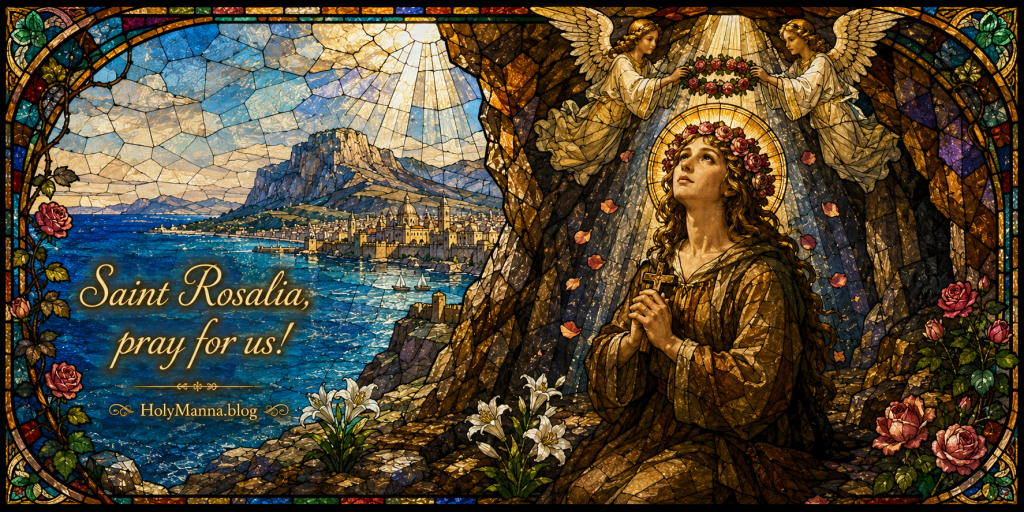
A Hidden Flower on the Mountain
Some saints preach to thousands. Some found orders, write books, or die in arenas. Saint Rosalia did none of these things. She left a palace, climbed a mountain, disappeared into a cave, and spent her life loving God where no one could see her. Then, nearly five hundred years after her death, she stepped back into history at the exact moment her city needed her most, and a plague that was devouring Palermo came to an end. The people of Sicily have never stopped calling her la Santuzza, the Little Saint, and they have never stopped climbing her mountain to thank her.
Rosalia is honored by the Church as a virgin and hermitess. She is the patroness of Palermo and of the whole island of Sicily, as well as of El Hatillo and Zuata in Venezuela, where Sicilian devotion took root across the ocean, and she has long been invoked against plagues and epidemics. Her feast day is September 4, the day of her death, and a second feast on July 15 commemorates the finding of her relics. Pope Urban VIII entered her name into The Roman Martyrology in 1630, and in doing so the Church held her up to all the faithful as a model and an intercessor. The Catechism explains why the Church does this at all: “By canonizing some of the faithful, i.e., by solemnly proclaiming that they practiced heroic virtue and lived in fidelity to God’s grace, the Church recognizes the power of the Spirit of holiness within her and sustains the hope of believers by proposing the saints to them as models and intercessors” (CCC 828). Rosalia’s model is a strange and beautiful one. She teaches that a life can matter infinitely even when the world never notices it, because God notices everything.
A Noble Daughter Who Walked Away from the Palace
Rosalia was born in Palermo around the year 1130, in the golden age of Norman Sicily. It is worth pausing to picture her world. The Normans had recently ended centuries of Arab rule over the island, and Palermo had become one of the most dazzling cities in Europe, a place where Latin, Greek, and Arabic were all heard in the streets and where the royal court glittered with wealth. It was also a time of intense spiritual renewal. Monasteries of both the Eastern and Western traditions flourished under the Norman kings, and the life of the hermit, given wholly to prayer and solitude, was honored as one of the highest forms of devotion a Christian could embrace.
Honesty requires saying plainly that very little about Rosalia’s early life can be established with documentary certainty. The written accounts of her life come from centuries after her death; the Bollandist scholar Johannes Stilting judged that her Vita was compiled from local traditions, paintings, and inscriptions rather than from contemporary records. Yet her veneration itself is ancient. Churches were dedicated in her honor in Sicily by 1237, and some scholars point to a document from as early as 1196 that already calls her “Saint Rosalia,” only a generation after her death. The people who lived closest to her memory clearly believed they had known a saint.
According to the tradition preserved in her Vita and in an inscription found near Santo Stefano Quisquina, Rosalia was the daughter of Sinibaldo, lord of Quisquina and of the Mount of the Roses, a nobleman of the Norman aristocracy whose family claimed descent from Charlemagne, and of Maria Guiscardi, said to be related to the royal house of King Roger II. Tradition places the young Rosalia at the Norman court itself, serving Queen Margaret, the wife of King William I. She was said to be beautiful, and the same tradition tells of a noble knight named Baldwin who sought her hand in marriage. One popular story recounts that on the eve of her betrothal, Rosalia looked into a mirror, saw the face of Jesus, cut off her hair, and announced to her family and the court that she belonged to another Bridegroom entirely. These courtly details, including Baldwin and the mirror, come from popular tradition rather than documented history, and this story cannot be verified.
What the whole tradition agrees on is the decision itself. A young woman with every worldly advantage, noble blood, courtly position, wealth, and the prospect of a brilliant marriage, walked away from all of it to live alone with God. Rosalia understood in her bones what Saint Paul wrote to the Philippians: “I consider everything as a loss because of the supreme good of knowing Christ Jesus my Lord” (Philippians 3:8). She withdrew first to a cave in her father’s lands near Bivona and Santo Stefano Quisquina, in the rugged interior of Sicily, where tradition says she lived for about twelve years. There, in a grotto beside a Benedictine monastery, a Latin inscription was later found carved into the rock, traditionally attributed to Rosalia herself. In English it reads: “I, Rosalia, daughter of Sinibald, Lord of Quisquina and of the Roses, have resolved to live in this cave for the love of my Lord, Jesus Christ.” It is the only sentence ever attributed to her. Scholars note that the inscription was discovered only in 1624, at the time her relics were found, and its authenticity cannot be verified with certainty. Yet even as a testimony of tradition, it captures her entire life in a single line. Everything she did, she did for the love of her Lord.
The Silence of the Cave and the Nearness of God
From Quisquina, Rosalia eventually returned toward Palermo and made her final home in a cave on Monte Pellegrino, the great limestone headland that rises dramatically above the sea about three miles from the city. Tradition holds that she was led to her cave by two angels, a story the faithful have treasured for centuries, though it cannot be verified. On that mountain, within sight of the glittering capital she had renounced, Rosalia lived out her remaining years in prayer, penance, and total hiddenness, and there she died alone, most likely around the year 1166, though sources give dates ranging from about 1160 to 1170. The Church keeps September 4 as the day of her passing into eternal life.
A reader might reasonably ask what a person actually accomplishes by living in a cave. The Church has a breathtaking answer. The Catechism teaches that hermits “devote their life to the praise of God and salvation of the world through a stricter separation from the world, the silence of solitude and assiduous prayer and penance” (CCC 920). And it goes further, explaining what such a life shows the rest of the Church: “They manifest to everyone the interior aspect of the mystery of the Church, that is, personal intimacy with Christ. Hidden from the eyes of men, the life of the hermit is a silent preaching of the Lord, to whom he has surrendered his life simply because he is everything to him” (CCC 921). Rosalia’s cave was not an escape from the world. It was a lifelong sermon preached in silence, declaring that God is real, that He is enough, and that a human heart can be completely satisfied in Him alone.
No miracles worked by Rosalia during her lifetime are recorded in any reliable source, and nothing should be invented to fill that silence. Her miracle during life was the life itself. She embodied the invitation Jesus gives in The Gospel of Matthew: “But when you pray, go to your inner room, close the door, and pray to your Father in secret. And your Father who sees in secret will repay you” (Matthew 6:6). Rosalia took that verse further than almost anyone. Her inner room was a mountain grotto, her closed door was solitude itself, and the Father who sees in secret repaid her in a way no one could have imagined. She also lived out the longing of the psalmist, who prayed, “One thing I ask of the LORD; this I seek: to dwell in the house of the LORD all the days of my life” (Psalm 27:4). For Rosalia, the house of the Lord was wherever the Lord was, even a damp cave in the rock. Her witness matters for every believer precisely because it is so extreme. If personal intimacy with Christ was worth a whole lifetime to her, it is surely worth an hour, a morning, a daily habit of prayer to those who admire her.
Hardships Hidden from the World
Rosalia was not a martyr. No executioner ever touched her, and no martyrdom should be attributed to her. Her hardships were of a different and quieter kind, and they deserve to be taken seriously, because in some ways they are harder for modern people to imagine than a dramatic death.
Consider first what she gave up. Renunciation is easy to romanticize and brutal to live. Rosalia surrendered her family, her inheritance, her social world, the possibility of marriage and children, and every comfort of one of the wealthiest courts in Europe. Tradition says that her parents and her suitor did not simply accept her decision, and that she moved from her first hermitage partly to escape their repeated attempts to bring her home. Whether or not those details can be verified, anyone who has ever disappointed a family’s expectations for the sake of following God will recognize the cost.
Consider next what she endured. Life in a cave in twelfth century Sicily meant cold, damp, hunger, and sickness with no remedy, year after year, with no applause and no companionship. The old accounts say she practiced great mortifications and lived in constant communion with God. The Church does not treat such penance as self hatred but as spiritual battle, and The Catechism states the principle without softening it: “The way of perfection passes by way of the Cross. There is no holiness without renunciation and spiritual battle” (CCC 2015). Rosalia fought that battle daily for decades. The Christian tradition has long spoken of such a life as a white martyrdom, a total offering of self to God without the shedding of blood, and it fits her perfectly. She died as she had lived, alone with God, and was buried in her cave. Water seeping through the limestone slowly sealed her tomb in stone, and as the centuries passed, the world forgot that she was there. If her story ended at that point, it would already be a complete Christian life. But God, who sees in secret, was not finished with her.
The Plague, the Procession, and a City Delivered
In May of 1624, a ship arriving from Tunis brought the plague to Palermo. The disease tore through the crowded city, killing hundreds and then thousands, and the terrified population begged heaven for deliverance. It was at this darkest moment that the forgotten hermitess of Monte Pellegrino returned to her city.
On July 15, 1624, human remains were discovered in the cave on Monte Pellegrino, encased in the limestone that had formed over them. The find caused a sensation, but also confusion, and here the historical record is refreshingly honest. Early examiners thought the deposit contained several skulls, which cast doubt on whether these could be the bones of the lone hermitess of local memory. In February of 1625, a commission of physicians and experts examined the remains carefully and determined that the bones belonged to a single female person; the supposed extra skulls turned out to be a clay vessel, a stone, and thick mineral deposits encrusting one genuine female skull. The Church of Palermo did not rush to acclaim a relic. It investigated, doubted, tested, and only then believed.
Alongside this documented examination, the faithful of Palermo have always told the story of Vincenzo Bonelli. According to the tradition, Bonelli was a humble soap maker who had lost his young wife to the plague. On February 13, 1625, crushed by grief, he climbed Monte Pellegrino in despair. There, the story goes, Saint Rosalia appeared to him in a vision, led him toward her cave, and gave him a mission: he was to tell Cardinal Giannettino Doria, the Archbishop of Palermo, that her relics must be carried in procession through the city, and the plague would cease. Some versions of the story add that Rosalia had earlier appeared to a sick woman with a similar message, and some describe Bonelli as a hunter rather than a soap maker. This account of the visions comes down as cherished tradition rather than verified fact, and it cannot be verified.
What happened next, however, belongs to documented history. On June 6, 1625, Cardinal Doria led a solemn procession through the streets of Palermo, carrying the relics of Saint Rosalia to the cathedral. The plague, which had raged for over a year, ceased. The people of Palermo attributed their deliverance to the intercession of the Little Saint, and their gratitude has never cooled in four hundred years. The city proclaimed her its patroness, and in 1630 Pope Urban VIII inscribed her name in The Roman Martyrology with her two feasts, September 4 and July 15.
The theology beneath this story matters as much as the drama. Catholics do not believe that bones work magic. They believe that the saints are alive in Christ and that they pray for the Church on earth. The Catechism teaches: “Being more closely united to Christ, those who dwell in heaven fix the whole Church more firmly in holiness. They do not cease to intercede with the Father for us, as they proffer the merits which they acquired on earth through the one mediator between God and men, Christ Jesus. So by their fraternal concern is our weakness greatly helped” (CCC 956). The deliverance of Palermo was received by the Church as exactly this, the fraternal concern of a daughter of the city, now in glory, helping her people in their weakness. And the veneration of her relics, the processions, and the pilgrimages that followed stand squarely within what The Catechism describes as the healthy religious sense of the Christian people, which “has always found expression in various forms of piety surrounding the Church’s sacramental life, such as the veneration of relics, visits to sanctuaries, pilgrimages, processions” (CCC 1674).
Rosalia’s afterlife in culture is astonishing for a woman who spent her life hiding. The Flemish master Anthony van Dyck happened to be trapped in Palermo by the quarantine of 1624 and 1625, and he painted her five times; his images of the golden haired hermitess crowned with roses, interceding for the plague stricken city, now hang in great museums from New York to Madrid and carried her fame across the world. A sanctuary was built into her very cave on Monte Pellegrino beginning in 1625, and it remains a major pilgrimage site, along with her hermitage at Santo Stefano Quisquina. Every July, Palermo erupts in the Festino di Santa Rosalia, one of the largest religious celebrations in Italy, with processions, music, and fireworks commemorating the deliverance of 1624; the city recently celebrated the four hundredth anniversary of that deliverance. Every September, pilgrims still make the traditional climb up Monte Pellegrino, many walking barefoot, in petition or in thanksgiving. Sicilian emigrants carried her devotion abroad, most famously to the Bensonhurst neighborhood of Brooklyn, where a Festino in her honor draws crowds every year around her feast, and to Venezuela, where towns took her as their patroness. She is invoked against plagues and epidemics to this day, and during recent global sickness many of the faithful rediscovered her. In one final surprise, her name is known even in the sciences, because a famous 1959 paper in ecology was titled in homage to Santa Rosalia after its author worked beside a pond near her Palermo shrine, so that even biologists who have never prayed in their lives have heard of the hermitess of Monte Pellegrino. God, it seems, delights in glorifying those who hide themselves in Him.
What a Cave Can Teach a Crowded Life
Rosalia’s life poses a quiet challenge to a generation that documents everything. She lived without an audience. No one liked, shared, or even saw her daily faithfulness, and she was content that God alone should see it, because God alone was the point. Jesus promised that the Father who sees in secret will repay, and Rosalia staked her entire existence on that promise. Four centuries of silence followed her death, and then God answered her hiddenness with a glory no influencer could dream of, a city saved, a people’s undying love, and a name written in The Roman Martyrology forever.
How much of your spiritual life would survive if no one ever saw it? That is the question Rosalia presses gently on every reader. The good news is that nobody needs a cave to answer it. Her witness can be woven into ordinary life in concrete ways. Begin by building a small daily solitude, ten or fifteen minutes with the door closed, the phone in another room, and nothing but Scripture and silence, taking seriously the words of Jesus about the inner room in Matthew 6:6. Practice one hidden act of charity each day that no one will ever discover, and let it stay hidden. Choose one comfort to renounce regularly, not out of gloom but out of love, remembering that The Catechism teaches that there is no holiness without renunciation (CCC 2015). When sickness or fear touches your family or your community, ask Saint Rosalia’s intercession explicitly, trusting the teaching of CCC 956 that the saints in heaven do not cease to intercede for us. And when life feels anonymous, when faithfulness seems invisible and unrewarded, remember the woman sealed in limestone whom God brought back to save a city. What would it look like to want God more than you want to be noticed? Is there a decision you have been avoiding because it would cost you the approval of people you love? Rosalia made that decision once, completely, and she has been repaid for eight and a half centuries.
Engage With Us!
The story of Saint Rosalia belongs to everyone who has ever wondered whether a hidden life can matter. Share your thoughts and reflections in the comments below; hearing how the Little Saint speaks to different hearts is a gift to this whole community of readers.
- Rosalia gave up wealth, status, and marriage to seek God alone. What is one thing you sense God may be inviting you to release in order to draw closer to Him?
- The Catechism calls the hermit’s life a silent preaching of the Lord (CCC 921). Who in your own life has preached Christ to you more by quiet example than by words?
- Rosalia’s faithfulness was invisible for centuries before God revealed it. How do you stay faithful in seasons when your efforts seem unseen and unrewarded?
- Palermo turned to a saint’s intercession in a time of plague. When crisis strikes your life, is prayer your first response or your last resort, and what would change if it came first?
- If you set aside fifteen minutes of daily silence with God this week, your own small cave, what would you most want to say to Him, and what might He want to say to you?
Saint Rosalia found everything when she chose the love of her Lord Jesus Christ over everything else, and that same Lord waits for you in the quiet places of your own life. Take one hidden step toward Him today. Live this week with courage, with prayer, and with a heart set on heaven, and do everything with the love and mercy that Jesus taught us.
Saint Rosalia, la Santuzza of Palermo, pray for us!
Follow us on YouTube, TikTok, Instagram and Facebook for more insights and reflections on living a faith-filled life.


Leave a Reply