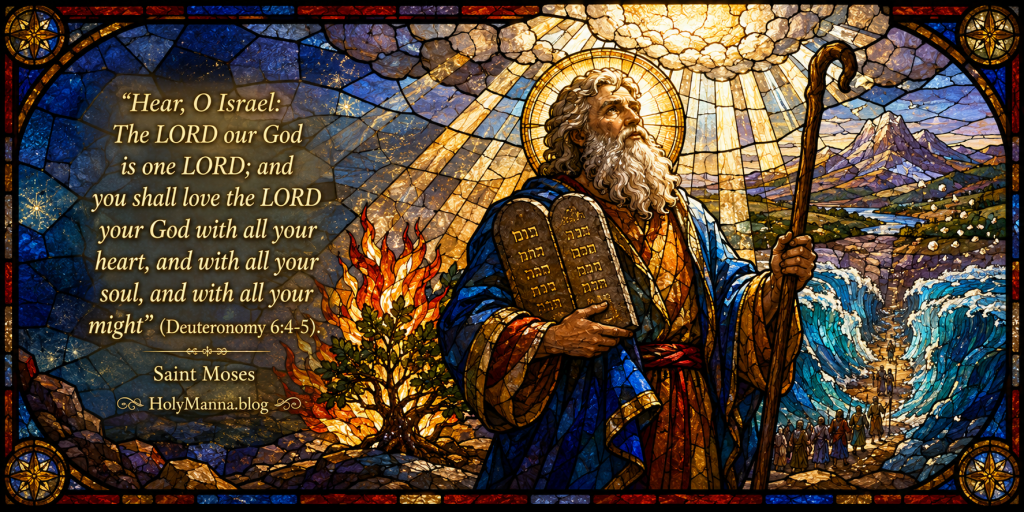
The Friend of God
Most Catholics are surprised to learn that Moses is a saint. He lived more than a thousand years before Christ, he never heard the name of Jesus spoken aloud, and yet every September 4th the Church commemorates him in the Roman Martyrology with these words: “Commemoration of Saint Moses, the prophet, whom God chose to free the people oppressed in Egypt and to lead them into the land of promise; to whom also on Mount Sinai He revealed Himself, saying: ‘I am who am,’ and proposed the law that would govern the life of the chosen people.” The entry closes by recording that this servant of God died on Mount Nebo in the land of Moab, facing the promised land, full of days. The Catechism explains why the Church honors him this way: “The patriarchs, prophets, and certain other Old Testament figures have been and always will be honored as saints in all the Church’s liturgical traditions” (CCC 61).
Moses stands at the very center of the Old Covenant. He is the liberator who led Israel out of slavery, the lawgiver who received the Ten Commandments, the intercessor who stood between a sinful people and a holy God, and the prophet of whom Scripture testifies, “And there has not arisen a prophet since in Israel like Moses, whom the LORD knew face to face” (Deuteronomy 34:10). The Church reads his whole life as a preparation for Christ, for as The Gospel of John declares, “The law was given through Moses; grace and truth came through Jesus Christ” (John 1:17). The Catechism teaches that through Moses, God formed Israel as His people and revealed His law to them, so that they would learn to await the promised Savior (CCC 62). To know Moses is to understand the long, patient love story that leads to Bethlehem and to Calvary.
He matters to the modern reader for a simpler reason too. Moses was not a plaster figure. He was a stammering, reluctant, hot tempered man who ran from his failures, argued with God, grew exhausted by the people he served, and died with his greatest dream unfulfilled. And this is precisely the man Scripture calls God’s friend. That fact alone should give every struggling believer hope.
Drawn Out of the Water
Moses was born in Egypt during the darkest hour of Israel’s slavery, likely somewhere between the fifteenth and thirteenth centuries before Christ; the sources honestly disagree on the precise dating, and the Church has never defined it. He belonged to the tribe of Levi, the son of Amram and Jochebed, the younger brother of Miriam and Aaron (Exodus 6:20). Pharaoh, fearing the growth of the Hebrew people, had commanded that every newborn Hebrew boy be thrown into the Nile. Jochebed hid her infant son for three months, and when she could hide him no longer, she waterproofed a basket of bulrushes, laid the child inside, and set him among the reeds at the river’s edge (Exodus 2:1 to 3).
What Pharaoh intended as a river of death became a river of deliverance. Pharaoh’s own daughter found the basket, took pity on the crying child, and raised him as her son, while his sister Miriam arranged for the baby’s own mother to nurse him. The princess named him Moses, “Because I drew him out of the water” (Exodus 2:10). So the future liberator of the Hebrews grew up in the very palace of their oppressor, formed in the learning of Egypt yet nursed on the faith of his mother.
His first attempt to help his people ended in disaster. As a grown man, Moses saw an Egyptian beating a Hebrew slave, and in anger he killed the Egyptian and hid the body in the sand (Exodus 2:11 to 12). When the deed became known, he fled for his life to the land of Midian. There he defended the daughters of the priest Jethro at a well, married one of them, Zipporah, and settled into four decades of obscurity as a shepherd. The prince of Egypt became a nobody watching sheep on the back side of the desert.
Then came the moment that changed salvation history. At Mount Horeb, Moses saw a bush that burned without being consumed, and from the fire God called his name. When Moses asked who was sending him, God revealed the divine name: “I AM WHO I AM” (Exodus 3:14). The Catechism treats this revelation as one of the foundational moments of all divine revelation, the disclosure of God as the fullness of being and of every perfection, the God who is always there, faithful to His people (CCC 204 to 213). Moses’ response was not eager heroism. He objected five times. He was not eloquent. He was slow of speech. Surely God should send someone else. God answered every excuse, gave him Aaron as a spokesman, and sent him back to Egypt with a shepherd’s staff and a promise. If Moses had a conversion, this was it: the moment a failed, hiding man stopped arguing and obeyed.
Signs and Wonders
What follows in The Book of Exodus is the greatest sustained display of divine power in the Old Testament, and Moses stood at the center of all of it. He walked into Pharaoh’s court with the demand of the Lord: “Let my people go, that they may hold a feast to me in the wilderness” (Exodus 5:1). Pharaoh refused, and through Moses God struck Egypt with ten plagues, culminating in the death of the firstborn and the institution of the Passover, the meal of the spotless lamb whose blood saved Israel from death. The Church has always seen in that lamb the figure of Christ, the true Paschal Lamb whose sacrifice delivers the world (CCC 1334, CCC 608).
At the Red Sea, with Pharaoh’s chariots closing in behind a trapped and terrified people, Moses stretched out his hand and God divided the waters, so that Israel passed through on dry ground while the army of Egypt was drowned (Exodus 14). The Catechism teaches that the Church reads this crossing as a sign of Baptism, the passage through water from slavery into freedom (CCC 1221). In the wilderness the miracles continued through him. Bread from heaven, the manna, fell each morning to feed the people (Exodus 16), which Jesus Himself would later invoke when He revealed the Eucharist, the true bread from heaven (John 6:32 to 35; CCC 1094). Water gushed from the rock at his word and the strike of his staff (Exodus 17:1 to 7). When Amalek attacked, Israel prevailed only while Moses held his arms raised in prayer on the hilltop, with Aaron and Hur supporting his weary hands until sunset (Exodus 17:8 to 13), an image the Church treasures as a picture of persevering intercession.
At Sinai, Moses ascended into cloud and fire and received the Ten Commandments, the heart of the moral law that the Catechism still uses as the frame of Christian moral teaching (CCC 2056 to 2063). And when Israel, in his absence, worshiped a golden calf, Moses did the most astonishing thing of his life. He stood between the guilty people and the justice of God and begged for their pardon, even offering to be blotted out of God’s book in their place (Exodus 32:31 to 32). The Catechism holds up the prayer of Moses as the most striking example of intercessory prayer in the Old Covenant, a prefiguring of the intercession of the one mediator, Christ Jesus (CCC 2574 to 2577). God answered by revealing His own heart: “The LORD, the LORD, a God merciful and gracious, slow to anger, and abounding in steadfast love and faithfulness” (Exodus 34:6).
Why should the reader remember and emulate this man? Because Moses shows what a human life looks like when it is placed entirely at God’s disposal. Scripture says, “Thus the LORD used to speak to Moses face to face, as a man speaks to his friend” (Exodus 33:11). Saint Gregory of Nyssa, Father and mystic of the fourth century, built his entire classic The Life of Moses on that friendship, teaching that the goal of the Christian life is exactly what Moses attained: “This is true perfection: not to avoid a wicked life because, like slaves, we servilely fear punishment, nor to do good because we hope for rewards,” but to count the friendship of God as the only thing worthy of desire. Holiness, in the end, is friendship with God, and Moses is its Old Testament icon.
The Long Wilderness
Moses was not a martyr, but few saints suffered longer. His hardships began the day he accepted his mission and did not end until the day he died. Pharaoh hardened his heart again and again, and Moses’ first efforts made the slaves’ burdens worse, so that his own people turned on him before the deliverance ever began (Exodus 5:20 to 23). Once Israel was free, the murmuring started almost immediately and never truly stopped. No water, no bread, no meat, and every shortage was laid at Moses’ feet, sometimes with stones in hand (Exodus 17:4). At Sinai the people he had just led out of slavery melted their gold into an idol while he was on the mountain receiving the Law for them.
The opposition was not only from the crowd. His own brother and sister, Aaron and Miriam, spoke against him (Numbers 12:1). Korah, Dathan, and Abiram led an open rebellion against his authority (Numbers 16). When the twelve spies returned from Canaan and ten of them spread fear, the whole congregation wept, proposed choosing a new leader, and talked of returning to Egypt (Numbers 14:1 to 4). For forty years Moses carried this people through the desert, and Scripture records how heavy the load became; he told God plainly that the burden was too much for one man to bear (Numbers 11:14). Yet through it all, the Word of God gives him this testimony: “Now the man Moses was very meek, more than all men that were on the face of the earth” (Numbers 12:3). Meekness here is not weakness. It is strength that refuses to grasp, power placed under God’s hand.
His sharpest trial was the one he brought on himself. At the waters of Meribah, commanded to speak to the rock, Moses struck it twice in frustration, and God told him that because he had not trusted and honored Him as holy before the people, he would not lead Israel into the promised land (Numbers 20:10 to 12). Forty years of labor, and the door closed at the threshold. There is a severe mercy in this. Even the friend of God answered for his sin, and even so, God did not stop loving him or working through him.
The end came with a tenderness unmatched in the Old Testament. At one hundred twenty years of age, “his eye was not dim, nor his natural force abated” (Deuteronomy 34:7), Moses climbed Mount Nebo, and from the heights of Pisgah the Lord showed him the whole land, from Gilead to the western sea. He saw the promise with his eyes though he could not cross into it with his feet. There he died, and Scripture says God Himself buried him in the valley, “but no man knows the place of his burial to this day” (Deuteronomy 34:6). No tomb, no relics, no shrine over his bones. God kept His friend’s grave for Himself.
The Prophet Who Stood Beside Christ
For most saints, the story after death is a story of relics and healings at a tomb. Moses has no tomb, and yet his afterlife in the economy of salvation is greater than any shrine. The New Testament itself preserves a mysterious tradition about his body: “But when the archangel Michael, contending with the devil, disputed about the body of Moses, he did not presume to pronounce a reviling judgment upon him, but said, ‘The Lord rebuke you’” (Jude 1:9). The fuller account behind this verse comes from an ancient writing outside the canon of Scripture, and the details of that dispute cannot be verified; the Church receives only what the inspired text of The Letter of Jude affirms. Similarly, 2 Maccabees 2:4 to 8 hands on the tradition that the prophet Jeremiah hid the Ark of the Covenant in a cave on the very mountain Moses had climbed, sealing it until God should gather His people again. This is presented in Scripture as a received account from ancient records, and its details likewise cannot be verified beyond what the sacred text reports.
The greatest appearance of Moses after death is beyond all dispute, because the Gospels record it. On the mountain of the Transfiguration, Peter, James, and John saw Jesus transfigured in glory, “and behold, there appeared to them Moses and Elijah, talking with him” (Matthew 17:3). The Law and the Prophets stood beside the Word made flesh. The Catechism teaches that Moses and Elijah had beheld God’s glory on the mountain in figure, and now they contemplated it unveiled in the face of Christ, with whom they spoke of His coming exodus in Jerusalem (CCC 555). Roughly thirteen centuries after his death on Nebo, Moses finally stood in the promised land, and he stood there with the Promised One. Jesus Himself confirmed Moses’ enduring role when He taught, “And as Moses lifted up the serpent in the wilderness, so must the Son of man be lifted up, that whoever believes in him may have eternal life” (John 3:14 to 15), and when, on the road to Emmaus, “beginning with Moses and all the prophets, he interpreted to them in all the scriptures the things concerning himself” (Luke 24:27).
Veneration of Moses took root early and has never faded. By the fourth century, Christians from Jerusalem were making pilgrimage to Mount Nebo in present day Jordan, where a church was raised over the traditional site of his death. In the fifth and sixth centuries it grew into a great basilica adorned with Byzantine mosaics that survive to this day. The Franciscan friars of the Custody of the Holy Land have guarded the Memorial of Moses on Nebo for nearly a century, and every September 4th they celebrate Mass there for the solemnity of Saint Moses. Outside the basilica rises the famous serpentine cross monument, uniting in one image the bronze serpent Moses lifted in the desert and the Cross of Christ it foreshadowed. Pope Saint John Paul II prayed at Mount Nebo during his Jubilee pilgrimage in the year 2000 and planted an olive tree beside the church, and pilgrims still stand where Moses stood, looking across the Jordan Valley toward Jericho and, on clear days, the distant hills of Jerusalem. Sinai, too, remains a place of pilgrimage, where the ancient Monastery of Saint Catherine preserves the traditional site of the burning bush. And Catholic culture bears his mark everywhere, perhaps nowhere more famously than in Rome itself, where Michelangelo’s towering marble Moses in the basilica of San Pietro in Vincoli has drawn the eyes of the faithful for five centuries. Every baptismal font recalls his sea crossing, and every tabernacle recalls the manna, for the Catechism teaches that the Church reads the events of the Exodus as figures fulfilled in the sacraments of Christ (CCC 1094, CCC 1221, CCC 1334).
Walking Through Your Own Wilderness
Saint Gregory of Nyssa wrote of the prophet’s journey into the cloud on Sinai: “Moses’ vision of God began with light; afterwards God spoke to him in a cloud. But when Moses rose higher and became more perfect, he saw God in the darkness.” That single line describes most honest spiritual lives. Faith often begins in light, in consolation, in the burning bush moments when God feels near. Then come the cloud and the desert, the long stretches when prayer feels dry and progress feels invisible. Moses teaches that the darkness is not abandonment. It can be the very place of deepest intimacy with God. When your prayer feels like wilderness, do you assume God has left, or can you believe He is leading you deeper?
Moses also teaches something bracing about excuses. He gave God five of them at the burning bush, and every one was reasonable. He was a failure, a fugitive, a poor speaker. God did not deny any of it; He simply promised His presence. The Catechism teaches that God calls each person and gives the grace to answer (CCC 2567). What excuse have you been offering God, and what might happen if you laid it down?
His intercession may be his most imitable virtue. Moses stood in the breach for people who were, at that moment, actively betraying him, and the Catechism points to his prayer as the pattern of intercession that finds its fulfillment in Christ (CCC 2574 to 2577). Anyone can practice this today: praying by name for the coworker who undermines you, the family member who wounds you, the leaders you distrust. Persevering prayer, like Moses’ upheld arms over the battle with Amalek, often needs an Aaron and a Hur, friends who steady weary hands; this is a quiet argument for small faith communities, prayer partners, and honest Catholic friendship. And Meribah offers its own hard comfort. Even great disobedience did not end Moses’ friendship with God, though it carried real consequences. The confessional is where the Catholic brings such failures, trusting the God who described Himself to Moses as merciful and gracious, slow to anger, abounding in steadfast love (Exodus 34:6; CCC 210 to 211). Where in your life are you standing at the threshold of a promise, and can you trust God with the timing, even if the fulfillment looks different than you dreamed?
Engage With Us!
The story of Saint Moses is vast, and every reader will hear something different in it. Share your thoughts and reflections in the comments below; the HolyManna community grows richer with every voice that joins the conversation. To help start that reflection, consider these questions:
- Moses argued with God at the burning bush before finally obeying. What call have you been resisting, and what would obedience look like this week?
- Israel grumbled through forty years of desert wandering. When life feels like wilderness, how do you keep gratitude and trust alive?
- Moses interceded for the very people who rebelled against him. Who is one difficult person you can commit to praying for by name this month?
- At Meribah, Moses’ frustration cost him dearly, yet God’s friendship endured. How does this shape the way you approach Confession after your own failures?
- Moses saw the promised land but entered God’s promise fully only at the Transfiguration, beside Christ. How does his story help you trust God’s timing with your own unfulfilled hopes?
Saint Moses spent his whole life walking toward a promise, and God proved faithful beyond anything he could have imagined, not in Canaan but on Tabor, face to face at last with the Lord he had served. Let his witness stir a deeper hunger for that same friendship with God. Walk faithfully through whatever wilderness this season holds, intercede generously, obey courageously, and do everything with the love and mercy that Jesus taught us.
Saint Moses, pray for us!
Follow us on YouTube, TikTok, Instagram and Facebook for more insights and reflections on living a faith-filled life.


Leave a Reply