Friday of the Twenty-second Week in Ordinary Time – Lectionary: 435
When God Sees What Nobody Else Can
There is a quiet freedom hiding in today’s readings, the kind that only shows up once a person stops performing for an audience. Friday of the Twenty-second Week in Ordinary Time places three texts side by side that all point to the same liberating truth: the Lord alone judges, the Lord alone saves, and the Lord alone makes new. Saint Paul, writing to a Corinthian church obsessed with ranking its teachers, shrugs off every human tribunal and even his own self-assessment, because “the one who judges me is the Lord.” The psalmist, singing an ancient wisdom song in a world where the wicked seemed to be winning, answers with a refrain the Church places on every heart today: “The salvation of the just comes from the Lord.” And Jesus, questioned about why His disciples feast while others fast, reveals Himself as the bridegroom of Israel and warns that new wine cannot survive in old wineskins.
Corinth was a boomtown of status and self-promotion, and first-century Judea measured holiness partly by visible disciplines like the twice-weekly fast. Both cultures shared an instinct that has never gone away, the urge to measure, compare, and justify oneself before other people. Into that instinct God speaks a better word. He sees the hidden motives of every heart, He vindicates the just in His own time, and He offers a newness that no amount of patching can imitate. The invitation of this Friday is simple and demanding at once: stop auditioning, start trusting, and let grace replace the old wineskin entirely. What would change in an ordinary Friday if God’s judgment were the only one that mattered?
First Reading — 1 Corinthians 4:1-5
The Steward Who Answers to One Master
The church in Corinth had a celebrity problem. Believers in that wealthy, competitive port city had begun sorting themselves into fan clubs, some for Paul, some for Apollos, some for Cephas, treating the Gospel’s ministers like rival patrons in the Roman honor system. Paul spends the first three chapters of this letter dismantling that mindset, and in chapter four he replaces it with two humble job titles: servant and steward. The Greek word for steward, oikonomos, described the household manager of the ancient world, a servant entrusted with goods that belonged entirely to his master. That single image reframes everything, because a steward is not evaluated by popularity but by trustworthiness, and only the master has the standing to render the verdict. This reading opens the day’s central theme by relocating judgment from the crowd, and even from the self, to the Lord alone.
1 Corinthians 4:1-5
Brothers and sisters:
Thus should one regard us: as servants of Christ
and stewards of the mysteries of God.
Now it is of course required of stewards
that they be found trustworthy.
It does not concern me in the least
that I be judged by you or any human tribunal;
I do not even pass judgment on myself;
I am not conscious of anything against me,
but I do not thereby stand acquitted;
the one who judges me is the Lord.
Therefore, do not make any judgment before the appointed time,
until the Lord comes,
for he will bring to light what is hidden in darkness
and will manifest the motives of our hearts,
and then everyone will receive praise from God.
Detailed Exegesis
Verse 1: “Brothers and sisters: Thus should one regard us: as servants of Christ and stewards of the mysteries of God.”
Paul begins by telling the Corinthians how to see their ministers correctly. The word translated “servants,” hyperetai, originally described under-rowers on a ship, men who labored below deck at another’s command. The “mysteries of God” are the hidden plan of salvation revealed in Christ, which the Church has always understood to include the sacraments themselves; the Latin word sacramentum translates the Greek mysterion. Apostles, and after them bishops and priests, do not own what they hand on. They administer treasures belonging to Christ.
Verse 2: “Now it is of course required of stewards that they be found trustworthy.”
The one qualification that matters is fidelity, not eloquence, charisma, or results. In the ancient household, a steward often knew the master’s affairs intimately, which made faithfulness the whole measure of his worth. The same standard governs every baptized person entrusted with time, talents, family, and faith.
Verse 3: “It does not concern me in the least that I be judged by you or any human tribunal; I do not even pass judgment on myself.”
Paul is not being dismissive of accountability. He is refusing to let the Corinthian popularity contest define his ministry. Remarkably, he extends the point to his own conscience; even self-evaluation is provisional, because no person sees his own heart with perfect clarity.
Verse 4: “I am not conscious of anything against me, but I do not thereby stand acquitted; the one who judges me is the Lord.”
A clear conscience is a gift, but it is not a verdict. Hidden faults, mixed motives, and blind spots escape even honest self-examination. Paul rests his case entirely with the Lord, who alone judges truly.
Verse 5: “Therefore, do not make any judgment before the appointed time, until the Lord comes, for he will bring to light what is hidden in darkness and will manifest the motives of our hearts, and then everyone will receive praise from God.”
The final verse turns the teaching into a command. Premature judgment usurps an office that belongs to Christ at His coming. Notice the surprising ending; Paul does not say everyone will receive condemnation, but praise. For the faithful steward, the last judgment is not primarily a threat but the moment when hidden fidelity finally receives its reward.
Teachings
Saint John Chrysostom preached on these exact verses in Homily 11 of his Homilies on First Corinthians, diagnosing the Corinthian spirit of comparison as a spiritual disease. He wrote, “For thou were not enjoined, O man, to judge others, but to test your own doings. Why then do you seize upon the office of the Lord? Judgment is His, not yours.” Chrysostom then gave three reasons why accurate judgment belongs to God alone, teaching that even a person conscious of nothing wrong still needs a judge, that most deeds remain concealed from human eyes, and that many outwardly good actions “come not of a right mind.” As he summarized, “For He who discerns secrets, He it is who with certainty judges.” The Catechism carries this wisdom into moral teaching on rash judgment. CCC 2478 instructs, “To avoid rash judgment, everyone should be careful to interpret insofar as possible his neighbor’s thoughts, words, and deeds in a favorable way,” and then quotes Saint Ignatius of Loyola’s Spiritual Exercises: “Every good Christian ought to be more ready to give a favorable interpretation to another’s statement than to condemn it.” Together the Fathers and the Catechism guard both truths at once, that stewards must genuinely be trustworthy, and that the final audit belongs to the Lord.
Reflection
This reading lands hard in an age of comment sections, performance reviews, and social media metrics, where nearly everything invites a public verdict. Paul offers a different way to live. Begin by naming the audience you actually perform for, whether a boss, a follower count, or an inner critic, and consciously hand that courtroom over to Christ in prayer. Practice the stewardship examination at night; rather than asking whether the day looked impressive, ask whether it was faithful with what God entrusted. Extend the same mercy outward by refusing one rash judgment each day and choosing the favorable interpretation Saint Ignatius recommends. Whose approval quietly drives your daily decisions? Where has harsh self-judgment or harsh judgment of others crowded out trust in the Lord’s verdict? What would you do differently this week if you truly believed your hidden fidelity will one day receive praise from God?
Responsorial Psalm — Psalm 37:3-6, 27-28, 39-40
A Song for People Tired of Waiting on Justice
Psalm 37 is one of the great wisdom psalms of David, composed in Hebrew as an acrostic, with each section beginning with a successive letter of the alphabet, as if to say that trust in God must be learned from A to Z. The psalm confronts a problem every generation knows painfully well; the wicked often flourish while the just struggle and wait. Its answer is not a philosophical system but a repeated command, trust, delight, commit, turn, and take refuge. The Church places this psalm between Paul’s teaching on divine judgment and Jesus’ revelation of the bridegroom because it supplies the emotional bridge between them. If the Lord alone judges hearts and vindicates His faithful ones, then the just can afford to stop grasping for vindication now. The refrain says it plainly: “The salvation of the just comes from the Lord.”
Psalm 37:3-6, 27-28, 39-40
R. (39a) The salvation of the just comes from the Lord.
Trust in the LORD and do good,
that you may dwell in the land and be fed in security.
Take delight in the LORD,
and he will grant you your heart’s requests.
R. The salvation of the just comes from the Lord.
Commit to the LORD your way;
trust in him, and he will act.
He will make justice dawn for you like the light;
bright as the noonday shall be your vindication.
R. The salvation of the just comes from the Lord.
Turn from evil and do good,
that you may abide forever;
For the LORD loves what is right,
and forsakes not his faithful ones.
Criminals are destroyed
and the posterity of the wicked is cut off.
R. The salvation of the just comes from the Lord.
The salvation of the just is from the LORD;
he is their refuge in time of distress.
And the LORD helps them and delivers them;
he delivers them from the wicked and saves them,
because they take refuge in him.
R. The salvation of the just comes from the Lord.
Detailed Exegesis
Verse 3: “Trust in the LORD and do good, that you may dwell in the land and be fed in security.”
Trust here is not passive. The Hebrew pairs confidence in God with active goodness, and the promised reward, dwelling in the land, evokes the covenant inheritance of Israel. Security flows not from controlling outcomes but from belonging to the God who keeps promises.
Verse 4: “Take delight in the LORD, and he will grant you your heart’s requests.”
This beloved verse is often misread as a formula for getting what one wants. Its real logic runs deeper; the person who delights in the Lord finds desire itself gradually healed, until the heart’s requests align with God’s own goodness.
Verse 5: “Commit to the LORD your way; trust in him, and he will act.”
The Hebrew image behind “commit” is that of rolling a burden onto someone stronger. The verse ends with a promise of divine initiative; God is not a spectator of the just person’s life but an actor within it.
Verse 6: “He will make justice dawn for you like the light; bright as the noonday shall be your vindication.”
Vindication arrives like sunrise, gradual, unstoppable, and on God’s schedule. This verse joins hands directly with 1 Corinthians 4:5, where the Lord “will bring to light what is hidden in darkness.” What the world obscures, God will illuminate.
Verse 27: “Turn from evil and do good, that you may abide forever.”
Wisdom literature always insists on the moral turn. Trust without conversion would be presumption, so the psalm binds the two together as one movement of the heart.
Verse 28: “For the LORD loves what is right, and forsakes not his faithful ones. Criminals are destroyed and the posterity of the wicked is cut off.”
The psalm grounds moral confidence in God’s own character. Because the Lord loves justice, fidelity is never wasted, and evil, however prosperous it appears, carries no future within it.
Verse 39: “The salvation of the just is from the LORD; he is their refuge in time of distress.”
This is the verse the Church selects as the refrain, and it names the psalm’s whole theology in a single line. Salvation is received, not achieved, and distress does not disprove God’s care but becomes the very place where refuge is found.
Verse 40: “And the LORD helps them and delivers them; he delivers them from the wicked and saves them, because they take refuge in him.”
The psalm closes its argument with a cascade of saving verbs, helps, delivers, saves. The condition is disarmingly simple; God saves those who take refuge in Him, which is to say, those who finally stop trusting themselves alone.
Teachings
The Catechism gathers the psalm’s spirituality into its teaching on Divine Providence. CCC 305 teaches, “Jesus asks for childlike abandonment to the providence of our heavenly Father who takes care of his children’s smallest needs.” That abandonment is precisely what Psalm 37 trains the soul to practice, and Jesus Himself gives it definitive form in the Sermon on the Mount when He commands, “Seek first the kingdom of God and his righteousness, and all these things will be given you besides” (Matthew 6:33). The Church’s moral tradition has also drawn on this psalm’s patience with God’s timing when consoling believers scandalized by the prosperity of evil, insisting that the apparent delay of justice is mercy’s patience, not justice’s absence.
Reflection
This psalm is medicine for anyone exhausted by the effort of securing his own vindication. Try praying its verbs as a daily sequence, trusting in the morning, delighting at midday, committing the day’s biggest burden to God by rolling it deliberately onto His shoulders in an evening prayer. When resentment rises toward someone who seems to be prospering through wrongdoing, answer it with the refrain rather than a rehearsed argument. Where are you still trying to make justice dawn by your own strength? What burden most needs to be rolled onto the Lord this week? When distress comes, is God your refuge of first resort or your last?
Holy Gospel — Luke 5:33-39
The Bridegroom Has Arrived, and Everything Is New
This Gospel scene unfolds in the afterglow of a party. Jesus has just called Levi the tax collector, and Levi has responded by throwing a great banquet, filling his house with the kind of guests respectable religion avoided. The scribes and Pharisees, already unsettled, now raise a pointed comparison; the disciples of John the Baptist fast often, the disciples of the Pharisees fast often, following the devout custom of fasting twice weekly beyond what the Law required, yet the disciples of Jesus eat and drink. The question is really about credibility, since visible asceticism was a badge of seriousness about God. Jesus answers with a wedding image and two parables that together announce the day’s central theme in its fullest form. God is doing something new in Christ, something that cannot be patched onto old self-justifying religion, and the only fitting response is a heart made fresh enough to hold it.
Luke 5:33-39
The scribes and Pharisees said to Jesus,
“The disciples of John the Baptist fast often and offer prayers,
and the disciples of the Pharisees do the same;
but yours eat and drink.”
Jesus answered them, “Can you make the wedding guests fast
while the bridegroom is with them?
But the days will come, and when the bridegroom is taken away from them,
then they will fast in those days.”
And he also told them a parable.
“No one tears a piece from a new cloak to patch an old one.
Otherwise, he will tear the new
and the piece from it will not match the old cloak.
Likewise, no one pours new wine into old wineskins.
Otherwise, the new wine will burst the skins,
and it will be spilled, and the skins will be ruined.
Rather, new wine must be poured into fresh wineskins.
And no one who has been drinking old wine desires new,
for he says, ‘The old is good.’”
Detailed Exegesis
Verse 33: “The scribes and Pharisees said to Jesus, ‘The disciples of John the Baptist fast often and offer prayers, and the disciples of the Pharisees do the same; but yours eat and drink.’”
The critics appeal to two respected communities at once, John’s disciples and their own. The implied charge is spiritual laxity. They measure holiness by visible discipline, exactly the kind of human judgment Paul renounced in the First Reading.
Verse 34: “Jesus answered them, ‘Can you make the wedding guests fast while the bridegroom is with them?’”
Jesus answers a question about fasting with a claim about His identity. In the prophets, God Himself is the bridegroom of Israel, as Isaiah 54:5 proclaims. By taking that title, Jesus quietly declares that the long-awaited wedding of God and His people has begun, and His table fellowship with sinners is the wedding feast.
Verse 35: “But the days will come, and when the bridegroom is taken away from them, then they will fast in those days.”
The phrase “taken away” is Luke’s first veiled prophecy of the Passion. Fasting is not abolished but transfigured; Christian fasting is the ache of the Bride for her Bridegroom between the Ascension and His return, which is why the Church still fasts, and why she keeps Fridays as days of penance.
Verse 36: “And he also told them a parable. ‘No one tears a piece from a new cloak to patch an old one. Otherwise, he will tear the new and the piece from it will not match the old cloak.’”
The parable of the garment teaches that the Gospel is not a repair job. Tearing a piece of Christ’s newness to patch a self-made righteousness ruins both; the new is torn and the old still fails.
Verse 37: “Likewise, no one pours new wine into old wineskins. Otherwise, the new wine will burst the skins, and it will be spilled, and the skins will be ruined.”
Ancient wineskins were made of leather that stretched as young wine fermented. Old skins, already stretched and brittle, would split under the pressure of new wine. Grace is living and expanding, and a rigid heart cannot contain it without breaking.
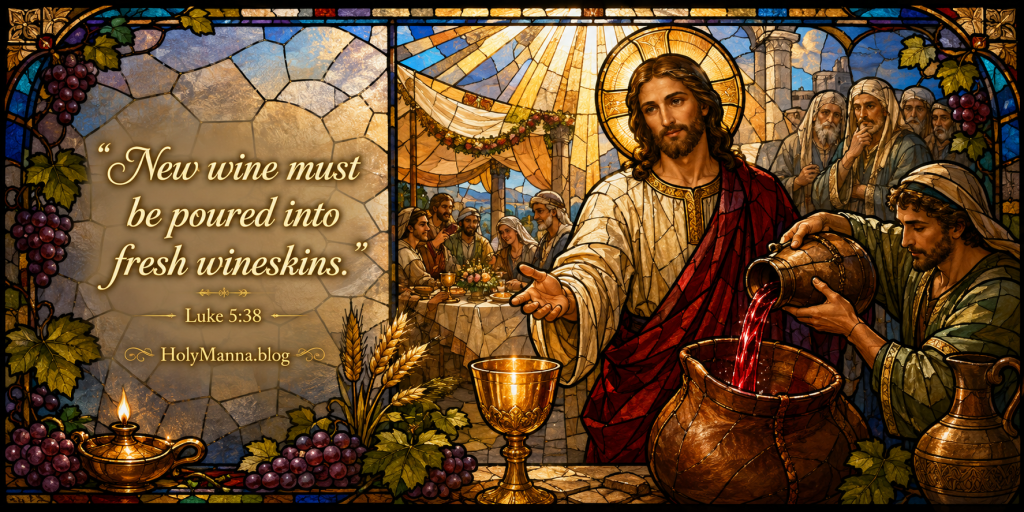
Verse 38: “Rather, new wine must be poured into fresh wineskins.”
The solution is not weaker wine but a renewed vessel. God does not dilute the Gospel to fit comfortable habits; He remakes the person, through conversion and the sacraments, into a vessel supple enough to hold His life.
Verse 39: “And no one who has been drinking old wine desires new, for he says, ‘The old is good.’”
This closing observation, unique to Luke, is Jesus’ compassionate diagnosis of human nature. Familiar religion, familiar sin, familiar routine all feel safer than grace. The verse is less a condemnation than a warning; comfort with the old can quietly close a soul to the newness God offers.
Teachings
The Catechism confirms the astonishing claim hidden in verse 34. CCC 796 teaches, “The unity of Christ and the Church, head and members of one Body, also implies the distinction of the two within a personal relationship. This aspect is often expressed by the image of bridegroom and bride. The theme of Christ as Bridegroom of the Church was prepared for by the prophets and announced by John the Baptist. The Lord referred to himself as the ‘bridegroom.’” The Church’s living practice of fasting also flows directly from verse 35. CCC 1434 teaches, “The interior penance of the Christian can be expressed in many and various ways. Scripture and the Fathers insist above all on three forms, fasting, prayer, and almsgiving, which express conversion in relation to oneself, to God, and to others.” Saint John Chrysostom’s insight from the First Reading illuminates the Pharisees’ error here as well, since their question sprang from exactly the comparing spirit he condemned when he preached, “Judgment is His, not yours.” The scribes measured Jesus’ disciples against their own disciplines and found them wanting, while the Bridegroom Himself stood before them unrecognized.
Reflection
The honest question this Gospel raises is uncomfortable; every believer has an old wineskin somewhere. It might be a prayer routine that has hardened into mere habit, a grudge so familiar it feels like part of the furniture, or a version of faith kept deliberately small so it never demands change. Ask the Holy Spirit this week to name one old wineskin, then take a concrete step to let God replace it, perhaps returning to Confession after a long absence, embracing the Friday penance the Church still asks of the faithful, or bringing joy back into faith by celebrating what God is actually doing rather than auditing everyone else’s devotion. Where has “the old is good” become the quiet motto of your spiritual life? Does your fasting and penance flow from longing for the Bridegroom or from the desire to be seen as serious? What new thing might God pour into your life if the vessel were finally made fresh?
The God Who Judges Gently and Makes All Things New
Taken together, this Friday’s readings tell a single story about letting go. Paul lets go of every human tribunal, and even his own self-verdict, because the Lord who sees hidden motives is the only judge worth having. The psalmist lets go of the exhausting project of self-vindication, rolling every burden onto the God who makes justice dawn like morning light. And in the Gospel, Jesus invites His questioners to let go of the old wineskin itself, the brittle, self-justifying religion that measures and compares, so that the new wine of the Bridegroom’s joy can be poured out without being spilled.
The thread running through all of it is trust. The steward trusts the Master’s judgment. The just man trusts the Lord’s salvation. The disciple trusts that the newness Christ brings is better than the comfort of the old. None of this is passive; trust in these readings looks like doing good, turning from evil, remaining faithful in hidden things, and allowing grace to stretch the heart in ways that sometimes ache.
So here is the invitation for the rest of this day. Resign from the courtroom, both the judge’s bench and the defendant’s chair. Hand the Lord one burden, one resentment, one worn-out routine, and ask Him to make it new. Keep the Friday penance not as a performance but as the Bride’s longing for her Bridegroom. The One who will one day bring every hidden thing to light is the same One who prepared a wedding feast and calls each soul to the table. He can be trusted with the verdict, with the timing, and with the wine.
Engage With Us!
Reflections, questions, and stories from fellow readers make this community stronger, so please share in the comments below how today’s readings spoke to your heart.
- In 1 Corinthians 4:1-5, Saint Paul says the Lord alone will manifest the motives of hearts. Whose judgment, including your own harsh self-judgment, do you most need to surrender to Christ, and what is one practical way you can do that this week?
- In Psalm 37:3-6, 27-28, 39-40, the psalmist commands trust, delight, and commitment to the Lord. Which of those three movements comes hardest for you right now, and what burden could you roll onto the Lord today?
- In Luke 5:33-39, Jesus warns that new wine bursts old wineskins. What old habit, routine, or attitude might be keeping the new wine of grace from expanding in your life?
- Considering all of today’s readings together, where is God inviting you to stop performing for human approval and to trust instead that He alone judges, saves, and makes new?
However the Lord speaks to you today, take heart in this; the God who sees every hidden thing sees your hidden fidelity too, and He never forsakes His faithful ones. Go into this Friday determined to live your faith with joy, doing everything, in word and in deed, with the love and mercy Jesus taught us.
Sacred Heart of Jesus, we trust in You!
Immaculate Heart of Mary, pray for us!
Saint Michael the Archangel, defend us in battle!
Follow us on YouTube, TikTok, Instagram and Facebook for more insights and reflections on living a faith-filled life.


Leave a Reply