The Servant Who Ruled
Only two popes in the entire history of the Church are honored with the title of the Great, and the man the Church celebrates on September 3rd is one of them. Pope Saint Gregory the Great, who reigned from 590 to 604, is a Doctor of the Church and one of the four great Latin Fathers of the West, standing alongside Saint Ambrose, Saint Augustine, and Saint Jerome. He is often called the father of the medieval papacy, the pope who held a collapsing Rome together with prayer, administration, and relentless charity while empires crumbled around him. He gave the Church the Pastoral Rule, a manual for shepherds of souls that bishops read for over a thousand years. He sent the missionaries who converted England. The Church’s ancient sacred music, Gregorian chant, bears his name. And he was the first pope to sign himself with a title every pope has used since, calling himself the servant of the servants of God.
Here is the beautiful irony at the heart of his story. The man who shaped the papacy for a thousand years never wanted to be pope. He wanted to be a monk, hidden away with his books and his prayers. God had other plans, and Gregory’s obedience to those plans is exactly why the Church calls him great. His greatness is the greatness the Catechism describes when it teaches that the exercise of authority in the Church is a true service, for CCC 876 explains that sacred ministers are truly servants and even slaves of Christ, following the example of the Lord who freely took the form of a slave for our sake.
Gregory the Great is the patron saint of musicians, singers, students, and teachers, a fitting legacy for a man who taught the whole Western Church how to pray, how to sing, and how to lead.
The Prefect Who Traded a Palace for a Cell
Gregory was born in Rome around the year 540, into one of the most distinguished Christian families the city had left. His home stood on the Caelian Hill, one of Rome’s seven ancient hills. His father, Gordianus, was a wealthy senator who held high office in the city. His great-great-grandfather was Pope Felix III, who reigned from 483 to 492, in an era before clerical celibacy was universally required in the West. Holiness ran even deeper on the other side of the family. His mother, Silvia, is herself a canonized saint, and two of his aunts, Tarsilla and Aemiliana, lived as consecrated virgins in their own home, devoting themselves to prayer and self-denial. Gregory grew up surrounded by people who took God seriously, and it marked him for life.
The Rome of Gregory’s childhood was not the Rome of marble glory. The Western Empire had already fallen. War, invasion, flood, and disease had gutted the city. Yet Gregory received the best education Rome could still offer, excelling in law and administration, and he rose fast. Around the year 572 or 573, while still a young man, he was appointed Prefect of the City of Rome, the highest civil office Rome had to give. He had reached the summit of worldly success before most men finish climbing.
Then he walked away from all of it. After his father’s death, Gregory made a decision that stunned Roman society. He sold his vast estates and used the proceeds to found six monasteries in Sicily. He gave generously to the poor. Then he did something even more radical, converting his own family mansion on the Caelian Hill into a monastery dedicated to Saint Andrew, and entering it himself, not as its founder and patron but as a simple monk. For roughly three years he lived in that hidden life of prayer, fasting, and study, and he would later call those years the happiest of his life. His austerities during this period were so severe that his biographers believed they permanently damaged his health, leaving him with chronic illness that shadowed the rest of his days.
The Church, however, does not let lamps stay hidden under bushel baskets. The pope drew Gregory out of the cloister, ordained him one of the seven deacons of Rome, and around 579 sent him to Constantinople as the papal representative to the imperial court, where he served for about six years. Even there, Gregory lived like a monk in the middle of a palace, keeping the monastic rhythm of prayer with the brothers who accompanied him and beginning his monumental commentary on the Book of Job, the Moralia in Job. Recalled to Rome, he became abbot of his beloved Saint Andrew’s, and he surely hoped the story would end there, in the quiet he loved. It did not.
A Shepherd for a Suffering City
In 590 the Tiber flooded Rome, and in the pestilence that followed, Pope Pelagius II died. The clergy and people of Rome turned with one voice to Gregory. He resisted, and tradition holds that he even wrote to the emperor asking that his election not be confirmed. His humility here was not false modesty. Gregory sincerely believed the contemplative life was his calling and dreaded the weight of governing souls. He was consecrated pope on September 3, 590, the very date the Church now keeps as his feast, and he accepted the office as a cross.
That reluctance became the seedbed of his wisdom. In his Pastoral Rule, written at the beginning of his pontificate, Gregory poured out everything he understood about spiritual leadership, warning the unprepared with words that still sting: “No one presumes to teach an art till he has first, with intent meditation, learned it. What rashness is it, then, for the unskilful to assume pastoral authority, since the government of souls is the art of arts!” For centuries, bishops across Europe were handed this book at their consecration. It shaped the Christian understanding of what a shepherd owes his flock, teaching that the leader must be close to each person in compassion while lifted above all in contemplation.
As pope, Gregory governed like a monk and served like a father. When famine struck Rome in the 590s, he ordered Church assets liquidated to feed the poor, and he organized the vast agricultural estates of the Church, the patrimony of Peter, into an efficient relief system that shipped grain into the starving city. He emptied the papal treasury to ransom captives taken by the invading Lombards, and when imperial authorities failed to protect Rome, Gregory himself negotiated with the Lombard king to spare the city. He removed unworthy clergy from office and forbade the taking of money for sacred services. He defended the Jewish communities of Italy, insisting in his letters that Jews must be free to practice their religion and enjoy their legal rights, and firmly forbidding forced baptisms, a principle of protection that later popes would repeat for centuries. He wrote more than eight hundred letters that survive to this day, guiding bishops, correcting abuses, comforting the afflicted, and managing the affairs of a continent, all while chronically ill.
His heart, though, always beat for the missions. Before his papacy, according to a beloved tradition first written down by English monastics around the year 700 and made famous by Saint Bede in his Ecclesiastical History, Gregory once saw fair-haired boys from Britain being sold in the Roman market. When told they were Angles and still pagan, he sighed that such beautiful faces should belong to souls without the light of Christ, and said, in Bede’s telling, “It is well, for they have the faces of angels, and such should be the co-heirs of the angels of heaven.” The famous short form of the saying, not Angles but angels, grew from this account. It is a treasured story handed down by tradition rather than a documented event, and it cannot be verified. What can be verified is what Gregory actually did. In 596 he sent forty monks from his own monastery of Saint Andrew, led by Saint Augustine of Canterbury, to evangelize Anglo-Saxon England. When the missionaries lost their nerve in Gaul and wanted to turn back, Gregory’s firm encouragement pushed them on. They landed in Kent in 597, King Ethelbert received them, and England entered the Catholic Church. For this, Gregory is honored as the Apostle of the English, a living witness to the missionary mandate the Catechism describes in CCC 849, that the Church is sent by God to the whole world as the universal sacrament of salvation.
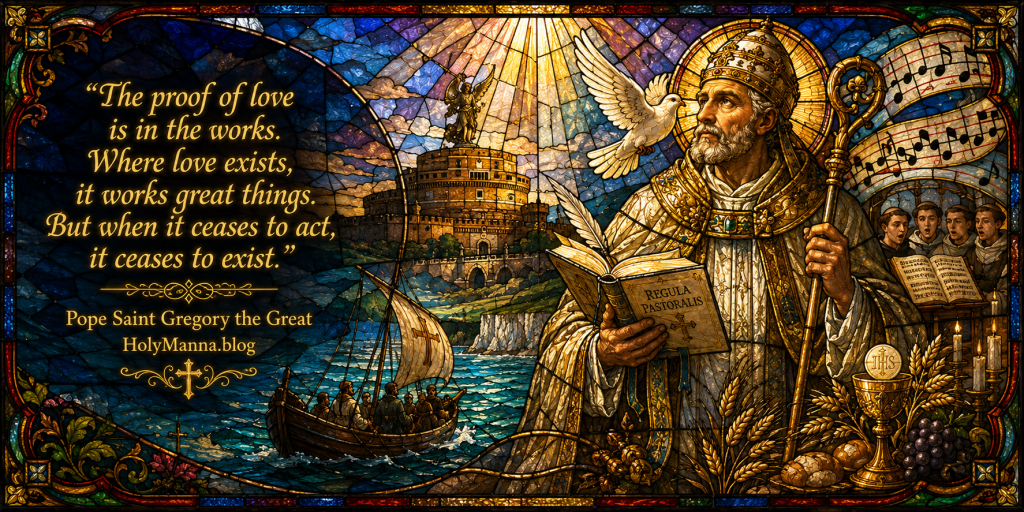
Gregory also left his fingerprints on the Mass itself. He strengthened the place of the Lord’s Prayer in the liturgy, where it remains to this day, and he revised and ordered the prayers of Roman worship. Tradition credits him with collecting and standardizing the sacred plainchant of the Church, which is why it is called Gregorian chant, and medieval art loved to paint the Holy Spirit in the form of a dove singing the melodies into his ear. Historians debate how much of the chant’s development belongs to Gregory personally, and the dove imagery comes from hagiography written centuries later, so this attribution is a tradition rather than settled fact and cannot be verified in its details. Yet the instinct behind the tradition is sound, because Gregory truly believed that the Church’s worship should be beautiful, reverent, and sung. The Catechism echoes his conviction in CCC 1156, teaching that the musical tradition of the universal Church is a treasure of inestimable value, greater even than that of any other art.
His preaching, meanwhile, was direct enough to reach a tired, frightened people and deep enough to feed the Church for fourteen centuries. In his homilies on the Gospels he gave one of his most famous verified teachings on love: “The proof of love is in the works. Where love exists, it works great things. But when it ceases to act, it ceases to exist.” He also gave the Church one of her great principles for reading the Bible, cited in the Catechism itself at CCC 94, where his Homilies on Ezekiel stand behind the teaching that understanding of the faith grows through contemplation and study, for the divine words grow with the one who reads them. His Moralia in Job gave the Church her classic enumeration of the seven deadly sins, and his Dialogues preserved almost everything the world knows about Saint Benedict of Nursia, the father of Western monasticism. Without Gregory, the memory of Benedict might have been lost.
One story from Gregory’s own pen deserves special attention. In Book Four of the Dialogues, Gregory recounts that a monk of his monastery named Justus died after breaking his vow of poverty by hiding three gold coins. Gregory, both as discipline and as mercy, ordered that Mass be offered for the repose of Justus on thirty consecutive days. At the end of the thirty days, Gregory relates, Justus appeared to his brother in a vision and announced that he had been released from his purification and admitted to communion with the blessed. This account, told as a miracle story by Gregory himself, became the origin of the venerable custom of Gregorian Masses, thirty Masses offered on consecutive days for a soul in purgatory, a practice the faithful continue to request to this day. As a private miracle account it cannot be independently verified, but the doctrine beneath it is the Church’s own. Indeed, the Catechism quotes Gregory directly when it teaches on purgatory, for CCC 1031 cites his words: “As for certain lesser faults, we must believe that, before the Final Judgment, there is a purifying fire.” The Church’s teaching in CCC 1030 to CCC 1032, that those who die in God’s grace but still imperfectly purified undergo purification, and that the faithful on earth can help them by prayer and above all by the Eucharistic sacrifice, stands on foundations Gregory helped articulate.
Illness, Invasion, and the Weight of the World
Gregory was not a martyr, and his iconography carries no palm, yet few popes have carried heavier crosses. His entire pontificate unfolded in a world that seemed to be ending. The Lombards ravaged Italy, burning towns and carrying off captives, and Gregory watched refugees stream into Rome with nothing. Plague returned again and again. Famine gnawed at the city. The imperial government in distant Constantinople offered little real help while resenting Gregory’s independence, and his relations with the East were strained further when the Patriarch of Constantinople adopted a grandiose title that Gregory believed wounded the humility proper to a bishop. It was partly in answer to that pride that Gregory chose for himself the opposite title, servant of the servants of God, turning a controversy into a permanent lesson in Christian leadership.
His most constant companion, though, was physical suffering. The severe fasting of his monastic years had wrecked his digestion, and for the rest of his life he endured chronic stomach ailments, gout, and long stretches when he was too weak to rise from bed. He often dictated letters and homilies while lying down in pain. He confessed openly in his writings how much he grieved the loss of his monastic quiet, describing his soul as tossed on the waves of worldly business while remembering the calm harbor of contemplation he had left behind. Here was a man who suffered not the executioner’s sword but the slow martyrdom of duty, illness, and interior longing, and who offered all of it to God without abandoning his post.
There is also the dramatic tradition attached to the very beginning of his papacy. In 590, with plague devouring Rome, Gregory called the whole city to penitential processions, begging God for mercy. The processions themselves are documented history, and the chronicler Gregory of Tours records that the pestilence was so fierce that dozens of the faithful died even as they marched and prayed. Tradition adds a glorious ending, telling that as the procession approached the mausoleum of the Emperor Hadrian beside the Tiber, Gregory saw the Archangel Michael standing atop the monument, sheathing his flaming sword as a sign that the chastisement was over, and that the plague then ceased. From this tradition the fortress took its present name, Castel Sant’Angelo, the Castle of the Holy Angel, and a statue of Michael sheathing his sword crowns it to this day. The earliest written accounts of the apparition come from centuries after Gregory’s death, so this story is a tradition and cannot be verified, yet it has shaped the prayer and the very skyline of Rome for over a thousand years.
Worn out by labor and illness, Gregory died on March 12, 604, having governed the Church for thirteen years, six months, and ten days. He was buried in Saint Peter’s Basilica.
The Acclamation of the Ages
Gregory was canonized immediately after his death by popular acclamation, in the ancient manner before formal canonization processes existed, so unanimous was the conviction of the faithful that a saint had gone home. His veneration answers exactly to what the Catechism teaches in CCC 828, that by canonizing certain of her faithful the Church recognizes the power of the Spirit of holiness within her and sustains the hope of believers by giving them models and intercessors.
His relics rest beneath an altar in Saint Peter’s Basilica in Rome, where pilgrims from every nation still kneel to ask his intercession, confident in the communion of saints described in CCC 956, which teaches that the saints in heaven do not cease to intercede with the Father for us. In 1295 Pope Boniface VIII declared him a Doctor of the Church, sealing what the faithful had known for seven centuries.
Later tradition attached miracle stories to his memory and to the Masses he celebrated. Among the most famous is the account, handed down by his medieval biographers, that during a Mass celebrated by Gregory a woman doubted the Real Presence of Christ in the Eucharist, and that at Gregory’s prayer the Lord granted a visible sign of the truth of His presence, confirming her faith. This story became enormously popular in the Middle Ages and inspired countless works of art depicting the Mass of Saint Gregory, in which the suffering Christ appears on the altar as Gregory prays. It is a tradition recorded long after his lifetime and it cannot be verified, but it endures because it points to a truth the Church solemnly professes, taught in CCC 1374, that in the Blessed Sacrament the Body and Blood of Christ, together with His soul and divinity, are truly, really, and substantially contained.
Gregory’s impact after death is measured less in isolated wonders and more in the sheer scale of his legacy. The custom of Gregorian Masses for the dead continues in monasteries and parishes around the world. Gregorian chant, the Church’s own song, carries his name into every generation that sings it, and the revival of chant among young Catholics today means a sixth-century pope is still teaching the twenty-first century how to pray. England, the nation he adopted from a slave market, venerated him for a millennium as its apostle. The Pastoral Rule formed the bishops of Europe. The Eastern churches honor him too, commemorating him on March 12th under the beautiful title Gregory the Dialogist, after his beloved Dialogues. Churches, schools, seminaries, and universities across the world bear his name, and his tomb in Saint Peter’s remains a station of pilgrimage at the heart of Christendom. Sixteen popes after him took the name Gregory, a quiet vote of the centuries for the kind of shepherd he was.
What the Reluctant Pope Teaches a Restless Generation
Gregory’s life speaks with surprising force to anyone trying to follow Christ in a demanding, distracted world. He was a man who had every excuse to choose comfort. He had wealth, status, and power by age thirty, and he discovered that none of it satisfied the hunger in his soul. What would it look like to be that honest about the emptiness of success? His answer was radical generosity, selling what he had, serving the poor, and giving God everything, and his answer echoes the invitation the Lord gives in The Gospel of Matthew, where Jesus calls the rich young man to sell his possessions, give to the poor, and follow Him.
Yet the deeper lesson may be what happened next, because God did not leave Gregory in the peaceful life Gregory chose for himself. He was pulled out of the monastery and handed responsibilities he dreaded. He served anyway, with his whole strength, while sick, grieving his lost quiet, and surrounded by catastrophe. That is a word for every person whose life does not look like the life they planned. Holiness is not found in the vocation we would have picked, but in the faithful living of the one God actually gives. The Catechism teaches in CCC 2427 that in work, the person exercises and fulfills part of the potential inscribed in his nature by the Creator, and that work can be a means of sanctification. Gregory sanctified paperwork, negotiations, grain shipments, and endless correspondence. Is there a duty in this season of life that feels like an interruption to holiness, when it may actually be the road to it?
Gregory also refused to separate love from action. His famous line that love proves itself in works, and ceases to exist when it ceases to act, is a standing examination of conscience. It is easy to feel compassion; Gregory fed people. It is easy to admire missionaries; Gregory sent forty of his own monks and refused to let them quit. Practical steps flow naturally from his example. Choosing one concrete act of mercy each week, a meal for someone struggling, a visit to someone lonely, a sacrificial gift to the poor, turns sentiment into charity. Praying for the dead, perhaps even requesting a Mass for a deceased loved one in the spirit of the Gregorian Masses, exercises the communion of saints that CCC 958 describes, where the Church from the earliest times has honored the memory of the dead and offered prayers for them, above all the Eucharistic sacrifice. Bringing beauty back into worship, even simply by learning a single chant or singing at Mass with full heart, honors the treasure CCC 1156 describes. And leading, wherever one leads, as a servant rather than a superior, whether in a family, a classroom, a parish, or a workplace, imitates the man who ruled the Church while calling himself the servant of the servants of God. Who is God asking you to serve in the place where you already stand?
Engage With Us!
Pope Saint Gregory the Great has been teaching the Church for more than fourteen centuries, and now it is your turn to sit in his classroom. Share your thoughts and reflections in the comments below; hearing how his story lands in your life is a gift to everyone who reads along. To get the conversation started, here are some questions to pray with.
- Gregory walked away from the highest office in Rome because success could not satisfy his soul. Where in your own life have you felt that same quiet emptiness, and what might God be inviting you to do about it?
- Gregory called the years he spent as a hidden monk the happiest of his life. What daily habit of prayer or silence could you build to give God that kind of hidden space in your schedule?
- Gregory taught that love proves itself in works and dies when it stops acting. What is one concrete act of mercy you can commit to this week?
- Gregory served faithfully in a vocation he never wanted, through illness and crisis. Is there a responsibility in your life that you have been treating as an interruption rather than a calling?
- The custom of Gregorian Masses grew from Gregory’s love for a soul in purgatory. Who among your beloved dead could you pray for, or have a Mass offered for, this month?
Take Gregory’s great title and make it your mission this week: be a servant of the servants of God in your home, your work, and your parish. Live your faith out loud, prove your love in works, and do everything with the love and mercy that Jesus taught us.
Pope Saint Gregory the Great, pray for us!
Follow us on YouTube, TikTok, Instagram and Facebook for more insights and reflections on living a faith-filled life.


Leave a Reply