Memorial of Saint Gregory the Great, Pope and Doctor of the Church – Lectionary: 434
The Foolish Wisdom of Letting Go
There is a moment in every believer’s life when human calculation runs out of road. The nets come up empty. The plan that looked so smart falls apart. And right there, in that exhausted, humbling place, God tends to show up with a request that makes no earthly sense. Today’s readings, on the Memorial of Saint Gregory the Great, are all about that moment. Saint Paul tells the Corinthians, a community obsessed with clever teachers and social status, that the wisdom of this world is foolishness to God, and that the only way to become truly wise is to become a fool in the world’s eyes. Psalm 24 announces the reason this surrender is safe: the earth and everything in it already belongs to the Lord, so nothing handed over to Him is ever really lost. Then Saint Luke shows what this looks like in flesh and blood. A professional fisherman, bone-tired after a fruitless night, takes rowing instructions from a carpenter and hauls in a catch that nearly sinks two boats. Simon Peter’s response is not a victory lap; it is worship, repentance, and total abandonment. The saint the Church celebrates today lived the same story. Gregory was Prefect of Rome, wealthy, brilliant, and powerful, and he walked away from all of it to become a monk, then a pope who signed his letters as the servant of the servants of God. The world called it a waste. Heaven called it wisdom. What might God be asking to be handed over today?
First Reading — 1 Corinthians 3:18-23
When Being Smart Is Not Enough
Corinth in the early 50s AD was a boomtown, a wealthy Roman port city where reputation was currency and eloquence was power. The young Christian community there had absorbed the culture around it, splitting into fan clubs behind favorite teachers: Paul, Apollos, Cephas. Paul spends the first three chapters of this letter dismantling that status game, and today’s passage is his closing argument. It fits the day’s central theme perfectly, because Paul demands the same surrender of intellectual pride that Peter will make of professional pride in the Gospel.
1 Corinthians 3:18-23
Brothers and sisters:
Let no one deceive himself.
If anyone among you considers himself wise in this age,
let him become a fool, so as to become wise.
For the wisdom of this world is foolishness in the eyes of God,
for it is written:God catches the wise in their own ruses,
and again:
The Lord knows the thoughts of the wise, that they are vain.
So let no one boast about human beings, for everything belongs to you,
Paul or Apollos or Cephas,
or the world or life or death,
or the present or the future:
all belong to you, and you to Christ, and Christ to God.
Detailed Exegesis
Verse 18: “Let no one deceive himself. If anyone among you considers himself wise in this age, let him become a fool, so as to become wise.” Paul names the most dangerous deception of all, self-deception. The phrase “in this age” is key; there is a wisdom proper to the passing world and a wisdom proper to God, and they measure success in opposite directions. Becoming a “fool” means accepting the crucified Christ as the center of reality, which sophisticated Corinth found laughable.
Verse 19: “For the wisdom of this world is foolishness in the eyes of God, for it is written: God catches the wise in their own ruses.” Paul quotes Job 5:13. The image is almost playful; the clever are tangled in the very traps they set. Human cunning, when it excludes God, becomes its own undoing.
Verse 20: “and again: The Lord knows the thoughts of the wise, that they are vain.” This second citation comes from Psalm 94:11. The word “vain” means empty, without substance. God is not intimidated by human brilliance; He sees straight through it to its expiration date.
Verse 21: “So let no one boast about human beings, for everything belongs to you,” Here Paul pivots brilliantly. The Corinthians were saying “I belong to Paul” or “I belong to Apollos,” shrinking themselves into the property of a teacher. Paul flips the ownership entirely: the teachers belong to you, as servants and gifts.
Verse 22: “Paul or Apollos or Cephas, or the world or life or death, or the present or the future: all belong to you,” The list explodes outward. Not just teachers, but the world, life, death, present, and future are placed in the believer’s inheritance. In Christ, even death becomes a servant, the doorway to eternal life rather than a master to be feared.
Verse 23: “and you to Christ, and Christ to God.” The chain of belonging ends in the Blessed Trinity. The believer’s vast inheritance is safe only because the believer is not self-owned; belonging to Christ, who belongs to the Father, is the anchor that makes everything else gift rather than possession.
Teachings
Saint John Chrysostom, preaching on this passage in his Homilies on First Corinthians, teaches that Paul humbles the factions by reversing their boasting; the teachers they idolized were in fact servants given to the Church for her benefit, so gluing one’s identity to any human leader gets the Gospel backwards. The Catechism identifies where real wisdom comes from in CCC 1831: “The seven gifts of the Holy Spirit are wisdom, understanding, counsel, fortitude, knowledge, piety, and fear of the Lord. They belong in their fullness to Christ, Son of David. They complete and perfect the virtues of those who receive them.” Wisdom heads the list, and it is received, not achieved. Saint Gregory the Great, whose memorial the Church keeps today, embodied this reading. One of the most capable administrators in Rome, he became a “fool” by worldly standards, trading the Prefecture for a monk’s cell. Yet in his Pastoral Rule, Book 1, he showed how seriously he took sacred responsibility: “What rashness is it, then, for the unskilful to assume pastoral authority, since the government of souls is the art of arts!” The man who renounced worldly wisdom became one of the wisest shepherds the Church has ever known, honored as a Doctor of the Church.
Reflection
This reading lands hard in an age of personal brands, credentials, and curated expertise. There is nothing wrong with education or skill; Gregory kept every ounce of his administrative genius and put it at God’s service. The question is ownership. Consider a practical step this week: identify one area of life where self-reliance has quietly replaced prayer, a career decision, a family conflict, a financial worry, and deliberately bring it before God first, before consulting anyone else. Another concrete practice is to pray for the gift of wisdom by name each morning, since CCC 1831 lists it first among the gifts of the Holy Spirit. Where does the temptation to appear wise “in this age” show up most, at work, online, or among friends? What would it cost to become a fool for Christ in that exact place?
Responsorial Psalm — Psalm 24:1-6
The Deed to the Whole Earth
Psalm 24 is an entrance liturgy, a hymn sung as pilgrims ascended Mount Zion toward the Temple, and ancient tradition associates it with David bringing the Ark of the Covenant into Jerusalem amid shouts and trumpet blasts. It opens with a claim so large it reframes everything else: God holds the deed to the entire created order. That claim is the hinge of today’s liturgy. Paul can tell the Corinthians that everything belongs to them in Christ, and Peter can abandon his boats, precisely because the earth and its fullness were never theirs to begin with.
Psalm 24:1-6
R. (1) To the Lord belongs the earth and all that fills it.
The LORD’s are the earth and its fullness;
the world and those who dwell in it.
For he founded it upon the seas
and established it upon the rivers.
R. To the Lord belongs the earth and all that fills it.
Who can ascend the mountain of the LORD?
or who may stand in his holy place?
He whose hands are sinless, whose heart is clean,
who desires not what is vain.
R. To the Lord belongs the earth and all that fills it.
He shall receive a blessing from the LORD,
a reward from God his savior.
Such is the race that seeks for him,
that seeks the face of the God of Jacob.
R. To the Lord belongs the earth and all that fills it.
Detailed Exegesis
Verse 1: “The LORD’s are the earth and its fullness; the world and those who dwell in it.” Everything, from the oceans to every human person, belongs to God by right of creation. This single verse demolishes both greed and anxiety; nothing can be truly lost that was never truly owned.
Verse 2: “For he founded it upon the seas and established it upon the rivers.” In the ancient Near East, the sea symbolized chaos and threat. The psalmist declares that God built the stable world on top of chaos itself, an image Peter will experience personally when the Lord of the sea commandeers his fishing boat.
Verse 3: “Who can ascend the mountain of the LORD? or who may stand in his holy place?” The pilgrim’s question. If the whole earth is His, approaching His presence is no casual matter. The question assumes what Peter will feel in the Gospel, that holiness exposes the one who draws near.
Verse 4: “He whose hands are sinless, whose heart is clean, who desires not what is vain.” The answer is moral, not ritual. Clean hands mean just deeds; a clean heart means purified intention; and the refusal of “what is vain” echoes Paul’s verdict that the thoughts of the worldly wise are vain. The ascent to God requires letting go of empty things.
Verse 5: “He shall receive a blessing from the LORD, a reward from God his savior.” Notice the direction of the gift. The climber does not seize the blessing at the summit; God bestows it. Even the purity required for the ascent is grace, since the verse names God as “savior.”
Verse 6: “Such is the race that seeks for him, that seeks the face of the God of Jacob.” The psalm widens from one pilgrim to a whole people, a generation of seekers. The Church reads herself here, a pilgrim people ascending together, longing not for things but for a Face.
Teachings
The Catechism connects this psalm’s demand for a clean heart to the words of Jesus in CCC 2518: “The sixth beatitude proclaims, ‘Blessed are the pure in heart, for they shall see God.’ ‘Pure in heart’ refers to those who have attuned their intellects and wills to the demands of God’s holiness, chiefly in three areas: charity; chastity or sexual rectitude; love of truth and orthodoxy of faith.” The psalmist’s question about who may ascend finds its final answer in the Beatitudes; purity of heart is the passport to the vision of God, and CCC 2519 adds that the pure in heart are promised to see God face to face. Saint Gregory the Great lived verse 4 with striking literalism. Inheriting substantial family wealth, he refused to treat it as his own, converting his family home on the Caelian Hill into a monastery and directing his resources toward monastic foundations and the poor. When famine and plague struck Rome, he organized the Church’s grain and goods for relief, administering everything as a steward rather than an owner, because the Lord’s are the earth and its fullness.
Reflection
This psalm invites a quiet audit of ownership. Everything held in your hands, income, home, talents, even time, is on loan from the God who founded the world upon the seas. A concrete practice is to begin each day this week by praying verse 1 aloud and then naming one possession or ability being returned to God’s service that day. Another step is an evening examination focused on verse 4: Were these hands sinless today, was this heart clean, and did any desire chase after what is vain? Generosity becomes much easier once the deed to the earth is read correctly. What one thing feels most like “mine,” and what would change if it were consciously handed back to its true Owner this week?
Holy Gospel — Luke 5:1-11
A Carpenter Gives Fishing Advice
The Lake of Gennesaret, Luke’s name for the Sea of Galilee, supported a thriving first-century fishing economy. Crews worked at night with linen trammel nets, when fish could not see the mesh, and then spent mornings washing and mending. Every professional on that shore knew daytime fishing in deep water was a waste of effort. That is exactly the backdrop Luke gives: exhausted experts, empty nets, and a teacher borrowing a boat. What follows binds the whole liturgy together, because Peter does what Paul demanded, setting aside worldly expertise to become a fool at the Lord’s word, and discovers what the psalm proclaimed, that the sea and everything in it belongs to God.
Luke 5:1-11
While the crowd was pressing in on Jesus and listening to the word of God,
he was standing by the Lake of Gennesaret.
He saw two boats there alongside the lake;
the fishermen had disembarked and were washing their nets.
Getting into one of the boats, the one belonging to Simon,
he asked him to put out a short distance from the shore.
Then he sat down and taught the crowds from the boat.
After he had finished speaking, he said to Simon,
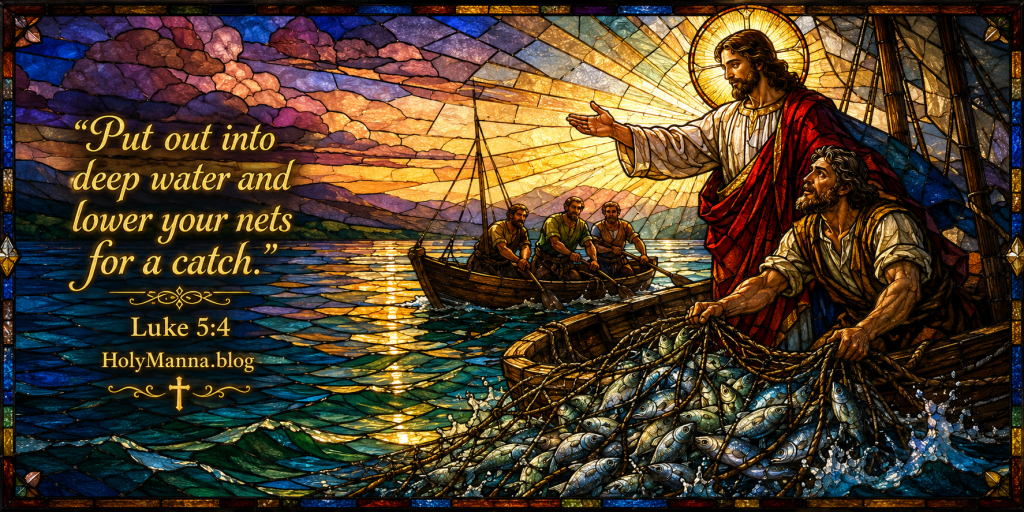
“Put out into deep water and lower your nets for a catch.”
Simon said in reply,
“Master, we have worked hard all night and have caught nothing,
but at your command I will lower the nets.”
When they had done this, they caught a great number of fish
and their nets were tearing.
They signaled to their partners in the other boat
to come to help them.
They came and filled both boats
so that the boats were in danger of sinking.
When Simon Peter saw this, he fell at the knees of Jesus and said,
“Depart from me, Lord, for I am a sinful man.”
For astonishment at the catch of fish they had made seized him
and all those with him,
and likewise James and John, the sons of Zebedee,
who were partners of Simon.
Jesus said to Simon, “Do not be afraid;
from now on you will be catching men.”
When they brought their boats to the shore,
they left everything and followed him.
Detailed Exegesis
Verse 1: “While the crowd was pressing in on Jesus and listening to the word of God, he was standing by the Lake of Gennesaret.” Luke stresses that the crowd hungers for “the word of God,” a phrase he deliberately applies to the preaching of Jesus. The scene begins with the Word, and everything that follows flows from hearing it.
Verse 2: “He saw two boats there alongside the lake; the fishermen had disembarked and were washing their nets.” The detail signals failure; nets were washed after a night’s work. Jesus approaches precisely at the moment of defeat, when human effort has produced nothing.
Verse 3: “Getting into one of the boats, the one belonging to Simon, he asked him to put out a short distance from the shore. Then he sat down and taught the crowds from the boat.” Jesus chooses Simon’s boat and makes it His pulpit; sitting was the posture of the authoritative teacher. The Fathers loved this image of the barque of Peter, the boat from which Christ teaches the world.
Verse 4: “After he had finished speaking, he said to Simon, ‘Put out into deep water and lower your nets for a catch.’” The command defies every professional instinct; deep water, daytime, after a failed night. Jesus does not ask Simon to try again in the shallows but to go where only trust can take him.
Verse 5: “Simon said in reply, ‘Master, we have worked hard all night and have caught nothing, but at your command I will lower the nets.’” Here is the hinge of the whole passage. Simon states the evidence honestly, then obeys anyway. “At your command” is the moment worldly wisdom bows to the Word, the exact foolishness Paul called true wisdom.
Verse 6: “When they had done this, they caught a great number of fish and their nets were tearing.” Obedience meets superabundance. The tearing nets show that God’s generosity exceeds human capacity to contain it.
Verse 7: “They signaled to their partners in the other boat to come to help them. They came and filled both boats so that the boats were in danger of sinking.” Grace this large cannot be handled alone; it demands partners. The overflowing catch spills into a second boat, a picture of a mission too big for any one man.
Verse 8: “When Simon Peter saw this, he fell at the knees of Jesus and said, ‘Depart from me, Lord, for I am a sinful man.’” Luke suddenly calls him “Simon Peter,” his apostolic name, at the very moment he confesses sin. Proximity to holiness exposes the heart, yet that exposure is the beginning of his calling, not the end of it.
Verse 9: “For astonishment at the catch of fish they had made seized him and all those with him,” The word “seized” is strong; holy awe grips them like a physical force. This is the fear of the Lord, which Scripture calls the beginning of wisdom.
Verse 10: “and likewise James and John, the sons of Zebedee, who were partners of Simon. Jesus said to Simon, ‘Do not be afraid; from now on you will be catching men.’” Jesus answers the confession of sin not with departure but with vocation. The fisherman’s skill is not discarded; it is transfigured into apostolic mission.
Verse 11: “When they brought their boats to the shore, they left everything and followed him.” The stunning irony: they abandon the greatest catch of their careers on the beach. Having glimpsed the Lord of the sea, the fish no longer matter.
Teachings
The Catechism places Peter’s cry in the great biblical pattern of encounter with holiness in CCC 208: “Faced with God’s fascinating and mysterious presence, man discovers his own insignificance. Before the burning bush, Moses takes off his sandals and veils his face in the presence of God’s holiness. Before the glory of the thrice-holy God, Isaiah cries out: ‘Woe is me! I am lost; for I am a man of unclean lips.’ Before the divine signs wrought by Jesus, Peter exclaims: ‘Depart from me, for I am a sinful man, O Lord.’ But because God is holy, he can forgive the man who realizes that he is a sinner before him.” Saint Augustine, in his Tractate 122 on the Gospel of John, compares this catch with the one after the Resurrection in John 21, teaching that the earlier fishing incident showed the nature of the Church as she is now, with good and bad mingled together and nets straining toward tearing, while the catch after the Resurrection, where the net held untorn, showed the nature of the Church as she will be at the end of the world, in the perfected peace of the saints. On total surrender, CCC 2544 teaches: “Jesus enjoins his disciples to prefer him to everything and everyone, and bids them ‘renounce all that [they have]’ for his sake and that of the Gospel.” Saint Gregory the Great sits at the meeting point of all of this, a successor of Peter who left everything, who sent Augustine of Canterbury in 596 to cast nets into deep English waters, and who called himself the servant of the servants of God.
Reflection
Every believer has a version of Peter’s boat, the arena of hard-won competence where taking direction feels almost insulting. Yet the Lord loves to work precisely there. A concrete step is to identify the “deep water” being avoided right now, a difficult conversation, a return to Confession after years away, an invitation to serve that feels beyond capacity, and to answer with Peter’s exact words: at your command. Another practice is to respond to failure differently this week; when effort produces empty nets, resist despair and instead ask in prayer what obedience looks like next. Notice too that Jesus met Peter’s confession with mission, not rejection. What command of the Lord currently sounds unreasonable, and what would lowering the nets anyway actually require? When holiness exposes sin, is the response to push Jesus away or to fall at His knees?
The Catch Waiting in Deep Water
Today’s liturgy tells one story in three movements. Paul pulls down the scaffolding of worldly wisdom and dares the Corinthians to become fools so they might finally become wise, because everything already belongs to them in Christ, who belongs to God. The psalmist explains why such recklessness is actually safe: the earth and its fullness are the Lord’s, and the one who climbs toward Him with clean hands and a heart emptied of vanity receives blessing from the God who saves. Then Peter lives it. A tired professional lowers his nets against all evidence, watches the Owner of the sea flood two boats with abundance, falls to his knees as a sinner, and rises as a fisher of men who leaves everything on the shore. Saint Gregory the Great walked the identical road nearly six centuries later, from the heights of Roman power to a monastery, and from the monastery to the Chair of Peter, where the man who called shepherding souls the art of arts spent himself as the servant of the servants of God. The invitation now passes to every reader of these words. Somewhere there is a boat, a net, and a stretch of deep water that human wisdom says to avoid. The Lord is already seated in the boat, and He is not asking for expertise; He is asking for trust. Answer Him with the five words that changed Peter’s life, at your command, and prepare for nets that tear from blessing. The God who owns the sea never sends anyone into deep water to leave them empty. Lower the nets, and let Him prove it.
Engage With Us!
Every reflection shared here strengthens someone else’s faith, so please share yours in the comments below. The community grows richer with every honest voice, whether the deep water right now is a career, a relationship, or a long-delayed return to the sacraments. Here are some questions to pray with today:
- In 1 Corinthians 3:18-23, Saint Paul says the wise of this age must become fools to become truly wise. Where is God asking for the surrender of worldly wisdom, status, or self-reliance right now?
- In Psalm 24:1-6, the psalmist declares that the earth and its fullness belong to the Lord and blesses the one with clean hands and a pure heart. Which possession, talent, or plan is hardest to hand back to its true Owner, and why?
- In Luke 5:1-11, Simon Peter says, at your command I will lower the nets, and then leaves everything to follow Jesus. What “deep water” is Jesus pointing toward, and what would obedience look like this week?
- Taking all the readings together on this Memorial of Saint Gregory the Great: What one concrete act of trust would declare that everything, career, possessions, and future, belongs to Christ?
May every net lowered in trust come up full, and may every day be lived with the love and mercy Jesus taught, doing small things and great things alike for the God to whom everything belongs. Live boldly, love generously, and keep seeking His face.
Sacred Heart of Jesus, we trust in You!
Immaculate Heart of Mary, pray for us!
Saint Michael the Archangel, defend us in battle!
Follow us on YouTube, TikTok, Instagram and Facebook for more insights and reflections on living a faith-filled life.


Leave a Reply