When Paris Ran Red
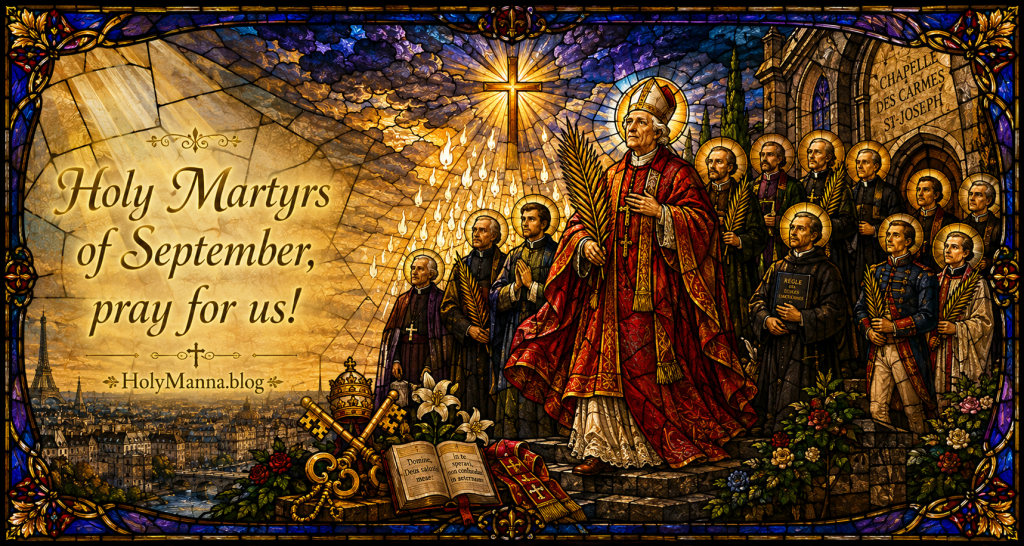
Every year on September 2nd, the Church pauses to remember not one saint but one hundred and ninety one of them together. The Martyrs of September, sometimes called the Martyrs of Paris or the Martyrs of Carmes, were bishops, priests, religious brothers, deacons, seminarians, and a handful of laymen who were slaughtered by revolutionary mobs in Paris on September 2nd and 3rd, 1792, at the height of the French Revolution. Their crime, in the eyes of their killers, was simple. They refused to swear an oath that would have torn the Church in France away from the Pope and placed her under the control of the state. Rather than betray the apostolic communion of the Church, they chose death, and they chose it together, in prison chapels and garden courtyards, singing psalms and absolving one another to the very end.
Pope Pius XI beatified the entire group on October 17th, 1926, under the title Blessed John du Lau and Companions, and the Roman Martyrology commemorates them on September 2nd. One of their number, Saint Solomon Leclercq, a humble teaching brother, was canonized by Pope Francis in 2016, the first of the group to be raised to the altars as a saint. Their story matters because it is not ancient history. These men died in the modern world, at the hands of a modern ideology, for a question that is still alive today: when the powers of this world demand your conscience, to whom does your first loyalty belong? The martyrs answered with the words of Saint Peter before the Sanhedrin, “We must obey God rather than men” (Acts 5:29), and they sealed that answer in blood.
Shepherds Formed in the Old Faith of France
The Martyrs of September came from every corner of France and every rank of the Church, and their stories before 1792 read like a portrait of French Catholic life on the eve of catastrophe. At their head stood Blessed Jean-Marie du Lau d’Allemans, the last Archbishop of Arles. He was born on October 30th, 1738, at the Château de la Côte at Biras in the Dordogne, into an aristocratic family that had given many sons to the service of the Church. Formed for the priesthood in the old tradition of the French clergy, he was named Archbishop of Arles in 1775 and governed one of the most ancient sees in Gaul, a diocese whose Christian roots stretch back to the earliest centuries.
Beside him stood two brothers who shared both blood and episcopal office. Blessed François-Joseph de La Rochefoucauld-Bayers, born at Angoulême on March 28th, 1755, was Bishop of Beauvais and had represented the clergy in the Estates General of 1789, where he defended the rights of the Church. His older brother, Blessed Pierre-Louis de La Rochefoucauld-Bayers, born in 1744, was Bishop of Saintes and known as a vigorous opponent of the Jansenist errors of his day. When the revolutionary government branded the brothers enemies of the constitutional order, they fled briefly to their sister, an abbess at Soissons. Unwilling to place her in danger, they turned around and went back to Paris, knowing what likely awaited them there. That quiet act of fraternal charity was itself a kind of first martyrdom of the will.
The group also included men whose lives spanned continents. Blessed André Grasset de Saint-Sauveur was born in Montreal on April 3rd, 1758, and would become, at his beatification, the first Canadian-born person ever beatified by the Church. Guillaume-Nicolas-Louis Leclercq, known in religion as Brother Solomon, was born at Boulogne-sur-Mer on November 15th, 1745, the son of a merchant family, and entered the Brothers of the Christian Schools, the teaching congregation founded by Saint John Baptist de La Salle. He spent his life as a teacher, bursar, and finally secretary to the superior general of his institute. There were Jesuits like Blessed Alexandre Lenfant, a celebrated court preacher, and the brothers Pierre and Robert Guérin du Rocher; there was Blessed Ambroise Chevreux, the last superior general of the great Benedictine Congregation of Saint-Maur; there was Armand de Foucauld de Pontbriand, the faithful vicar general of Arles who followed his archbishop into prison and into eternity.
What united this varied company was not social class or religious order but a single crisis of conscience. In 1790 the revolutionary government enacted the Civil Constitution of the Clergy, a law that denied papal authority over the Church in France, redrew dioceses at the will of the state, and required every cleric to swear an oath of submission to this new arrangement. Pope Pius VI condemned the oath in 1791. Nearly all the bishops of France refused it, and tens of thousands of priests refused with them. The Church has always taught what these men instinctively understood, as The Catechism states: “The citizen is obliged in conscience not to follow the directives of civil authorities when they are contrary to the demands of the moral order, to the fundamental rights of persons or the teachings of the Gospel” (CCC 2242). For these shepherds, the deepening of faith did not come through a dramatic conversion story. It came through a slow, deliberate decision, renewed day after day as the pressure mounted, to remain in full communion with the See of Peter no matter the cost.
A Church Within Prison Walls
In August 1792, after the storming of the Tuileries palace and the fall of the monarchy, the revolutionary authorities began rounding up the priests who had refused the oath. Monasteries and seminaries in Paris were emptied of their communities and converted into holding pens. The largest group, roughly one hundred and fifty men, was locked inside the church and grounds of the Discalced Carmelite house on the Rue de Vaugirard, the place history remembers as the Carmes. Others were held at the Abbey of Saint-Germain-des-Prés, at the Vincentian seminary of Saint-Firmin, and at the prison of La Force.
What happened inside those walls during the last weeks of August 1792 is one of the most moving chapters in the whole history of the Church, and it is here that the martyrs performed what might be called the quiet miracle of their lives. Deprived of freedom, comfort, and any realistic hope of rescue, they did not despair, and they did not organize resistance. They organized prayer. Under the guidance of Archbishop du Lau, the prisoners at the Carmes kept a regular schedule of common prayer and worship, hearing one another’s confessions, meditating, and preparing their souls. Eyewitnesses recorded that the guards were astonished by the joy the prisoners displayed. Nearly all the men at the Carmes were clergy, with one striking exception: accounts tell of a layman, a cavalry officer, who volunteered to accompany his own parish priest into prison rather than let him face death alone. Among the prisoners, Brother Solomon wrote a final letter to his family on August 15th, 1792, the feast of the Assumption, and was arrested that same day for refusing the oath.
The Church does not need to attribute wonders to these men to call their witness miraculous, because their serenity was itself a work of grace. The Catechism teaches that “Martyrdom is the supreme witness given to the truth of the faith: it means bearing witness even unto death” (CCC 2473). The witness begins before the dying. It begins in the decision to be faithful in small things, in the daily office prayed in a crowded prison, in the confession heard minutes before the mob arrives. Faith, compassion, and God’s sustaining intervention were all on display at the Carmes in those August weeks, not in signs and prodigies, but in the supernatural peace of men who had already surrendered everything to Christ. That is why the reader should remember them and emulate them. Most Christians will never face a pike or a sword, but every Christian faces the same underlying question the martyrs faced: whether to keep worshiping, keep praying, and keep trusting when the situation looks hopeless.
Two Days That Shook Heaven and Earth
By the beginning of September 1792, Paris was gripped by panic. The armies of Austria and Prussia were advancing toward the city, the prisons were overflowing with those arrested since August 10th, and rumors spread that the prisoners were plotting a breakout. On the afternoon of September 2nd, the storm broke. A mob attacked a transport of about thirty priests being brought to prison and killed them all. Killings began at the Abbey of Saint-Germain-des-Prés, where a self-appointed tribunal condemned prisoners on the spot. Then, around four o’clock in the afternoon, an armed crowd descended on the Carmes.
The scene that followed was preserved by priests who escaped the garden and lived to testify, and their accounts formed the basis of the beatification process. The killers burst into the grounds hunting the clergy with axes, pikes, swords, and pistols. Survivors reported that the mob called out for the Archbishop of Arles by name. Archbishop du Lau was praying in the chapel. He rose, came out to meet them, and, according to the testimony of the survivors, said, “I am he whom you seek.” They struck him down on the spot, crushing his skull and stabbing him. The leaders of the mob then set up a mock tribunal at the foot of a staircase. The imprisoned clergy were summoned before it and given one final chance to swear the oath. One by one, they refused. One by one, as they passed down the stairs into the garden, they were cut down. In the space of about two hours, roughly one hundred and fifteen priests, along with a religious brother and a layman, were killed at the Carmes, among them both La Rochefoucauld brothers, the vicar general de Foucauld de Pontbriand, Father Grasset, Dom Chevreux, and Brother Solomon. Father Lenfant, the Jesuit preacher, was hearing the confession of a fellow priest only minutes before both of them were killed.
The slaughter did not end with nightfall. During the night and into September 3rd, the mobs returned to the Abbey, moved on to the seminary of Saint-Firmin, where they massacred the priests and seminarians held there, and killed three more confessors of the faith at the prison of La Force. The bodies of the martyrs, stripped of their clothing, were thrown into mass graves and into an old well in the Carmes garden. The September Massacres as a whole claimed well over a thousand victims across the prisons of Paris, and by the end of 1792 the number of clergy killed in France had climbed into the hundreds. From among all these dead, the Church, after careful investigation of each cause, beatified one hundred and ninety one whose martyrdom for the faith could be rigorously documented.
There were no miraculous escapes for these men, and the Church does not pretend otherwise. Their divine protection took a deeper form, the form the Lord promised when He said, “And do not fear those who kill the body but cannot kill the soul; rather fear him who can destroy both soul and body in hell” (The Gospel of Matthew, Mt 10:28). The mob could take their lives. It could not take their fidelity, and it could not take their souls. Jesus had warned His disciples plainly, “If they persecuted me, they will persecute you” (The Gospel of John, Jn 15:20), and on those two September days His words were fulfilled to the letter in the heart of a nation once called the eldest daughter of the Church.
From a Garden Well to the Altars of the Church
The blood of the martyrs did not disappear into the soil of Paris. In the 1860s, during construction work connected with the rebuilding of the city, workers uncovered mass graves in trenches near the Carmes church, the bones bearing the unmistakable wounds of the massacre. Around the same time, remains of victims killed in the garden were discovered in the old well where they had been thrown. In 1867 these relics were solemnly transferred to a crypt beneath the church, now called the Crypt of the Martyrs. The church itself, Saint-Joseph-des-Carmes, still stands on the Rue de Vaugirard within the grounds of the Institut Catholique de Paris, and pilgrims visit the crypt to this day, above all around September 2nd, when the martyrs are commemorated at the very place where so many of them died. It is a sobering and grace-filled thing to stand in that quiet crypt, surrounded by the bones of men who chose Christ over survival, in the middle of one of the busiest neighborhoods of modern Paris.
The formal recognition of their sanctity came in 1926, when Pope Pius XI issued the decree of martyrdom and then beatified the one hundred and ninety one on October 17th of that year. The Catechism explains what the Church does in such acts: “By canonizing some of the faithful, i.e., by solemnly proclaiming that they practiced heroic virtue and lived in fidelity to God’s grace, the Church recognizes the power of the Spirit of holiness within her and sustains the hope of believers by proposing the saints to them as models and intercessors” (CCC 828). For ninety years the group remained at the rank of Blessed. Then, in 2016, the cause of Brother Solomon Leclercq reached its completion. A healing attributed to his intercession, the recovery of a young girl in Venezuela who had been bitten by a venomous snake, was examined and approved by the Church as miraculous, and Pope Francis canonized him on October 16th, 2016. Saint Solomon Leclercq thus became the first, and so far the only, member of the group to be declared a saint, a teaching brother who never sought attention in life and who now intercedes for teachers, students, and all who serve Christ in hidden fidelity.
The cultural reach of the martyrs extends beyond France. Blessed André Grasset is honored in Canada as the first Canadian-born beatus, and a college in Montreal bears his name in his memory. More broadly, the Martyrs of September became for the whole Church a defining witness against the claim of any state to rule the conscience and to sever the faithful from Peter. The ancient observation of Tertullian in the Apologeticus, that the blood of Christians is seed, a line popularly rendered as saying that the blood of the martyrs is the seed of the Church, proved true once again. The Church in France was not destroyed. She went underground, she suffered, and she rose again, carrying the memory of the Carmes with her.
What the Martyrs Ask of You
It is tempting to file the Martyrs of September under history, something tragic that happened long ago in a faraway country. Their feast resists that temptation. These were not figures from the age of the catacombs. They were men of the modern world, educated, articulate, living in one of the most sophisticated cities on earth, and they were killed by their own countrymen in the name of progress and liberty. Their story asks every believer a set of uncomfortable and liberating questions. If an oath were placed in front of you tomorrow, requiring you to choose between your faith and your comfort, your career, or your safety, do you know, honestly, what you would do? Where in your life right now are you already being asked, in small ways, to soften, hide, or renegotiate what the Church teaches in order to keep the peace?
The martyrs teach that fidelity in the great moment is built out of fidelity in a thousand small ones. They did not become heroes on the staircase at the Carmes. They became heroes in prison chapels during the weeks before, in daily prayer, in confession, in charity toward one another, in the decision of two bishop brothers to return to Paris rather than endanger their sister, in the choice of one layman to walk into prison beside his parish priest. Practical imitation of the martyrs looks like this: keep a fixed time of daily prayer and defend it as they defended their prison liturgies; go to confession regularly, remembering Father Lenfant absolving a brother priest minutes before death; refuse the small daily oaths, the little compromises of honesty and charity, that train the soul for the big one; and stay visibly, joyfully Catholic in places where the faith is mocked, because the guards at the Carmes were converted in their astonishment before a single blow ever fell. The martyrs also teach the reader to love the Church concretely, in her hierarchy and her communion with the Pope, since that communion was precisely the thing they would not surrender. The Book of Revelation describes their company forever: “These are they who have come out of the great tribulation; they have washed their robes and made them white in the blood of the Lamb” (The Book of Revelation, Rev 7:14). What robe is Christ asking you to wash today, and what is holding you back?
Engage With Us!
The story of the Martyrs of September belongs to the whole family of faith, and their witness deserves to be talked about, wrestled with, and prayed over. Share your thoughts and reflections in the comments below. Which martyr’s story struck you the most, the archbishop who stepped forward, the brothers who went back, the teacher, the Canadian, or the layman who refused to let his priest walk alone? To help the conversation along, here are some questions to pray with this week:
- When Archbishop du Lau said that he was the one they were seeking, he imitated Christ in the garden of Gethsemane; where is God inviting you to stop hiding and step forward in your own life?
- The martyrs refused an oath that would have separated them from the Pope and the universal Church; how deeply do you value your own communion with the Church, and how do you nourish it?
- The prisoners at the Carmes turned a jail into a house of prayer; what difficult or joyless place in your daily routine could you begin to sanctify through prayer this week?
- One layman chose imprisonment beside his parish priest; who in your parish or family needs you to stand beside them right now, and what would that cost you?
- Saint Solomon Leclercq lived a hidden life of teaching and service before his martyrdom; how can you grow in faithfulness within the ordinary, unseen duties God has already given you?
The Martyrs of September did not choose the hour of their trial, but they chose, long before it arrived, whose they would be. That same choice sits before every believer this very day, in quieter forms but with the same eternal weight. Choose Christ, choose His Church, and hold nothing back. Live this day, and every day, with courage, with joy, and with the love and mercy of Jesus poured out for the whole world.
Holy Martyrs of September, pray for us!
Follow us on YouTube, TikTok, Instagram and Facebook for more insights and reflections on living a faith-filled life.

 Holy Manna!
Leave a comment