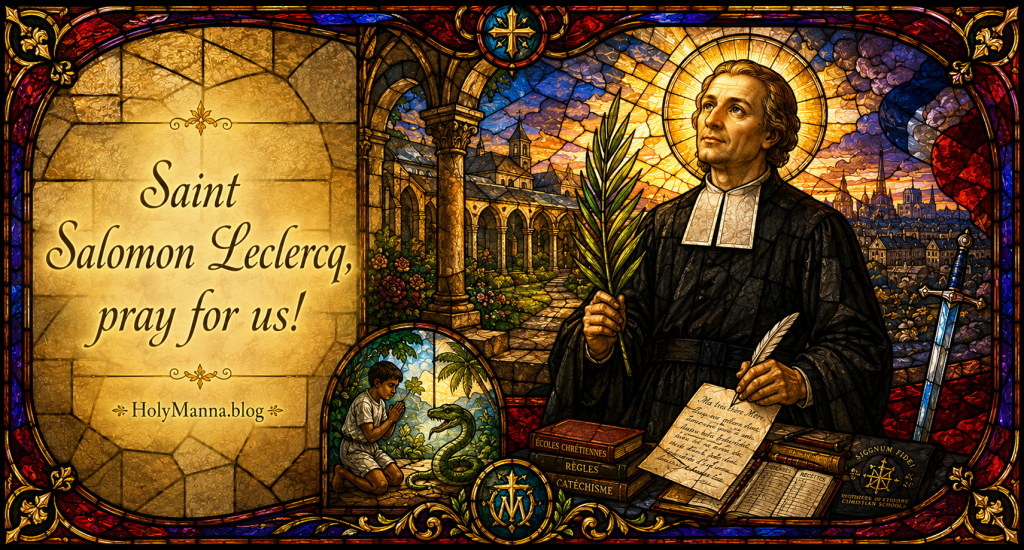
A Teacher’s Heart in an Age of Terror
Some saints thunder across history with miracles, missions, and mountains of writings. Saint Salomon Leclercq is not one of them. He was a schoolteacher, a bookkeeper, a secretary, the kind of man who kept the accounts balanced and the novices encouraged and the letters answered on time. He might have passed through this world without leaving a trace, and he very nearly did. Then the French Revolution demanded that he sign away his conscience, and this quiet, careful man discovered that he would rather die than lie to God.
Salomon Leclercq was a Brother of the Christian Schools, the teaching congregation founded by Saint John Baptist de La Salle, and he became the first member of that Institute to be martyred and the first to be beatified. On September 2, 1792, he was cut down by sword in the garden of a Carmelite monastery in Paris that had been converted into a prison, one of the many victims of the September Massacres. More than two centuries later, on October 16, 2016, Pope Francis canonized him in Saint Peter’s Square, and he is honored as the first martyr of the French Revolution to be raised to the altars as a canonized saint. The Church teaches that “Martyrdom is the supreme witness given to the truth of the faith: it means bearing witness even unto death” (CCC 2473). Salomon’s whole life was preparation for that single moment of witness, and his story is proof that heroic sanctity can grow in the most ordinary soil.
His feast is celebrated on September 2, together with the Blessed Brother Martyrs of the hulks of Rochefort, who followed him into glory only a few years later.
The Merchant’s Son of Boulogne-sur-Mer
Guillaume-Nicolas-Louis Leclercq was born in mid-November 1745 in Boulogne-sur-Mer, a busy seaport on the English Channel in northern France. Records differ by a single day on his birth date, with the Institute’s own sources giving November 14 and other reference works giving November 15, a small reminder that even well documented saints come to us through imperfect human archives. What is certain is the world he was born into. His family were merchants, his father a prosperous wine trader, and young Guillaume grew up surrounded by ledgers, shipments, contracts, and the steady rhythm of commerce.
His education came from the Brothers of the Christian Schools, who ran a commercial school in his town. This detail matters more than it first appears. The Brothers had been founded by Saint John Baptist de La Salle in the late seventeenth century precisely to give a solid, Christian, practical education to boys who would otherwise have had none, and by Guillaume’s day their schools were forming the sons of tradesmen and merchants all across France. The boy who would become Salomon was himself a fruit of that mission before he ever joined it.
His father had clear plans. Guillaume was to take over the family business, and according to the accounts preserved in Catholic sources, he was sent to Paris to learn the trade, a kind of apprenticeship in commerce. But something else was tugging at his heart. The young man came home and told his father plainly that he believed God was calling him to a life of service. There was no dramatic vision here, no voice from the clouds, no lightning strike on the road. There was simply a young man who had been taught by holy educators, who had tasted the world of business, and who knew in his bones that his life belonged to Someone else. Conversion for Salomon was not a turn from wickedness to faith but a deepening, the moment a baptized soul stops drifting and starts choosing. The Church describes this universal call with beautiful clarity, teaching that all the faithful, “whatever their condition or state”, are called by the Lord to the perfection of charity (CCC 825).
On March 25, 1767, the feast of the Annunciation, the twenty-one-year-old entered the novitiate of the Brothers of the Christian Schools. One secondary account gives the date as March 26, another minor discrepancy in the records, but the Institute’s official memory holds to the 25th. He received the religious habit and a new name, Salomon, after the wise king of Israel. He made vows in 1769 and his final profession in 1772. The merchant’s son had signed his last and greatest contract, and it was with God.
Chalk Dust and Hidden Holiness
What did sanctity look like for Brother Salomon? It looked like a classroom. It looked like arithmetic lessons and account books and long evenings of correspondence. Over the next twenty-five years he served his congregation as a mathematics teacher, as a director of novices, as a bursar managing the temporal goods of a school, and finally as personal secretary to Brother Agathon, the Superior General of the entire Institute and the author of the celebrated treatise The Twelve Virtues of a Good School Master. By 1787 or 1788, Salomon was working at the very heart of the congregation’s government in Paris.
The testimonies about his character are consistent and warm. He was known for a great love of people and a great attachment to his work. He was somewhat shy by temperament, yet as a teacher he was gentle and firm at once, exactly the combination Saint John Baptist de La Salle had asked of his Brothers. Honesty requires saying plainly that no miracles are recorded from Salomon’s lifetime. He healed no lepers, raised no dead, and levitated in no chapels. His life offers something in some ways harder to imitate than wonders: decades of faithfulness in hidden, repetitive, unglamorous service.
Why should anyone remember and emulate such a man? Because this is precisely where the Church says holiness lives. The Catechism teaches that “the ordinary knowledge of God’s will” comes through the duties of one’s state in life, and it insists that all Christians “should hence receive both interior sanctification and the strength to act” in their daily labors. The vocation of the laity and of religious teachers alike is worked out in classrooms, offices, and kitchens, for the Church holds that the faithful sanctify the world from within, like leaven (CCC 940). Brother Salomon graded papers for the glory of God. He balanced budgets for the glory of God. When the moment of supreme testing came, he did not suddenly become a different man. He simply kept being the man that thousands of small fidelities had already made him.
There is a lesson here that a distracted age badly needs. The novices Salomon formed, the students he taught, the Superior General he served, all of them were touched by a compassion that asked for no applause. God’s intervention in his life during those years was not spectacular but sustaining, the daily grace of perseverance that the Church calls final perseverance’s seedbed, for “the just man justified by grace” must persevere to the end, and this perseverance is itself a gift to be sought in prayer (CCC 2016). Does the hidden work in front of you feel too small to matter to God? Salomon’s chalk dust says otherwise.
One Word Before the Sword
In 1789 the Revolution broke over France, and once the monarchy tottered, the Church became the next target. In 1790 the National Assembly imposed the Civil Constitution of the Clergy, a law that placed the Church in France under complete state control, redrew dioceses, and demanded that priests and religious swear an oath of allegiance to the new arrangement if they wished to continue their ministry. Rome condemned the oath. For a Catholic in vows, to swear it was to declare that Caesar, not Peter, governed the Church of Jesus Christ.
Most of the Brothers refused. The consequences arrived in waves. In 1791 the Brothers were forced to abandon their schools, their communities, and their religious identity, and the Institute was ultimately stripped of all legal standing in France. Brother Salomon stayed at his post. He remained at the congregation’s Paris headquarters, dressed now in ordinary secular clothes, quietly looking after the temporal affairs of the house as best he could, a religious without a habit, a secretary of an order that legally no longer existed. When the authorities finally required him personally to take the oath, he refused. He could not bring himself to swear away the liberty of the Church.
Consider what that refusal cost him and how easily it could have been avoided. One signature, one public formula, and he could have lived out his days in peace. The Church teaches why he could not, for conscience is the sanctuary where the human person is alone with God, and “Man has the right to act in conscience and in freedom so as personally to make moral decisions” (CCC 1782). The Catechism likewise teaches that the duty of witness admits no exemptions, since “Service of and witness to the faith are necessary for salvation” (CCC 1816). Salomon understood that a coerced oath against the Church was not a technicality but a betrayal of Jesus Christ, who warned His disciples in The Gospel of Matthew that whoever denies Him before men will be denied before the Father, and who promised, “Everyone who acknowledges me before others I will acknowledge before my heavenly Father” (Mt 10:32).
For roughly a year Salomon lived alone in Paris in secrecy, monitored by the government, sustaining his family’s spirits through a steady stream of letters that the Institute treasures to this day. The summer of 1792 turned lethal. That August the Legislative Assembly closed all Catholic schools in Paris and outlawed the wearing of religious habits in public. Clergy who refused the oath were ordered to leave the country, and some twenty-five thousand did. Salomon stayed.
On August 15, 1792, the feast of the Assumption of the Blessed Virgin Mary, he wrote his final letter to his family. That very day he was arrested. His interrogation ended with the question that defined the age, whether he had taken the oath, and his entire defense, his entire crime, was a single word of refusal. He answered no. He was imprisoned in the Hôtel des Carmes, a Carmelite monastery in Paris that the revolutionaries had converted into a holding prison, alongside bishops and priests who had made the same refusal, among them the Archbishop of Arles.
From his confinement he wrote to his sister words that survive in the archives of his Institute and that reveal the interior of a martyr’s soul. Rather than fear or complaint, he expressed joy and thanksgiving at bearing the cross, and he added with astonishing humility, “I am not worthy to suffer for Him”, marveling that he had so far been spared the worse treatment that other confessors of the faith were enduring. The man awaiting the sword worried that his suffering was too light.
The end came on September 2, 1792. As foreign armies advanced on France, revolutionary mobs in Paris turned on the prisons in the slaughter history remembers as the September Massacres, in which roughly twelve hundred people were butchered in about two days. Armed men stormed the Carmes prison, and in the monastery garden the prisoners were put to death by the sword. Accounts of the total number killed there vary, with sources counting between roughly one hundred fifty and one hundred ninety-one martyrs across September 2 and 3, and one account of Salomon’s own death describing blows rather than the blade, small variations that the sources themselves acknowledge. What no source disputes is that Brother Salomon Leclercq died there for refusing the oath, hated, in the classic formula of the Church, in odium fidei, out of hatred for the faith. The Psalmist’s words belong to that garden: “Precious in the eyes of the LORD is the death of his devoted” (Ps 116:15). He was forty-six years old.
A Snakebite in Venezuela and a Crown in Rome
The Church did not forget the garden of the Carmes. The cause for the martyrs opened in Paris in 1901, and on October 17, 1926, Pope Pius XI beatified Brother Salomon together with 188 companions of the September Massacres. He was the first Brother of the Christian Schools ever beatified, a distinction that made him especially dear to Lasallian schools around the world. For martyrs, the Church waives the miracle normally required for beatification, since martyrdom itself is considered a miracle of grace, the supreme conformity to Christ.
Canonization, however, awaited a sign from heaven, and it came from an unexpected corner of the world. Devotion to Blessed Salomon had taken root in Venezuela, where the De La Salle Brothers had long served in education. In the small community of Sabaneta de El Hatillo, a short distance east of Caracas, a statue of Brother Salomon stood in the local church, and the people venerated him as their intercessor.
In 2007, a five-year-old girl of that community, María Alejandra Hernández, was bitten by a venomous snake. Religious Sisters, children, and parishioners gathered before the statue of Blessed Salomon and begged his intercession for her. Against every medical expectation, the child survived for two days after the bite with no medical intervention at all. When she was finally brought to the hospital, her condition was so grave that doctors prepared to amputate her leg to save her life. Then, suddenly and without any natural explanation, she recovered completely, regaining her health and the full use of her leg as if nothing had happened.
The Church subjected the case to her characteristically rigorous scrutiny. A diocesan investigation ran through much of 2011, after which the case went to the Congregation for the Causes of Saints in Rome. The board of medical consultants approved the healing as scientifically inexplicable on March 3, 2016, a panel of theologians approved it on April 5, 2016, the Congregation confirmed it on May 3, 2016, and Pope Francis approved the canonization within the week, with the decree published in the days following. This careful process is itself an act of faith and reason together, for the Church teaches that “By canonizing some of the faithful” she “recognizes the power of the Spirit of holiness within her” and sustains the hope of believers by giving them models and intercessors (CCC 828).
On October 16, 2016, in Saint Peter’s Square, Pope Francis canonized Salomon Leclercq alongside six companions in glory, among them the fourteen-year-old Mexican martyr José Sánchez del Río and the French Carmelite mystic Elisabeth of the Trinity. Preaching on the parable of the persistent widow from The Gospel of Luke, the Holy Father said that the new saints “fought the good fight of faith and love by their prayers”, and that through their example and intercession God enables His people to become men and women of prayer. It is hard to imagine a better one-line portrait of the quiet Brother from Boulogne-sur-Mer.
Today Saint Salomon’s memory is kept alive on several continents. A chapel in Sabaneta de El Hatillo honors him in Venezuela, an altar dedicated to him stands in the Generalate of the Brothers of the Christian Schools in Rome, and the worldwide Lasallian family, present in some eighty countries, celebrates his feast every September 2 together with the Blessed Brother Martyrs of Rochefort. In France he stands within the larger company of the Holy September Martyrs, a permanent witness against every attempt of the state to claim lordship over the Church. The healing of María Alejandra rests on the Church’s formal judgment; the wider devotional stories that circulate about favors received through his intercession in Venezuela and elsewhere are told within the Lasallian family as accounts of grace, and where such individual stories go beyond the officially examined miracle, they cannot be verified.
What a Quiet Man Teaches a Loud World
Saint Salomon Leclercq is a saint for people who feel unremarkable, which is to say, a saint for almost everyone. He never founded an order, never wrote a famous book, never preached to crowds. He taught math. He kept books. He wrote letters. And when the defining test of his generation arrived, all that hidden faithfulness turned out to be steel.
His life poses uncomfortable and healthy questions. If the practice of your faith suddenly carried a real price, a job, a friendship, a reputation, would the person your daily habits have built be able to pay it? Salomon did not improvise his courage in the Carmes garden. He had been rehearsing it for twenty-five years in classrooms and account books, in obedience and small sacrifices, in the unseen fidelity that the world calls boring and heaven calls preparation. The Catechism insists that “The way of perfection passes by way of the Cross” and that there is no holiness without renunciation and spiritual battle (CCC 2015). For most believers that cross arrives not as a sword but as a schedule, a duty, an inconvenient truth that must be spoken.
His witness also speaks directly to conscience in public life. Salomon loved France. He was no rebel and no politician. But when the state demanded authority over the things of God, he knew where the line was, and he held it with a single, costly word. Followers of Christ in every age need that same clarity, offered without hatred and without compromise, remembering the Lord’s warning in The Gospel of John that the servant is not greater than the master: “If they persecuted me, they will also persecute you” (Jn 15:20).
There are practical ways to weave his lessons into ordinary life. A person can consecrate hidden work by offering each unglamorous task of the day to God deliberately, the way Salomon offered his ledgers. A family can imitate his letter writing by deliberately encouraging the faith of relatives and friends, especially those who are isolated or suffering, since his surviving letters were instruments of hope for his family in a terrifying time. A student or teacher can honor him by treating education itself as a work of mercy, for instructing the ignorant stands among the spiritual works of mercy the Church commends (CCC 2447). And every believer can ask his intercession for perseverance, trusting the Church’s teaching that the saints in heaven “do not cease to intercede with the Father for us” (CCC 956). Which hidden duty in your life is quietly forming the person you will be when your own test comes?
Engage With Us!
HolyManna.blog would love to hear from you. Share your thoughts and reflections on Saint Salomon Leclercq in the comments below, and let his quiet courage start a conversation in your own circle of family and friends. Consider these questions as a starting point.
- Saint Salomon spent decades in hidden, ordinary service before his moment of witness. What ordinary duty in your life could become your training ground for holiness?
- He refused an oath that would have made his life easy but betrayed his conscience. Where in your daily life are you tempted to trade a small piece of your faith for comfort or approval?
- From prison he wrote that he was not worthy to suffer for Christ. How does his humility challenge the way you think about your own hardships?
- The people of a Venezuelan village prayed to a French martyr who died two centuries earlier, and a child was healed. How real is the communion of saints in your own prayer life?
- If you were writing a final letter to your family, as Salomon did on the feast of the Assumption, what would you want them to know about your faith?
Saint Salomon Leclercq teaches that heaven is won one faithful day at a time, and that no life offered to God is ever too small for glory. Take his example into this week. Do your hidden work with love, guard your conscience without fear, and encourage someone who is struggling to stay faithful. Above all, live everything, the great trials and the tiny tasks alike, with the love and mercy that Jesus taught us.
Saint Salomon Leclercq, pray for us!
Follow us on YouTube, TikTok, Instagram and Facebook for more insights and reflections on living a faith-filled life.


Leave a Reply