Wednesday of the Twenty-second Week in Ordinary Time – Lectionary: 433
The Quiet Hand Behind Every Harvest
Every gardener knows the strange humility of the craft. A person can till the soil, drop the seed, water it faithfully, and pull every weed, yet no human being on earth can make a single seed sprout. That power belongs to Someone else. On this Wednesday of the Twenty-second Week in Ordinary Time, the Church hands her children three readings that all whisper the same secret: God is the one doing the real work. In 1 Corinthians 3:1-9, Saint Paul confronts a divided church in Corinth, a bustling Roman port city obsessed with celebrity orators, and reminds them that he and Apollos are only field hands, for “God caused the growth.” In Psalm 33, Israel sings of a God who looks down from heaven, who “fashioned the heart of each,” and whose people wait on Him as their help and shield. Then in Luke 4:38-44, Jesus sweeps through Capernaum healing fevers, diseases, and demonic oppression, only to slip away at daybreak because the mission belongs to the Father’s plan rather than the crowd’s wishes. The first-century world of these readings prized patronage, status, and loyalty to powerful personalities, whether Corinthian rhetoricians or local wonder-workers. Into that world, and into this one, God speaks a liberating word. He is not one patron among many. He is the source of every increase, every heartbeat, every healing. The invitation today is to stop grasping for control and credit, and to take an honest place in God’s field as a servant who trusts the Gardener. What might change in a restless heart that finally lets God be the one who gives the growth?
First Reading — 1 Corinthians 3:1-9
When the Church Forgot Who Makes Things Grow
Corinth in the fifties of the first century was loud, rich, and competitive. Perched on the isthmus connecting mainland Greece to the Peloponnese, the city hummed with sailors, merchants, athletes, and traveling philosophers who built followings the way modern influencers build platforms. When Paul founded the church there around the year 51, the converts brought that celebrity culture into the pews. By the time Paul wrote from Ephesus a few years later, the community had split into fan clubs, some claiming Paul, others the eloquent Alexandrian preacher Apollos. Paul’s response in this passage is one of the most disarming leadership statements in all of Scripture. He refuses the pedestal entirely. He and Apollos are laborers in a field that belongs to God, and the growth, the only thing that ultimately matters, comes from God alone. This is the beating heart of today’s central theme.
1 Corinthians 3:1-9
Brothers and sisters,
I could not talk to you as spiritual people,
but as fleshly people, as infants in Christ.
I fed you milk, not solid food,
because you were unable to take it.
Indeed, you are still not able, even now,
for you are still of the flesh.
While there is jealousy and rivalry among you,
are you not of the flesh, and walking
according to the manner of man?
Whenever someone says, “I belong to Paul,” and another,
“I belong to Apollos,” are you not merely men?What is Apollos, after all, and what is Paul?
Ministers through whom you became believers,
just as the Lord assigned each one.
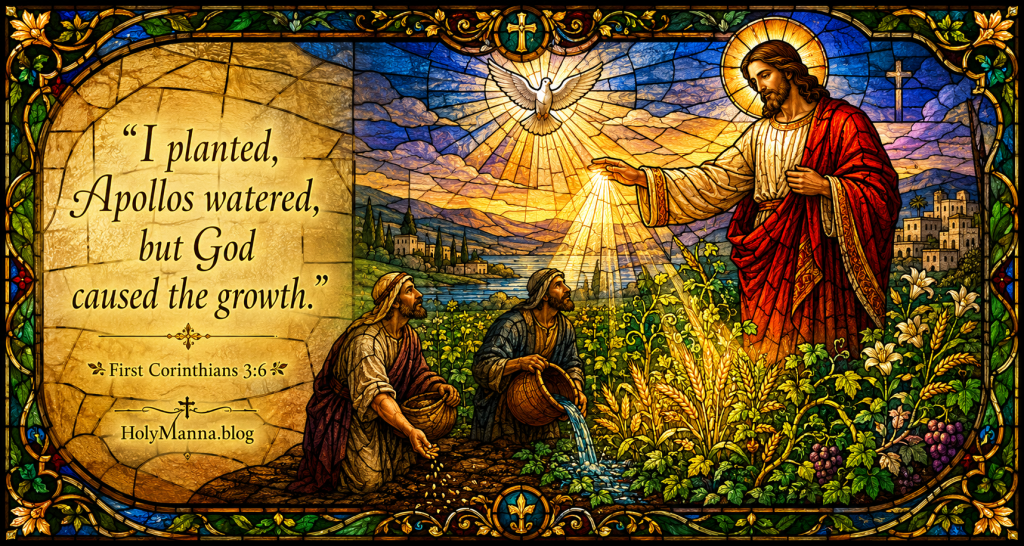
I planted, Apollos watered, but God caused the growth.
Therefore, neither the one who plants nor the one who waters is anything,
but only God, who causes the growth.
He who plants and he who waters are one,
and each will receive wages in proportion to his labor.
For we are God’s co-workers;
you are God’s field, God’s building.
Detailed Exegesis
Verse 1: “Brothers and sisters, I could not talk to you as spiritual people, but as fleshly people, as infants in Christ.” Paul opens with tenderness and honesty at once. Calling them infants is not an insult but a diagnosis. They have received the Holy Spirit in Baptism, yet they are living by worldly instincts, and a good father tells his children the truth.
Verse 2: “I fed you milk, not solid food, because you were unable to take it. Indeed, you are still not able, even now.” The image of milk and solid food describes stages of doctrinal and moral formation. Paul adapted his teaching to their capacity, the way the Church has always done in catechesis, but maturity was supposed to follow. Growth in Christ is expected, not optional.
Verse 3: “For you are still of the flesh. While there is jealousy and rivalry among you, are you not of the flesh, and walking according to the manner of man?” Here is the evidence for the diagnosis. Jealousy and rivalry are not minor personality quirks. For Paul they are proof that the old self, not the Spirit, is steering the community.
Verse 4: “Whenever someone says, ‘I belong to Paul,’ and another, ‘I belong to Apollos,’ are you not merely men?” Belonging language is covenant language, and it belongs to God alone. A baptized Christian belongs to Christ, never to a preacher, a movement, or a faction, however holy the founder.
Verse 5: “What is Apollos, after all, and what is Paul? Ministers through whom you became believers, just as the Lord assigned each one.” Notice the question is what, not who. Paul deliberately depersonalizes himself to make the point. Ministers are instruments, and their assignments come from the Lord, not from ambition or audience demand.
Verse 6: “I planted, Apollos watered, but God caused the growth.” This is the thesis of the entire passage. Paul evangelized Corinth first, Apollos later strengthened the community with his preaching, and God did what only God can do, which is give life.
Verse 7: “Therefore, neither the one who plants nor the one who waters is anything, but only God, who causes the growth.” Paul pushes the logic to its stunning conclusion. Measured against the divine action, even apostles are nothing. This is not false modesty but accurate theology of grace.
Verse 8: “He who plants and he who waters are one, and each will receive wages in proportion to his labor.” Unity replaces rivalry. Paul and Apollos are one team on one mission, and God, the just employer, will reward each laborer’s faithfulness rather than his fame.
Verse 9: “For we are God’s co-workers; you are God’s field, God’s building.” The passage lands on breathtaking dignity. God chooses to work through human hands, and the community itself is God’s own cherished property, His cultivated field and rising temple.
Teachings
Saint John Chrysostom, the golden-mouthed Doctor of the Church, preached on this very passage in his Homily 8 on First Corinthians and explained the division of labor with beautiful precision: “I planted, Apollos watered, but God gave the increase. That is, I first cast the word into the ground; but, in order that the seeds might not wither away through temptations, Apollos added his own part. But the whole was of God.” Chrysostom saw that Paul was healing the Corinthians’ pride gently, honoring the ministers while returning all glory to God. The Catechism develops this same theology of cooperation in CCC 307, teaching that God grants human beings the ability to share freely in His providence, so that they truly become, in the language of this reading, God’s fellow workers for His Kingdom. The Catechism also preserves the famous principle of Saint Augustine, cited in CCC 1847 from his Sermo 169: “God created us without us: but he did not will to save us without us.” Grace is always first, yet grace enlists real human labor. Church history offers a vivid confirmation. The missions of Saints Cyril and Methodius among the Slavs, and centuries later the labors of countless missionaries who planted churches they never saw flourish, all rested on the confidence that the harvest belonged to God rather than to their own lifespans.
Reflection
This reading lands hard in an age of platforms, followers, and personal brands, including within Catholic circles. It is easy to attach faith to a favorite podcaster, apologist, or parish priest, and quietly begin to say, in effect, I belong to him. Paul’s correction invites a healthier posture. Thank God for good teachers, then belong to Christ alone. A concrete practice this week could be praying by name for one priest or catechist who planted seeds in your life, while consciously giving God the credit for whatever grew. Another practice is examining conscience for jealousy and rivalry, the two symptoms Paul names, especially in family life and parish life. Whose approval has quietly become more important to you than God’s? Where might God be asking you to plant or water faithfully without needing to see the growth yourself?
Responsorial Psalm — Psalm 33:12-15, 20-21
The God Who Sees, Shapes, and Shields
Psalm 33 is a jubilant hymn that ancient Israel likely sang in Temple worship, praising the Lord as Creator of the cosmos and sovereign over the nations. The verses selected for today’s liturgy form a perfect bridge between Paul’s field and Luke’s Capernaum. They celebrate a God who chooses a people as His own inheritance, who watches all humanity from heaven, who personally fashioned every single heart, and who is worth waiting for with rejoicing trust. In the ancient Near East, surrounding nations imagined distant gods who needed to be appeased. Israel sang of a God who is both utterly transcendent, enthroned in heaven, and astonishingly intimate, the craftsman of each interior life. The refrain gathers it all into one cry: blessed the people the Lord has chosen to be his own.
Psalm 33:12-15, 20-21
R. (12) Blessed the people the Lord has chosen to be his own.
Blessed the nation whose God is the LORD,
the people he has chosen for his own inheritance.
From heaven the LORD looks down;
he sees all mankind.
R. Blessed the people the Lord has chosen to be his own.
From his fixed throne he beholds
all who dwell on the earth,
He who fashioned the heart of each,
he who knows all their works.
R. Blessed the people the Lord has chosen to be his own.
Our soul waits for the LORD,
who is our help and our shield,
For in him our hearts rejoice;
in his holy name we trust.
R. Blessed the people the Lord has chosen to be his own.
Detailed Exegesis
Verse 12: “Blessed the nation whose God is the LORD, the people he has chosen for his own inheritance.” Blessedness here is not luck but relationship. Israel’s privilege, extended in Christ to the Church, rests entirely on divine election, on God’s initiative rather than the nation’s merit, exactly as Paul insisted about the growth in Corinth.
Verse 13: “From heaven the LORD looks down; he sees all mankind.” The divine gaze in this psalm is not surveillance but care. Nothing and no one falls outside God’s attention, which means no forgotten person and no hidden suffering escapes His notice.
Verse 14: “From his fixed throne he beholds all who dwell on the earth.” The throne is fixed, meaning stable and unshakeable, while earthly powers rise and fall. The psalmist is quietly teaching politics as well as prayer, since history sits beneath a throne that never wobbles.
Verse 15: “He who fashioned the heart of each, he who knows all their works.” This may be the most tender line in the psalm. The same God who spread out the heavens shaped each individual heart like a potter at his wheel, and therefore knows every deed from the inside.
Verse 20: “Our soul waits for the LORD, who is our help and our shield.” Waiting is Israel’s characteristic act of faith. The soul that waits is not passive but poised, like a watchman or a servant, confident that help and protection come from the Lord rather than from human schemes.
Verse 21: “For in him our hearts rejoice; in his holy name we trust.” The psalm ends where mature faith always ends, in joy and trust. The heart God fashioned finds its gladness only in the God who fashioned it.
Teachings
The Catechism teaches in CCC 27 the truth this psalm sings: “The desire for God is written in the human heart, because man is created by God and for God; and God never ceases to draw man to himself.” The heart fashioned by God in verse 15 is a heart built with a homing instinct for its Maker. Saint Augustine, Doctor of Grace, gave that instinct its most famous voice in the opening of his Confessions: “You have made us for yourself, O Lord, and our heart is restless until it rests in you.” The psalm’s theology of providence also echoes through CCC 301, which teaches that God does not abandon His creatures after creating them but at every moment upholds and sustains them in being. That is what the fixed throne and the watching gaze mean in doctrinal language. Divine providence is not occasional intervention but constant, loving governance. The waiting posture of verse 20 belongs to the great biblical tradition of hopeful trust that the Church sees fulfilled in figures like Simeon and Anna in The Gospel of Luke, who waited for the consolation of Israel and lived to hold Him.
Reflection
Modern life trains people to refresh, scroll, and demand instant results, which makes the psalm’s waiting soul feel almost countercultural. Yet waiting on the Lord is where trust gets forged. A practical way to pray this psalm is to sit for five unhurried minutes and repeat verse 20 slowly, letting the words recalibrate an anxious day. Another application is gratitude for election, remembering that Baptism made you part of the people God has chosen as His own inheritance, a fact worth more than any achievement on a resume. When was the last time you let God’s steady gaze feel like protection rather than pressure? What would waiting on the Lord look like in the one situation you are most tempted to force?
Holy Gospel — Luke 4:38-44
A Fever Rebuked and a Mission That Could Not Stay Put
The scene opens in Capernaum, the lakeside fishing town that became the headquarters of Jesus’ Galilean ministry. He has just left the synagogue, where His teaching carried authority and His word expelled an unclean spirit. Now the power that filled the assembly walks into a private home, the house of Simon, the fisherman who will one day be called Peter. Luke, whom tradition remembers as a physician, records with clinical precision that the fever afflicting Simon’s mother-in-law was severe. What follows is a portrait of the Messiah in miniature. Jesus heals one woman, then a whole town at sunset, silences demons who know too much, withdraws to pray before dawn, and then announces that the good news of the Kingdom cannot be confined to one grateful village. The reading shows exactly what Paul and the psalmist proclaimed, that God Himself is at work, and His plan is larger than anyone’s expectations.
Luke 4:38-44
After Jesus left the synagogue, he entered the house of Simon.
Simon’s mother-in-law was afflicted with a severe fever,
and they interceded with him about her.
He stood over her, rebuked the fever, and it left her.
She got up immediately and waited on them.At sunset, all who had people sick with various diseases
brought them to him.
He laid his hands on each of them and cured them.
And demons also came out from many, shouting, “You are the Son of God.”
But he rebuked them and did not allow them to speak
because they knew that he was the Christ.At daybreak, Jesus left and went to a deserted place.
The crowds went looking for him, and when they came to him,
they tried to prevent him from leaving them.
But he said to them, “To the other towns also
I must proclaim the good news of the Kingdom of God,
because for this purpose I have been sent.”
And he was preaching in the synagogues of Judea.
Detailed Exegesis
Verse 38: “After Jesus left the synagogue, he entered the house of Simon. Simon’s mother-in-law was afflicted with a severe fever, and they interceded with him about her.” Grace moves from the liturgy into the home, a pattern every Catholic family should recognize. Notice too the first recorded intercession in Simon’s house. Others bring her need to Jesus, modeling the prayer of petition the Church still practices for her sick.
Verse 39: “He stood over her, rebuked the fever, and it left her. She got up immediately and waited on them.” Jesus rebukes the fever the way He rebuked the demon moments earlier, revealing sovereign authority over every enemy of human flourishing. Her response is the whole Christian life in one line, since the one who is healed rises immediately to serve.
Verse 40: “At sunset, all who had people sick with various diseases brought them to him. He laid his hands on each of them and cured them.” Sunset ended the Sabbath, so the town could now carry its sick through the streets. The detail that He laid hands on each of them is pure Luke. There is no mass production in the Kingdom, only person by person tenderness.
Verse 41: “And demons also came out from many, shouting, ‘You are the Son of God.’ But he rebuked them and did not allow them to speak because they knew that he was the Christ.” The demons speak true words with hostile intent, and Jesus silences them. His identity must be revealed through the Cross and Resurrection, on the Father’s timetable, not shouted prematurely by enemies who would distort it.
Verse 42: “At daybreak, Jesus left and went to a deserted place. The crowds went looking for him, and when they came to him, they tried to prevent him from leaving them.” After the most successful night imaginable, Jesus seeks solitude. The parallel account in The Gospel of Mark specifies that He prayed there. The crowd’s impulse to keep Him is deeply human and quietly possessive, faith trying to hold God in place.
Verse 43: “But he said to them, ‘To the other towns also I must proclaim the good news of the Kingdom of God, because for this purpose I have been sent.’” The word must signals divine necessity. His mission flows from being sent by the Father, and no local success, however wonderful, can override the plan of the One who gives the growth.
Verse 44: “And he was preaching in the synagogues of Judea.” Luke closes the scene with motion. The Word keeps moving outward, foreshadowing a Gospel that will travel from Galilee to Jerusalem and, through the Church, to the ends of the earth.
Teachings
Saint Cyril of Alexandria, the great Doctor who defended Christ’s divinity at Ephesus, commented on this exact scene in Sermon 12 of his Commentary on Luke, noting the striking language of rebuke: “He stood over her, and rebuked the fever, and it left her.” Cyril observed that only Luke describes the fever being rebuked, as though affliction itself must bow before the personal authority of the Lord. The Catechism gathers the meaning of all these healings in CCC 1503: “Christ’s compassion toward the sick and his many healings of every kind of infirmity are a resplendent sign that God has visited his people and that the Kingdom of God is close at hand.” The miracles are never magic tricks. CCC 547 teaches that Jesus accompanies His words with mighty works and signs that manifest the Kingdom present in Him and attest that He is the promised Messiah. The pre-dawn withdrawal also carries doctrinal weight. CCC 2602 teaches that “Jesus often draws apart to pray in solitude, on a mountain, preferably at night.” The Church’s entire sacramental care for the sick, above all the Anointing of the Sick, continues this Gospel scene, since Christ still lays His hands on each of the suffering through the ministry of His priests.
Reflection
Two figures in this Gospel offer a complete spiritual program. Simon’s mother-in-law shows what healed people do, which is get up and serve, and Jesus shows what sent people do, which is pray in solitude and then obey the mission. A concrete step this week is to intercede for one sick person by name every day, imitating the household that brought her need to Jesus, and where possible to pair that prayer with a visit, a call, or a meal. Another step is claiming a deserted place of your own, even fifteen quiet minutes before the day begins, since a mission without prayer eventually becomes noise. When God has healed or helped you, have you gotten up to serve, or simply gone back to normal? Is there any place in your life where you are trying to keep Jesus from moving, preferring the comfort He gives over the mission He calls you to?
The Harvest Belongs to Him
Step back and watch the three readings become one story. In Corinth, a proud church learns that apostles are only farmhands, because “God caused the growth.” In the psalm, a chosen people learns to wait with joy on the God who fashioned every heart and watches from an unshakeable throne. In Capernaum, a healed woman rises to serve, a rescued town tries to keep its Healer, and Jesus walks on at daybreak because the Father’s plan reaches farther than any single village. The thread running through it all is wonderfully freeing. God is the protagonist. He plants His word through imperfect ministers, shapes hearts He has never stopped watching, rebukes fevers, silences hell, and carries the good news of the Kingdom outward with unstoppable purpose. The human part is real but humble, to plant and water faithfully, to wait and trust joyfully, to rise from every healing and serve. That is not a small life. Paul calls it being God’s co-workers, laborers in God’s own field. So here is the invitation for today. Release one thing you have been white-knuckling, whether a child’s faith, a career outcome, a parish project, or a private struggle, and hand the growth back to the only One who can give it. Then do your part with a light heart. Say the prayer, plant the seed, make the visit, serve the meal. The Gardener sees, the throne is fixed, and the harvest is already His. A soul that finally believes this stops performing and starts flourishing, which is exactly what the Lord had in mind when He fashioned that heart in the first place.
Engage With Us!
Every field needs many laborers, so please share your reflections in the comments below. Stories of answered prayer, hard-won trust, and quiet service encourage this whole community more than you know. Here are some questions to prayerfully consider:
- In 1 Corinthians 3:1-9, Paul says he planted, Apollos watered, but God caused the growth. Where in your life is God asking you to labor faithfully while surrendering the results to Him?
- In Psalm 33:12-15, 20-21, the psalmist sings of the God who fashioned the heart of each person. How does knowing that God personally shaped your heart change the way you bring your worries to Him?
- In Luke 4:38-44, Simon’s mother-in-law is healed and immediately gets up to serve. What healing or blessing has God given you recently, and how could you turn it into service this week?
- Taken together, today’s readings proclaim that God alone gives the growth. What is one concrete area of control you can release to God today, trusting that the harvest belongs to Him?
Living a life of faith means showing up each day as a humble co-worker in God’s field, planting and watering with patience, waiting on the Lord with a rejoicing heart, and rising from every grace to serve someone else. Keep going, keep trusting, and do everything with the love and mercy Jesus taught us.
Sacred Heart of Jesus, we trust in You!
Immaculate Heart of Mary, pray for us!
Saint Michael the Archangel, defend us in battle!
Follow us on YouTube, TikTok, Instagram and Facebook for more insights and reflections on living a faith-filled life.


Leave a Reply