A Saint Older Than the Church Herself
Before there were martyrs in the Colosseum, before there were monks in the desert, before there was even a Church at Pentecost, there were holy men and women who belonged to God with their whole hearts. The Catholic Church has never forgotten them. The Catechism teaches that the patriarchs, prophets, and certain other Old Testament figures have always been honored as saints in all the Church’s liturgical traditions (CCC 61). Saint Joshua, son of Nun, stands among the greatest of them, and the Roman Martyrology commemorates him each year on September 1st. The 2004 typical edition opens that day with him, recalling him as the servant of the Lord who, when Moses had laid hands upon him, was “filled with the spirit of wisdom”, and who after the death of Moses miraculously led the people of Israel through the dry bed of the Jordan into the land of promise.
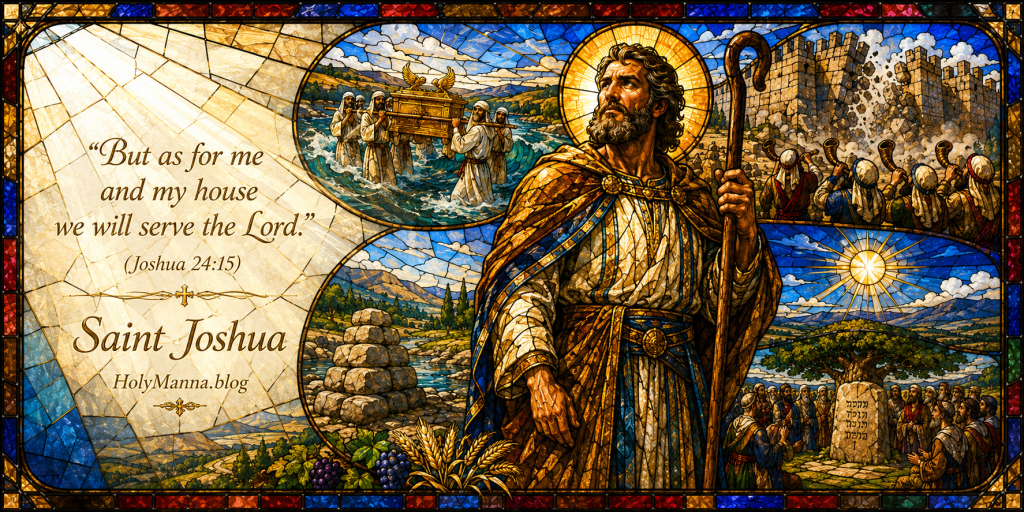
Joshua is the warrior who watched the walls of Jericho collapse at the sound of trumpets. He is the general who prayed and watched the sun stand still in the sky. He is the old man who gathered a nation at Shechem and drew a line in the sand with one of the most quoted sentences in all of Scripture: “As for me and my house, we will serve the Lord” (Joshua 24:15). And hidden inside all of that is the most astonishing fact about him, the one the Church Fathers could never stop talking about. His name, Yehoshua in Hebrew, is rendered in Greek as Iesous. It is, letter for letter, the name of Jesus. The man who led God’s people into the Promised Land carried, centuries in advance, the very name of the One who leads God’s people into heaven. Everything about his life reads like a prophecy written in flesh and blood, and that is exactly how the Catholic Church has always read it (CCC 128 to 130).
Born a Slave, Formed a Servant
Joshua was born in Egypt, during the long night of Israel’s slavery, into the tribe of Ephraim. Scripture names his father as Nun (Numbers 13:8; 1 Chronicles 7:27), and beyond that his family remains in the shadows. He grew up making bricks under Pharaoh’s taskmasters, a child of a people who had been groaning under bondage for generations. His parents did not name him Joshua. They named him Hoshea, which means “salvation.” It was Moses who later changed his name to Yehoshua, “The Lord saves” (Numbers 13:16), and that small change carries enormous weight. Salvation is not an abstract idea floating in the air. Salvation has an author, and His name is the Lord. Moses built that truth into the very name of his successor.
Joshua’s conversion, if that word can be used for a man born into the covenant, was really a lifelong deepening, and it began the moment Israel walked out of Egypt. He was a young man when the sea parted, when the manna first fell, when the pillar of fire lit the camp at night. He saw all of it with his own eyes, and unlike so many of his generation, he never let the memory grow cold. Scripture first introduces him not as a dreamer but as a fighter. When Amalek attacked Israel at Rephidim, Moses turned to one man: “Choose out men: and go out and fight against Amalec” (Exodus 17:9). Joshua fought in the valley while Moses prayed on the hill with his arms stretched wide, and as long as those arms stayed raised, Israel prevailed. Saint Justin Martyr, writing in the second century, saw in that scene a double prophecy. In his Dialogue with Trypho he taught that Moses’ outstretched hands were a type of the Cross, while the man renamed Jesus led the battle below, so that the victory belonged at once to the sign of the Cross and to the power of the Name.
From then on, Joshua rarely left Moses’ side. He is called Moses’ minister and aide from his youth (Numbers 11:28). He alone accompanied Moses partway up Mount Sinai when the Law was given (Exodus 24:13). And in one of the most quietly beautiful verses in the Torah, Scripture says that when Moses would finish speaking with God face to face and return to the camp, “his servant Josue the son of Nun, a young man, departed not from the tabernacle” (Exodus 33:11). While everyone else went back to their tents, Joshua stayed where the Presence was. Long before he ever commanded an army, he learned to linger with God. That is the hidden engine of his entire life, and it is worth pausing on. The great public victories at the Jordan and Jericho were won years earlier, in silence, by a young man who simply refused to leave the tent.
The Spirit of Wisdom and the Wars of the Lord
The defining test of Joshua’s early life came at Kadesh, when Moses sent twelve men to scout the Promised Land. Ten came back terrified, spreading fear about giants and fortified cities. Only two, Joshua and Caleb, told the truth in faith. They tore their garments and pleaded with the people: “The Lord is with us, fear ye not” (Numbers 14:9). The congregation’s answer was to pick up stones to kill them, and only the sudden appearance of the glory of the Lord saved their lives. For that fidelity, Joshua and Caleb alone of their entire generation were permitted to enter the land. Everyone else who had doubted would die during forty years of wandering, and Joshua would wander with them, waiting four decades for a promise he had believed from the first day.
At the end of those years, God commanded Moses to lay his hands on Joshua before the whole community (Numbers 27:18 to 23), and Scripture records the result in words the Roman Martyrology still echoes: “And Josue the son of Nun was filled with the spirit of wisdom, because Moses had laid his hands upon him” (Deuteronomy 34:9). Catholic eyes cannot miss what is happening there. Grace and office are handed on through the imposition of hands, publicly, before the assembly. The pattern that runs through the whole sacramental life of the Church is already visible on the plains of Moab.
Then Moses died, and God spoke to Joshua the words that have steadied believers in every century since: “Take courage, and be strong. Fear not and be not dismayed: because the Lord thy God is with thee in all things whatsoever thou shalt go to” (Joshua 1:9). What followed was a cascade of miracles worked by God through this man’s obedience. At the Jordan, at flood stage, the waters stopped flowing the moment the feet of the priests carrying the Ark touched the river, and the entire nation crossed on dry ground (Joshua 3 to 4). Joshua had twelve stones set up as a memorial so that children would ask their parents what the stones meant, and the parents would tell the story of what God had done. He understood something every Catholic family still needs to understand. Faith is handed on through memory, ritual, and story, deliberately kept alive.
At Gilgal he had the new generation circumcised and celebrated the first Passover in the land, and the manna ceased the very next day (Joshua 5). Then, outside Jericho, Joshua looked up and saw a man standing with a drawn sword, who announced himself: “I am prince of the host of the Lord, and now I am come” (Joshua 5:14). Joshua fell on his face and was told to remove his sandals, for the ground was holy. Even Israel’s commander had a Commander. The fall of Jericho that followed is one of the most famous miracles in the Bible precisely because it is designed to look nothing like a military victory. For six days the army marched silently around the walls behind the Ark and seven priests with trumpets. On the seventh day they circled seven times, the trumpets blasted, the people shouted, and the walls collapsed flat (Joshua 6). God was teaching His people, and everyone who would ever read the story, that the battle belongs to Him.
The most staggering miracle of Joshua’s life came at Gibeon, where he marched all night to rescue an allied city and God threw the enemy into panic, raining down hailstones that killed more of the foe than the sword did. In the middle of that battle Joshua prayed aloud before all Israel: “Move not, O sun, toward Gabaon, nor thou, O moon, toward the valley of Ajalon” (Joshua 10:12), and Scripture testifies that the sun stood still until the victory was complete, adding that there was no day like it before or after, when the Lord obeyed the voice of a man (Joshua 10:13 to 14). The sacred author is not merely reporting a wonder. He is revealing the intimacy between God and His faithful servant, an intimacy so deep that heaven itself bent to the prayer of a man who had spent his life refusing to leave the tent of meeting.
Why should any of this matter to a Catholic today? Because the Church reads Joshua the way she reads all of the Old Testament, discerning in God’s works of the Old Covenant prefigurations of what He accomplished in Christ (CCC 128). The Catechism teaches that typology reveals the unity of God’s plan across both Testaments (CCC 129 to 130), and the liturgy itself is built on this way of reading, in which the events of the Exodus and the entry into the promised inheritance become the pattern of Baptism and salvation (CCC 1094). The Fathers were relentless on this point. Origen, preaching his Homilies on Joshua near the end of his life, shortly before he was tortured for the faith in the Decian persecution, taught that the book does not so much recount the deeds of the son of Nun as it “represents for us the mysteries of Jesus my Lord”. Many of the Fathers even called the book Jesus Nave, and the Letter to the Hebrews makes the typology explicit when it argues that the rest Joshua gave was not final: “For if Jesus had given them rest, he would never have afterwards spoken of another day” (Hebrews 4:8). In that verse the Douay-Rheims does not even translate the name differently; Joshua simply appears as Jesus. Moses, representing the Law, could lead the people to the edge of the promise but could not bring them in. It took a man named Jesus to carry God’s people across the Jordan. The Law prepares; Jesus saves. Joshua’s entire career is that sentence acted out over a lifetime.
Forty Years of Waiting and a Lifetime of War
Joshua was never martyred. He died in peace, full of years, and the Church honors him as a faithful servant rather than as a martyr. But it would be a serious mistake to imagine his path was gentle, because his hardships were long, grinding, and mostly invisible.
He was born into slavery and spent his childhood under the whip of Egypt. As a young commander he fought a battle at Rephidim in which victory rose and fell with an old man’s tired arms. At Kadesh he stood with Caleb against an entire nation in full revolt and came within moments of being stoned to death by his own people for telling the truth (Numbers 14:10). Then came the punishment that was not his. Because the people refused to trust God, Joshua, who had trusted, spent forty years walking in circles through the wilderness, watching the entire generation of his friends and neighbors die one by one. He buried a nation before he led one. There may be no purer test of patience in all of Scripture. He carried a promise he knew was true through four decades of delay caused by other people’s sins, and he never grew bitter and never walked away.
When leadership finally came, it came as a crushing weight. He had to succeed Moses, the man who spoke with God face to face, a task so intimidating that God repeated the command to be strong and courageous four times in a single chapter (Joshua 1). The conquest itself brought humiliation as well as triumph. At Ai, Israel was routed because one man, Achan, had secretly stolen what was devoted to God, and Joshua tore his garments and lay on his face before the Ark until evening, learning in grief that hidden sin in the camp wounds the whole body (Joshua 7). At Gibeon he was deceived by ambassadors in worn-out clothes because, as Scripture pointedly notes, the leaders did not consult the mouth of the Lord (Joshua 9:14). Even a saint can stumble when he leans on his own judgment, and Joshua, honest man that he was, kept the rash oath anyway rather than add sin to sin. Beyond these episodes stretched years of hard campaigning, north and south, against coalition after coalition. Through all of it, God shielded him. The hailstones at Gibeon, the panic that fell on his enemies, and the long miracle of a leader who was never once defeated when he sought the Lord first, all testify to the divine protection that surrounded a man whose courage was really obedience wearing armor.
His final hardship was the quietest one. As an old man he could see what was coming. He knew the people’s hearts, and in his farewell at Shechem he warned them with painful honesty that they were prone to wander. So he did the only thing a dying father can do. He renewed the covenant, set up a great stone as a witness, and staked his own household publicly on God: “But as for me and my house we will serve the Lord” (Joshua 24:15). He could not choose for Israel. He could choose for his own house, and he did, in front of everyone, with no exit clause.
A Tomb in the Hill Country
Scripture records that Joshua, the servant of the Lord, died at one hundred ten years of age and was buried in the border of his own inheritance at Timnath-serah in the hill country of Ephraim (Joshua 24:29 to 30). It adds a line that is perhaps the greatest compliment ever paid to a leader: Israel served the Lord all the days of Joshua, and all the days of the elders who outlived him and who had known the works the Lord had done for Israel (Joshua 24:31). His life was so saturated with fidelity that its influence outlasted his heartbeat by a full generation.
The Bible records no miracles worked through Joshua after his death, and honesty requires saying so plainly; no verified posthumous miracle accounts exist in Catholic sources. What history does show is centuries of veneration. The son of Sirach, writing some two centuries before Christ, enshrined him in the great hymn to the ancestors: “Valiant in war was Jesus the son of Nave, who was successor of Moses among the prophets, who was great according to his name” (Sirach 46:1), going on to recall the sun standing still and to ask whether any before him so stood firm, for the Lord Himself brought down his enemies. That is Israel’s own canonization of Joshua, sung in the liturgy of the synagogue before the Church ever existed. There is also a long tradition that identifies his tomb at Timnath-serah with a site in the village of Kifl Haris in Samaria, northwest of ancient Shiloh, where pilgrims across many centuries, including travelers of the Byzantine era, came to honor the resting place of the son of Nun. It is told here as a tradition of pilgrimage attached to the biblical burial notice, and the identification of that exact site as the true tomb of Joshua cannot be verified.
His formal place in Catholic devotion rests on the Roman Martyrology, which fixes his commemoration on September 1st, and the Eastern churches honor him on the same day, at the very opening of the Byzantine liturgical year, so that the man who began Israel’s life in the land begins the Church’s year of grace in the East. His cultural impact is almost impossible to measure because it hides in plain sight. Every time the name Joshua is given to a child, and it remains among the most beloved names in the Christian world, the memory of this saint is renewed. Every baptism echoes his Jordan crossing, since the Fathers loved to see in Israel’s passage through that river, behind the Ark, a figure of the Christian’s passage through the waters of Baptism into the true inheritance, a way of reading that belongs to the typological heart of Catholic worship (CCC 1094). Spirituals, hymns, and countless sermons have retold the fall of Jericho. And above all, his name became the Name. When the angel told Saint Joseph to call the child Jesus, because He would save His people from their sins, heaven was reaching back to the slave child from Egypt whom Moses renamed, and completing what that renaming had promised all along.
Courage Is Obedience Wearing Armor
Joshua’s life hands every believer a set of lessons that have not aged a single day. The first is that greatness in God’s eyes begins in hiddenness. Joshua spent decades as an assistant, an aide, the young man who would not leave the tabernacle, before he ever led anything. Where in your own life is God asking you to be faithful in a hidden role, with no applause, simply because His presence is there?
The second lesson is that courage is not a feeling but a decision grounded in a promise. God did not tell Joshua to feel brave. He told him to be strong and courageous because “the Lord thy God is with thee” (Joshua 1:9). The command rests entirely on the presence. Every baptized person carries a greater presence still, and the Catechism teaches that faith means clinging to God’s promises even when everything visible argues against them, after the pattern of the great believers of the Old Covenant (CCC 146 to 147). What Jericho is standing in your life right now, some wall you have circled for years, and are you still marching, still praying, still waiting on God’s timing rather than your own?
The third lesson is Kadesh. Sometimes fidelity means standing with the minority of two while the crowd reaches for stones. In an age when Catholic convictions about faith, life, and family are often as unpopular as Joshua’s report about the land, his example is bracing. Speak the truth, trust the Lord, and let Him handle the outcome. The fourth lesson is patience under other people’s failures. Joshua lost forty years to sins he did not commit and served God cheerfully anyway. Anyone who has suffered in a family, a workplace, or even a parish because of the choices of others knows exactly how hard that is. And the final lesson is Shechem. At the end of everything, Joshua reduced the spiritual life to one sentence about his household. Practical ways to live that sentence are close at hand: pray together as a family each day, even briefly; keep the Lord’s Day genuinely holy; place a crucifix or an image of Our Lady where the household actually gathers; go to Confession regularly and bring the family along; read a few verses of Scripture at the table, the way Joshua set up memorial stones so the children would ask questions. If a stranger spent one week inside your home, would they be able to tell whom your house serves?
Engage With Us!
Saint Joshua’s story is your story too, because every Christian is on the road from slavery to the Promised Land, following a Leader named Jesus. Share your thoughts and reflections in the comments below; this community grows stronger every time someone speaks honestly about the journey. Here are some questions to pray with this week.
- Joshua stayed at the tent of meeting when everyone else went home. What would it look like for you to linger with the Lord this week, perhaps in Eucharistic Adoration or a few minutes of silence after Mass?
- God told Joshua to be strong and courageous because He was with him. What fear in your life would shrink if you truly believed that promise applied to you?
- Joshua and Caleb stood alone against the crowd at Kadesh. Where is God asking you to hold to the truth even when it costs you socially?
- Joshua waited forty years for a promise delayed by other people’s sins. How do you respond when your faithfulness is not rewarded on your schedule?
- “As for me and my house, we will serve the Lord.” What is one concrete change you could make this month so that your household serves the Lord more visibly?
Take heart from the old general who never left the tent, never doubted the promise, and never fought a battle without the Lord going before him. The same God who stopped a river, flattened a city, and stilled the sun is with you in all things, wherever you go. Live this day with courage, choose whom you will serve, and do everything with the love and mercy that Jesus taught us.
Saint Joshua, pray for us!
Follow us on YouTube, TikTok, Instagram and Facebook for more insights and reflections on living a faith-filled life.


Leave a Reply