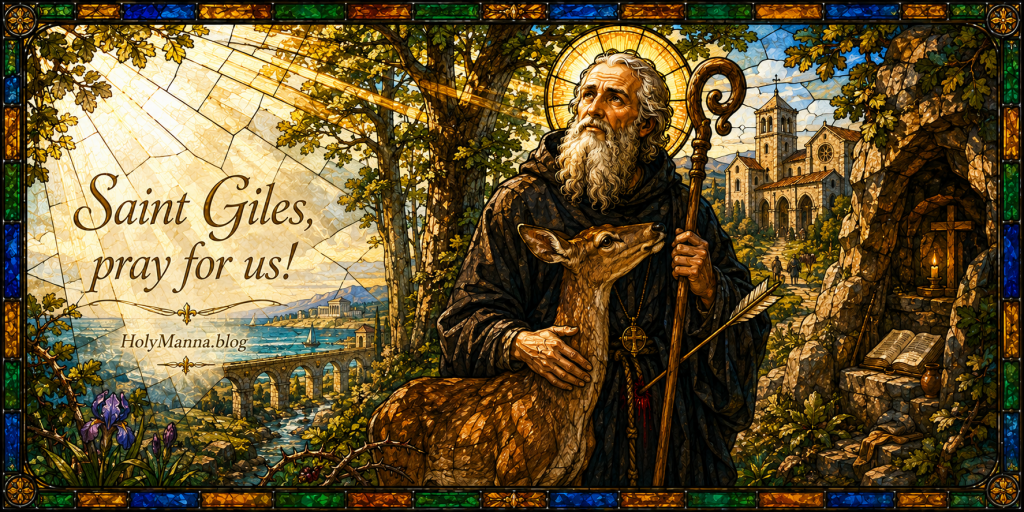
A Quiet Man Whom the Whole World Came to Find
There is a beautiful irony at the heart of the story of Saint Giles. Here was a man who spent his entire life running away from attention, and the Church has spent thirteen centuries refusing to let him be forgotten. Known in Latin as Aegidius and in French as Gilles, this hermit and abbot of southern Gaul became one of the most beloved saints of the Middle Ages. His feast is celebrated on September 1st, and the Roman Martyrology honors him with characteristic brevity: “In the province of Narbonne, Saint Giles, abbot and confessor.”
Notice that word, confessor. Saint Giles was not a martyr. He belongs to that great company of saints who bore witness to Christ not by shedding their blood but by the slow, hidden martyrdom of a life poured out in prayer, penance, and charity. The Catechism of the Catholic Church teaches that when the Church canonizes some of the faithful, “she recognizes the power of the Spirit of holiness within her and sustains the hope of believers by proposing the saints to them as models and intercessors” (CCC 828). Saint Giles is exactly that kind of model, a man whose holiness was so magnetic that kings sought him out in the wilderness and pilgrims wore roads into the earth to reach his tomb.
He holds a remarkable collection of patronages, all documented in Catholic tradition and all flowing directly from the events of his life. He is the patron of beggars and the poor, of the disabled, of lepers and outcasts, of blacksmiths, of hermits, and of those who struggle to make a full and honest confession, and he is the patron saint of the city of Edinburgh in Scotland, whose ancient High Kirk still bears his name. He is also counted among the Fourteen Holy Helpers, the saints medieval Christians invoked with special confidence in times of plague and desperate need, and within that company he holds a singular distinction: he is the only one of the fourteen who was not a martyr. Gentleness, it turns out, earned him a place among heroes.
Before entering his story, honesty requires a word about sources. Nearly everything known about the life of Saint Giles comes from a biography called the Vita sancti Aegidii, written in the tenth century, roughly two hundred years after his death, and scholars recognize that it mixes genuine memory with pious embellishment. This post will tell the traditions as traditions and mark clearly what cannot be verified. What is beyond doubt is this: a holy hermit and abbot lived and died in the lower Rhône valley around the turn of the eighth century, a monastery and then an entire town grew up around his tomb, and the Christian world loved him with an intensity reserved for very few saints.
A Rich Young Man Who Actually Said Yes
According to the traditional account, Giles was born in Athens around the middle of the seventh century, the child of a noble and wealthy family. Some versions of the story even call his parentage royal, though historians point out that Athens had not had a king for many centuries by that time, which is one reason the Vita must be read with care. What the tradition consistently affirms is that Giles was raised a Christian and that from his earliest years he was drawn to the things of God with unusual seriousness.
When his parents died, the tradition says, Giles inherited a fortune, and here his story deliberately echoes The Gospel of Matthew, where the Lord tells the rich young man, “If you wish to be perfect, go, sell what you have and give to the poor, and you will have treasure in heaven; then come, follow me” (Mt 19:21). The rich young man of the Gospel could not do it. The rich young man of Athens could. Tradition holds that Giles gave his entire inheritance to the poor and began a life of prayer and works of mercy.
The Vita attaches several miracles to his youth in Greece. It recounts that he healed a sick beggar by giving the man his own cloak, that he cured a man suffering from snakebite, and that he delivered another man from demonic possession. These stories come from the late biography and cannot be verified, and they are presented here as the traditions they are. Yet even as traditions they reveal how the early Church remembered him: as a man in whom generosity and healing were inseparable, whose compassion was itself the channel of God’s power.
His holiness had a consequence Giles never wanted. He became famous. Crowds gathered, admirers multiplied, and the young man found that the praise of others was becoming a snare for his soul. So he did something radical. Around the year 683, according to the traditional chronology, he left Greece entirely, boarding a ship for the western Mediterranean, trading his homeland, his language, and his reputation for the anonymity of a foreign shore. He landed at Marseilles and made his way into the wild country of southern Gaul, in the region of Provence and Septimania near the mouth of the Rhône river.
One detail of the traditional account deserves an honest flag. The Vita claims that Giles spent two years in the company of Saint Caesarius, the great bishop of Arles, yet Caesarius died in the year 542, more than a century before Giles is said to have arrived in Gaul. The two holy men cannot have met if the seventh-century dating of Giles is correct, and the story of the meeting cannot be verified.
What drove this man across the sea was not restlessness but a hunger the world could not satisfy. Jesus taught in The Gospel of Matthew, “But when you pray, go to your inner room, close the door, and pray to your Father in secret. And your Father who sees in secret will repay you” (Mt 6:6). Giles took that teaching about as literally as any human being ever has. He made the wilderness itself his inner room.
The Deer, the King, and the Making of an Abbot
Giles settled first as a hermit in the wilderness near the mouth of the Rhône, and later along the River Gard. But even in Gaul the pattern of his life repeated itself. His sanctity attracted notice, notice attracted crowds, and crowds drove him deeper into hiding. At last he withdrew into a dense forest near the city of Nîmes, where tradition says he lived for years in a cave whose entrance was guarded by a thick thorn bush, in a solitude so complete that his only companion was a wild deer, a gentle hind.
Here begins the most famous story ever told about Saint Giles, and it must be told as the cherished tradition it is. The account relates that God, seeing the extreme poverty of his servant, sent the hind to Giles so that she might nourish him with her own milk, and the hermit and the deer lived together in peace, an image of Eden quietly restored in one corner of a fallen world. Then one day a royal hunting party caught sight of the hind. The hounds pursued her, and the frightened creature fled straight to the one place she knew she was safe, the cave of the hermit. A huntsman loosed an arrow into the thorn bush where she had vanished, and when the party pushed through the undergrowth they found no wounded deer, but an old man in a rough habit, calm and praying, with the arrow lodged in his body and the hind unharmed beside him. Differing versions place the wound in his leg or his foot, and the whole episode rests on the tenth-century Vita and cannot be verified, though it has been retold for a thousand years because it is so worth retelling.
The tradition continues that the hunting party belonged to the king of the Visigoths, whom the Vita names Flavius. The king was overcome with remorse at what his men had done. He sent his own physicians to tend the hermit’s wound, and he returned again and again to visit him, though Giles begged simply to be left alone. And here the tradition adds a detail that shaped centuries of devotion: Giles refused to be fully healed. He asked that the wound be left as it was, choosing to live the rest of his life with a limp, so that his suffering might be a continual act of penance united to Christ. From this tradition, which likewise cannot be verified, comes his ancient patronage of the disabled and of all who live with permanent injury. The medieval poor saw in him a saint who did not merely pity their condition but shared it, and freely.
There is deep Catholic instinct in that detail. Saint Paul wrote in his Second Letter to the Corinthians that the Lord told him, “My grace is sufficient for you, for power is made perfect in weakness” (2 Cor 12:9). The Catechism teaches that suffering, united to the Passion of Christ, can become a participation in his saving work (CCC 1505, CCC 1521). Whether or not the arrow story happened exactly as the Vita tells it, the theology the story carries is solid rock.
The king, unable to repay the holy man in any way Giles would accept, finally found the one gift the hermit could not refuse: a gift for God rather than for himself. He offered land and resources to build a monastery in that valley. Giles consented on the condition that the monastic life there be authentic and disciplined, and he became the community’s first abbot. Around that monastery grew a town that exists to this day and bears his name, Saint-Gilles-du-Gard, in the south of France.
As abbot, the traditional account presents Giles as a father who led by example rather than by force, a model of every virtue who drew his monks upward simply by the sight of his own life. The Catechism describes the vocation Giles lived in words that could have been written about him: hermits “manifest to everyone the interior aspect of the mystery of the Church, that is, personal intimacy with Christ”, and their hidden life “is a silent preaching of the Lord, to whom he has surrendered his life simply because he is everything to him” (CCC 921). Giles surrendered everything, twice: once when he gave away his fortune, and again when he gave away his solitude to shepherd the souls God kept sending him.
The most consequential miracle attributed to his lifetime, according to the tradition, was not a healing of the body at all but the conversion of the king himself, who under the influence of the abbot’s prayers confessed his sins and did penance for the rest of his days. That tradition points directly to the most famous story in the whole dossier of Saint Giles, the one that made him the patron of difficult confessions.
The tradition, recorded in the tenth-century Vita and repeated in many later medieval texts including the Legenda Aurea, tells that a great ruler, identified in the legend as the Emperor Charles, begged the abbot to pray for him, for there was one sin on his conscience so shameful that he had never dared to speak it in confession. As Giles offered the Holy Sacrifice of the Mass for the emperor, an angel descended and laid upon the altar a letter on which that hidden sin was written, together with the assurance that God would grant pardon through the abbot’s intercession, provided the ruler repented and confessed. The emperor, confronted with the proof that nothing is hidden from God, repented fully. This scene, known as the Mass of Saint Giles, became one of the treasured images of medieval art. The story must be flagged honestly on two counts. It cannot be verified, and its identification of the ruler with Charlemagne is impossible, since Charlemagne lived from roughly 742 to 814, decades after the death of Giles. The story cannot be verified, and its chronology contradicts documented history.
Yet the reason the medieval Church loved this story is the reason it still matters. It preaches, in narrative form, exactly what the Church teaches about the Sacrament of Reconciliation. The Catechism states that “all mortal sins of which penitents after a diligent self-examination are conscious must be recounted by them in confession” (CCC 1456), and it warns in the same paragraph, quoting Saint Jerome, that the one who knowingly withholds sins places nothing before the divine mercy, for “if the sick person is too ashamed to show his wound to the doctor, the medicine cannot heal what it does not know.” For a thousand years, Catholics crushed by shame have asked Saint Giles to pray for them before they entered the confessional. That is a patronage worth reviving in this generation.
The Wounds He Kept and the Fame He Could Not Escape
Saint Giles was never dragged before a tribunal and never faced an executioner. His hardships were of a quieter kind, and precisely for that reason they speak powerfully to ordinary believers, because his crosses look so much like the ones most people actually carry.
His first hardship was the one he chose: a lifetime of severe asceticism, years in the forest marked by hunger, exposure, and radical poverty, a life stripped to prayer and survival. The Church has always understood such voluntary penance not as self-hatred but as love concentrated, undertaken so that nothing would stand between the soul and God (CCC 2015).
His second hardship arrived on the tip of an arrow. If the tradition is received, Giles spent the last decades of his life in constant pain, walking with difficulty, permanently marked by another man’s careless shot, and he chose to keep that wound. In an age obsessed with optimizing every discomfort out of existence, there is something almost shocking about a man who saw in his own suffering not an enemy to be eliminated but an offering to be made, and who endured it without bitterness toward the huntsman or the king, and without a shred of self-pity that any tradition records.
His third hardship may have been the heaviest: he never got the solitude he longed for. Twice he fled across the world to be alone with God, and twice the world followed him. In the end, obedience meant surrendering the very hermitage he had crossed the sea to find, accepting the office of abbot, the crowds of pilgrims, the visits of royalty, and the endless demands of souls. The Psalms give words to the longing that must have lived in him all his life: “As the deer longs for streams of water, so my soul longs for you, O God” (Ps 42:2). It is a lovely providence that the Church remembers him with a deer at his side, for the hind pressed against the hermit is the image of every soul that runs to God for refuge, and Giles spent his whole life being sheltered in exactly the same way.
He died at his monastery, full of years, around the early eighth century. The sources disagree on the exact year, offering dates around 710, 712, and 720, and honesty is better served by saying simply that he passed to the Lord in the opening decades of that century, having governed his monks faithfully to the end.
The Tomb That Built a Town and Moved a Continent
If the life of Saint Giles was hidden, his afterlife in the Church’s memory was anything but. The traditional account records that miracles began at his tomb almost immediately, healings and answered prayers in such numbers that a whole town rose from the ground around the crowds of pilgrims, taking the saint’s own name: Saint-Gilles-du-Gard. These early tomb miracles come from tradition and cannot be individually verified, but the pilgrimage they ignited is one of the best documented phenomena of the Middle Ages.
The abbey of Saint-Gilles became one of the great gathering points in France for pilgrims walking to Santiago de Compostela, the starting place of the route known as the Via Tolosana, and the old road running north through the Cévennes is still called the Regordane Way, the Saint Gilles trail. The abbey church, rebuilt in the twelfth century, remains one of the glories of Romanesque art. In the tenth century the abbey, originally dedicated to Saint Peter, was rededicated to Saint Giles himself, and in the year 925 the abbot Autulphus solemnly translated the saint’s relics within the abbey precincts.
History records a genuinely dramatic chapter for those relics. When the Albigensian wars tore through Languedoc in 1209, the relics of Saint Giles were exposed to danger, and a portion was carried to the church of Saint Sernin in Toulouse, which afterward claimed the body of the saint. For centuries Saint-Gilles and Toulouse maintained rival claims, a documented medieval dispute that the sources themselves acknowledge. In 1862 rediscoveries in the crypt at Saint-Gilles renewed veneration at the original tomb, and pilgrims venerate Saint Giles at both sites to this day.
The measure of this saint’s reach is staggering. Churches and monasteries dedicated to him spread across France, Spain, Germany, Poland, Hungary, Slovakia, and the British Isles, and England alone counts roughly one hundred and sixty ancient churches under his name. In London, Saint Giles Cripplegate and Saint Giles-in-the-Fields both carry his patronage, and the latter began its life in 1101 as a hospital for lepers, placed under the protection of the saint who loved the outcast. In Scotland he became the patron of the capital itself, and Saint Giles’ Cathedral has stood at the heart of Edinburgh’s Royal Mile since the Middle Ages. In Rome, a church of Sant’Egidio in Trastevere later gave its name to the Community of Sant’Egidio, the Catholic movement devoted to prayer and friendship with the poor, so that even now his name is attached to exactly the works of mercy he practiced.
Medieval devotion gathered him into the Fourteen Holy Helpers, the saints invoked together with special trust during the centuries of plague, and he stands among them as the only confessor in a company of martyrs. In sacred art he is instantly recognizable: an aged abbot with a long white beard, crosier in hand, with a hind resting her head against him and an arrow marking the wound he refused to surrender. The Catechism explains why the Church encourages such veneration: the saints in heaven “do not cease to intercede with the Father for us, as they proffer the merits which they acquired on earth through the one mediator between God and men, Christ Jesus” (CCC 956). Thirteen centuries of Christians have tested that promise on Saint Giles, and thirteen centuries have kept coming back.
What a Wounded Hermit Teaches a Restless Generation
It would be easy to file Saint Giles away as a charming figure from a distant world. That would be a mistake, for few ancient saints speak more directly to the anxieties of the present moment.
Consider his flight from fame. Giles lived in a world without screens, yet he understood something this generation is only painfully learning: the applause of others can quietly become the master of the soul. He fled his reputation, twice, across a sea, because he wanted God more than he wanted to be seen. How much of daily life is currently arranged around being noticed, and what would change if it were arranged around being faithful instead? A phone left in another room during prayer, a good deed done in genuine secret as The Gospel of Matthew counsels (Mt 6:1 to 6), a decision not to broadcast an accomplishment: these are the hermitages available to modern life.
Consider his wound. Nearly everyone carries something that will not fully heal, a chronic illness, a disability, an old grief, a limitation that prayer has not removed. Saint Giles teaches that such things need not be dead weight. United to the Cross, they become offering, intercession, even power, for as the Lord said, “My grace is sufficient for you, for power is made perfect in weakness” (2 Cor 12:9). What wound in this life is waiting to be handed over to Christ, not for elimination, but for transformation?
Consider the hind. The frightened creature ran to the hermit because she knew where safety lived, and the hermit took the arrow meant for her. It is hard to find a more tender image of what Christ does for every sinner, and of what his saints learn to do for one another. The Catechism teaches that love for the poor and defenseless belongs to the Church’s constant tradition (CCC 2444, CCC 2447). Who, in the ordinary orbit of this week, is running toward safety and finding none, and who will absorb the arrow for them?
Consider, finally, the confession. The most enduring patronage of Saint Giles belongs to those who are too ashamed to confess. Shame is the oldest trick in the enemy’s book; it convinced Adam to hide among the trees, and it convinces countless Catholics to hide their gravest wounds from the one Sacrament that exists to heal them. The story of the angel’s letter, however legendary its details, tells the truth: God already knows. Nothing brought into the light of the confessional can survive there, and nothing kept in the dark can be healed there (CCC 1455 to 1456). Is there a sin that has waited years to be spoken aloud, and could this feast of Saint Giles be the day it finally meets the mercy of God? A concrete practice for this week presents itself naturally: find a parish confession time, ask Saint Giles for the courage he obtained for a king, and go.
Engage With Us!
The story of Saint Giles has been drawing hearts to God since the eighth century, and now it is the reader’s turn to respond. Share thoughts, reflections, and experiences in the comments below; this community grows stronger every time someone speaks honestly about the journey of faith.
- Saint Giles fled from fame twice because he feared what praise was doing to his soul. In what specific area of life does the desire to be noticed compete with the desire to be holy?
- Tradition says Giles asked to keep his wound as a lifelong offering to God. What suffering, limitation, or unhealed hurt could be consciously offered to Christ this week instead of merely endured?
- The hind ran to the hermit for refuge, and he bore the arrow meant for her. Who in daily life needs that kind of protection right now, and what would it cost to provide it?
- Saint Giles is the patron of those afraid to make a full confession. What holds people back from the Sacrament of Reconciliation, and what one step could be taken before his feast day ends to move toward it?
- Giles wanted solitude, but God kept sending him people, and he obeyed. Where might God be redirecting carefully made personal plans toward the needs of others?
Saint Giles gave away a fortune, crossed a sea, embraced a wound, and opened his solitude to every soul God sent him, and through it all he kept his eyes on the face of Christ. The same call rests on every baptized person reading these words. Live this day with generosity that holds nothing back, with courage that brings every sin into the light of mercy, and with tenderness toward every wounded creature seeking refuge. Do everything with the love and mercy that Jesus taught us.
Saint Giles, pray for us!
Follow us on YouTube, TikTok, Instagram and Facebook for more insights and reflections on living a faith-filled life.


Leave a comment