Tuesday of the Twenty-second Week in Ordinary Time – Lectionary: 432
A Word That Does What It Says
Some words simply describe the world, while other words change it. Every person has heard both kinds. A weather report describes; a judge’s sentence changes everything. Today’s readings for Tuesday of the Twenty-second Week in Ordinary Time are about the second kind of word, the word of God, which never returns empty.
Saint Paul tells the Corinthians, a congregation dazzled by clever Greek orators and philosophical fads, that the deepest truths cannot be reached by human brilliance at all. Only “the Spirit of God” knows “the depths of God,” and that same Spirit has been freely given to believers so that they may possess nothing less than “the mind of Christ.” The psalmist then sings of a Lord who is “faithful in all his words and holy in all his works,” a God whose speech and action are never out of sync. And then Luke shows what happens when the eternal Word Himself, made flesh, stands up in a small-town synagogue in Capernaum and speaks. The people are astonished. A demon shrieks. And with one short command, “Be quiet! Come out of him!”, the unclean spirit is expelled without harming the man.
First-century Galilee knew plenty of teachers, and the Greco-Roman world knew plenty of self-styled exorcists with their elaborate incantations. What it had never seen was authority like this: no formulas, no borrowed power, no “Thus says the Lord.” Just the Lord, speaking. The uniting theme of this day is the living authority of God’s word, a word that scrutinizes the depths, sustains a Kingdom for all ages, and commands even the powers of darkness. The invitation is to let that same word speak into ordinary life with the same power.
First Reading — 1 Corinthians 2:10b-16
The Wisdom No Textbook Can Teach
Corinth was the kind of city that would feel familiar today: wealthy, cosmopolitan, image-obsessed, and addicted to impressive speech. Traveling philosophers and rhetoricians competed for followers the way influencers compete for subscribers. The young Christian community there had started ranking its teachers, Paul, Apollos, Cephas, as if the Gospel were another school of thought to be evaluated by worldly standards. Writing around the year 56, Paul confronts this head-on. In the verses just before today’s passage, he reminds them that he came preaching “Jesus Christ, and him crucified,” not with sublime words of wisdom. Now he explains why: the things of God are simply inaccessible to unaided human reason. They must be revealed, and the Revealer is the Holy Spirit. This reading fits the day’s theme perfectly, because it explains where the authority of God’s word comes from and how a believer becomes capable of receiving it.
1 Corinthians 2:10b-16
Brothers and sisters:
The Spirit scrutinizes everything, even the depths of God.
Among men, who knows what pertains to the man
except his spirit that is within?
Similarly, no one knows what pertains to God except the Spirit of God.
We have not received the spirit of the world
but the Spirit who is from God,
so that we may understand the things freely given us by God.
And we speak about them not with words taught by human wisdom,
but with words taught by the Spirit,
describing spiritual realities in spiritual terms.Now the natural man does not accept what pertains to the Spirit of God,
for to him it is foolishness, and he cannot understand it,
because it is judged spiritually.
The one who is spiritual, however, can judge everything
but is not subject to judgment by anyone.For “who has known the mind of the Lord, so as to counsel him?”
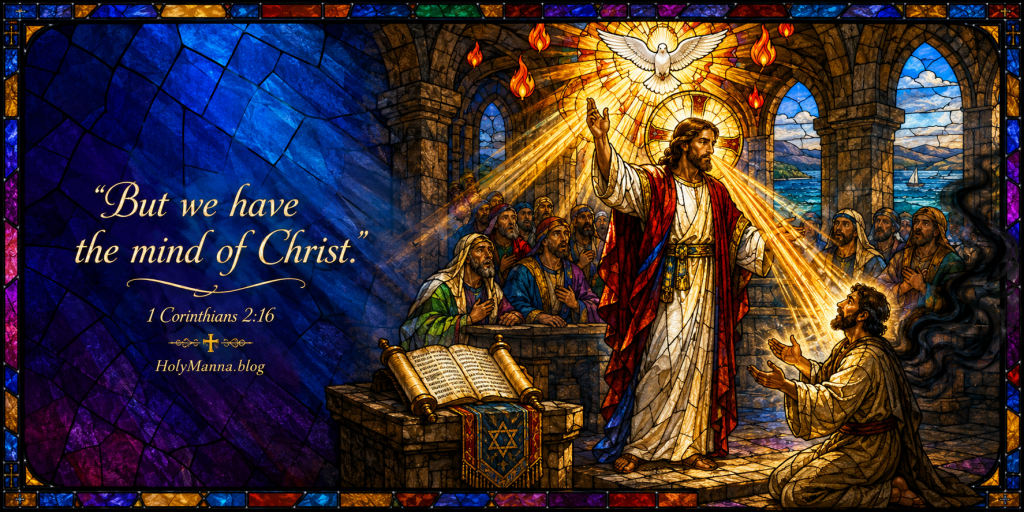
But we have the mind of Christ.
Detailed Exegesis
Verse 10b: “The Spirit scrutinizes everything, even the depths of God.”
The Greek verb behind “scrutinizes” suggests active, thorough searching. Paul is teaching something staggering about the Holy Spirit: He penetrates even the unfathomable interior life of God. No creature, not even the highest angel, can do this. The Church has always read this verse as evidence of the Spirit’s full divinity, since only God can know God exhaustively. CCC 687 opens its article on the Holy Spirit with this very verse: “‘No one comprehends the thoughts of God except the Spirit of God.’ Now God’s Spirit, who reveals God, makes known to us Christ, his Word, his living Utterance, but the Spirit does not speak of himself.”
Verse 11: “Among men, who knows what pertains to the man except his spirit that is within? Similarly, no one knows what pertains to God except the Spirit of God.”
Paul uses a beautifully simple analogy. No one truly knows another person’s interior thoughts; only that person’s own spirit does. Likewise, only God’s own Spirit knows God’s interior life. The analogy also implies intimacy: the Spirit is not outside God looking in but belongs to God as one’s own spirit belongs to oneself, a truth the Church would later articulate in her Trinitarian doctrine.
Verse 12: “We have not received the spirit of the world but the Spirit who is from God, so that we may understand the things freely given us by God.”
Here is the astonishing gift. The Spirit who knows the depths of God has been given to believers, not so they can become spiritually elite, but “so that we may understand the things freely given us by God.” Notice the word “freely.” Grace is not earned by intelligence, credentials, or eloquence, which was precisely the Corinthian temptation.
Verse 13: “And we speak about them not with words taught by human wisdom, but with words taught by the Spirit, describing spiritual realities in spiritual terms.”
Paul defends his plain preaching style. The message determines the medium: spiritual realities require Spirit-taught words. This is why the Church insists that Scripture must be read in the same Spirit in which it was written, and why prayer must accompany study.
Verse 14: “Now the natural man does not accept what pertains to the Spirit of God, for to him it is foolishness, and he cannot understand it, because it is judged spiritually.”
The “natural man” translates the Greek psychikos, the person living by merely human faculties. Such a person is not necessarily wicked, but is closed off from a whole dimension of reality, like someone trying to appreciate a symphony by reading a seating chart. To him the Cross looks like foolishness, exactly as Paul said earlier in this letter.
Verse 15: “The one who is spiritual, however, can judge everything but is not subject to judgment by anyone.”
The spiritual person, alive in the Holy Spirit, gains a capacity for true discernment, the ability to weigh all things against the measure of God. The world, lacking that measure, cannot render a final verdict on the person of faith. Martyrs from Saint Stephen to Saint Thomas More have lived this verse, judged by human courts but answerable to a higher one.
Verse 16: “For ‘who has known the mind of the Lord, so as to counsel him?’ But we have the mind of Christ.”
Paul quotes Isaiah 40:13 and then delivers one of the most breathtaking sentences in all his letters. What the prophet declared impossible, knowing the mind of the Lord, has become the baptized believer’s inheritance through the indwelling Spirit. This is not a metaphor for positive thinking. It is a real participation in the interior life of Christ.
Teachings
Saint John Chrysostom, the golden-mouthed Doctor of the Church, preached through this chapter in his Homilies on First Corinthians. In Homily 7 he explains how revelation transforms the very organ of understanding: “For after the gift of the Spirit the heart of the Prophets was not the heart of man, but a spiritual heart; as also he says himself, ‘We have the mind of Christ.’” He adds that before the blessing of the Spirit, “no one of us nor yet of the Prophets conceived them in his mind.” In other words, grace does not merely add information; it renovates the knower. The Catechism carries the same teaching forward in CCC 683: “‘No one can say “Jesus is Lord” except by the Holy Spirit.’” Even the most basic act of Christian faith is already the Spirit at work. This is why the Church begins every serious endeavor, councils, conclaves, catechesis, with the invocation of the Holy Spirit, and why the Veni Creator Spiritus has echoed through Christian history at every decisive moment.
Reflection
This reading is a direct challenge to a culture that treats faith as one opinion among many. If Paul is right, the deepest realities are not crowdsourced; they are revealed. A practical response starts small. Before opening Scripture, pause and ask the Holy Spirit to teach, even with a single sentence of invitation. Before a difficult conversation or decision, ask for the mind of Christ rather than rehearsing talking points. Fast occasionally from the “spirit of the world,” the endless scroll of hot takes, and give that time to the word of God. When facing a hard decision, is the first instinct to consult the Spirit of God or the spirit of the age? What would change in daily life if the phrase “we have the mind of Christ” were taken completely seriously?
Responsorial Psalm — Psalm 145:8-14, 17
A Kingdom Measured in Kindness
Psalm 145 is the last psalm in the Psalter attributed to David, and it is a masterpiece of design: an acrostic, with each verse beginning with a successive letter of the Hebrew alphabet, praise organized from A to Z, so to speak. Jewish tradition holds this psalm in extraordinary honor, and it entered daily synagogue prayer, which means the Lord Jesus Himself would have prayed these very words. Placed between Paul’s teaching on the Spirit and Luke’s account of Jesus’ authority in Capernaum, the psalm supplies the connective tissue of the day’s theme: it describes what God’s authority is actually like. His Kingdom endures through all generations, yet its signature is not domination but graciousness, compassion, faithfulness, and the lifting up of those who fall.
Psalm 145:8-14, 17
R. (17) The Lord is just in all his ways.
The LORD is gracious and merciful,
slow to anger and of great kindness.
The LORD is good to all
and compassionate toward all his works.
R. The Lord is just in all his ways.
Let all your works give you thanks, O LORD,
and let your faithful ones bless you.
Let them discourse of the glory of your Kingdom
and speak of your might.
R. The Lord is just in all his ways.
Making known to men your might
and the glorious splendor of your Kingdom.
Your Kingdom is a Kingdom for all ages,
and your dominion endures through all generations.
R. The Lord is just in all his ways.
The LORD is faithful in all his words
and holy in all his works.
The LORD lifts up all who are falling
and raises up all who are bowed down.
R. The Lord is just in all his ways.
Detailed Exegesis
Verse 8: “The LORD is gracious and merciful, slow to anger and of great kindness.”
This verse quotes God’s own self-description to Moses on Sinai after the golden calf, recorded in Exodus 34:6. Israel’s most treasured creed about God was born not in triumph but in the aftermath of national sin, when God chose mercy. CCC 210 recalls that Sinai moment, where the Lord passes before Moses and proclaims Himself “a God merciful and gracious, slow to anger, and abounding in steadfast love and faithfulness.” Divine patience is not weakness; it is strength held in reserve for the sake of love.
Verse 9: “The LORD is good to all and compassionate toward all his works.”
The word “all” does the heavy lifting here, appearing again and again in this psalm. God’s goodness is not tribal. It extends to every creature He has made, a truth that grounds the Church’s teaching on the universal offer of salvation and on care for all creation.
Verse 10: “Let all your works give you thanks, O LORD, and let your faithful ones bless you.”
Creation itself testifies, but the faithful add something more: conscious, willing blessing. Gratitude is the creature’s native language.
Verse 11: “Let them discourse of the glory of your Kingdom and speak of your might.”
The faithful are not called to keep the Kingdom a private comfort. They are to discourse of it, to make God’s reign a topic of actual conversation. Evangelization begins in this verse.
Verse 12: “Making known to men your might and the glorious splendor of your Kingdom.”
The purpose of that speech is missionary: so that others, “men” in the universal sense, come to know. Israel’s vocation, and now the Church’s, is to be the loudspeaker of God’s splendor to the nations.
Verse 13: “Your Kingdom is a Kingdom for all ages, and your dominion endures through all generations.”
Empires rise and collapse. Against every Babylon and Rome, the psalmist stakes this claim: God’s dominion alone endures. When Jesus arrives in Galilee proclaiming that the Kingdom of God is at hand, this is the Kingdom His hearers had been singing about for centuries.
Verse 14: “The LORD lifts up all who are falling and raises up all who are bowed down.”
Here is the Kingdom’s distinctive style. Its King stoops. The verbs anticipate the Gospels, where Jesus literally raises the paralytic, the widow’s son, and the man freed from the demon in today’s Gospel, who is thrown down but rises unharmed. CCC 303 teaches that “the witness of Scripture is unanimous that the solicitude of divine providence is concrete and immediate; God cares for all, from the least things to the great events of the world and its history.”
Verse 17: “The LORD is faithful in all his words and holy in all his works.”
The refrain verse. In God there is no gap between speech and action, promise and performance. What He says, He does. This is the exact quality on display in Capernaum, where a single sentence from Jesus accomplishes a deliverance.
Teachings
The Church prays this psalm constantly; portions of Psalm 145 appear repeatedly in the Liturgy of the Hours, keeping its vision of God’s Kingdom before the eyes of priests, religious, and lay faithful across the world every week. Its theology saturates the Catechism’s treatment of divine providence. CCC 303 continues with striking words: “The sacred books powerfully affirm God’s absolute sovereignty over the course of events.” Sovereignty and tenderness, might and mercy, are not competing attributes in God but one single simplicity of love. The psalm’s Sinai echo also matters for understanding the whole of salvation history: when the Church proclaims that God is “slow to anger,” she is quoting the covenant language God gave Moses at the very moment Israel deserved condemnation. Divine justice, the refrain insists, is not opposed to divine mercy; the Lord is just precisely in the ways He lifts up the fallen.
Reflection
The psalm offers a portrait of authority worth imitating in homes, parishes, and workplaces. Whoever holds any power over others, parental, professional, or pastoral, can ask whether that power lifts people up or presses them down. A concrete practice: pray verse 14 slowly each morning this week, then look for one falling person to lift, a discouraged coworker, an overwhelmed parent, a friend sliding away from the faith. Another practice: obey verse 11 literally and discourse of the Kingdom, letting God come up naturally in one real conversation. Which verse of this psalm describes the God encountered personally in prayer, and which verse feels hardest to believe right now? Who in daily life is bowed down and waiting to be raised?
Holy Gospel — Luke 4:31-37
Authority That Needs No Introduction
Jesus has just been rejected in His hometown of Nazareth, where the congregation tried to throw Him off a cliff. He goes down, literally downhill, some 1,300 feet in elevation, to Capernaum, a fishing town on the northwest shore of the Sea of Galilee. Capernaum sat near an international trade route and had a customs post and a modest garrison, a working town of fishermen, farmers, and traders. It becomes Jesus’ adopted home base, and its basalt-and-limestone synagogue becomes the stage for this first public confrontation between the Holy One of God and the powers of darkness in Luke’s Gospel. The scene delivers the day’s theme in dramatic form: the word that the Spirit teaches and the psalmist praises now walks into a room and speaks, and unclean spirits have no choice but to obey.
Luke 4:31-37
Jesus went down to Capernaum, a town of Galilee.
He taught them on the sabbath,
and they were astonished at his teaching
because he spoke with authority.
In the synagogue there was a man with the spirit of an unclean demon,
and he cried out in a loud voice,
“What have you to do with us, Jesus of Nazareth?
Have you come to destroy us?
I know who you are–the Holy One of God!”
Jesus rebuked him and said, “Be quiet! Come out of him!”
Then the demon threw the man down in front of them
and came out of him without doing him any harm.
They were all amazed and said to one another,
“What is there about his word?
For with authority and power he commands the unclean spirits,
and they come out.”
And news of him spread everywhere in the surrounding region.
Detailed Exegesis
Verse 31: “Jesus went down to Capernaum, a town of Galilee. He taught them on the sabbath.”
Rejected in one town, Jesus simply continues the mission in another, an early lesson in apostolic perseverance. Saint Cyril of Alexandria observes why the Lord pairs teaching with mighty works in this town: “Those whom argument cannot bring to the sure knowledge of Him Who by nature and in truth is God and Lord, may perhaps be won by miracles unto a docile obedience.” The Sabbath setting matters too; Jesus brings His word into the very heart of Israel’s worship.
Verse 32: “And they were astonished at his teaching because he spoke with authority.”
The scribes taught by citing chains of earlier rabbis, and even the prophets prefaced their oracles with “Thus says the Lord.” Jesus does neither. Cyril captures the difference exactly: “For He never said, Thus saith the Lord, as of course was their custom, but as being the Lord of the law He spake things that surpass the law.” The astonishment of Capernaum is the human mind brushing up against divine speech in its native register.
Verse 33: “In the synagogue there was a man with the spirit of an unclean demon, and he cried out in a loud voice.”
Luke, the careful physician, distinguishes demonic affliction from ordinary illness throughout his Gospel. The tormented man is found not in a graveyard but in the synagogue, a sobering reminder that the enemy does not avoid holy places. The demon cannot remain quiet in the presence of Christ; holiness forces the hidden into the open.
Verse 34: “What have you to do with us, Jesus of Nazareth? Have you come to destroy us? I know who you are–the Holy One of God!”
The demon’s theology is accurate and useless. It knows Jesus’ identity before the townspeople do, yet knowledge without love is the very definition of the demonic. Cyril teaches that the demons spoke this way craftily, putting on “the false appearance of well-sounding words,” hoping flattery might spare them. The plural “us” reveals that the whole kingdom of darkness senses its end approaching in this one Galilean rabbi.
Verse 35: “Jesus rebuked him and said, ‘Be quiet! Come out of him!’ Then the demon threw the man down in front of them and came out of him without doing him any harm.”
No incantations, no props, no borrowed names, just two short commands. Cyril marvels: “With godlike power He rebuked the unclean spirits, making the miracle follow immediately upon His words, that we might not disbelieve.” And again: “the Lord stops their impure tongues, and commands them to depart from those possessed by them.” Christ silences the demon because truth on an impure tongue serves lies. Luke the physician adds the tender clinical note that the man suffered no harm; the Lord who casts out is the Lord who protects.
Verse 36: “They were all amazed and said to one another, ‘What is there about his word? For with authority and power he commands the unclean spirits, and they come out.’”
The crowd asks precisely the right question. The answer, which Luke lets the reader discover, is that this word is the Word, the eternal Son through whom all things were made. CCC 550 interprets the moment: “The coming of God’s kingdom means the defeat of Satan’s: ‘If it is by the Spirit of God that I cast out demons, then the kingdom of God has come upon you.’ Jesus’ exorcisms free some individuals from the domination of demons. They anticipate Jesus’ great victory over ‘the ruler of this world.’”
Verse 37: “And news of him spread everywhere in the surrounding region.”
Authentic encounter with Christ is never containable. The witnesses of Capernaum become involuntary evangelists, spreading the report through Galilee, a foreshadowing of the Church’s mission to the ends of the earth.
Teachings
Cyril of Alexandria draws out one more treasure: this victory belongs not to Christ alone but to human nature in Him. Because the Word truly became man, Cyril teaches that “in His own person He crushed Satan, and closed the profane mouth of impure demons,” and believers now share that triumph as members of His Body. The Church continues this ministry today. CCC 1673 teaches: “When the Church asks publicly and authoritatively in the name of Jesus Christ that a person or object be protected against the power of the Evil One and withdrawn from his dominion, it is called exorcism. Jesus performed exorcisms and from him the Church has received the power and office of exorcizing.” Every baptism includes a minor exorcism; every diocese provides for this ministry under the bishop’s authority. The Capernaum synagogue was not a one-time event but the opening act of a liberation that runs through the sacraments into the present day.
Reflection
The demon knew who Jesus was and remained a demon. The question this Gospel presses is not whether a person knows facts about Christ but whether that person surrenders to His authority. Practical steps follow naturally. Renew baptismal promises deliberately, perhaps at the next Sunday Mass, giving full weight to the renunciation of Satan and all his works. Bring hidden struggles into the light through the Sacrament of Reconciliation, since the enemy’s power thrives on secrecy and dies in confession. Let Christ’s word actually command daily life by choosing one teaching that has been resisted, forgiveness of a particular person, honesty in a particular matter, and obeying it this week. Is Jesus a subject known about, or a Lord actually obeyed? What area of life has been kept quiet and off-limits, waiting for His word of authority?
When the Word Speaks, Everything Listens
Today’s readings tell a single story from three angles. Paul reveals the source: the Holy Spirit, who alone searches the depths of God, has been poured into believers so generously that they possess “the mind of Christ.” The psalmist reveals the character of divine authority: a Lord “gracious and merciful, slow to anger,” whose everlasting Kingdom is proved not by conquest but by lifting up all who are falling. And Luke reveals the authority itself in action: one Sabbath morning in a fishing town, the Word made flesh speaks two short commands, and the kingdom of darkness loses a prisoner it thought it owned.
The man in the Capernaum synagogue had probably sat through many Sabbaths in silent torment, hiding in plain sight among the devout. Then Jesus walked in, and hiding became impossible, and freedom became real. That same Jesus is neither retired nor distant. He speaks today through the Scriptures proclaimed at Mass, absolves through the words of His priests, and gives Himself entirely in the Eucharist, where His word still does exactly what it says: “This is my body.”
So here is the invitation for this Tuesday in Ordinary Time. Stop treating the word of God as background noise or ancient literature. Open the daily readings and let them scrutinize the depths of the heart the way the Spirit scrutinizes the depths of God. Bring the falling and bowed-down places of life to the Lord who raises up. And when His authority makes demands, obey with the joyful confidence of Capernaum’s crowd, whose amazement became a news report that never stopped spreading. Speak of His Kingdom today. Someone nearby is waiting to hear a word with real power in it.
Engage With Us!
The conversation does not end here, and every reflection shared helps someone else grow closer to Christ, so please share thoughts, questions, and experiences in the comments below. Here are some questions to pray with today:
- In 1 Corinthians 2:10b-16, Saint Paul teaches that believers have received the Spirit of God in order to understand what God has freely given. What is one concrete way to consult the mind of Christ, rather than the spirit of the world, before the next big decision?
- In Psalm 145:8-14, 17, the psalmist praises the Lord who lifts up all who are falling and raises up all who are bowed down. Who in daily life is falling or bowed down right now, and what would it look like to be God’s instrument in lifting that person up this week?
- In Luke 4:31-37, the people of Capernaum are amazed that Jesus commands unclean spirits with authority and power. What part of life has not yet been placed under the authority of Jesus, and what is one step toward surrendering it to Him today?
- Taken together, the readings proclaim that God’s word carries living power to reveal, to sustain, and to set free. Where is God’s word being invited to speak with real authority in daily life, and where is it still being kept at a safe distance?
Keep pressing forward in faith, one honest prayer and one small obedience at a time. The same Lord who spoke freedom in Capernaum speaks it still, and He is faithful in all His words. Go into this day determined to do everything with the love and mercy Jesus taught, and trust that His Kingdom, a Kingdom for all ages, is already at work in every faithful heart.
Sacred Heart of Jesus, we trust in You!
Immaculate Heart of Mary, pray for us!
Saint Michael the Archangel, defend us in battle!
Follow us on YouTube, TikTok, Instagram and Facebook for more insights and reflections on living a faith-filled life.


Leave a Reply