The Courage That Came at Dusk
On August 31, the Church pauses to remember two men who almost missed their moment. The current Roman Martyrology commemorates them together with these words: “At Jerusalem, the commemoration of Saints Joseph of Arimathea and Nicodemus, who received the body of Jesus taken down from the cross, wrapped it in a shroud and placed it in the sepulchre.” One sentence, and yet inside that sentence lives one of the most moving stories in all of Scripture. These were not fishermen from Galilee with nothing to lose. These were wealthy, respected, connected men, members of the very council that condemned Jesus to death. For most of the Lord’s public ministry they followed him quietly, carefully, from the shadows. Then, at the exact moment when the apostles scattered and hid, these two cautious men found a courage that has echoed for two thousand years.
Saint Joseph of Arimathea is the patron of funeral directors and undertakers, a patronage he earned by performing the most consequential burial in human history. Saint Nicodemus holds no formally documented patronage, but he holds something every honest seeker recognizes: he is the man who came to Jesus with questions in the dark and left with the words that generations have memorized before any others, “For God so loved the world that he gave his only Son, that whoever believes in him should not perish but have eternal life” (Jn 3:16; see CCC 458). Together, these two saints show what happens when hidden faith finally goes public, and why the Church still holds them up as models for anyone who has ever been afraid to be known as a Christian.
A Rich Man from Arimathea and a Teacher of Israel
Everything the Church reliably knows about these two saints comes from the pages of the four Gospels, and what the Gospels give is remarkably rich. Each evangelist paints Joseph from a slightly different angle, and the composite portrait is striking. The Gospel of Matthew introduces him simply: “there came a rich man from Arimathea, named Joseph, who also was a disciple of Jesus” (Mt 27:57). The Gospel of Mark tells the reader what that wealth was attached to: “Joseph of Arimathea, a respected member of the council, who was also himself looking for the kingdom of God, took courage and went to Pilate, and asked for the body of Jesus” (Mk 15:43). The council in question was the Sanhedrin, the supreme religious court of the Jewish people, the very body that had handed Jesus over to Pilate. The Gospel of Luke is careful to protect Joseph’s conscience on that point, calling him “a good and righteous man, who had not consented to their purpose and deed” (Lk 23:50 to 51). And The Gospel of John names the wound in his heart honestly: Joseph was a disciple of Jesus, “but secretly, for fear of the Jews” (Jn 19:38).
Arimathea itself is generally identified with Ramathaim in the hill country of Judea, and ancient Christian memory associated it with the region of modern Ramla in the Holy Land, where a Catholic church dedicated to both of these saints stands to this day. Beyond his hometown and his wealth, Scripture tells nothing of Joseph’s family or upbringing, and the Church says nothing more, because nothing more can be verified.
Nicodemus appears only in The Gospel of John, but John gives him three unforgettable scenes that trace an entire spiritual journey. He enters the story as “a man of the Pharisees, named Nicodemus, a ruler of the Jews” (Jn 3:1). He was a teacher of Israel, a man of standing among the Pharisees, and a member of the ruling class of Jerusalem. His conversion did not begin with a lightning bolt. It began with curiosity that refused to die. “This man came to Jesus by night and said to him, ‘Rabbi, we know that you are a teacher come from God; for no one can do these signs that you do, unless God is with him’” (Jn 3:2). The night visit has been read from the earliest centuries as a picture of the man himself: drawn to the light, but not yet ready to be seen standing in it.
What Jesus told him that night became the foundation of the Church’s entire theology of Baptism. “Truly, truly, I say to you, unless one is born anew, he cannot see the kingdom of God” (Jn 3:3). Nicodemus, the learned teacher, famously misunderstood, asking how an old man could enter his mother’s womb a second time. Jesus answered with the words the Church has treasured ever since: “unless one is born of water and the Spirit, he cannot enter the kingdom of God” (Jn 3:5). The Catechism teaches that Baptism “signifies and actually brings about the birth of water and the Spirit without which no one ‘can enter the kingdom of God’” (CCC 1215). Every baptized Christian, in a real sense, has inherited the answer to the question Nicodemus asked in the dark.
Questions in the Night and Courage Before Pilate
Scripture attributes no miracles worked by the hands of either of these saints. Their greatness lies elsewhere, and it is worth saying plainly why they matter. Joseph and Nicodemus are the Gospel’s great witnesses that discipleship can grow slowly, quietly, and imperfectly, and still arrive exactly where God needs it to be. The reader should remember them because most believers are far more like them than like Peter leaping out of a boat. They hesitated. They calculated the cost. They kept their faith private because going public could destroy everything they had built. And then, when it mattered most, grace won.
Nicodemus’s growth shows in his second scene. When the chief priests and Pharisees raged that no ruler had believed in Jesus, Nicodemus risked a careful, lawyerly defense: “Does our law judge a man without first giving him a hearing and learning what he does?” (Jn 7:51). It was a modest protest, and it earned him instant scorn from his colleagues, who sneered that no prophet arises from Galilee. He did not yet confess Jesus openly, but he refused to join the mob, and that refusal cost him standing. Luke says something similar of Joseph, who “had not consented to their purpose and deed” (Lk 23:51). In the councils of power, both men were already dissenting before they were ever disciples in the open.
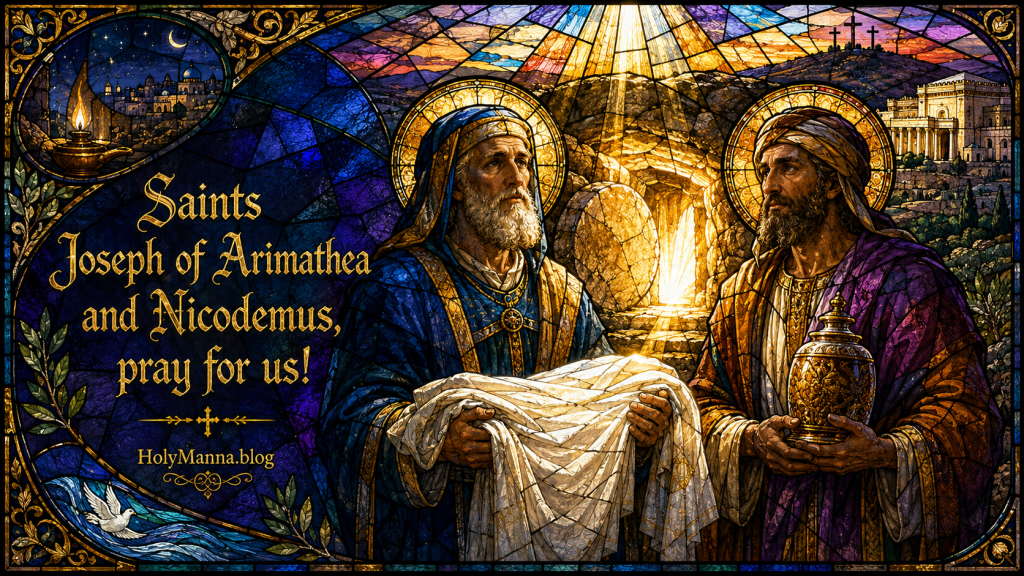
Then came Good Friday, and the two hidden disciples did what the visible ones could not. With the apostles in hiding, Joseph “took courage and went to Pilate, and asked for the body of Jesus” (Mk 15:43). Consider what that request meant. Jesus had just been executed by Rome as a criminal, condemned with the cooperation of Joseph’s own council. To claim the body was to declare allegiance to the crucified, publicly, in writing, before the Roman governor himself. The secrecy was over forever. Pilate granted the request, and Joseph, joined by Nicodemus, performed the burial that all four Gospels record. “Nicodemus also, who had at first come to him by night, came bringing a mixture of myrrh and aloes, about a hundred pounds’ weight” (Jn 19:39). A hundred pounds of spices was a burial fit for a king, an extravagant, almost reckless act of love from the man who once dared approach Jesus only after sunset. “And Joseph took the body, and wrapped it in a clean linen shroud, and laid it in his own new tomb, which he had hewn in the rock” (Mt 27:59 to 60).
The Church Fathers saw in this moment the fulfillment of prophecy, for Isaiah 53:9 had foretold of the Suffering Servant, “and they made his grave with the wicked and with a rich man in his death.” The rich man had a name, and it was Joseph. The Catechism teaches the meaning of what these two men were handling with such tenderness: “By the grace of God ‘he tasted death for every one’. In his plan of salvation, God ordained that his Son should not only ‘die for our sins’ but should also ‘taste death,’ experience the condition of death, the separation of his soul from his body, between the time he expired on the cross and the time he was raised from the dead” (CCC 624). Joseph and Nicodemus were the first to honor the dead body of the Lord, and in doing so they became the founding fathers of a corporal work of mercy. The Catechism teaches: “The bodies of the dead must be treated with respect and charity, in faith and hope of the Resurrection. The burying of the dead is a corporal work of mercy; it honors the children of God, who are temples of the Holy Spirit” (CCC 2300). Every Catholic funeral, every reverent burial, every graveside prayer stands in a line that begins with these two men on a Friday evening outside Jerusalem.
And then there is the miracle. It was not worked by them, but it happened in their gift. The tomb Joseph surrendered became the empty tomb. The stone he rolled across the entrance became the stone the angel rolled away. When the women arrived at dawn and the apostles came running, the sign that met them was the burial place these two saints had prepared, now open and filled with light. The Catechism notes that the discovery of the empty tomb was the first step toward recognizing the Resurrection itself (CCC 640). Joseph of Arimathea gave Jesus a grave, and Jesus gave it back transfigured, the most famous empty room in the history of the world.
The Cost of Discipleship in the Shadow of the Sanhedrin
Neither Joseph nor Nicodemus is a verified martyr, and the Church commemorates them as holy disciples rather than as men who shed their blood. But it would be a mistake to imagine that their path was safe. The Gospel of John records that the authorities had already agreed “that if any one should confess him to be Christ, he was to be put out of the synagogue” (Jn 9:22). For men whose entire identity, livelihood, and social world ran through the synagogue and the council, expulsion was a kind of living death. This is the fear John names in Joseph, and it is the reason Nicodemus first came at night. Their hardship was the long, grinding pressure of belonging to an institution that had turned against the One they loved, and the moment they acted at the cross, they accepted whatever consequences would follow.
What those consequences were, history does not record with certainty, but tradition has much to say, and the traditions deserve to be told as traditions. An ancient apocryphal writing known as The Gospel of Nicodemus, also called The Acts of Pilate, tells the story that the Jewish authorities, furious at the burial, seized Joseph of Arimathea and locked him in a windowless cell to await punishment, and that on Easter the risen Lord himself appeared to Joseph in the cell and delivered him unharmed. It is a beautiful story of divine protection for the man who protected the Lord’s body, but it comes from an apocryphal source and cannot be verified.
For Nicodemus, a tradition preserved in a fifth century account associated with the priest Lucian of Caphargamala tells the story that after the Resurrection, Nicodemus was baptized, was stripped of his office and expelled from the Sanhedrin for his faith, was driven from Jerusalem, and spent his final years sheltered in the country house of his kinsman Gamaliel, the great teacher of the law, who buried him with honor when he died. This story, moving as it is, likewise cannot be verified. What can be said with confidence is what Scripture shows: two men who began in fear and ended in public fidelity, at real and lasting cost.
Relics, Traditions, and a Thorn That Blooms at Christmas
The centuries after their deaths wrapped both saints in stories, pilgrimages, and works of art, and the Church’s memory of them stretches from the Holy Land to the edge of the known world.
The same fifth century account connected with Lucian of Caphargamala tells the story that in the year 415, the relics of Saint Stephen the first martyr were discovered near Jerusalem, and that resting beside them were found the remains of Gamaliel, his son Abibas, and Nicodemus himself, who had been buried in Gamaliel’s family tomb. The discovery of Stephen’s relics set off waves of devotion across the ancient Church, and Nicodemus’s name traveled with it. The story of Nicodemus’s relics resting beside Stephen’s cannot be verified.
Joseph of Arimathea’s memory made an even longer journey. Beginning in the Middle Ages, a tradition grew up in England, attached above all to Glastonbury Abbey, telling the story that Joseph traveled from the Holy Land to Britain as a missionary, that he planted his walking staff on Wearyall Hill where it took root and became the Glastonbury Thorn, a hawthorn that flowers near Christmas rather than only in spring, and that he founded on that spot the first Christian church in Britain. Later medieval romance literature added the story that Joseph carried with him the Holy Grail, the cup of the Last Supper, and vessels containing the precious blood of Christ. These stories made Joseph of Arimathea one of the most celebrated figures of medieval Christian imagination, and Glastonbury became one of England’s great pilgrimage destinations because of them. All of these British stories arose more than a thousand years after Joseph lived; they are told here as the traditions they are, and they cannot be verified. What is documented is the devotion they inspired, which endures to this day: descendants of the Glastonbury Thorn still grow in the town, and a flowering sprig is still traditionally cut each December and sent to the British monarch for the Christmas table.
Nicodemus left his own mark on Christian art and pilgrimage. In Lucca, Italy, the cathedral houses the Volto Santo, the Holy Face, a venerated ancient crucifix that tradition says was carved by Nicodemus himself, who had seen the Lord’s face with his own eyes, and completed with the help of an angel. The story of its carving cannot be verified, but the devotion is very real: pilgrims have venerated the Volto Santo for over a thousand years, and every September the city of Lucca still honors it with the candlelit procession of the Luminara di Santa Croce. And in Florence, one of the most personal sculptures Michelangelo ever carved, the Pietà now kept in the cathedral museum, shows a hooded elderly man cradling the dead Christ; that figure has long been identified as Nicodemus, and tradition dating to Michelangelo’s own era holds that the artist gave Nicodemus his own face. The old sculptor, near the end of his life, chose to place himself in the story precisely as the man who held the body of the Lord.
In the East, both saints are honored on the Sunday of the Myrrh-bearing Women in the Easter season, counted forever among those who came to the tomb with spices and love. In the Holy Land, the church of Saint Nicodemus and Saint Joseph of Arimathea in Ramla keeps their names alive at the traditional site of Joseph’s hometown. Two men who tried so hard to stay hidden have ended up remembered on three continents.
Faith That Refuses to Stay Hidden
The lives of these two saints press a gentle, uncomfortable question into the heart of every believer: where are you still a disciple in secret? Very few Christians today sit on councils that condemn the innocent, but nearly everyone knows the fear of Joseph and the caution of Nicodemus. It is the silence at the dinner table when faith is mocked. It is the hesitation to bless a meal in public, to mention Mass on Monday morning, to defend the Church’s teaching when it would be easier to study the floor. Nicodemus’s first defense of Jesus was procedural and careful, and God did not despise it. Grace worked with what the man could give, and grew it, night visit by night visit, until the day he carried a king’s weight of myrrh through the streets in broad daylight.
There is deep encouragement in that pattern. The Catechism teaches that the disciple of Christ must not only keep the faith and live on it, but also profess it, bear witness to it, and spread it (CCC 1816). Joseph and Nicodemus show that this profession can arrive late and still arrive gloriously. Their story suggests some practical resolutions. A believer can honor them by performing the work of mercy they pioneered, praying for the dead, attending funerals with reverence, and comforting those who grieve, in the hope of the Resurrection that transformed Joseph’s own tomb (CCC 2300). A believer can imitate Nicodemus by bringing honest questions to the Lord rather than letting them harden into distance, trusting that Jesus received a questioner at night with patience and gave him the greatest promise in Scripture. And a believer can imitate Joseph by asking for one concrete act of public faith this week, one moment of taking courage.
When was the last time fear kept you from being known as a follower of Jesus? What would it look like, in your workplace or family, to take courage as Joseph did? What question have you been holding back from God, waiting for a safer moment that never comes? The tomb outside Jerusalem is empty, and because it is empty, there is nothing left to fear.
Engage With Us!
The story of Saints Joseph of Arimathea and Nicodemus belongs to everyone who has ever loved Jesus quietly and wondered whether their faith was enough. Share your thoughts and reflections in the comments below; your experience may be exactly the encouragement another reader needs. Here are some questions to pray with and to discuss:
- Nicodemus first approached Jesus at night, afraid to be seen. In what area of your life are you still coming to Jesus “by night,” and what is one step toward the daylight?
- Joseph of Arimathea gave Jesus his own new tomb, the most valuable thing he could offer at that moment. What is the costly gift you sense God asking you to surrender?
- Burying the dead is a corporal work of mercy (CCC 2300). How can you honor the dying, the dead, and the grieving in your own community this month?
- Both saints dissented quietly before they ever confessed openly. Where might God be honoring your small, imperfect acts of fidelity and inviting them to grow?
- Jesus told Nicodemus that everyone must be born of water and the Spirit (Jn 3:5). How are you living out the grace of your own Baptism today?
Take heart from these two late blooming saints. Courage that arrives at the last hour is still courage, and love that comes out of hiding is still love. Live your faith in the open this week, serve someone who is grieving, ask Jesus your hardest question, and do everything with the love and mercy that Jesus taught us.
Saints Joseph of Arimathea and Nicodemus, pray for us!
Follow us on YouTube, TikTok, Instagram and Facebook for more insights and reflections on living a faith-filled life.


Leave a Reply