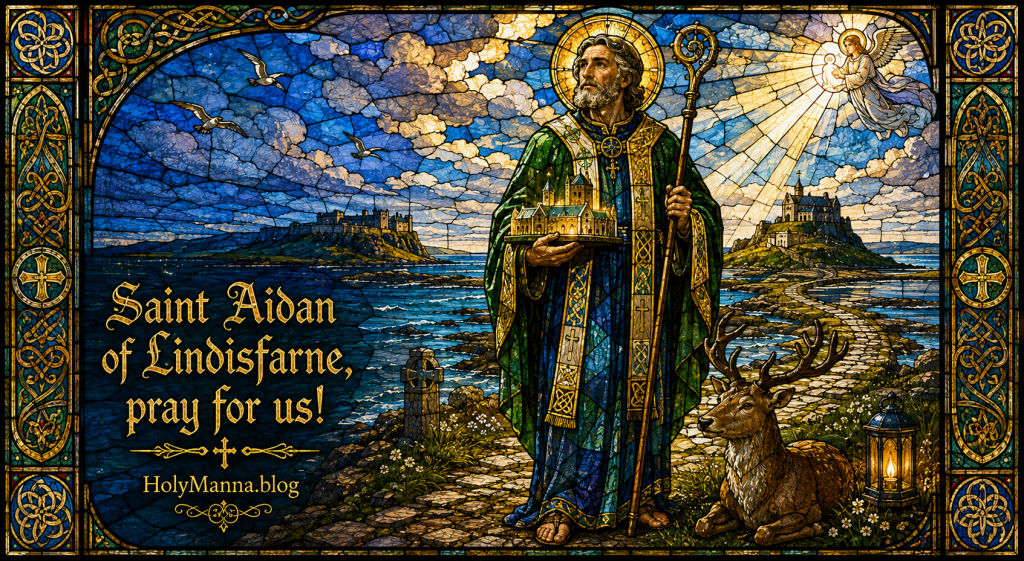
The Gentle Flame of the North
Some saints conquer the world with thunder. Saint Aidan of Lindisfarne conquered it with milk. When the Church celebrates him each year on August 31, she remembers a seventh century Irish monk who was handed one of the hardest mission fields in Europe, the half pagan kingdom of Northumbria in northern England, and who won it not by force, not by clever argument, but by walking its muddy roads on foot, talking to every single person he met, and living so simply that kings did not know what to do with him. Bede the Venerable, the great Father and Doctor of the Church who recorded Aidan’s life within living memory of it, wrote that he was “a pontiff inspired with a passionate love of virtue, but at the same time full of a surpassing mildness and gentleness.” History remembers him as the Apostle of Northumbria, the founder and first bishop of the monastery of Lindisfarne on Holy Island, a house that became the spiritual engine of northern England and the school of saints like Eata, Chad, and Cedd. The Church teaches that “the Church is holy… in her members perfect holiness is something yet to be acquired” (CCC 825), and that the saints are given to believers as models and intercessors (CCC 828). Aidan is one of the clearest models the Church possesses of how to share the faith with people who do not yet believe, which makes him a saint tailor made for this generation. Anyone who has ever wondered how to talk about Jesus with friends who find the faith strange, harsh, or irrelevant has a friend and teacher in Aidan.
From Ireland’s Green Silence to Iona’s School of Saints
Aidan was born in Ireland, and honesty requires saying up front that almost nothing certain is known about his early years. Even his birth year is an educated guess; the commonly repeated date of around 590 is an estimate rather than a documented fact. A tradition holds that he studied as a young man under Saint Senan on Scattery Island in the River Shannon before crossing the sea to Scotland. That connection cannot be verified, and it is offered here as tradition rather than established history. What is documented is where his story becomes visible: the island monastery of Iona, founded by Saint Columba, one of the most influential centers of prayer and learning in the early medieval world. There Aidan lived the disciplined rhythm of Irish monasticism, work and prayer, fasting and study, the slow formation that God so often uses before He sends a man into public mission. The Catechism describes this hidden logic of preparation when it teaches that the Christian life is a gradual growth, since “the way of perfection passes by way of the Cross” (CCC 2015).
The door to Aidan’s mission opened through a king. Oswald of Northumbria had spent years of exile among the Irish monks and had been baptized among them, learning their language and loving their faith. When he won back his throne, he did something remarkable for a warrior king of that age: he asked Iona to send a bishop who could preach the Gospel to his largely pagan people. The first missionary sent was a man of rough and austere temper. He got nowhere, gave up, went home, and blamed the English for being stubborn and unteachable. The Irish clergy gathered in a synod to figure out what had gone wrong, and it was there that Aidan, until then an obscure monk, spoke the words that changed his life and the history of England. Bede records his counsel to the failed missionary: “It seems to me, brother, that you were more severe to your unlearned hearers than you ought to have been, and did not at first, conformably to the apostolic rule, give them the milk of more easy doctrine, till, being by degrees nourished with the word of God, they should be capable of greater perfection.” Every eye in the room turned toward him. The assembly concluded that the man who understood the problem was the man who should solve it. Aidan was consecrated bishop and sent to Northumbria in the year 635.
Walking the Roads of Northumbria with the Gospel
King Oswald gave Aidan the island of Lindisfarne, a tidal island off the Northumbrian coast within sight of the royal fortress of Bamburgh, cut off from the mainland twice a day by the sea. It was a deliberate echo of Iona, a place of silence and prayer from which mission could flow outward. There Aidan founded the monastery that later generations called the English Iona, and from it he evangelized the north of England for sixteen years. Lindisfarne became a center of learning and missionary activity for the whole region, and it earned the name it still carries today, Holy Island.
The most touching detail of the early mission is this: in the beginning, Aidan’s English was poor, so King Oswald himself stood beside him and translated his preaching into the language of his nobles and soldiers. Picture that scene for a moment. A king, fresh from battle, humbly serving as interpreter for a foreign monk, because the Word of God mattered more to him than royal dignity. Throne and altar, side by side, in service of the Gospel.
Aidan’s method was almost absurdly simple, and it worked. He refused to ride a horse except in cases of real necessity, because a man on horseback looks down on people, and a man on foot looks them in the eye. Bede writes that as Aidan walked, whether the people he met were rich or poor, he invited the pagans among them to embrace the mystery of the faith, and he strengthened the believers, stirring them up by his words and his example to almsgiving and good works. This is precisely what the Catechism means when it teaches that the missionary mandate belongs to the whole Church, for “she exists in order to evangelize” (CCC 849, quoting the mission entrusted by the Lord), and that the witness of a Christian life is the first form of that mission, since Christians “can also evangelize by the witness of their life” and are called to be “witnesses of the Gospel” in the world (CCC 2044, CCC 2472).
Bede’s summary of Aidan’s relationship with money deserves to be memorized: “He neither sought nor loved anything of this world, but delighted in distributing immediately among the poor whatsoever was given him by the kings or rich men of the world.” Whatever wealth reached his hands passed straight through them. With donated money he ransomed slaves, and some of those freed men he educated and eventually ordained as priests. The man once sold as property came back to his people as a shepherd of souls. Aidan took twelve English boys into his school at Lindisfarne to form them for mission, among them the future Saint Eata; the great missionary bishops Chad and Cedd came out of the tradition of his school, and he encouraged Saint Hilda, the future abbess of Whitby, in her vocation. He kept the Irish custom of fasting on Wednesdays and Fridays, and during Lent he would withdraw to the tiny island of Inner Farne to pray alone with God. In all of this he lived what the Church teaches about the love owed to the poor, that “the works of mercy are charitable actions by which we come to the aid of our neighbor in his spiritual and bodily necessities” (CCC 2447).
Bede also records miracles that God worked through Aidan during his lifetime. When a priest named Utta was sent by sea to escort a royal bride, Aidan foresaw the storm that would strike the voyage. He gave Utta a vessel of blessed oil and told him that when the sea rose against the ship, he should pour the oil upon the waters and they would grow calm. The storm came exactly as foretold, the oil was poured out, and the sea was stilled. On another occasion, the pagan warlord Penda of Mercia marched against Bamburgh and, unable to take the fortress by assault, piled timber and thatch against its walls and set the whole mass ablaze with the wind at his back. Aidan was at prayer on Inner Farne, saw the smoke rising above the royal city, lifted his eyes to heaven, and cried out with tears, “Behold, Lord, how great mischief Penda does!” Bede records that the wind immediately turned and drove the flames back upon the attackers, and the city was saved. The prayer of this gentle man was a stronger wall than stone.
A Shepherd’s Sorrows
Aidan was not a martyr, but his sixteen years as bishop were a long endurance test, and his hardships deserve to be told in full. He arrived in a land where the old paganism was resurgent and the memory of Christianity had nearly been extinguished. He preached, at first, in a language not his own, to a warrior culture that respected strength and had little instinctive sympathy for a barefoot monk preaching mercy. He chose poverty in a world where bishops could easily have lived like lords, and he held that line for his entire episcopate, refusing comfort, refusing status, refusing even the convenience of a horse. Behind the charming stories stands a man who simply never stopped walking, never stopped fasting, never stopped giving things away, year after year, in the cold and rain of the North Sea coast.
War was the constant backdrop of his mission. In 642 his friend and co worker King Oswald, the man who had once translated his sermons, was killed in battle against Penda, the same pagan warlord who would later try to burn Bamburgh. Aidan had to watch the kingdom he was evangelizing torn apart by the violence of men who despised everything he preached, and he responded not with despair but with prayer, as the siege of Bamburgh showed.
The most personal of his sorrows came near the end. Aidan grew close to King Oswine of Deira, a ruler of rare humility. Oswine once gave Aidan a fine royal horse for difficult journeys, and almost immediately Aidan gave it away, saddle, trappings, and all, to a beggar who asked him for alms. The king, understandably stung, confronted him: why give away a royal gift to a beggar when cheaper horses would have done? Aidan’s answer has echoed for fourteen centuries: “What is it you say, O king? Is that son of a mare more dear to you than the Son of God?” They went in to dinner, and as Aidan sat, the king stood by the fire, turning the rebuke over in his heart. Then Oswine unbuckled his sword, handed it to a servant, and knelt at the bishop’s feet, begging his forgiveness and promising never again to question what Aidan gave to the sons of God. Aidan raised him up, deeply moved, and begged him to be merry. But as the king cheered, Aidan grew sorrowful and began to weep. Asked why, he answered, “I know that the king will not live long, for I never before saw a humble king; therefore I think he will soon be snatched out of this life, because this nation is not worthy of such a ruler.” The prophecy proved true. Oswine was betrayed and murdered on August 20, 651. Aidan’s heart seems to have broken with him. Roughly twelve days later, on August 31, 651, Aidan himself died at a royal estate near Bamburgh. He was too ill to be moved indoors, so his companions stretched a tent for him against the west wall of the church, and he died leaning against a wooden buttress that supported the building. A missionary to the end, he did not die in a palace or even in a bed, but propped against the wall of a church, as close to the house of God as a dying man could get. The Church sees in such perseverance the truth that “the way of perfection passes by way of the Cross. There is no holiness without renunciation and spiritual battle” (CCC 2015).
The Beam That Would Not Burn
God began confirming Aidan’s holiness almost immediately. On the very night he died, a teenage shepherd was watching his master’s flocks in the hills of Lammermuir. Looking up, the boy saw the heavens opened and a company of angels descending and then rising again, carrying with them a human soul wrapped in splendor toward heaven. The boy was Cuthbert, and when he later learned that Bishop Aidan had died at that very hour, he understood what he had seen. He gave up shepherding sheep to shepherd souls, entered the monastery, and became Saint Cuthbert, the most beloved saint of the English north and himself a future bishop of Lindisfarne. Aidan’s first posthumous act, so to speak, was to recruit his own greatest successor. This account comes from Bede, who knew the Lindisfarne community personally, and it stands among the best attested visions of the early English Church, a living illustration of the communion of saints, in which “the union of the wayfarers with the brethren who sleep in the peace of Christ is in no way interrupted” (CCC 955).
Then there is the beam. The wooden buttress against which Aidan died remained part of the church at Bamburgh. That church later burned down; the fire consumed the building, but the beam survived. The church was rebuilt, and in time it burned again; again the beam survived, scorched around but intact. The people of Northumbria drew the obvious conclusion, that the timber which had supported the dying saint had been touched by his holiness. Bede records that many people cut small chips from that beam, placed them in water, and gave the water to the sick, and the sick recovered. The beam was eventually set inside the rebuilt church as a relic, and visitors to Bamburgh are still shown a venerable beam in the church ceiling above the baptismal font, held by tradition to be that same wood. The core of this account, the beam surviving two fires and the healings through the chips, rests on Bede’s testimony; the identification of the exact beam displayed today cannot be verified.
Aidan was first buried in the monks’ cemetery on Lindisfarne, and when a larger church dedicated to Saint Peter was built there, his body was translated to a place of honor at the right side of the altar. After the Synod of Whitby in 664 settled the dispute over the dating of Easter in favor of the Roman calculation, Bishop Colman, who had defended the Irish custom, withdrew from Lindisfarne and carried part of Aidan’s bones home to Ireland with him, a final journey back to the land of his birth. Later medieval claims arose that his relics rested at Glastonbury, and other accounts pointed to Iona; those claims conflict with one another, the shrines involved were destroyed in later centuries, and none of it can be verified. A gentler tradition attached itself to his memory as well, the story that Aidan once saved a hunted deer by rendering it invisible to its pursuers, which is why sacred art sometimes shows him with a stag at his feet. That story appears only in later sources, not in Bede, and it cannot be verified.
What can be verified is his legacy. Lindisfarne became one of the great lights of Christian Europe, the community that would later produce the Lindisfarne Gospels, one of the most breathtaking illuminated manuscripts ever made. The monastery flourished as the leading ecclesiastical center of the north until the Viking raids began in 793. Today Holy Island remains a living place of pilgrimage; travelers still cross the tidal causeway as Aidan’s monks once did, and a statue of the saint stands near the priory ruins, gazing toward Bamburgh. Historians have long noted that the quiet, patient mission that flowed out of Lindisfarne did as much as any single effort to make England a Christian nation.
Milk Before Meat
Aidan’s life lands with surprising force in the present day, because his mission field looks a lot like the modern one. He preached to people who did not know the faith, or who had heard just enough of it, badly presented, to want nothing to do with it. His predecessor failed because he led with severity. Aidan succeeded because he led with milk before meat, meeting people where they were and nourishing them by degrees, exactly as a wise parent feeds a child. That is not compromise; it is love with a strategy, and it is deeply Catholic. The Catechism itself teaches that God reveals Himself gradually, communicating His mystery “in stages” and preparing humanity “by stages” to welcome the fullness of revelation (CCC 53, CCC 54). Anyone hoping to share the faith with a skeptical friend, a fallen away sibling, or a curious coworker should ask a simple question first. Is this conversation offering milk, or is it demanding that a beginner chew meat?
His poverty asks its own uncomfortable questions. Aidan gave away a royal horse without a second thought, because a beggar was a son of God and a horse was a son of a mare. The Catechism echoes him almost exactly when it teaches that “love for the poor is even one of the motives for the duty of working so as to ‘be able to give to those in need’” (CCC 2444, citing Ephesians 4:28), and that giving alms to the poor is “a witness to fraternal charity” and “a work of justice pleasing to God” (CCC 2462). Nobody needs to give away a horse this week. But everybody owns something that would serve a son or daughter of God better than it currently serves a closet. What is the royal horse in this house, the possession held onto mostly out of habit, that could set someone free if it were given away?
Aidan also teaches the apostolate of walking. He met people because he put himself, slowly and on foot, where people actually were. In an age of screens, his example suggests something almost radical: presence. Talk to the neighbor. Learn the barista’s name. Ask a real question and wait for a real answer. Evangelization in Aidan’s style begins not with an argument but with an encounter, and it is sustained by the interior life he modeled, the fasting, the retreats, the prayer that turned back fire at Bamburgh. The Church calls every baptized person to exactly this, since “all Christians in any state or walk of life are called to the fullness of Christian life and to the perfection of charity” (CCC 2013). Who is the one person God has placed nearby who is waiting, without knowing it, for someone to walk toward them?
Engage With Us!
The story of Saint Aidan of Lindisfarne is a story about gentleness that turned out to be stronger than fire, and every reader carries a piece of that mission now. Share your thoughts and reflections in the comments below; this community grows the same way Northumbria’s faith grew, one honest conversation at a time. Here are some questions to pray with this week.
- When has someone shared the faith with you harshly, and when has someone shared it gently? What difference did the approach make in your heart?
- Aidan offered “the milk of more easy doctrine” before greater perfection. Who in your life needs milk right now rather than meat, and how can you offer it?
- Aidan gave away a king’s horse because a beggar was a son of God. What possession is God inviting you to release, and to whom?
- King Oswald translated a missionary’s sermons; the shepherd boy Cuthbert answered a vision. What humble, hidden role might God be asking you to play in someone else’s conversion?
- Aidan died leaning against the wall of a church. What would it look like for you to spend your last ounce of strength close to God?
Saint Aidan walked every road God put in front of him, gave away everything God put in his hands, and loved every soul God put in his path. Go and do likewise this week. Walk toward someone, give something away, speak one gentle word about Jesus, and do all of it with the love and mercy that Christ Himself taught us.
Saint Aidan of Lindisfarne, pray for us!
Follow us on YouTube, TikTok, Instagram and Facebook for more insights and reflections on living a faith-filled life.


Leave a Reply