Monday of the Twenty-second Week in Ordinary Time – Lectionary: 431
The Power That Needs No Applause
Some voices do not need a microphone. Today the Church places side by side a nervous preacher, a psalmist in love with God’s law, and the Lord Himself reading Scripture in the synagogue where He grew up, and all three scenes make the same quiet, unsettling point. The power of God does not depend on human polish, human approval, or human expectations. Paul tells the Corinthians that he arrived among them trembling, stripped of every rhetorical trick, resolved to know “nothing… except Jesus Christ, and him crucified.” In a city that idolized eloquent philosophers the way modern culture idolizes influencers, that was a scandalous strategy. Yet it worked, because the Gospel carries its own power. The psalmist sings the same truth from another angle. His wisdom does not come from being smarter than his teachers or his enemies. It comes from meditating on God’s commands until they become the air he breathes. Then Luke brings the theme to its sharpest edge. Jesus stands up in Nazareth, reads the words of Isaiah about the Spirit anointing the Messiah, and announces that the ancient promise is being fulfilled at that very moment. The hometown crowd is amazed, then offended, then murderous, all within a few verses, because the Word of God refused to fit inside their expectations. These readings arrive at the start of an ordinary week in Ordinary Time, and that timing feels providential. Ordinary days are exactly when the temptation grows to trust clever plans over grace, and to domesticate Jesus into someone familiar and manageable. Today the liturgy asks for something braver: to let God’s word be received on God’s terms, and to let His power, not human wisdom, carry the weight.
First Reading — 1 Corinthians 2:1-5
A Trembling Apostle and an Unshakable Message
Corinth was the kind of city that would have loved a polished speaker. A wealthy Roman port at the crossroads of the empire, it prized the traveling sophists who could sway crowds with dazzling rhetoric, and it ranked public figures by their eloquence. Paul arrived there around the year 50, during his second missionary journey, coming directly from Athens, where the philosophers of the Areopagus had mostly shrugged at his preaching (Acts 17–18). By worldly logic, the lesson should have been to sharpen the sales pitch. Paul drew the opposite conclusion. He deliberately set aside the tools of persuasion so that nothing would stand between the Corinthians and the crucified Christ. This reading opens a two-week journey through First Corinthians in the weekday Lectionary, and it establishes the theme the whole letter will develop: God’s wisdom looks like foolishness to the world, and the world’s wisdom is foolishness to God.
1 Corinthians 2:1-5
When I came to you, brothers and sisters,
proclaiming the mystery of God,
I did not come with sublimity of words or of wisdom.
For I resolved to know nothing while I was with you
except Jesus Christ, and him crucified.
I came to you in weakness and fear and much trembling,
and my message and my proclamation
were not with persuasive words of wisdom,
but with a demonstration of spirit and power,
so that your faith might rest not on human wisdom
but on the power of God.
Detailed Exegesis
Verse 1: “When I came to you, brothers and sisters, proclaiming the mystery of God, I did not come with sublimity of words or of wisdom.” Paul reminds the Corinthians of his first arrival among them. The “mystery of God” is not a puzzle to be solved but God’s hidden plan of salvation now revealed in Christ. Paul refuses “sublimity of words,” the elevated oratory Corinth admired, because the message is not his performance to elevate.
Verse 2: “For I resolved to know nothing while I was with you except Jesus Christ, and him crucified.” This is one of the most quoted resolutions in all of Scripture, and it was a genuine decision, not a limitation. Paul was brilliantly educated, yet he chose to preach the one subject that Greeks considered absurd and Jews considered scandalous: a crucified Messiah. Everything else in Christian teaching flows from and returns to the Cross.
Verse 3: “I came to you in weakness and fear and much trembling,” Paul does not present himself as a confident closer. The Acts of the Apostles records that he had recently been beaten in Philippi and driven out of Thessalonica, and in Corinth the Lord had to appear to him in a vision, saying, “Do not be afraid. Go on speaking, and do not be silent” (Acts 18:9). The apostle’s honesty here is a comfort for anyone who has ever felt inadequate to share the faith.
Verse 4: “and my message and my proclamation were not with persuasive words of wisdom, but with a demonstration of spirit and power,” The proof of Paul’s preaching was not airtight argumentation but the visible work of the Holy Spirit: conversions, transformed lives, and the signs God worked through him. Grace demonstrated what rhetoric never could.
Verse 5: “so that your faith might rest not on human wisdom but on the power of God.” Here is the purpose of the whole approach. A faith built on clever arguments collapses when a cleverer arguer comes along. A faith resting on the power of God has a foundation no debate can shake.
Teachings
Saint John Chrysostom, the great fourth-century Doctor of the Church, preached on this very passage in his Homilies on First Corinthians. He explains why God chose demonstration by the Spirit over demonstration by argument: “Now when demonstration is made by wisdom of words, even the worse oftentimes overcome the better, having more skill in words; and falsehood outstrips the truth. But in this case it is not so: for neither doth the Spirit enter into an unclean soul, nor, having entered in, can it ever be subdued; even though all possible cleverness of speech assail it” (Homily VI on First Corinthians). The Catechism carries this teaching into its meditation on God’s omnipotence, explaining that divine power is revealed most fully where the world sees only defeat: “But in the most mysterious way God the Father has revealed his almighty power in the voluntary humiliation and Resurrection of his Son, by which he conquered evil. Christ crucified is thus ‘the power of God and the wisdom of God’” (CCC 272). The Church has always understood this passage as a charter for evangelization: the messenger’s weakness is not an obstacle to grace but often its chosen instrument.
Reflection
There is real freedom hiding in this reading. You do not need to win every argument about the faith. You do not need a theology degree, a quick wit, or a fearless personality before you can share Christ with a coworker, a sibling, or a friend who has drifted from the Church. Paul, the most effective missionary in history, showed up scared. What he refused to do was stay silent or dilute the message. This week, consider one concrete step: speak naturally about your faith one time, in one conversation, without polishing it into a presentation. Mention Sunday Mass when someone asks about your weekend. Offer to pray for someone who is struggling, and then actually do it. Let the Holy Spirit handle the results. When was the last time fear of sounding foolish kept you from mentioning Jesus at all? If your faith rests on the power of God rather than on human approval, what is one risk you could take for the Gospel this week?
Responsorial Psalm — Psalm 119:97-102
Falling in Love with the Law
Psalm 119 is the longest chapter in the Bible, a massive alphabetic acrostic of twenty-two stanzas, one for each letter of the Hebrew alphabet, with every stanza containing eight verses. Today’s selection comes from the Mem stanza, and it reads less like legal commentary and more like a love letter. For ancient Israel, the law was never mere regulation. It was the revealed heart of God, the covenant gift that set Israel apart from every nation, and meditating on it day and night was the mark of the blessed man described in Psalm 1. Placed between Paul’s rejection of worldly wisdom and Nazareth’s rejection of the Word made flesh, this psalm shows what the right response looks like: delighted, humble, daily attention to what God has said.
Psalm 119:97-102
R. (97) Lord, I love your commands.
How I love your law, O LORD!
It is my meditation all the day.
R. Lord, I love your commands.
Your command has made me wiser than my enemies,
for it is ever with me.
R. Lord, I love your commands.
I have more understanding than all my teachers
when your decrees are my meditation.
R. Lord, I love your commands.
I have more discernment than the elders,
because I observe your precepts.
R. Lord, I love your commands.
From every evil way I withhold my feet,
that I may keep your words.
R. Lord, I love your commands.
From your ordinances I turn not away,
for you have instructed me.
R. Lord, I love your commands.
Detailed Exegesis
Verse 97: “How I love your law, O LORD! It is my meditation all the day.” The stanza opens with an exclamation of love, not obligation. The Hebrew practice of meditation involved murmuring the sacred text aloud, turning it over continually, the way a person replays words from someone they love.
Verse 98: “Your command has made me wiser than my enemies, for it is ever with me.” The psalmist’s advantage over his enemies is not strategy or strength but the constant companionship of God’s command. Wisdom here is portable; it goes wherever he goes because the word lives within him.
Verse 99: “I have more understanding than all my teachers when your decrees are my meditation.” This is not arrogance toward honest teachers but a statement about the source of true understanding. Human instruction can inform the mind, while God’s own word forms the soul. The student who prays the Scriptures receives what no classroom alone can give.
Verse 100: “I have more discernment than the elders, because I observe your precepts.” In the ancient world, wisdom belonged to age and experience. The psalmist makes the striking claim that obedience is a faster teacher than years. Discernment grows not merely from living long but from living rightly.
Verse 101: “From every evil way I withhold my feet, that I may keep your words.” Love of God’s word produces concrete moral choices. The psalmist physically redirects his steps, a reminder that meditation which never changes behavior has not yet become prayer.
Verse 102: “From your ordinances I turn not away, for you have instructed me.” The stanza closes by naming God Himself as the teacher. Every human instructor is at best a servant of the divine Instructor who writes His law upon the heart.
Teachings
The Catechism describes exactly the kind of prayer this psalm models: “Meditation engages thought, imagination, emotion, and desire. This mobilization of faculties is necessary in order to deepen our convictions of faith, prompt the conversion of our heart, and strengthen our will to follow Christ” (CCC 2708). This is the ancient practice the Church calls lectio divina, the slow, prayerful reading of Scripture that monks and laypeople alike have treasured for centuries. The Catechism also explains why love, not fear, is the engine of the new covenant: “The New Law is called a law of love because it makes us act out of the love infused by the Holy Spirit, rather than from fear” (CCC 1972). The psalmist, centuries before Christ, already sensed this. His obedience flows from delight, anticipating the day when the law would have a face and a name.
Reflection
Honesty check: most modern Catholics spend far more of the day meditating on notifications than on God’s word. The psalmist offers a realistic alternative, because his meditation happened in the middle of ordinary life, not in a monastery. Try choosing one verse from today’s readings and carrying it through the day. Write it on a sticky note, set it as a phone lock screen, or repeat it at red lights. Let it be your meditation “all the day.” Over time this small habit rewires the imagination, so that God’s word becomes the lens through which everything else is seen. Which voice currently gets the most meditation time in your day, and what would change if Scripture took that place? Is there one command of God you have been treating as advice rather than as love?
Holy Gospel — Luke 4:16-30
The Hometown Sermon That Nearly Ended on a Cliff
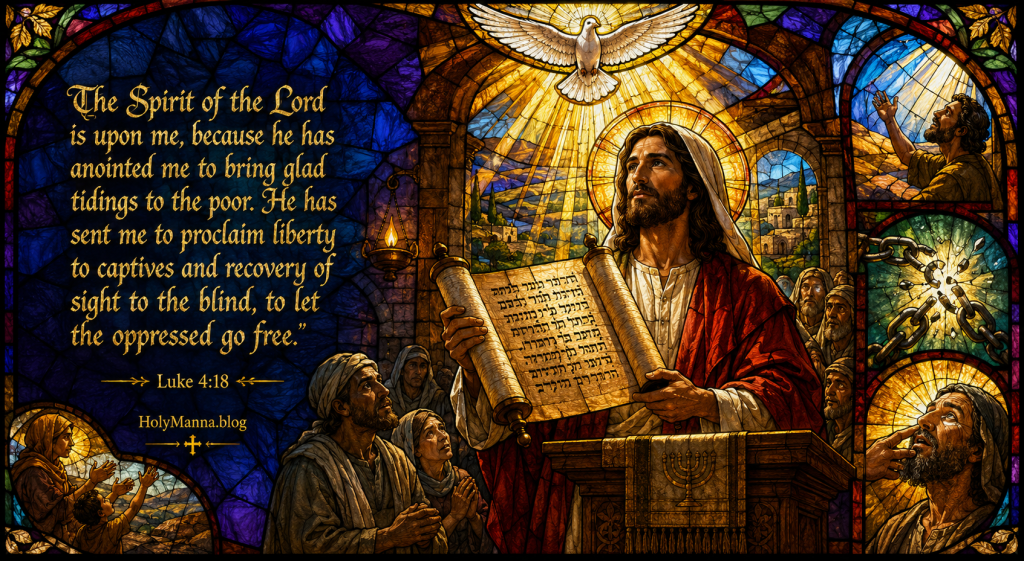
Nazareth was a tiny farming village in the hills of Galilee, home to perhaps a few hundred people, the kind of place where everyone knew everyone and no one expected greatness. Saint Luke sets this scene at the very launch of Jesus’ public ministry, immediately after His baptism and His forty days of temptation in the desert, so that this synagogue reading functions as His mission statement. The scroll handed to Him contains the prophet Isaiah, and Jesus finds the passage from Isaiah 61 that describes the Spirit-anointed servant proclaiming good news to the poor and liberty to captives, language echoing the jubilee year of Leviticus 25, when debts were forgiven and slaves set free. What happens next is one of the most dramatic reversals in the Gospels, as a congregation moves from admiration to attempted murder in the span of a single homily. The scene fits the day’s theme perfectly, because Nazareth had wisdom about who Jesus was supposed to be, and that wisdom nearly cost them everything.
Luke 4:16-30
Jesus came to Nazareth, where he had grown up,
and went according to his custom
into the synagogue on the sabbath day.
He stood up to read and was handed a scroll of the prophet Isaiah.
He unrolled the scroll and found the passage where it was written:
The Spirit of the Lord is upon me,
because he has anointed me
to bring glad tidings to the poor.
He has sent me to proclaim liberty to captives
and recovery of sight to the blind,
to let the oppressed go free,
and to proclaim a year acceptable to the Lord.
Rolling up the scroll,
he handed it back to the attendant and sat down,
and the eyes of all in the synagogue looked intently at him.
He said to them,
“Today this Scripture passage is fulfilled in your hearing.”
And all spoke highly of him
and were amazed at the gracious words that came from his mouth.
They also asked, “Is this not the son of Joseph?”
He said to them, “Surely you will quote me this proverb,
‘Physician, cure yourself,’ and say, ‘Do here in your native place
the things that we heard were done in Capernaum.’”
And he said,
“Amen, I say to you, no prophet is accepted in his own native place.
Indeed, I tell you,
there were many widows in Israel in the days of Elijah
when the sky was closed for three and a half years
and a severe famine spread over the entire land.
It was to none of these that Elijah was sent,
but only to a widow in Zarephath in the land of Sidon.
Again, there were many lepers in Israel
during the time of Elisha the prophet;
yet not one of them was cleansed, but only Naaman the Syrian.”
When the people in the synagogue heard this,
they were all filled with fury.
They rose up, drove him out of the town,
and led him to the brow of the hill
on which their town had been built, to hurl him down headlong.
But he passed through the midst of them and went away.
Detailed Exegesis
Verse 16: “Jesus came to Nazareth, where he had grown up, and went according to his custom into the synagogue on the sabbath day. He stood up to read” Luke notes that sabbath worship was Jesus’ custom. The Son of God faithfully practiced the ordinary religious life of His people, a quiet rebuke to every claim that spiritual maturity outgrows communal worship.
Verse 17: “and was handed a scroll of the prophet Isaiah. He unrolled the scroll and found the passage where it was written:” Jesus deliberately finds this passage. This is no accident of the lectionary cycle; He chooses the text that reveals His identity.
Verses 18 and 19: “The Spirit of the Lord is upon me, because he has anointed me to bring glad tidings to the poor. He has sent me to proclaim liberty to captives and recovery of sight to the blind, to let the oppressed go free, and to proclaim a year acceptable to the Lord.” Every word matters here. “Anointed” translates the root of the word Messiah, so Jesus is reading His own job description. The mission is directed to the poor, the captive, the blind, and the oppressed, meaning both those materially afflicted and every soul bound by sin. The “year acceptable to the Lord” evokes the jubilee, God’s great amnesty now arriving in person.
Verse 20: “Rolling up the scroll, he handed it back to the attendant and sat down, and the eyes of all in the synagogue looked intently at him.” Sitting was the posture of authoritative teaching. Luke slows the narrative down deliberately, and the reader can feel the silence as the whole village waits.
Verse 21: “He said to them, ‘Today this Scripture passage is fulfilled in your hearing.’” This may be the shortest homily ever preached, and the most explosive. Centuries of longing collapse into one word, “today.” Fulfillment is no longer a future hope; it is a present Person standing in front of them.
Verse 22: “And all spoke highly of him and were amazed at the gracious words that came from his mouth. They also asked, ‘Is this not the son of Joseph?’” Admiration and dismissal arrive in the same breath. The question about Joseph’s son is the sound of a town filing the infinite under the familiar. They think they already know Him, and that assumed knowledge blocks real faith.
Verse 23: “He said to them, ‘Surely you will quote me this proverb, “Physician, cure yourself,” and say, “Do here in your native place the things that we heard were done in Capernaum.”‘” Jesus names the demand hiding beneath their politeness. They want hometown privileges, miracles on demand as proof and as entertainment. Grace, however, is never owed.
Verse 24: “And he said, ‘Amen, I say to you, no prophet is accepted in his own native place.’” Jesus places Himself in the long line of rejected prophets, foreshadowing Jerusalem and the Cross. Familiarity had bred not love but contempt.
Verses 25 and 26: “Indeed, I tell you, there were many widows in Israel in the days of Elijah when the sky was closed for three and a half years and a severe famine spread over the entire land. It was to none of these that Elijah was sent, but only to a widow in Zarephath in the land of Sidon.” Jesus reaches into First Kings 17. During Israel’s famine, God sent His prophet to a Gentile widow in pagan territory. Divine grace overflows the boundaries His hearers assumed contained it.
Verse 27: “Again, there were many lepers in Israel during the time of Elisha the prophet; yet not one of them was cleansed, but only Naaman the Syrian.” The second example, from Second Kings 5, doubles the offense. Naaman was not only a Gentile but a commander of an enemy army, and he received the healing Israel’s lepers did not.
Verses 28 and 29: “When the people in the synagogue heard this, they were all filled with fury. They rose up, drove him out of the town, and led him to the brow of the hill on which their town had been built, to hurl him down headlong.” The congregation becomes a mob. Nothing enrages entitled hearts like the news that God’s mercy is not their private property. Luke shows the shadow of Calvary falling across the very first sermon.
Verse 30: “But he passed through the midst of them and went away.” No struggle, no negotiation. Jesus will lay down His life, but only at the hour the Father appoints, and only freely. His serene passage through the mob quietly reveals that His life is never taken from Him against His will.
Teachings
The Catechism teaches that the very name “Christ” is unlocked in this scene: “The word ‘Christ’ comes from the Greek translation of the Hebrew Messiah, which means ‘anointed’” (CCC 436), and it presents this synagogue moment as the inauguration of the Gospel itself, with Christ making the words of Isaiah His own (CCC 714). Saint Cyril of Alexandria, Doctor of the Church, preached on this passage in his Commentary on Luke and marveled at what the anointing reveals about who Jesus is: “For being at once God and man, He both gives the Spirit to the creation in His divine nature, and receives it from God the Father in His human nature” (Sermon 12 on Luke). In other words, the eternal Son did not need the Spirit for Himself; He received the anointing in His humanity so that He could pour the same Spirit out on us. The Catechism also affirms whom this mission seeks first: “The kingdom belongs to the poor and lowly, which means those who have accepted it with humble hearts” (CCC 544). Nazareth’s tragedy was the opposite of that humility, a heart so sure it already knew Joseph’s son that it could not receive the Anointed One of God.
Reflection
The most sobering detail in this Gospel is that the people who rejected Jesus were religious people at worship, hearing Scripture, on the sabbath. Proximity to holy things is not the same as openness to God. Every believer carries a mental picture of Jesus, and He is always greater than that picture. When He challenges a comfortable assumption, blesses someone judged undeserving, or asks for a surrender that was not part of the plan, the choice of Nazareth returns: fury or faith. A concrete practice for this week is to pray with today’s Gospel and deliberately ask the Lord to show one area where He has been domesticated, whether in politics, in grudges, in judgments about who is beyond His mercy, or in a settled routine that leaves Him no room to speak. Then bring that area to Confession or to honest prayer. Where might Jesus be saying “today” to you, and are you treating His word as fulfilled now or postponed indefinitely? Is there a person or group you quietly resent seeing receive God’s mercy, and what does that reveal?
Let the Word Have the Last Word
Taken together, today’s readings tell a single story about power and reception. Paul arrives in Corinth trembling, armed with nothing but Christ crucified, and a Church is born, because faith built on the power of God outlasts every clever argument. The psalmist spends his days murmuring God’s law with delight and discovers a wisdom that outpaces enemies, teachers, and elders, because the word of God forms what mere information can never reach. Then Jesus stands in the Nazareth synagogue and announces that every ancient promise has a face, and the people closest to Him refuse the gift, because He does not match the Messiah they had already designed. The contrast could not be sharper. The Corinthians received a weak preacher and found the power of God. Nazareth received the very Son of God and found only the son of Joseph. The difference was never in the message; it was in the hearts that heard it. This is the invitation waiting at the start of an ordinary week. God’s word will be proclaimed again today, at every Mass, in every Bible opened on a kitchen table, in every verse carried quietly through a workday. It arrives without fanfare, the way it arrived in Corinth and Nazareth, and it asks for the same response it has always asked for: a humble heart that lets God be as surprising, as generous, and as sovereign as He actually is. Say yes to that word today. Let it read you while you read it, and trust that the same Spirit who anointed Jesus and emboldened Paul is more than able to fulfill His promises, beginning now.
Engage With Us!
Your reflections matter here, and this little corner of the internet is better when you share them, so please add your thoughts, questions, and experiences in the comments below. To help start the conversation, here are a few questions drawn from today’s readings.
- In 1 Corinthians 2:1-5, Paul resolves to know nothing except Christ crucified and admits he preached in weakness and fear. Where is God inviting you to share your faith despite feeling unqualified, and what would trusting His power instead of your polish look like?
- In Psalm 119:97-102, the psalmist loves God’s law and meditates on it all day long. What one practical change could make Scripture a daily meditation in your life rather than an occasional visit?
- In Luke 4:16-30, the people of Nazareth reject Jesus because He does not match their expectations. What expectation or assumption about Jesus might be keeping you from receiving what He wants to do in your life today?
- Across all of today’s readings, faith rests on the power of God rather than on human wisdom. In what area of your life are you still leaning on your own understanding, and how can you surrender it to God this week?
Wherever this week takes you, remember that the same Spirit who anointed Jesus in that Nazareth synagogue has been poured into your heart through Baptism and Confirmation. Live this day with open hands and a teachable heart, and do everything, at home, at work, and online, with the love and mercy Jesus taught us.
Sacred Heart of Jesus, we trust in You!
Immaculate Heart of Mary, pray for us!
Saint Michael the Archangel, defend us in battle!
Follow us on YouTube, TikTok, Instagram and Facebook for more insights and reflections on living a faith-filled life.

 Holy Manna!
Leave a comment