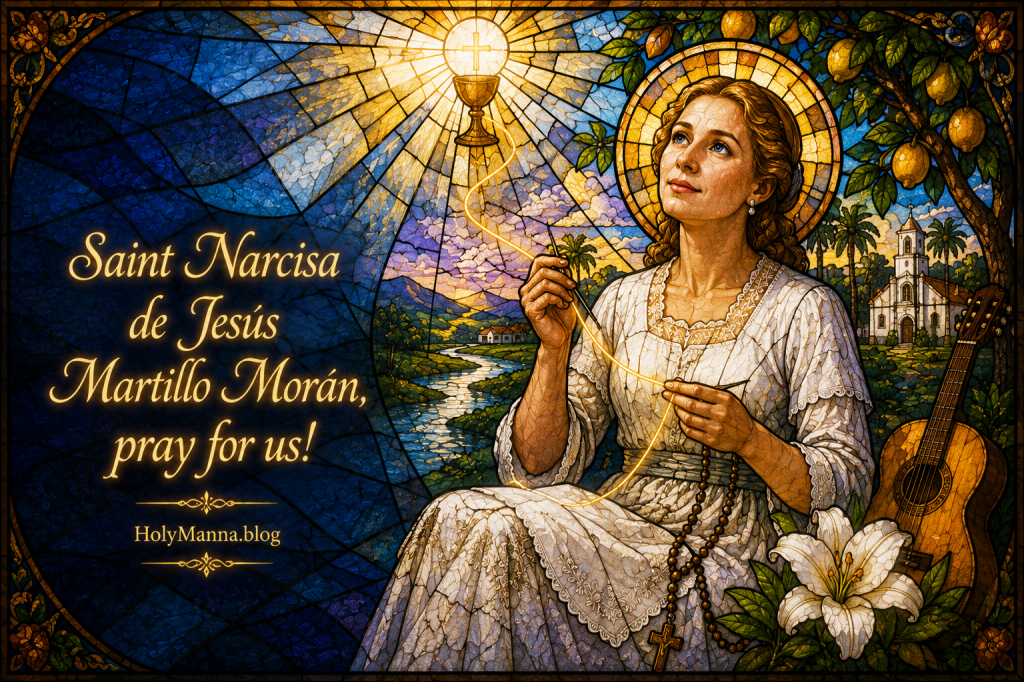
The Seamstress of Nobol
Some saints founded religious orders that spread across continents. Some preached to crowds of thousands. Some governed dioceses, wrote theological masterworks, or died before firing squads with the name of Christ on their lips. Saint Narcisa de Jesús Martillo Morán did none of these things. She sewed clothes for a living. She taught catechism to children. She prayed for hours in a rented room. And when she died quietly in a convent guest quarters in Lima on the Solemnity of the Immaculate Conception in 1869, almost no one outside of Ecuador and Peru had ever heard her name.
Yet on October 12, 2008, Pope Benedict XVI raised this Ecuadorian laywoman to the altars of the universal Church, declaring in his canonization homily that she “offers us a perfect example of a prompt and generous response” to the invitation the Lord extends to every soul. That single phrase captures why Narcisa matters so much right now. She was never a nun. She never took public vows. She held no office and left behind no writings of note. She was, in the world’s eyes, an orphaned seamstress from a small river town. And the Church looked at that hidden life and saw Christian perfection.
The Catechism teaches that “all Christians in any state or walk of life are called to the fullness of Christian life and to the perfection of charity” (CCC 2013). Narcisa is what that sentence looks like when it puts on work clothes and picks up a needle. Her feast is celebrated on August 30, and she is beloved throughout Latin America as “La Santa de Nobol,” the Saint of Nobol, the town of her birth, which today proudly bears her own name.
A Childhood Beneath the Guava Tree
Narcisa de Jesús Martillo Morán was born on October 29, 1832, in the hamlet of San José in Nobol, in the Daule region of coastal Ecuador, within the province of Guayas. The Dominican Order had cared for the parish there for nearly three hundred years, and that quiet Dominican presence would shape the whole arc of her life, from her baptism in a Dominican parish to her death in a Dominican house in Lima. Her parents, Pedro Martillo and Josefina Morán, were landowners, modest and hardworking people of deep faith. Her father possessed a lively intelligence and a great capacity for work, and through it he built up considerable means for his family. He nurtured a strong devotion to Mariana de Jesús de Paredes, the “Lily of Quito,” who had not yet been canonized in his lifetime, and to Saint Hyacinth, who is venerated with special fervor throughout Guayas. Narcisa was the sixth of nine children, and the household she grew up in was healthy, faithful, and full of life.
Sorrow arrived early. In 1838, when Narcisa was only six years old, her mother died. A teacher and an older sister stepped in to help raise her, and under their care she learned to read and write, to sing and play the guitar, to cook, to weave and embroider, and above all to sew, a skill she mastered so thoroughly that it would one day become her livelihood. She had an artistic soul with a particular gift for music. The Vatican’s official biography for her canonization records that her prayer often became song, intimate and devout, rising from her heart to the God who deserved it.
The decisive moment of her childhood came on September 16, 1839, when she received the Sacrament of Confirmation at the age of seven. Pope Benedict XVI singled out this moment in his canonization homily, teaching that already at that early age she felt clearly in her heart the call to live a life of holiness and devotion to God. This is worth pausing over, because the Church teaches that Confirmation is no mere ceremony of passage. The Catechism explains that through the sacrament the baptized “are more perfectly bound to the Church and are enriched with a special strength of the Holy Spirit” (CCC 1285). In Narcisa, that special strength took visible root in a seven-year-old girl on the Ecuadorian coast.
Her response was strikingly concrete. She grew into the habit of withdrawing to a small wood near her family’s home to give herself to the contemplation of divine realities. The guayabo tree, the guava tree beneath which she loved to pray, still stands as a destination for large pilgrimages today. She turned a small room in the family house into a domestic chapel. She decided consciously to imitate Mariana de Jesús, identifying with the vocation of a victim soul, offering herself in union with the suffering Christ for the redemption of the world. Those who knew her described a thoughtful, lovable, happy girl with a sweet and peaceful character, obedient, generous, compassionate toward the poor, and deeply devout. She helped with the household chores and worked in the fields alongside her family. She grew into a tall, strong, strikingly attractive young woman, and she became an excellent catechist who simply could not keep the fire of divine love to herself, communicating it to her family and to the children of the neighborhood.
Eight Hours of Prayer and a Sewing Needle
In January 1852, Narcisa’s father died, and the nineteen-year-old found herself an orphan. She moved to the port city of Guayaquil, staying at first with a well-known family who lived near the cathedral, and she remained in that city until 1868, apart from a period spent in Cuenca. What she built in Guayaquil over those sixteen years was one of the most remarkable hidden rules of life in the history of the modern Church.
She earned her living as a seamstress. This detail deserves more attention than it usually gets. Narcisa did not withdraw from the economy of ordinary life; she participated in it, supporting herself with skilled manual labor and using what she earned to help the poor and the sick. The Catechism teaches that human work “can be redemptive” and that by enduring its hardship in union with Jesus, man collaborates in his own way with the redemptive work of the Son of God (CCC 2427). Narcisa’s sewing table was her cloister. Her needle was, in its own way, an instrument of sanctification.
Around that daily labor she constructed an interior life of astonishing intensity. Accounts preserved in Catholic sources describe a demanding daily schedule built around roughly eight hours of prayer offered in silence and solitude, joined to further hours given over to penance, all offered to God in expiation for the sins of the world. These hour counts come from the testimony of those who knew her and from the traditional accounts of her life rather than from any written rule she left behind, and the Church has never needed to verify the arithmetic to verify the substance. What the canonization process did establish is stated plainly in the Vatican’s official biography: her mortifications were very severe, she fasted with such austerity that doctors were later amazed she could have lived so long on so little food, and she bore on her body the marks of her voluntary union with the crucified Lord.
After her death it became known that she had bound herself by private vows to perpetual virginity, poverty, obedience, enclosure, an eremitical manner of life, fasting on bread and water, daily Communion, frequent confession, mortification, and prayer, and that she kept every one of them faithfully. Here the Catechism sheds light on what she was doing, teaching that from apostolic times Christian virgins, “called by the Lord to cling only to him” with greater freedom of heart, have lived lives consecrated to God (CCC 922). Narcisa never entered a novitiate, yet she lived the substance of consecrated virginity as a laywoman in rented rooms, moving house repeatedly within Guayaquil precisely to protect her solitude and her freedom for prayer.
Her hidden rule never curdled into isolation. She worked intensely in the apostolate, above all teaching catechism to children, just as she had done since her youth in Nobol. She served abandoned young people at a house of refuge in the city. She visited the sick and the dying. When her spiritual director, Monsignor Amadeo Millán, was dying of tuberculosis, she traveled to Cuenca and spent herself caring for him until his death in 1867. Throughout these years she remained docile to the guidance of her spiritual directors, a point Pope Benedict XVI emphasized in his canonization homily, teaching that she considered spiritual direction one of the most effective means of arriving at holiness. She also shared her ideals, and for a time even shared a house, with Blessed Mercedes de Jesús Molina, the future foundress of the Sisters of Mariana de Jesús, so that two of Ecuador’s greatest holy women of the nineteenth century once lived under a single roof, hidden from the world and known fully only to God.
Concerning miracles worked during her lifetime, the honest answer, and the one the sources support, is that Narcisa’s earthly life was not marked by publicly attested wonders of the kind associated with some saints. The Vatican’s biography states that the Lord favored her with extraordinary gifts and showed her how pleasing her life was to Him in the midst of interior trials. Those extraordinary graces belonged to the secret dialogue between her soul and God, glimpsed by her directors and confirmed by the Church’s judgment on her heroic virtue rather than displayed before crowds. Her life itself was the sign. A woman who could not be explained by natural means, sustained through years of radical fasting, radiant in charity, was herself a standing testimony to what the Catechism calls the “wonderful communion” binding the faithful to Christ (CCC 1474).
Orphanhood, Loneliness, and the Long Road to Lima
Narcisa was never persecuted for her faith. No tyrant demanded she renounce Christ. Her hardships were of the quieter kind, and precisely for that reason they may speak more directly to the ordinary reader than the sufferings of the arena. She lost her mother at six and her father at nineteen. She spent her entire adult life without the natural security of husband, community, or institution, an unmarried working woman in a nineteenth-century port city, dependent on her own labor and on the kindness of families who took her in. She knew the grief of watching her beloved spiritual director die slowly of tuberculosis. And she knew the particular loneliness of a soul whose vocation fit no existing category, a woman called to total consecration in an age that offered no recognized path for a lay virgin living in the world.
That last hardship came to a head after Monsignor Millán’s death in 1867. Returning to Guayaquil, Narcisa could not find a spiritual director suited to guide her unusual path. For a soul who regarded direction as essential to holiness, this was a genuine desert. Acting on the advice of a Franciscan religious, she made the most dramatic decision of her life. In 1868 she left Ecuador entirely and traveled south to Lima, Peru. The Vatican’s biography places her departure in June of that year, while contemporary Catholic reporting places it at the beginning of 1868, a small discrepancy in the sources that changes nothing of substance. In Lima she was received as a laywoman, a guest and not a religious, into the Dominican convent of Patrocinio, a house founded in 1688 in the very district where Saint John Macías had once grazed his flock. It is a lovely providence that the seamstress from a Dominican parish in Nobol ended her days in a Dominican house sanctified by the memory of another humble saint.
There her hidden rule continued unchanged: prayer, penance, daily Communion, silence. Toward the end of September 1869 she was struck with high fevers. Medical remedies accomplished little, yet she refused to surrender her rhythm of life. She completed a novena and assisted at the celebration of the Eucharist with great joy, dressed in white, on the Solemnity of the Immaculate Conception, December 8, 1869. It was, remarkably, the very day on which Blessed Pius IX solemnly opened the First Vatican Council in Rome. At the end of that day she took leave of the sisters with words the Vatican biography has preserved, telling them she was going “on a journey very far.” The sisters took it as a pleasantry. A short while later, one of the sisters charged with blessing the cells noticed a splendor and a special fragrance coming from Narcisa’s room. The community gathered and found that she had died. She was thirty-seven years old. The account of the light and the fragrance in her cell comes down from the testimony of the community and belongs to the tradition surrounding her death; the details of that final scene cannot be independently verified.
She was not a martyr, and the Church does not honor her as one. She is a virgin and confessor of the faith, and her long, slow self-offering illustrates what the Catechism teaches about the cross in every Christian life, that Jesus “calls his disciples to take up their cross and follow him” (CCC 618). Narcisa took up hers daily for thirty years, one hidden hour at a time.
The Fragrance in the Cell and the Incorrupt Body of Nobol
What happened after Narcisa’s death is one of the most striking chapters of her story. The Vatican’s biography records that her body remained supple for a long time and gave off a pleasant scent, and that before it many graces were granted. The people of Lima acclaimed her a saint at once, and the acclamation was echoed in Guayaquil and Nobol. The Dominican Sisters of Patrocinio guarded her tomb and the memory of her virtues with great veneration for the better part of a century.
Then, in 1955, her body was transferred from Lima back to Guayaquil in her native Ecuador, and it was found to be practically incorrupt, a condition that has been recognized since that year. Reports from the time of her canonization record that in 1972 her remains were brought home at last to Nobol itself. On August 22, 1998, a national shrine was dedicated in her honor there, the Santuario de Santa Narcisa de Jesús, and her incorrupt body rests within it to this day. Pilgrims stream to Nobol from across Ecuador and far beyond, praying before her body, visiting the guava tree of her childhood prayers, and entrusting their needs to her intercession. The faithful recount favors of healing, reconciliation, and renewed faith obtained through her prayers; these popular accounts of graces are treasured as testimony of devotion, though as individual stories they cannot be verified. The civil impact of her holiness is almost without parallel: the canton of her birth is today officially known by her own name, Narcisa de Jesús, so that a map of Ecuador itself bears witness to the seamstress of Nobol.
The Church, for her part, proceeded with characteristic care. Her cause opened on September 27, 1975, under Pope Paul VI. Pope John Paul II declared her heroic virtue on October 23, 1987, giving her the title Venerable. A healing from 1967, attributed to her intercession, was rigorously examined and approved, and John Paul II beatified her in Saint Peter’s Square on October 25, 1992. The miracle that opened the way to her canonization occurred in that same year of 1992, when a seven-year-old child suffering from a congenital defect was healed after prayer at Narcisa’s shrine. Medical experts found the healing scientifically inexplicable in January 2006, theologians affirmed its connection to her intercession that April, and Pope Benedict XVI approved the miracle on June 1, 2007. On October 12, 2008, in Saint Peter’s Square, he canonized her alongside Saint Gaetano Errico, Saint Maria Bernarda Bütler, and Saint Alphonsa of the Immaculate Conception, the first canonized daughter of India. This is precisely how the Church understands canonization, for the Catechism teaches that by canonizing some of the faithful the Church “recognizes the power of the Spirit of holiness within her” and sustains the hope of believers by giving them models and intercessors (CCC 828).
One note of precision for careful readers: the Roman Martyrology commemorates her on December 8, the day of her death, and its entry, composed before 2008, still styles her Blessed, since the current typical edition of 2004 predates her canonization. Her liturgical memorial in general observance, and the celebration kept with such joy in Ecuador, falls on August 30. Both dates honor the same radiant truth.
What a Quiet Life Says to a Loud World
It would be easy to admire Narcisa from a distance and conclude that her life has nothing to do with a person holding a phone in one hand and a coffee in the other. That conclusion would be exactly backwards, and Pope Benedict XVI said so explicitly, teaching in his canonization homily that Saint Narcisa shows the faithful a path of Christian perfection obtainable for all. Not for nuns only. Not for priests only. For all.
Consider what her life actually consisted of. A job, done well, for years. Care for the people God placed in front of her. A stubborn commitment to prayer that no schedule, illness, or upheaval could break. Docility to wise spiritual guidance. Penance embraced quietly, without announcement. The Catechism teaches that interior penance can find expression in many forms, above all “fasting, prayer, and almsgiving” (CCC 1434), and Narcisa’s life was simply those three things, practiced without interruption for three decades. She also demonstrates the teaching that the lay faithful, sharing in Christ’s priestly office, offer their work, their prayers, their daily activities, and even life’s hardships as spiritual sacrifices pleasing to God (CCC 901). Her sewing was liturgy in the broad sense. Her rented rooms were sanctuaries.
The reader does not need to fast on bread and water to imitate her; severe bodily penances like hers are undertaken only under wise spiritual direction, exactly as she herself insisted. What every reader can imitate today is the shape of her life. A daily appointment with God that does not move. Work offered rather than merely endured. Money quietly shared with someone poorer. Presence at the bedside of someone sick or dying, even when it costs a whole season of life, as Cuenca cost Narcisa. A trusted priest or spiritual guide consulted with humility rather than a life navigated on vibes alone.
Where is the guava tree in your own life, the one quiet place where you could actually meet God every day, and what is currently keeping you from going there? If holiness is genuinely obtainable in your exact job and your exact apartment, as the Church taught through Narcisa’s canonization, what is the first ordinary thing you would need to start offering to God? Who is the Monsignor Millán in your life, the person whose illness or need is quietly asking for more of you than is comfortable?
Narcisa’s answer to all of these questions was the same: a prompt and generous yes, given young, and renewed daily until the evening she went on her journey very far.
Engage With Us!
Saint Narcisa de Jesús proves that the road to the altars can run straight through a sewing table, a rented room, and an utterly ordinary-looking life. Share your thoughts and reflections in the comments below; this community grows stronger every time one reader tells another what God is doing in a hidden place. To help the conversation begin, here are some questions to pray with and to answer below.
- Narcisa felt her call to holiness at her Confirmation at age seven. Looking back, when did you first sense that God was personally calling you, and how did you respond?
- She sanctified her daily work as a seamstress. What is one concrete way you could offer your own job to God this week?
- Narcisa treasured spiritual direction as one of the most effective means to holiness. Is there a priest, confessor, or wise mentor you could commit to seeing regularly, and what has held you back so far?
- She kept eight hours of prayer; most people struggle to keep eight minutes. What realistic daily prayer commitment could you actually keep for the next thirty days?
- Her care for her dying spiritual director in Cuenca cost her years of her life. Who in your life needs that kind of costly, unglamorous presence right now?
Saint Narcisa never preached a sermon, yet her hidden faithfulness now instructs the whole Church. Let her quiet courage stir something in you today. Choose one small, concrete act of prayer, penance, or charity, and do it before the day ends, not to be seen, but to be faithful. Live this day, and every day, with the love and mercy that Jesus taught us, and trust that no life offered to God, however hidden, is ever wasted.
Saint Narcisa de Jesús Martillo Morán, pray for us!
Follow us on YouTube, TikTok, Instagram and Facebook for more insights and reflections on living a faith-filled life.


Leave a Reply