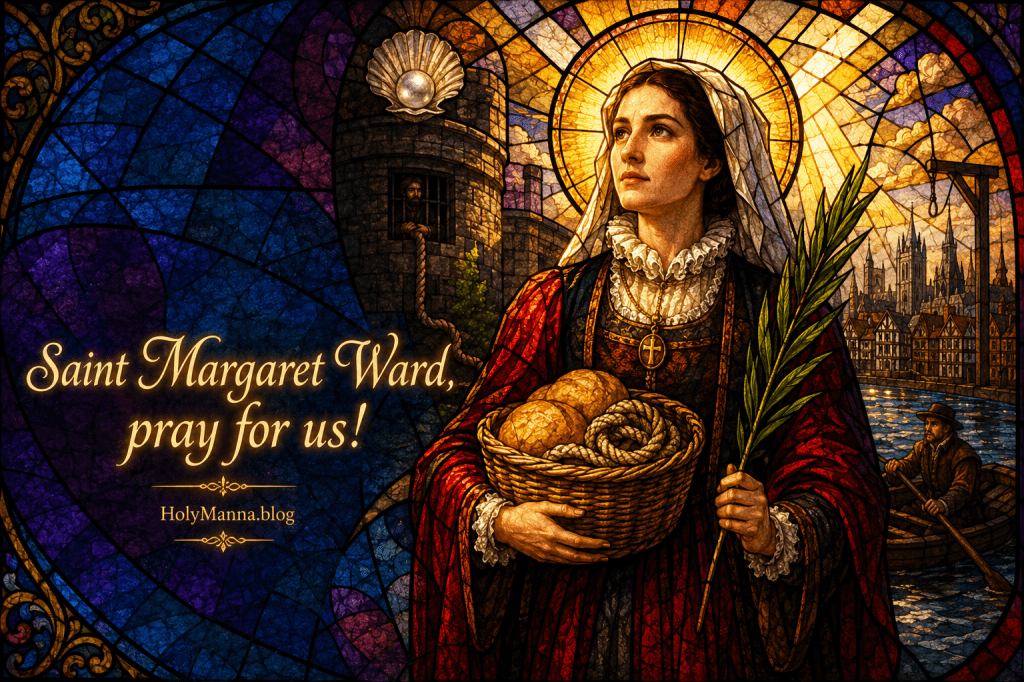
The Pearl of Tyburn
Some saints ruled kingdoms. Some founded religious orders that reshaped continents. Saint Margaret Ward did neither. She was a laywoman in domestic service, a gentlewoman’s companion in Elizabethan London, and history barely noticed her until the day she carried a coil of rope into one of the most feared prisons in England, hidden beneath the bread in her basket. That single act of daring charity freed a broken priest, cost Margaret her life, and won her a martyr’s crown that the Church solemnly recognized nearly four centuries later. On October 25, 1970, Pope Paul VI canonized her among the Forty Martyrs of England and Wales, and she stands as one of only three women in that company, alongside Saint Margaret Clitherow and Saint Anne Line. Tradition remembers her by a name that captures both her hiddenness and her worth: the Pearl of Tyburn.
The Church celebrates her on August 30, the anniversary of her death in 1588, together with the companions who died at Tyburn beside her, among them Blessed John Roche, the Irish boatman whose generosity matched her own. Her story matters because it answers a question every ordinary believer eventually asks: what can one person with no power, no wealth, and no title actually do for Christ? Margaret’s answer was simple. She could visit a prisoner. She could carry a basket. She could refuse to lie. The Catechism teaches that “Martyrdom is the supreme witness given to the truth of the faith: it means bearing witness even unto death” (CCC 2473), and Margaret shows that this supreme witness is not reserved for bishops and theologians. It is within reach of a servant with a brave heart.
A Gentlewoman in Service
Margaret Ward was born in Congleton, in Cheshire, England, sometime around the middle of the sixteenth century; the exact year is not recorded. The early Catholic accounts tell us that she came of a good family, what Bishop Richard Challoner’s Memoirs of Missionary Priests calls a gentleman’s family, and that as an adult she lived in London in the service of a lady of distinction, whose family name is given in the sources as Whitall or Whittle. Beyond that, the documented record of her early life is honestly blank. There are no childhood stories, no accounts of her education, no record of the moment her faith took fire. The historian must admit this plainly, and the believer can find something beautiful in it. Margaret lived the hidden, ordinary life of millions of Catholic women of her age, and God saw her when no chronicler did.
What is certain is the world she grew up in. Margaret’s England was a land where the Catholic faith had been driven underground. Under Queen Elizabeth I, the celebration of the Mass was outlawed, priests ordained abroad were declared traitors by the mere fact of their priesthood, and any layperson who sheltered or aided a priest committed a felony punishable by death. Attendance at the official Protestant services was compelled by law, and those who refused, the recusants, paid crushing fines or worse. In 1588, the year of Margaret’s death, England had just repelled the Spanish Armada, and a wave of patriotic fury broke over the Catholic community, which was widely and unjustly suspected of disloyalty. In that single year, more than thirty Catholics died for the faith.
To remain Catholic in that England was itself a conversion renewed daily. Margaret did not merely inherit the old faith; she chose it, at a price posted publicly on every gallows in London. Her deepest formation is visible not in any surviving document about her youth but in her conduct under pressure, where she showed a conscience so clearly formed that neither torture nor the offer of life itself could bend it. The Catechism teaches that “Man has the right to act in conscience and in freedom so as personally to make moral decisions” (CCC 1782), and Margaret’s whole story is that teaching written in flesh and blood.
A Basket of Bread and a Hidden Rope
The one great documented episode of Margaret’s life began with an act of mercy toward a man many would have written off. A priest named Watson, trained at the English seminary at Rheims, was imprisoned at Bridewell for his priesthood. The near-contemporary account preserved by Bishop Diego de Yepes and handed on by Challoner gives his name as Richard Watson, while the old Catholic Encyclopedia identifies him as William Watson; the early sources genuinely differ on details like this, and honesty requires saying so. What the accounts agree on is what happened to him. Worn down by torture, starvation, and the miseries of Bridewell, the priest gave way through human frailty and attended a Protestant service once, and for that conformity he was released.
His freedom became his torment. Challoner records that the priest found “the present torments of his mind much more insupportable, than those which he before had endured in his body” (Memoirs of Missionary Priests). He sought out imprisoned fellow priests, confessed his sin with deep repentance, and received absolution. Then, desiring to repair the scandal in the very place where he had given it, he returned to the chapel at Bridewell and publicly declared before the whole congregation that he had done evil in joining their service. He was seized on the spot and thrown into a dungeon so low and narrow that he could neither stand upright nor lie down at full length, loaded with irons, and kept for a month on starvation rations of bread and water.
Here Margaret enters the story. London’s Catholics knew of the priest’s sufferings, but they dared not approach him for fear of being taken as accomplices. Challoner writes that no one moved to help “till Mrs. Margaret Ward, a gentlewoman of a courage above her sex, undertook to do it” (Memoirs of Missionary Priests). The phrasing belongs to the eighteenth century, but the substance is timeless. When everyone else calculated the risk and stayed home, Margaret asked her mistress for leave, changed her dress, took up a basket of provisions, and went to Bridewell. Our Lord’s words in The Gospel of Matthew could serve as her banner: “I was in prison and you came to me” (Mt 25:36). The Catechism teaches that “The works of mercy are charitable actions by which we come to the aid of our neighbor in his spiritual and bodily necessities” (CCC 2447), and it lists visiting the imprisoned among them. Margaret is what that paragraph looks like when it walks into a prison.
Gaining access was itself a campaign. She won over the gaoler’s household by patience and kindness, and was finally permitted to visit the priest on strict conditions. She was searched coming in and going out. For the first month the guards even broke apart the loaves and pies she brought, lest a letter be hidden inside, and someone stood by to overhear every word between them. Margaret simply kept coming. Week after week, her sheer constancy persuaded the guards that she was nothing more than a compassionate woman bringing food, and their vigilance relaxed. That was the opening. The priest told her he had found a way to escape from the top of the building if only he had a long enough cord, and Margaret procured the rope and carried it into Bridewell in her basket, hidden under the bread.
There were no thunderbolts in Margaret’s life, no cures or visions recorded. Her miracle, if we may speak loosely, was the quieter wonder of grace perfecting ordinary virtues: patience that outlasted suspicion, prudence that planned an escape to the minute, and charity that kept walking toward danger when every instinct said to walk away. The Church has never needed to embellish her story, and this post will not do so either.
Irons, Scourges, and the Gallows at Tyburn
The escape itself unfolded in the small hours of the morning. Margaret had arranged for two Catholic watermen to wait with a boat near Bridewell between two and three o’clock. The priest doubled the rope over a cornice, misjudging the height of the building, and partway down found himself dangling in the air with the doubled cord too short. Commending himself to God, he let go of one end and fell onto an old wooden shed, which collapsed under him with a crash. He broke his right arm and right leg, yet the watermen rushed in, carried him to the boat, and hid him until he healed. In the confusion, the rope was left hanging from the prison wall.
That rope sealed Margaret’s fate. The gaoler knew that only one visitor could have brought it, and officers were sent to her lodgings early in the morning, where they arrested her just as she was preparing to move to new quarters. The aftermath also swept up a second hero. The early accounts differ slightly in sequence, but they agree that when the first boatman Margaret had engaged refused to keep the bargain, she confided her distress to a young Irish waterman named John Roche, who took on the danger willingly. Roche exchanged clothes with the priest to cover his flight, and when the gaoler later spotted those clothes on Roche in the street, he was arrested in the priest’s place. Offered his life if he would ask the queen’s pardon and attend the Protestant church, Roche refused as steadfastly as Margaret did, and he died beside her.
Margaret’s treatment in prison was brutal. She was kept in irons for eight days, and the accounts of Dr. Champney and Father Ribadeneira add that she was hung up by the hands and cruelly scourged. Challoner records her response to these torments: she bore them with wonderful courage, “saying, they were preludes of martyrdom with which, by the grace of God, she hoped she should be honoured” (Memoirs of Missionary Priests). Read that again slowly. Suspended by her wrists and whipped, this laywoman spoke of her torture the way an athlete speaks of a warm-up.
At her trial she was asked whether she was guilty of furnishing the means by which the priest had escaped. She answered cheerfully that she was, and, in Challoner’s rendering, declared “that she never, in her life, had done any thing of which she less repented, than of the delivering that innocent lamb from the hands of those bloody wolves” (Memoirs of Missionary Priests). The judges condemned her to death as a felon, yet held out mercy on two conditions: she must ask the queen’s pardon and promise to attend the Protestant church. Her reply deserves to be quoted at length, because it is a masterclass in a rightly formed conscience. She answered that she had never offended the queen, and that it was not just to confess a fault by asking pardon where there was none. As for freeing the priest, she said “she believed the queen herself, if she had the bowels of a woman, would have done as much, if she had known the ill treatment he underwent” (Memoirs of Missionary Priests). As for attending the state church, she had been convinced for many years that it was not lawful, would not act against her conscience, and told the court plainly “that she was willing to lay down not one life only, but many, if she had them, rather than betray her conscience, or act against her holy religion” (Memoirs of Missionary Priests).
Margaret Ward was hanged at Tyburn on August 30, 1588. A few later retellings claim she suffered the fuller traitor’s death of drawing and quartering, but the older and stronger sources say she was hanged, which matches the treatment of women condemned for felony, and that is the account this post follows. A later devotional tradition adds that she was denied any final words on the scaffold because the authorities feared the effect her speech would have on the crowd; that detail comes from later retelling, and it cannot be verified. Challoner’s account closes with what the witnesses saw: she died “showing to the end a wonderful constancy and alacrity; by which the spectators were much moved, and greatly edified” (Memoirs of Missionary Priests). Five companions died in the same executions that day: Blessed John Roche; Blessed Richard Leigh, a priest; and three laymen condemned for aiding priests, Blessed Edward Shelley, Blessed Richard Martin, and Blessed Richard Lloyd. Her sacrifice echoes the words of Our Lord in The Gospel of John: “Greater love has no man than this, that a man lay down his life for his friends” (Jn 15:13).
From an Unmarked Grave to the Altars of Rome
Margaret’s story after death is unusual among the saints, and it is worth telling honestly. There are no recorded relics, because the bodies of the Tyburn martyrs were disposed of by their executioners rather than handed over for veneration, and there are no documented miracles attributed to her individually, either during her life or after her death. Her cause rested entirely on the fact of her martyrdom, which the Church examines with great care. In 1929, Pope Pius XI beatified her together with a great company of the English martyrs, including John Roche and the companions who died beside her. Then, on October 25, 1970, Pope Paul VI canonized her among the Forty Martyrs of England and Wales, a representative company chosen from the hundreds who died for the faith in England and Wales between 1535 and 1679. In support of that collective cause, the Church accepted a modern cure attributed to the joint intercession of the Forty Martyrs as a company; the accounts describe the scientifically inexplicable healing of a young mother from a malignant tumor. That healing is attached to the Forty together rather than to Margaret alone, and this post states that plainly rather than claiming more than the record supports.
The Catechism explains what canonization means: “By canonizing some of the faithful, i.e., by solemnly proclaiming that they practiced heroic virtue and lived in fidelity to God’s grace, the Church recognizes the power of the Spirit of holiness within her and sustains the hope of believers by proposing the saints to them as models and intercessors” (CCC 828). In Margaret’s case, the Church holds up a laywoman with no relics, no shrine of her body, and no wonder stories, and says to the whole world that this is what heroic holiness looks like.
Her memory is very much alive. In the Roman Martyrology she is commemorated on August 30, the day of her death, together with her companions. In England, the Forty Martyrs were long celebrated together on October 25, and the Church in England and Wales now honors the English Martyrs as a company on May 4. The Diocese of Shrewsbury claims her with particular pride as a daughter of Congleton, one of only two of the Forty Martyrs connected with that diocese, alongside Saint John Plessington. Schools carry her name, most notably Saint Margaret Ward Catholic Academy in Stoke-on-Trent, where generations of students have grown up under the patronage of a woman who was once an anonymous servant. In London, a statue at Saint Etheldreda’s Church in Ely Place shows her with the rope coiled in her basket, and at Tyburn itself a community of Benedictine nuns at Tyburn Convent keeps perpetual prayer near the site of the gallows, honoring the whole company of the Tyburn martyrs. In sacred art she is recognized by her two humble attributes, the basket and the rope, perhaps the most ordinary emblems held by any canonized saint, and all the more powerful for it. The communion we share with her is real and present, for as The Catechism teaches, “Our communion with the saints joins us to Christ, from whom as from its fountain and head issues all grace, and the life of the People of God itself” (CCC 957).
What the Pearl of Tyburn Asks of You
Margaret Ward never preached a sermon, never wrote a book, and never worked a recorded miracle, yet the Church sets her before you as a model. Why? Because her life answers the excuse that whispers in every ordinary heart: someone else is better placed to act than I am. Margaret was not better placed than anyone. She was a servant who had to ask permission from her employer to perform her act of mercy. She had no legal protection, no influential friends, and no plan B. She had a basket, a rope, and a conscience that belonged wholly to God, and that was enough.
Her witness lands on three points that speak directly to life today. The first is mercy that moves. Margaret did not merely feel sorry for the suffering priest; she went to him, week after week, under searches and surveillance. The Catechism teaches that “The disciple of Christ must not only keep the faith and live on it, but also profess it, confidently bear witness to it, and spread it” (CCC 1816). There are prisoners in every life within reach: the lonely coworker, the estranged relative, the friend sinking under depression, the actual inmate no one writes to. Visiting them will rarely be convenient and will sometimes be costly.
The second is mercy toward the fallen. Never forget who Margaret risked everything for: a priest who had publicly denied the faith under pressure and then repented. She did not treat his fall as disqualifying. She treated his repentance as the only thing that mattered, and she staked her life on the worth of a man the world had labeled both traitor and coward. In an age of permanent records and unforgiving public judgment, Margaret’s charity toward a repentant sinner is almost more countercultural than her martyrdom.
The third is a conscience that cannot be bought. Margaret was offered her life twice, once if she would betray the priest’s hiding place and once if she would ask pardon and conform. She refused both times, courteously, cheerfully, and immovably. Consider the small purchases the world attempts daily: the pressure to stay silent about the faith at work, to laugh along with contempt for the Church, to bend the truth when honesty costs something. When was the last time holding to your faith or your conscience actually cost you anything? If freedom were offered to you at the price of one small public compromise, what would you do?
Practical ways to walk with Saint Margaret Ward this week are close at hand. Perform one concrete work of mercy for someone isolated, whether a visit, a letter, or a phone call that is overdue. Pray for priests, especially for those who have fallen or grown weary, asking through Margaret’s intercession that they find the grace of repentance and restoration that Father Watson found. Examine one area where fear of others has been quietly editing the faith out of daily life, and choose one honest act of witness. None of these requires a rope or a gallows. All of them require the same heart.
Engage With Us!
The story of Saint Margaret Ward, the Pearl of Tyburn, has a way of unsettling comfortable faith, and that is a grace. Share your thoughts and reflections in the comments below; your experience may be exactly the encouragement another reader needs today. To help the conversation begin, here are some questions to ponder and to answer:
- Margaret’s great act began with simply visiting a prisoner. Who in your life is imprisoned by loneliness, illness, shame, or literal walls, and what is one step you could take toward them this week?
- Margaret risked everything for a priest who had publicly failed and then repented. Is there someone whose past failure you have quietly treated as permanent, and what would mercy toward them look like?
- Margaret refused freedom because it was priced at a violation of her conscience. Where do you feel pressure to purchase comfort or approval at the cost of your faith?
- Margaret’s only recorded attributes are a basket and a rope, ordinary objects turned to heroic use. What ordinary things in your hands right now could God be asking you to use for someone else’s rescue?
- She said she would gladly lay down many lives rather than act against her holy religion. What would it take for your faith to hold that kind of central place in your decisions?
Saint Margaret Ward proves that heaven is not reserved for the powerful, the learned, or the famous. It is won by ordinary people who love greatly in the moment God gives them. Take her courage with you into this week. Visit the forgotten, forgive the fallen, and guard your conscience as the treasure it is. Do everything, from the smallest errand to the hardest sacrifice, with the love and mercy that Jesus taught us, and trust that no act of faithful charity, however hidden, is ever lost before God.
Saint Margaret Ward, Pearl of Tyburn, pray for us!
Follow us on YouTube, TikTok, Instagram and Facebook for more insights and reflections on living a faith-filled life.


Leave a Reply