Twenty-second Sunday in Ordinary Time – Lectionary: 124
When Following God Stops Being Comfortable
There comes a moment in every serious walk with God when the honeymoon ends. The prayers that once felt sweet start to feel costly. The faith that once made life easier starts asking for things that hurt. This Sunday, the Twenty-second Sunday in Ordinary Time, the Church places that moment under a spotlight and refuses to look away.
Jeremiah opens with one of the rawest prayers in all of Scripture, accusing God to His face: “You duped me, O LORD, and I let myself be duped.” The prophet has been beaten, mocked, and humiliated for preaching, and yet the word of God burns in his bones like a fire he cannot hold in. The Psalmist answers with the other side of that same fire, a thirst for God so fierce that he calls God’s love “a greater good than life.” Saint Paul then turns the whole thing into a command for every believer: offer your bodies as “a living sacrifice, holy and pleasing to God.” And Jesus brings it all home at Caesarea Philippi, telling Peter, fresh from his great confession, that the Messiah must suffer and die, and that anyone who wants to follow Him must deny himself and take up his cross.
The uniting theme is total self-surrender. God’s call costs everything, and it satisfies everything. The fire that consumes Jeremiah is the same fire that satisfies the Psalmist like a rich banquet, and the cross that Peter dreads is the doorway to the only life worth having. Together the readings ask the most important question there is: what is a soul actually worth?
First Reading — Jeremiah 20:7-9
The Prophet Who Could Not Walk Away
Jeremiah preached in Jerusalem during the final decades before the Babylonian catastrophe of 587 BC. Just before this passage, in Jeremiah 20:1-6, the priest Pashhur had Jeremiah beaten and locked overnight in the stocks at the temple gate for prophesying the city’s destruction. This prayer erupts out of that humiliation. It belongs to the intensely personal prayers scattered through Jeremiah 11 through 20, often called the confessions of Jeremiah, in which the prophet argues with God with startling boldness. Here the day’s theme begins: a man with every human reason to quit, who discovers that he cannot.
Jeremiah 20:7-9
You duped me, O LORD, and I let myself be duped;
you were too strong for me, and you triumphed.
All the day I am an object of laughter;
everyone mocks me.Whenever I speak, I must cry out,
violence and outrage is my message;
the word of the LORD has brought me
derision and reproach all the day.I say to myself, I will not mention him,
I will speak in his name no more.
But then it becomes like fire burning in my heart,
imprisoned in my bones;
I grow weary holding it in, I cannot endure it.
Detailed Exegesis
Verse 7: “You duped me, O LORD, and I let myself be duped; you were too strong for me, and you triumphed. All the day I am an object of laughter; everyone mocks me.”
The Hebrew verb behind “duped” carries the sense of being enticed, even seduced, and “too strong for me” uses the language of being overpowered. Jeremiah is saying that God drew him into this vocation, and the fine print turned out to include beatings and public ridicule. Yet the accusation is itself a prayer; complaining directly to God is its own act of faith. Origen, preaching on this verse in his Homilies on Jeremiah, taught that God’s so-called deception is like that of a wise physician or a loving father, a condescension that leads not to harm but to a healing the soul could never have chosen for itself.
Verse 8: “Whenever I speak, I must cry out, violence and outrage is my message; the word of the LORD has brought me derision and reproach all the day.”
Jeremiah’s message was not popular religion. He announced that Judah’s injustice and idolatry would bring violence and outrage upon the nation, and the messenger absorbed the anger meant for the message. Every generation of believers who have spoken hard truths into a culture that did not want them has found a companion in this verse.
Verse 9: “I say to myself, I will not mention him, I will speak in his name no more. But then it becomes like fire burning in my heart, imprisoned in my bones; I grow weary holding it in, I cannot endure it.”
Here is the turning point, and one of the greatest images of vocation ever written. Jeremiah tries resignation. He decides to go silent, to protect himself, to live a quieter life. And he discovers that the word of God is not an opinion he holds but a fire that holds him. Suppressing it exhausts him more than proclaiming it ever did. God’s triumph in verse 7 turns out to be this fire in verse 9: the call that cannot be extinguished by suffering, mockery, or even the prophet’s own will.
Teachings
The Catechism holds up exactly this kind of prayer as a model rather than a scandal. CCC 2584 teaches: “In their ‘one to one’ encounters with God, the prophets draw light and strength for their mission. Their prayer is not flight from this unfaithful world, but rather attentiveness to the Word of God. At times their prayer is an argument or a complaint, but it is always an intercession that awaits and prepares for the intervention of the Savior God, the Lord of history.” Jeremiah’s argument with God is prayer at full strength. The tradition of the Church has long read Jeremiah as a figure of Christ, the innocent man mocked and struck for speaking God’s word in Jerusalem, which is why the Church pairs this reading with the first Passion prediction in the Gospel.
Reflection
Almost everyone who takes faith seriously eventually reaches Jeremiah’s moment, the temptation to say, quietly, “I will speak in his name no more.” Maybe it comes after being mocked for a moral conviction at work, or after a family dinner turned hostile, or simply after long weariness. This reading gives permission to bring that exhaustion directly to God, complaint and all, because honest argument with God is still communion with God. Try this concrete step in the coming week: when the urge comes to stay silent about the faith out of embarrassment, say one true, gentle sentence anyway, and notice what it does to the fire. When has following God cost something real, and what happened next? Is there a fire in the bones, or has the flame been allowed to cool, and what would it take to stir it up again?
Responsorial Psalm — Psalm 63:2-6, 8-9
A Thirst the World Cannot Quench
The ancient superscription of this psalm places David in the wilderness of Judah, a landscape of rock and dust where water is a matter of life and death. Out of that physical desperation the Psalmist forges the Bible’s most vivid vocabulary of desire for God. The early Church loved this psalm so much that it became a standard morning prayer, and the Liturgy of the Hours still assigns it to Sunday Lauds. Where Jeremiah gave the day’s theme its fire, the Psalm gives it its thirst: the same all-consuming God, experienced now not as burden but as the one satisfaction the soul actually craves.
Psalm 63:2-6, 8-9
R. (2b) My soul is thirsting for you, O Lord my God.
O God, you are my God whom I seek;
for you my flesh pines and my soul thirsts
like the earth, parched, lifeless and without water.
R. My soul is thirsting for you, O Lord my God.
Thus have I gazed toward you in the sanctuary
to see your power and your glory,
for your kindness is a greater good than life;
my lips shall glorify you.
R. My soul is thirsting for you, O Lord my God.
Thus will I bless you while I live;
lifting up my hands, I will call upon your name.
As with the riches of a banquet shall my soul be satisfied,
and with exultant lips my mouth shall praise you.
R. My soul is thirsting for you, O Lord my God.
You are my help,
and in the shadow of your wings I shout for joy.
My soul clings fast to you;
your right hand upholds me.
R. My soul is thirsting for you, O Lord my God.
Detailed Exegesis
Verse 2: “O God, you are my God whom I seek; for you my flesh pines and my soul thirsts like the earth, parched, lifeless and without water.”
The Psalmist does not say his soul thirsts for blessings, answers, or relief. It thirsts for God Himself. Body and soul together pine, because biblical prayer never splits the human person in two; the whole self, flesh included, is made for God.
Verse 3: “Thus have I gazed toward you in the sanctuary to see your power and your glory.”
Desert longing drives the Psalmist to the sanctuary, the place of God’s presence. The parched soul knows where the water is, and it goes to the house of God to gaze.
Verse 4: “For your kindness is a greater good than life; my lips shall glorify you.”
This is one of the most radical sentences in the Psalter. The word translated “kindness” is the great covenant word for God’s steadfast love, and the Psalmist ranks it above life itself. That single verse is the logic of every martyr, and the hidden logic of this Sunday’s Gospel.
Verse 5: “Thus will I bless you while I live; lifting up my hands, I will call upon your name.”
Desire becomes commitment. The lifted hands are the ancient posture of prayer, the body itself joining the vow of lifelong praise.
Verse 6: “As with the riches of a banquet shall my soul be satisfied, and with exultant lips my mouth shall praise you.”
The desert image gives way to a feast. The soul that seeks God is not left thirsty forever; it is satisfied as at a rich banquet, an image the Church hears as pointing toward the Eucharist, the true banquet.
Verse 8: “You are my help, and in the shadow of your wings I shout for joy.”
The shadow of the wings evokes both the mother bird sheltering her young and the wings of the cherubim over the Ark, tenderness and majesty in a single image.
Verse 9: “My soul clings fast to you; your right hand upholds me.”
The Hebrew verb for “clings” is the same word used in Genesis 2:24 for a husband clinging to his wife. The psalm ends in mutual grasp: the soul holds on to God, and discovers that God’s right hand was holding it up all along.
Teachings
The Catechism teaches that this thirst is not a one-way street. CCC 2560 says: “‘If you knew the gift of God!’ The wonder of prayer is revealed beside the well where we come seeking water: there, Christ comes to meet every human being. It is he who first seeks us and asks us for a drink. Jesus thirsts; his asking arises from the depths of God’s desire for us. Whether we realize it or not, prayer is the encounter of God’s thirst with ours. God thirsts that we may thirst for him.” Saint Augustine gave the same truth its most famous form in the opening of his Confessions: “You have made us for yourself, O Lord, and our heart is restless until it rests in you.” Augustine had chased satisfaction through ambition, philosophy, and pleasure before discovering that every one of those thirsts was really this thirst in disguise.
Reflection
Modern life is an economy of substitute waters, endless scrolling, endless consuming, endless distraction, and the parched feeling never quite goes away. This psalm invites an honest inventory: name the things reached for first thing in the morning and last thing at night, and ask whether they have ever actually satisfied. A concrete practice for this week is to pray verse 2 slowly upon waking, before touching a phone, and to make one short visit to gaze toward the Lord in the sanctuary, ideally before the tabernacle. What is the soul actually thirsting for beneath the surface cravings of an ordinary day? Could God’s love honestly be called a greater good than life, and what would change if it were?
Second Reading — Romans 12:1-2
The Sacrifice God Actually Wants
These two verses form the hinge of Saint Paul’s greatest letter. For eleven chapters, Romans has unfolded the mercies of God, sin, grace, justification, and the mystery of God’s plan. Then comes the therefore. Everything God has done now demands a response, and Paul names it with a phrase that would have stunned his first hearers, for whom sacrifice meant a dead animal on an altar: offer your bodies as a living sacrifice. He calls it spiritual worship, worship that engages the reason and the will, and it stands at the exact center of this Sunday’s theme of total self-surrender.
Romans 12:1-2
I urge you, brothers and sisters, by the mercies of God,
to offer your bodies as a living sacrifice,
holy and pleasing to God, your spiritual worship.
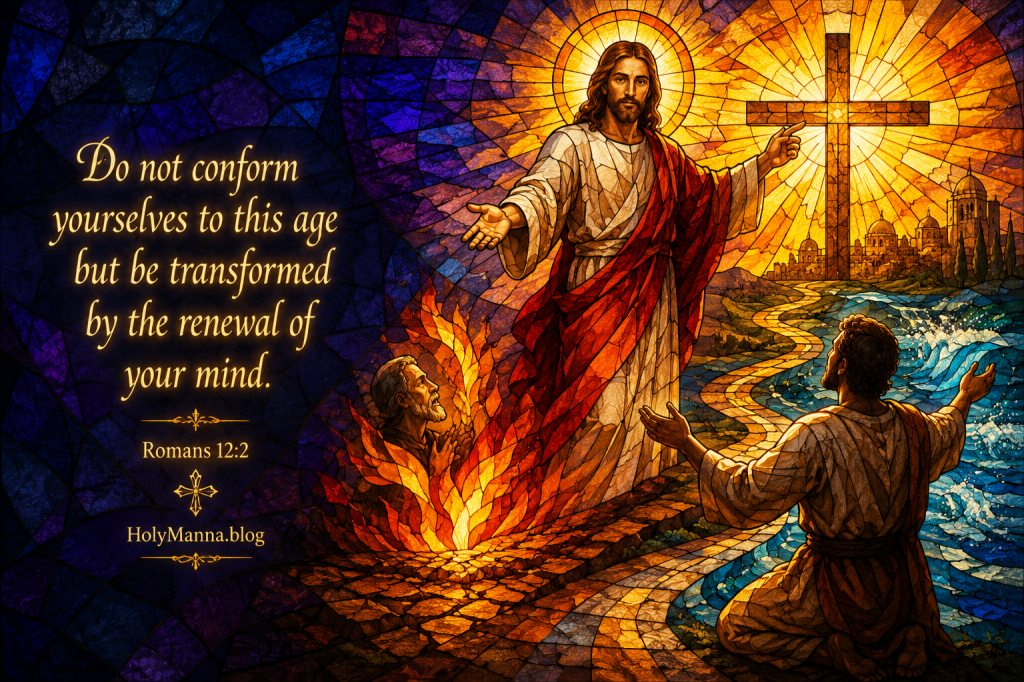
Do not conform yourselves to this age
but be transformed by the renewal of your mind,
that you may discern what is the will of God,
what is good and pleasing and perfect.
Detailed Exegesis
Verse 1: “I urge you, brothers and sisters, by the mercies of God, to offer your bodies as a living sacrifice, holy and pleasing to God, your spiritual worship.”
Paul appeals not by threat but by the mercies of God; gratitude, not fear, is the engine of the Christian moral life. The word “bodies” is deliberate. God does not want vague good intentions or an hour on Sunday; He wants the hands, the eyes, the schedule, the paycheck, the whole embodied person, offered continuously. A living sacrifice differs from a dead one in exactly the way that makes it harder: it can crawl off the altar, so it must be offered again every morning.
Verse 2: “Do not conform yourselves to this age but be transformed by the renewal of your mind, that you may discern what is the will of God, what is good and pleasing and perfect.”
Two forces compete for every mind: the pressure of the age, which molds from the outside, and the grace of God, which transforms from the inside. Paul’s word for “transformed” is the same root as the word used for the Transfiguration of Christ. The stakes of the battle are practical, because only a renewed mind can discern God’s will. A mind marinated in the assumptions of the age will find the Gospel absurd, exactly as Peter does in this Sunday’s Gospel when he rebukes the idea of a suffering Messiah.
Teachings
The Catechism quotes this very passage to define the whole moral life. CCC 2031 teaches: “The moral life is spiritual worship. We ‘present [our] bodies as a living sacrifice, holy and acceptable to God,’ within the Body of Christ that we form and in communion with the offering of his Eucharist. In the liturgy and the celebration of the sacraments, prayer and teaching are conjoined with the grace of Christ to enlighten and nourish Christian activity. As does the whole of the Christian life, the moral life finds its source and summit in the Eucharistic sacrifice.” Saint John Chrysostom, preaching on this passage in his Homilies on Romans, made the offering wonderfully concrete: “How then is the body, it may be said, to become a sacrifice? Let the eye look upon no evil thing, and it hath become a sacrifice; let thy tongue speak nothing filthy, and it hath become an offering; let thine hand do no lawless deed, and it hath become a whole burnt offering.” For Chrysostom, holiness is built one bodily choice at a time, an eye, a tongue, a hand, each laid on the altar.
Reflection
The quiet tragedy of much modern religion is worship that stays in the building, faith on Sunday and conformity to the age the other six days. Paul’s command dissolves that split. Try Chrysostom’s method literally this week: offer the thumbs by refusing to type the cutting comment, offer the eyes by turning away from what degrades, offer the ears by giving an annoying coworker genuine attention. Each small act is a living sacrifice made in the middle of ordinary life. And guard the mind by feeding it Scripture and the Catechism at least as faithfully as it is fed headlines and feeds. Which patterns of thinking have been quietly conformed to this age rather than to Christ? What would offering the body as a living sacrifice look like tomorrow morning, in concrete and specific terms?
Holy Gospel — Matthew 16:21-27
From Rock to Stumbling Stone
This scene follows immediately after last Sunday’s Gospel. At Caesarea Philippi, Peter had just made the greatest confession in history, “You are the Christ, the Son of the living God,” and Jesus had named him the rock on which the Church would be built. Now, within moments, everything turns. Jesus reveals what kind of Messiah He is, one who must suffer and die, and Peter, the rock, becomes an obstacle; the Greek word Jesus uses is the word for a stumbling stone. The fire of Jeremiah, the thirst of the Psalm, and the living sacrifice of Paul all converge here, in the shadow of the cross.
Matthew 16:21-27
Jesus began to show his disciples
that he must go to Jerusalem and suffer greatly
from the elders, the chief priests, and the scribes,
and be killed and on the third day be raised.
Then Peter took Jesus aside and began to rebuke him,
“God forbid, Lord! No such thing shall ever happen to you.”
He turned and said to Peter,
“Get behind me, Satan! You are an obstacle to me.
You are thinking not as God does, but as human beings do.”Then Jesus said to his disciples,
“Whoever wishes to come after me must deny himself,
take up his cross, and follow me.
For whoever wishes to save his life will lose it,
but whoever loses his life for my sake will find it.
What profit would there be for one to gain the whole world
and forfeit his life?
Or what can one give in exchange for his life?
For the Son of Man will come with his angels in his Father’s glory,
and then he will repay all according to his conduct.”
Detailed Exegesis
Verse 21: “Jesus began to show his disciples that he must go to Jerusalem and suffer greatly from the elders, the chief priests, and the scribes, and be killed and on the third day be raised.”
The word “must” carries divine weight. The Passion is not an accident that will befall Jesus but the Father’s saving plan, freely embraced. The resurrection is announced in the same breath as the death; the disciples hear the first half and miss the second.
Verse 22: “Then Peter took Jesus aside and began to rebuke him, ‘God forbid, Lord! No such thing shall ever happen to you.’”
Peter’s protest is love, but it is love shaped by human calculation. A crucified Messiah fits no category he knows. He takes Jesus aside, as though the Master needed correcting in private, and rebukes the very one he just confessed as Son of the living God.
Verse 23: “He turned and said to Peter, ‘Get behind me, Satan! You are an obstacle to me. You are thinking not as God does, but as human beings do.’”
The rebuke echoes the desert, where Jesus dismissed the tempter with nearly the same words in Matthew 4:10. Satan had offered the kingdoms of the world without a cross, and now that same temptation returns through the mouth of a friend. Yet even the rebuke contains a vocation: “get behind me” is literally the posture of a disciple, who walks behind the Master rather than standing in his way.
Verse 24: “Whoever wishes to come after me must deny himself, take up his cross, and follow me.”
Jesus universalizes the Passion. Discipleship has three verbs: deny self, take up the cross, follow. To a first-century listener, a cross was not a metaphor for minor inconvenience; it was the empire’s instrument of execution.
Verse 25: “For whoever wishes to save his life will lose it, but whoever loses his life for my sake will find it.”
This is the great paradox at the heart of the Gospel. The self-protective life, hoarded and defended, slips through the fingers. The life poured out for Christ is the only one that endures. The Psalm already whispered the reason: God’s kindness is a greater good than life.
Verse 26: “What profit would there be for one to gain the whole world and forfeit his life? Or what can one give in exchange for his life?”
Jesus frames eternity as the ultimate accounting question, placing the whole world on one side of the ledger and a single soul on the other, and the soul outweighs it.
Verse 27: “For the Son of Man will come with his angels in his Father’s glory, and then he will repay all according to his conduct.”
The passage ends with the judgment. The crucified one is also the coming King, and the choices made about the cross in this life will be read aloud in glory. The cross is temporary; the repayment is forever.
Teachings
The Catechism gathers this whole Gospel into two luminous passages. CCC 618 teaches in part: “The cross is the unique sacrifice of Christ, the ‘one mediator between God and men.’ But because in his incarnate divine person he has in some way united himself to every man, ‘the possibility of being made partners, in a way known to God, in the paschal mystery’ is offered to all men. He calls his disciples to ‘take up [their] cross and follow [him],’ for ‘Christ also suffered for [us], leaving [us] an example so that [we] should follow in his steps.’” And CCC 2015 states plainly: “The way of perfection passes by way of the Cross. There is no holiness without renunciation and spiritual battle. Spiritual progress entails the ascesis and mortification that gradually lead to living in the peace and joy of the Beatitudes.” The Church has never taught a crossless Christianity, because her Lord never offered one. Peter himself learned the lesson; tradition holds that the man who once said “No such thing shall ever happen to you” went to a martyr’s death in Rome, following his Master at last all the way.
Reflection
Everyone carries a little of Peter, the instinct to edit the cross out of the story, to want Christ’s glory without Christ’s path. This Gospel invites a fearless question: where has thinking “as human beings do” quietly replaced thinking as God does? The concrete practice this week is to identify one cross currently being avoided, an apology owed, a duty postponed, a sacrifice dodged, and to take it up deliberately, offering it in union with Christ. Then let verse 26 serve as a nightly examen: weigh the day’s pursuits against the worth of the soul. What is being clung to so tightly that Jesus cannot pry it loose, and what might be found if it were finally surrendered? If the Son of Man repaid today’s conduct this evening, what would the ledger show?
The Life You Find When You Let Go
Put the four readings side by side and a single story emerges, told four ways. Jeremiah tried to put God down and found a fire in his bones that would not go out. The Psalmist looked at everything life could offer and declared God’s love a greater good than all of it. Paul took that discovery and turned it into a daily liturgy of the body, a living sacrifice offered in kitchens and offices and ordinary hours. And Jesus stood at Caesarea Philippi and spoke the secret out loud: the life clutched and saved is lost, and the life laid down for Him is the only one ever truly found.
This is not a comfortable Sunday, and it is not meant to be. The readings dismantle the polite arrangement so many souls make with God, a little devotion in exchange for a lot of autonomy. God is not interested in a corner of a life. He wants the fire, the thirst, the body, the cross, everything, because He intends to give everything in return.
So take the step. Name the one thing being held back from God, the one cross being avoided, and hand it over this week. Go to Mass and mean the offering; when the bread and wine are placed on the altar, place the whole self beside them. The saints all testify to the same astonishing discovery, that the moment of surrender, so dreaded beforehand, turns out to be the moment the real life begins. The fire is a gift. The thirst has an answer. The cross has a third day.
Engage With Us!
The conversation does not end with the final blessing at Mass; it continues right here. Share a reflection in the comments below, because someone else’s walk with Christ may be strengthened by an honest word about yours. To help get started, here are some questions drawn from today’s readings.
- In Jeremiah 20:7-9, the prophet tries to stop speaking God’s word and finds it burning like fire in his heart. When have you tried to set your faith aside, and what drew you back?
- In Psalm 63:2-6, 8-9, the Psalmist calls God’s kindness a greater good than life itself. What substitute waters do you find yourself reaching for, and how might you bring that thirst to God this week?
- In Romans 12:1-2, Saint Paul urges believers to offer their bodies as a living sacrifice and to resist conformity to this age. What is one concrete way you could offer your body, your eyes, your tongue, or your hands, as worship tomorrow?
- In Matthew 16:21-27, Jesus tells Peter he is thinking as human beings do, not as God does. Where in your life might you be resisting a cross that Christ is asking you to take up?
- Taken together, today’s readings teach that a life surrendered to God is the only life truly found. What is one thing you have been holding back from God, and what would it take to place it on the altar this Sunday?
Whatever you share, know that every small act of surrender matters, and none of it is wasted. Keep seeking Him with a thirsting soul, keep offering the ordinary moments as living sacrifice, and keep walking behind Jesus, cross and all, doing everything with the love and mercy He taught us. He is faithful, and His right hand upholds you.
Sacred Heart of Jesus, we trust in You!
Immaculate Heart of Mary, pray for us!
Saint Michael the Archangel, defend us in battle!
Follow us on YouTube, TikTok, Instagram and Facebook for more insights and reflections on living a faith-filled life.

 Holy Manna!
Leave a comment