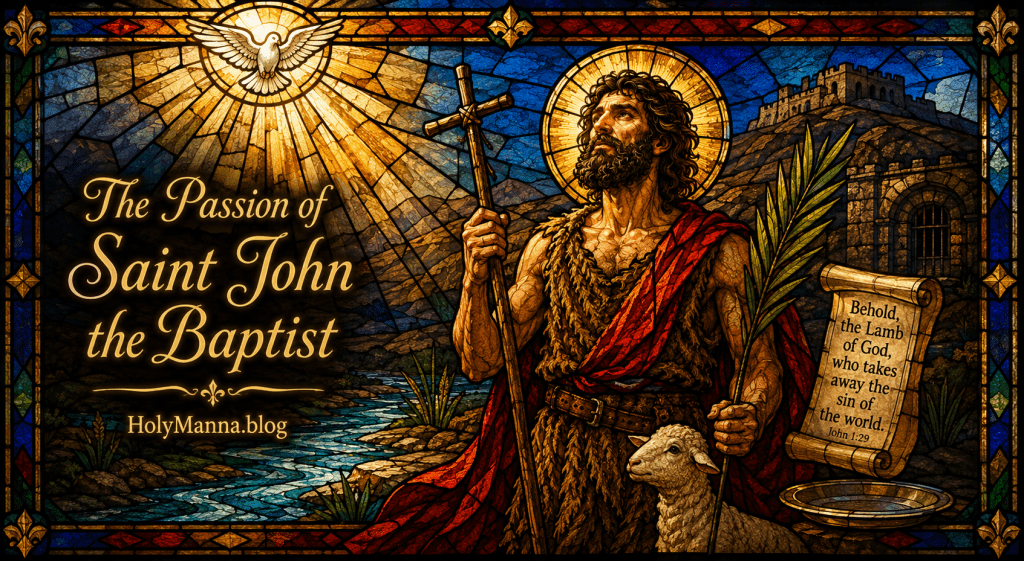
The Voice That Would Not Go Quiet
Every year on August 29th the Church pauses to remember one of the most unsettling scenes in the New Testament. A king throws himself a birthday party. A young girl dances. A rash oath is sworn in front of important guests. By the end of the night, the greatest prophet who ever lived is dead, his head carried into the banquet hall on a serving dish. The Memorial of the Passion of Saint John the Baptist does not soften any of this. The Church places Mark 6:17-29 before the faithful and asks them to look.
Why build a yearly celebration around something so dark? Because the death of John the Baptist is not really a story about a dance or a grudge. It is a story about what a person does when speaking the truth becomes expensive. John had given his whole life to pointing toward Jesus, and this day honors the moment when that pointing cost him everything.
John holds a place in the liturgical calendar that belongs to no other saint. Pope Benedict XVI, preaching on this very memorial in 2012, observed that in the Roman Calendar John is the only saint whose birth and whose death are both celebrated, his Nativity on June 24th and his martyrdom on August 29th. The Catechism of the Catholic Church explains why he matters so much. “St. John the Baptist is the Lord’s immediate precursor or forerunner, sent to prepare his way” (CCC 523). That same paragraph notes that John bears witness to Christ “in his preaching, by his Baptism of conversion, and through his martyrdom” (CCC 523). In other words, John’s death is not an afterthought to his mission. It is part of the mission itself.
The Church calls this day a “passion” on purpose. The older name was the Beheading, or Decollation, of Saint John the Baptist. The current Roman Missal and the 2004 Martyrologium Romanum both use the language of passion, the same word the Church uses for the suffering and death of Jesus. John went ahead of Christ in birth, in preaching, and finally in an unjust death. His passion is a rehearsal for the Passion of the Lord.
For anyone trying to live a serious faith in a noisy world, this memorial asks a simple question. What happens when conviction collides with power, comfort, or the approval of the people watching? John answers with his life, and the Church holds his answer up every August 29th.
How August 29th Came to Be
The Gospels never give the date of John’s death, so August 29th grew not from an anniversary but from a place. Early Christians venerated the tomb of John the Baptist at Sebaste, the city built on the ruins of ancient Samaria. Benedict XVI, in his General Audience of August 29th, 2012, stated that the memorial dates back to the dedication of a crypt at Sebaste where the head of the Baptist had already been venerated since the middle of the 4th century. From there the celebration spread to Jerusalem, to the Churches of the East, and to Rome under the title of the Beheading of Saint John the Baptist. The Vatican City State’s own saint-of-the-day notice confirms evidence of the Latin observance in France in the 5th century and in Rome in the 6th century, connected to the church built at Sebaste.
Sebaste itself carries a sorrowful history. Early Church historians such as Rufinus and Theodoret report that during the reign of the Emperor Julian, around the year 362, pagans broke open the tomb of John at Sebaste, burned his bones, and scattered the ashes, and that some of the relics were rescued by monks and eventually sent to Saint Athanasius in Alexandria. This account rests on later historians rather than contemporary records, so it is best received as an early tradition rather than documented fact.
The Roman Martyrology adds a second layer to the date. The entry for August 29th notes that on this day the Church also recalls the second finding of the head of the Baptist, which was brought to Rome and honored in the church of San Silvestro in Capite in the Campo Marzio. Here a discrepancy must be flagged honestly. Several churches across the centuries have claimed to possess the head of Saint John the Baptist, including San Silvestro in Capite in Rome, the Cathedral of Amiens in France, which received a relic brought from Constantinople in 1206, and the Umayyad Mosque in Damascus, which Pope Saint John Paul II visited in 2001. The Church has never issued a definitive judgment settling these competing claims, and they are presented here as traditions.
East and West keep the same date but not quite the same way. In the Byzantine tradition, August 29th is the Beheading of the Holy, Glorious Prophet, Forerunner, and Baptist John, and it is kept as a day of strict fasting even when it falls on a Sunday, a sign of mourning for the Forerunner’s death. Eastern Catholics in communion with Rome, such as the Ukrainian, Melkite, and Ruthenian churches, share this observance. The Coptic Church remembers the beheading on a different date in its own calendar, in early September according to the civil reckoning. In the West the day was long listed as the Beheading of Saint John the Baptist and, after the post-conciliar reform of the calendar, was retained as an obligatory memorial and retitled the Passion of Saint John the Baptist.
The Prison, the Banquet, and the Oath
The fullest account of what happened to John is Mark 6:17-29, the Gospel proclaimed at Mass on August 29th. Matthew 14:1-12 gives a shorter version, and Luke 3:19-20 records the imprisonment, while Luke 9:7-9 shows Herod afterward, perplexed and wanting to see Jesus.
Mark tells how it began. “Herod was the one who had John the Baptist arrested and bound in prison on account of Herodias, the wife of his brother Philip, whom he had married” (Mark 6:17). The Herod in question is Herod Antipas, tetrarch of Galilee and Perea, a son of Herod the Great. He had divorced his first wife and married Herodias, who was both his niece and the wife of his half-brother. The Law of Moses forbade exactly this. Leviticus 18:16 and Leviticus 20:21 prohibit taking a brother’s wife. So John said what the Law said. “It is not lawful for you to have your brother’s wife” (Mark 6:18).
One historical discrepancy deserves an honest note. Mark calls the first husband Philip, while the Jewish historian Josephus, in Antiquities of the Jews 18.5, names him Herod, a different son of Herod the Great, and reserves the name Philip for another brother who ruled a separate territory. Scholars have proposed various reconciliations, and the Church does not require the faithful to settle it. What is not in dispute is the marriage, the scandal, and the prophet who refused to look away.
“Herod feared John, knowing him to be a righteous and holy man, and kept him in custody. When he heard him speak he was very much perplexed, yet he liked to listen to him” (Mark 6:20). Herod was not a cartoon villain. He enjoyed the sound of truth as long as it stayed safely in a cell. The real hatred came from Herodias, who, Mark says, harbored a grudge and wanted John dead but could not manage it.
Then came the birthday. Herod hosted a banquet for his courtiers, his officers, and the leading men of Galilee. The daughter of Herodias danced, and Herod, delighted and showing off, swore an oath. “I will grant you whatever you ask of me, even to half of my kingdom” (Mark 6:23). The girl ran to her mother, and her mother answered without hesitation. “The head of John the Baptist” (Mark 6:24). Mark records that the king was deeply distressed, but he would not lose face in front of his guests. An executioner went to the prison, and the head was brought in on a platter and handed to the girl, who gave it to her mother. John’s disciples came, took the body, and laid it in a tomb.
The Gospels never name the dancing girl. The name Salome comes from Josephus, not from Scripture, and readers should know that when they hear it. Nor do the Gospels name the prison. Josephus places John’s execution at the fortress of Machaerus, east of the Dead Sea in modern Jordan, and gives a complementary motive, Herod’s fear that John’s enormous following could lead to unrest. The two accounts do not contradict each other. A prophet who rebukes the ruler’s marriage and draws massive crowds is dangerous on both counts.
John’s martyrdom is therefore among the best attested in antiquity, recorded in three Gospels and confirmed in outline by a Jewish historian with no interest in honoring Christians. The red vestments of August 29th proclaim the Church’s verdict.
Martyrdom as the Highest Form of Honesty
What makes John a martyr is not simply that he died violently. The Church has always taught that a martyr dies as a witness. The Catechism puts it plainly. “Martyrdom is the supreme witness given to the truth of the faith: it means bearing witness even unto death” (CCC 2473). That same paragraph adds that the martyr “endures death through an act of fortitude” (CCC 2473). John did not die for refusing to worship an idol or for confessing a creed. He died because he would not stop saying that a marriage was unlawful. His witness was to the truth of God’s law and to the God who gave it.
The Venerable Bede, a Doctor of the Church, captured this with a line that the Church still reads in the Liturgy of the Hours on August 29th. Benedict XVI quoted it in 2012. Bede says of John, “He was not ordered to deny Jesus Christ, but was ordered to keep silent about the truth” (Homily 23, cited in the General Audience of August 29th, 2012). Benedict drew the conclusion himself. John “did not keep silent about the truth and thus died for Christ who is the Truth” (General Audience, August 29th, 2012). The Catechism teaches that “the disciple of Christ consents to ‘live in the truth,’ that is, in the simplicity of a life in conformity with the Lord’s example, abiding in his truth” (CCC 2470). John lived in that truth all the way to the executioner.
Pope Saint John Paul II connected John’s death directly to the Church’s teaching on moral truth. In his Angelus of August 29th, 2004, he recalled that his encyclical Veritatis Splendor had pointed to the sacrifice of John the Baptist, and he repeated the encyclical’s teaching that martyrdom is “an outstanding sign of the holiness of the Church” and that it “represents the high point of the witness to moral truth” (Veritatis Splendor 93, cited in the Angelus of August 29th, 2004). The same Angelus added that while few are called to literal martyrdom, every Christian owes a consistent daily witness.
Herod’s oath deserves a theological word as well. The Catechism teaches that an oath calls God to witness to what is said, and that taking God’s name in an oath is a serious matter governed by truthfulness and the holiness of God’s name (CCC 2150-2155). An oath can never bind a person to do evil, because the Church teaches that “one may never do evil so that good may result from it” (CCC 1789), and that certain acts are always wrong regardless of intention or circumstances (CCC 1756). Herod treated the approval of his dinner guests as more binding than the law of God. He had the knowledge, since he knew John was righteous and holy, but he lacked the fortitude to act on it. The Catechism describes fortitude as the virtue that “enables one to conquer fear, even fear of death, and to face trials and persecutions” (CCC 1808). John had it. Herod did not.
Finally, John’s passion is inseparable from his role in the history of salvation. The Catechism teaches that in John “the Holy Spirit concludes his speaking through the prophets” (CCC 719) and that he is “more than a prophet” (CCC 719, quoting Luke 7:26). Benedict XVI stressed that John’s extraordinary strength flowed from prayer, from a life rooted in relationship with God from the moment of his conception in answer to the prayers of Zechariah and Elizabeth. The martyr of August 29th is not a hero of stubborn willpower but a man of prayer with nothing left to protect except the truth.
Following the Forerunner on Pilgrimage
The starting point of any pilgrimage in John’s honor is the Jordan River, where he baptized. The site venerated as Bethany beyond the Jordan, on the eastern bank in present-day Jordan, has been visited by Pope Saint John Paul II, Pope Benedict XVI, and Pope Francis. Not far to the south rises the hill of Mukawir, the ancient Machaerus, where Josephus places John’s imprisonment and death. Pilgrims who climb it today stand on the ruins of Herod’s fortress overlooking the Dead Sea, the traditional place of John’s martyrdom.
Sebaste, in the West Bank, preserves the memory of the tomb that gave the memorial its date, with the ruins of a Crusader-era church of Saint John the Baptist still standing. In Ein Karem, near Jerusalem, pilgrims visit the Church of Saint John the Baptist, built over the traditional site of his birth.
In Rome, the church of San Silvestro in Capite takes its very name from the relic it houses. The Latin phrase in capite means “at the head,” and the church has kept a relic venerated as the head of the Baptist since the Middle Ages. The Cathedral of the Bishop of Rome, the Archbasilica of Saint John Lateran, is likewise dedicated to the Most Holy Savior and to Saints John the Baptist and John the Evangelist. The Cathedral of Amiens in France displays its own relic, honored as the face of the Baptist, brought from Constantinople after 1204. In Damascus, the Umayyad Mosque contains a shrine venerated by Muslims and Christians alike as holding the head of John, and in 2001 John Paul II became the first pope to enter a mosque when he visited it. These relic claims, as noted earlier, compete with one another and none is officially adjudicated.
The Sovereign Military Order of Malta, historically the Knights Hospitaller of Saint John of Jerusalem, has honored John the Baptist as its patron since the 11th century, which is why Saint John’s Co-Cathedral in Valletta bears his name. John is also invoked in the Litany of the Saints immediately after the angels, a placement that reflects the Lord’s own words that none born of woman is greater than he (Matthew 11:11; Luke 7:28).
The devotions that cluster around August 29th tend to be simple and sober, in keeping with the day. The faithful pray the Liturgy of the Hours, which offers Bede’s homily in the Office of Readings. Many pray for persecuted Christians, since John is the forerunner not only of Christ but of every martyr who followed. The Catechism teaches that the saints in heaven “do not cease to intercede with the Father for us” (CCC 956), and John’s intercession is sought especially by those who must speak an unwelcome truth, whether in a marriage, a workplace, a family, or a public square.
A Fast in the East, a Painting in Malta, a Gospel in Every Church
Because the memorial remembers a death, its customs are quieter than those of June 24th, when bonfires and summer festivals mark the Baptist’s birth. Yet the day has left a deep mark on Christian culture.
In the Christian East, August 29th is a day of strict fast, observed even when it falls on a Sunday, out of grief for the Forerunner. Eastern Catholic communities in the United States, including Ukrainian, Melkite, and Byzantine Ruthenian parishes, keep this fast alongside their Orthodox neighbors. The Byzantine liturgy sings of John as the one who went ahead of Christ even into Hades to announce the Savior to the dead, an image drawn from liturgical tradition rather than from the Gospel text.
In the West, the story of John’s beheading became one of the great subjects of Christian art. The Church of Saint John’s Co-Cathedral in Valletta, Malta, houses Caravaggio’s The Beheading of Saint John the Baptist, painted in 1608. It is the only work Caravaggio is known to have signed, and the signature is famously set in the blood flowing from the Baptist’s neck, a startling confession from an artist who was himself a fugitive. Maltese Catholics, whose island was ruled for centuries by the Knights of Saint John, gather there in a special way each August 29th.
John is also the documented patron of Florence, Turin, Puerto Rico, Jordan, and French Canadians, though in most of these places the great festivities belong to June 24th, and August 29th is kept with Masses and prayer.
The liturgy itself is the heart of the day. The Mass of August 29th, 2026, which falls on a Saturday, draws its readings from the Lectionary for Mass, numbers 430 and 634. The first reading, from the Saturday of the 21st Week in Ordinary Time, is 1 Corinthians 1:26-31, where Saint Paul reminds the Corinthians that “God chose the weak of the world to shame the strong” (1 Corinthians 1:27). It is a fitting companion to the story of a desert preacher silenced by a king and vindicated by God. The Responsorial Psalm is Psalm 33:12-13, 18-19, 20-21, with the refrain “Blessed the people the Lord has chosen to be his own” (Psalm 33:12). The Gospel Acclamation is Matthew 5:10, “Blessed are those who are persecuted for the sake of righteousness, for theirs is the Kingdom of heaven.” The Gospel is Mark 6:17-29. The Lectionary also provides a proper first reading for the memorial, Jeremiah 1:17-19, with Psalm 71, which may be used in place of the weekday reading. Jeremiah is told to stand up and speak everything God commands, which is John’s vocation exactly. The vestments are red, the color of martyrs. Because August 29th, 2026, is a Saturday, evening Masses that day will be the anticipated Mass of the 22nd Sunday in Ordinary Time, so the memorial is kept at morning and midday celebrations.
The Collect of the day asks God, who willed that Saint John the Baptist should go ahead of the Son both in his birth and in his death, to grant that the faithful may fight hard for the confession of what God teaches. That prayer sums up the whole memorial.
Your Own Herod Moment
It is tempting to read this story and cast yourself as John. Honesty suggests that most days look more like Herod. You know what is right. You might even enjoy hearing it preached. And then a moment comes, at a dinner table, in a group chat, in a meeting, in a relationship, when saying the true thing would cost you the approval of the people watching. Herod’s sin was not ignorance. It was the fear of looking foolish in front of his guests. The Catechism calls the disciple of Christ to “profess it, confidently bear witness to it, and spread it” (CCC 1816), and that confidence is exactly what Herod lacked.
So ask where you have traded a clear conscience for a comfortable room. John’s passion is not primarily a lesson about confronting other people’s sins. It is a lesson about refusing to go quiet on the truth when silence is easier. Benedict XVI said it without decoration. “The Truth is Truth; there are no compromises” (General Audience, August 29th, 2012). He went on to say that Christian life demands a kind of daily martyrdom, the courage to let Christ grow within you and guide your thoughts and actions.
Then notice where that courage came from. Benedict insisted that John’s strength was born from prayer, not from temperament. If you want to stand in front of power and speak plainly, you will not get there by gritting your teeth, but by spending time with God until his approval matters more than anyone else’s. Pick one concrete practice this week. Pray the Benedictus, the canticle of Zechariah that the Church prays every morning at Lauds, and let it remind you that John’s whole purpose was to prepare a way for someone greater. Sit with Mark 6:17-29 slowly and ask which character you resemble today.
Finally, let John teach you how to decrease. “He must increase, but I must decrease” (John 3:30). Every honest word you speak, every quiet witness you give, is meant to point past you toward Christ. You are not the Lamb of God. You are the finger pointing at him. When your truth-telling comes from that kind of humility, it carries the gentleness of the Lord himself, and it can be received even by people who do not yet want to hear it. Speak the truth, speak it in love, and keep praying until you can do both without fear.
Engage With Us!
Thank you for spending this Memorial of the Passion of Saint John the Baptist with the HolyManna community. Please share your thoughts and reflections in the comments below. Your honesty encourages everyone who reads it.
- Herod liked listening to John but would not act on what he heard. Where in your life do you enjoy the sound of truth without letting it change you?
- John was not asked to deny Christ, only to stay silent. Is there a truth you have been keeping quiet about because speaking it would cost you something?
- Benedict XVI said John’s courage was born from prayer. What would change in your own witness if your prayer life became steadier?
- Herod’s oath trapped him because he cared more about his guests than about God. Whose approval are you most afraid to lose, and why?
- John said, “He must increase, but I must decrease.” What is one practical way you could point more clearly toward Christ this week?
Go out this week and live your faith with the courage of the Forerunner and the humility that made him great. Speak the truth, but speak it the way Jesus taught, with love and mercy for the person in front of you. May Saint John the Baptist pray for all who must say hard things in hard rooms, and may the Lord grow greater in every one of you.
Saint John the Baptist, pray for us!
Follow us on YouTube, TikTok, Instagram and Facebook for more insights and reflections on living a faith-filled life.


Leave a Reply