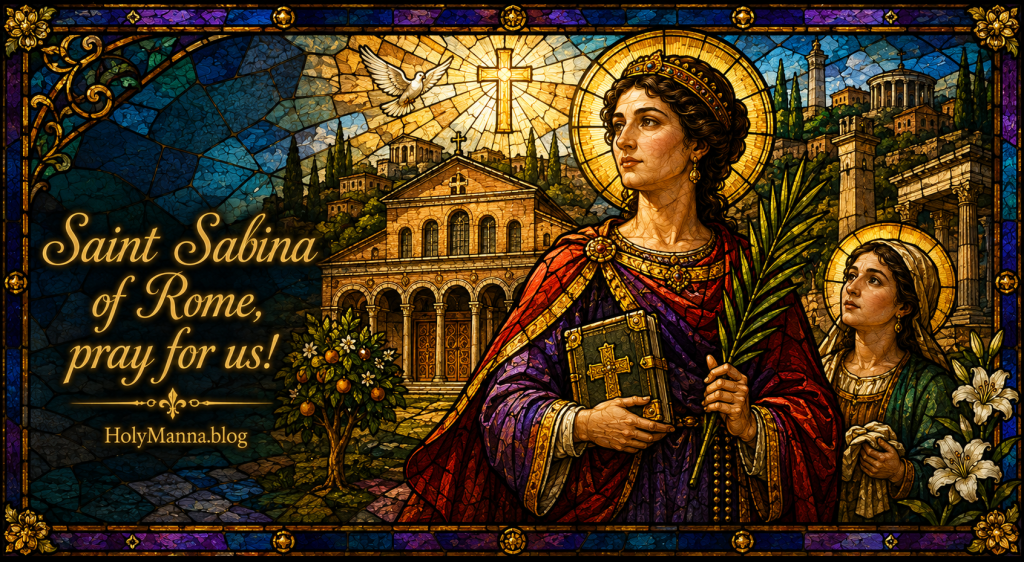
The Woman Whose House Became a Church
There is a quiet hill in Rome where the tour buses rarely stop. Climb the Aventine past the orange groves and the famous keyhole view of Saint Peter’s dome, and you arrive at a plain brick basilica that looks nothing like the gilded churches of the city center. Inside, light pours through high windows onto twenty-four marble columns and a long, simple nave that has stood almost unchanged since the early fifth century. This is the Basilica of Santa Sabina, and the woman whose name it carries is the saint the Church remembers on August 29.
Saint Sabina of Rome is one of those ancient figures whose memory survives less in documents than in stone and in the prayer of the faithful. The current Roman Martyrology, in its 2004 typical edition, commemorates her with a single restrained line: “At Rome, the commemoration of Saint Sabina, whose titular church on the Aventine preserves her venerable name.” The older edition of the Martyrology, the one in use before 1969, was bolder, calling her a martyr who, under the emperor Hadrian, “was struck with the sword, and thus obtained the palm of martyrdom.” Between those two lines lies the whole story of how the Church remembers her: as a Roman noblewoman of the second century, a widow of wealth and standing, who by long tradition was brought to Christ through the witness of a servant in her own household, who honored that servant’s body after her death, and who gave her own life for the faith. The tradition also holds that her home on the Aventine became a place where Christians gathered, and that the great basilica was raised over it.
Vatican News describes her plainly as a Roman noble who was killed in hatred of the faith by decapitation. Her image appears among the virgin martyrs in the sixth-century mosaics of Sant’Apollinare Nuovo in Ravenna, carrying a book, a palm, and a crown. Although she no longer appears on the General Roman Calendar, she remains in the Martyrology, her basilica remains the first of the Lenten station churches, and her name is on the lips of every Dominican who calls Santa Sabina the mother church of the Order of Preachers. This post honors her exactly as the Church does, with reverence for the tradition and honesty about what can and cannot be verified.
A Widow of the Aventine and the Servant Who Changed Everything
Almost everything told about Sabina’s personal history comes from a single source, the Acts or Passio of Saints Sabina and Serapia, a text scholars date to the sixth century. The Catholic Encyclopedia states frankly that these Acts “have no historic value,” and the New Catholic Encyclopedia notes that the place names they give cannot be located by modern archaeology and may reflect a corrupted text. That does not mean the story is false. It means the Church hands it on as a story, and so will this post.
According to that tradition, Sabina was the daughter of a man named Herod, surnamed Metallarius, a name that seems to mean the metalworker, and she was the widow of a senator named Valentinus. She was wealthy, she was well connected, and she was pagan. Her house stood in one of the most exclusive neighborhoods of Rome, the Aventine, near a temple of Juno, in a quarter of patrician homes and imperial shrines. By every worldly measure, she had arrived.
Into that household came a young woman named Serapia. The tradition says Serapia was born at Antioch in Syria of Christian parents, that she fled to Italy during the persecution under Hadrian, that she had made a vow of chastity, and that she sold what she owned, gave the money to the poor, and entered the service of the widow Sabina. Some retellings say she sold herself into slavery; others describe her simply as a servant. Either way, she arrived with nothing but her faith, and that faith did its quiet work. According to the tradition, Sabina watched, asked questions, and was converted to Christ.
There is something deeply scriptural in this picture, whatever its historical precision. Saint Paul had written to the Galatians decades earlier, “There is neither Jew nor Greek, there is neither slave nor free, there is neither male nor female; for you are all one in Christ Jesus” (Galatians 3:28). The Catechism teaches the same truth in its own language: “Created in the image of the one God and equally endowed with rational souls, all men have the same nature and the same origin. Redeemed by the sacrifice of Christ, all are called to participate in the same divine beatitude: all therefore enjoy an equal dignity” (CCC 1934). In Sabina’s house, the social order of Rome was turned upside down by the Gospel. The mistress learned the faith from her servant, and the two women became sisters.
The tradition goes on to say that after her conversion Sabina withdrew with a few devout companions to one of her country estates, a place the Acts call Vindena in Umbria, and that her home became a place where Christians gathered. None of this can be verified; the names, the estates, and the sequence of events rest on the late Passio alone. But the shape of the story is the shape of countless real conversions in the early Church, where the faith spread through the witness of one life lived well in front of another.
The Quiet Witness of a Roman Household
Sabina performed no recorded miracles during her life. The Catholic sources are unanimous on this point, and this post will not invent any. What the tradition offers instead is something arguably harder and more imitable: a picture of a woman who, having received the faith, opened her home, her wealth, and her social standing to the service of Christ and His Church.
Consider what it would have meant for a senator’s widow to become a Christian in Rome in the first decades of the second century. The reign of Hadrian, from 117 to 138, was not a period of constant, empire-wide persecution, but a Christian could still be denounced, tried, and executed for refusing to sacrifice to the gods. Everything Sabina possessed rested on her participation in the civic religion of Rome. To abandon it was to become suspect; to shelter Christians in her house was to court disaster. The tradition says she did both.
This is why the Church remembers her, and why the reader should too. She shows what it looks like when faith moves from the heart into the concrete arrangements of a life. The Catechism teaches that lay people “fulfill their prophetic mission by evangelization, ‘that is, the proclamation of Christ by word and the testimony of life’” (CCC 905). Serapia evangelized Sabina by the testimony of her life; Sabina, in turn, evangelized by the testimony of her house. Nearly everyone reading these words has a home, a table, a front door. The question Sabina’s story presses on the reader is what those things are for.
There is also a deeper point hidden in the later history of her house. The earliest reliable reference to Sabina is not the Passio at all but the name of a church. In the fifth century, the basilica on the Aventine was known simply as the titulus Sabinae, that is, the title of Sabina, a phrase that in early Roman usage meant a church established in or on the property of a particular donor. Only in the sixth century did it become the titulus sanctae Sabinae, the title of Saint Sabina. Many scholars believe that the historical Sabina was a Roman matron who gave her house to the Church, and that she was later identified with a martyr of the same name. If that is right, then the most certain fact about her is also the most telling: she gave what she had so that the Eucharist could be celebrated there. The Catechism describes a church building as “a house of prayer in which the Eucharist is celebrated and reserved, where the faithful assemble, and where is worshipped the presence of the Son of God our Savior” (CCC 1181). Whether Sabina gave her house or her blood or both, she gave Rome a house of prayer that is still standing.
Denounced, Tried, and Faithful to the End
The tradition of Sabina’s martyrdom is inseparable from Serapia’s, so the two must be told together, with the caution that what follows rests on the sixth-century Acts and cannot be independently confirmed.
According to the story, Serapia was the first to be arrested. Denounced as a Christian during the persecution under Hadrian, she was brought before a local official and ordered to sacrifice. She refused. The Passio then tells of an attempt to violate her chastity: she was handed over to two men, and, the story says, God struck them down with sickness before they could harm her, protecting her purity. She was accused of sorcery for this, beaten, and put to death. Sources disagree sharply on the manner of her death, describing her variously as beaten to death, beheaded, burned, or hanged, which is one more sign that the account was shaped over centuries of retelling rather than recorded by an eyewitness. This episode of divine protection is a story handed down in the tradition, and it cannot be verified.
What Sabina did next is the hinge of her whole legend, and it is the act for which the Church most honors her. She went and recovered Serapia’s body, and she buried it with honor in her own family tomb, the mausoleum where she herself expected one day to be laid. In the Rome of that era, to claim the body of an executed Christian and give it a dignified burial was to declare oneself a Christian. It was a public act, and it was a dangerous one.
The reader should not rush past how Christian this gesture is. The Old Testament holds up Tobit, who risked his life to bury the dead: “I would give my bread to the hungry and my clothing to the naked; and if I saw any one of my people dead and thrown out behind the wall of Nineveh, I would bury him” (Tobit 1:17). The Gospels give Joseph of Arimathea, who went boldly to Pilate to ask for the body of Jesus. The Catechism teaches that “the bodies of the dead must be treated with respect and charity, in faith and hope of the Resurrection. The burial of the dead is a corporal work of mercy; it honors the children of God, who are temples of the Holy Spirit” (CCC 2300). Sabina honored Serapia’s body because she believed that body would rise. A widow of the Aventine laid her servant in the tomb of senators, and in doing so proclaimed that in Christ the servant was her sister and her equal.
The denunciation followed quickly. The tradition says Sabina was accused before the prefect, named Elpidius in most versions, who pressed her hard to renounce the faith. Vatican News describes her as stalwart in refusing every pressure and repeatedly affirming her faith in Jesus Christ. She was condemned and beheaded. The date is given variously as 119, 120, 125, 126, or 127; the Catholic Encyclopedia settles on about 126. Some versions place her death in Rome, others at Vindena in Umbria, where the Acts say she was buried alongside Serapia. None of these details can be confirmed.
Here honesty requires one further note. The 2004 Roman Martyrology commemorates Sabina without the title of martyr, speaking only of her venerable name preserved by the Aventine basilica, whereas the older Martyrology, Vatican News, and the Church’s long iconographic tradition present her as one. The Church has not denied her martyrdom; she has simply chosen, in the current edition, to state only what can be stated with confidence. The martyrdom is an ancient and honored tradition, not a documented event, and the Church honors her regardless.
What matters for the Christian is what that tradition teaches. The Catechism says that “martyrdom is the supreme witness given to the truth of the faith: it means bearing witness even unto death. The martyr bears witness to Christ who died and rose, to whom he is united by charity” (CCC 2473). Our Lord promised, “So every one who acknowledges me before men, I also will acknowledge before my Father who is in heaven” (Matthew 10:32). Whatever the exact circumstances of her death, the Sabina the Church remembers is a woman who acknowledged Christ before men when it cost her everything.
A Basilica, a Pair of Doors, and Eight Hundred Years of Dominicans
No healings or post-mortem wonders are recorded for Saint Sabina in the Catholic sources, and this post will not manufacture them. What the Church received after her death was something different and no less remarkable: a house that became a basilica, a basilica that became a mother church, and a name spoken in prayer on the Aventine for sixteen centuries.
The tradition holds that in the year 430 Sabina’s relics, together with Serapia’s, were brought to the Aventine and placed in a new church built on the site of her home. The historical record for the church itself is solid. Between 422 and 432, under Pope Celestine I, a priest from Dalmatia named Peter of Illyria built the basilica, and it was consecrated under Pope Sixtus III. Visitors can still read the proof: above the entrance, a fifth-century mosaic inscription in gold letters on deep blue names Peter of Illyria and Pope Celestine. Twenty-four fluted Corinthian columns divide the nave from the aisles; tradition says they came from the nearby temple of Juno, though that is not certain. The basilica is the oldest church in Rome to preserve its original colonnaded plan, and art historians study it as the clearest surviving window into what the Constantinian basilicas, including the original Saint Peter’s, once looked like. The church was originally dedicated to both Sabina and Serapia; over time the dedication was narrowed to Sabina alone. Vatican News affirms that the relics of the two women rest there to this day, under the high altar.
Then there are the doors. The main portal of Santa Sabina is closed by a pair of cypress-wood doors carved in the fifth century, roughly contemporary with the building. Of the original twenty-eight carved panels, eighteen survive, showing scenes from the Old and New Testaments: Moses, Elijah, the Epiphany, miracles of Christ, the Ascension. In the upper left corner is a small panel that scholars consider one of the earliest surviving public depictions of the Crucifixion of Christ between the two thieves. For the first four centuries, the cross was shown rarely and discreetly, since crucifixion was still too raw a memory to be made into art. At Santa Sabina, on the doors of a church named for a woman who by tradition died for the Crucified, the Church began to show the world His Passion openly.
The centuries added their layers. Pope Eugenius II restored and adorned the basilica in 824. In the thirteenth century came the decisive moment in the church’s later history. Pope Honorius III, who had approved the Order of Preachers in 1216, entrusted Santa Sabina to Saint Dominic and his friars; sources give the date as 1218, 1219, or 1222. Dominic lived, prayed, and governed his young order there, and the convent beside the basilica remains the headquarters of the Dominicans to this day. Saint Thomas Aquinas taught in that convent.
Two Dominican stories cling to the place and deserve to be told as exactly what they are. Behind a small window in the narthex wall, visitors can see an orange tree in the cloister garden, and Dominican tradition holds that it descends from a tree Saint Dominic himself planted around 1220 with seed brought from Spain, the first orange tree in Rome. And just inside the entrance, on a twisted column, sits a round black stone called the lapis diaboli, the devil’s stone; tradition says the devil hurled it at Dominic as he lay praying one night on the slab over the martyrs’ tomb, and that it shattered the paving stone but left the saint unharmed. Both are treasured stories of the Order. Neither can be verified.
The basilica’s liturgical role is entirely verifiable. Santa Sabina is the statio for Ash Wednesday, the first of the Roman station churches, and the Popes have gone there in procession on that day since the time of Saint John XXIII to receive ashes and preach the opening homily of Lent. So every year, the Church’s season of penance begins under the name of Sabina, a Roman widow who, by tradition, gave her house and her life to Christ and now lends her roof to the Successor of Peter as he calls the whole Church to repentance.
One last and sobering detail. Scholars note that the titulus Sabinae may originally have commemorated a donor, and that the martyr of the Passio, placed in an Umbrian town no one can now find, may have been a different Sabina altogether, later joined to the Roman foundress by the coincidence of a name. The Church knows this and continues to honor her, because the Catechism teaches that the saints are venerated not as puzzles to be solved but as “models and intercessors” (CCC 828), and because the communion of saints is a communion of persons, not of documents. “Exactly as Christian communion among our fellow pilgrims brings us closer to Christ, so our communion with the saints joins us to Christ” (CCC 957). Whoever Sabina was precisely, she is with Christ, and her basilica says so in stone.
What a 2nd Century Widow Can Teach a 21st Century Believer
It would be easy to leave Sabina on her hill, admired and distant. But her story, precisely because it is so simple, speaks directly into ordinary life.
Begin with Serapia, because Sabina’s story begins there too. The most important person in Sabina’s life was not her senator husband or her wealthy father; it was a servant who prayed in her kitchen. Every reader has people like Serapia nearby: the colleague who goes to daily Mass without announcing it, the relative whose patience seems inexplicable, the friend whose peace in suffering raises questions. Who has been Serapia to you? Is there someone whose quiet faith you have noticed but never asked about? The faith still spreads mostly the way it spread in Sabina’s house, one life witnessed by another.
Then consider Sabina herself, and the turning of the social order inside her home. She was converted by someone the world said was beneath her, and she came to call that person sister. In a culture that sorts people relentlessly by status, income, and influence, Sabina invites the reader to ask who in your life do you treat as less than a brother or sister in Christ? The person who cleans the office, the driver, the cashier, the new hire, the aging parent who now needs help: Sabina’s story suggests that God may be speaking through exactly the people one is tempted to overlook. The practical step is small: learn a name, ask a real question, give full attention to someone the world trains you to pass by.
Consider, too, the burial of Serapia. Sabina’s most celebrated act was not a miracle or a speech but a work of mercy performed at great personal risk. The corporal works of mercy are not heroic in the dramatic sense; they are feeding, clothing, visiting, sheltering, burying. When was the last time you performed a work of mercy that cost you something? Not a donation made from surplus, but an act that took time you did not have, risked an awkward conversation, or exposed you to criticism. Sabina’s witness is that such acts are where faith becomes visible.
Consider the house. Whether or not Sabina shed her blood, the one thing history most confidently attaches to her name is a building given over to the worship of God. The Catechism calls the Christian family the Ecclesia domestica, the domestic church, and teaches that in the home “the father of the family, the mother, children, and all members of the family exercise the priesthood of the baptized in a privileged way ‘by the reception of the sacraments, prayer and thanksgiving, the witness of a holy life, and self-denial and active charity’” (CCC 1657). Is your home a titulus, a place where the faith is visibly at home? A crucifix on the wall, grace before meals, a door open to someone who needs a meal or a bed: these are the modern forms of what Sabina did with her villa on the Aventine.
Finally, consider the doors. Sabina’s church was among the first in the world to show the Crucifixion to anyone who walked in. The Christian life ends, as it begins, at the foot of the Cross. Are you willing, like Sabina, to be publicly identified with the Crucified, even when it costs you standing, comfort, or approval? Most readers will never face a prefect demanding sacrifice to Jupiter, but nearly all will face a moment at work, at a family table, or online where acknowledging Christ carries a price. Sabina, by the Church’s long tradition, paid the highest price. The reader can begin by paying the smaller ones.
Engage With Us!
Saint Sabina’s story is quiet, ancient, and, in places, uncertain, which makes it all the more interesting to think about together. Please share your thoughts and reflections in the comments below. Has someone unexpected ever led you closer to Christ? Here are some questions to pray and talk over this week:
- Sabina was evangelized by a servant in her own household. Who has been the quiet witness in your life, and have you ever thanked God for that person, or told them what their faith meant to you?
- The Gospel overturned the social order in Sabina’s home, making mistress and servant sisters in Christ. Whom do you find hardest to see as a true equal, and what would change if you did?
- Sabina’s most honored act was burying her friend at great risk. Which corporal work of mercy is God asking you to perform this week, and what would it cost you?
- Sabina’s house became the titulus Sabinae, a home for the Eucharist. In what concrete way could your home become more visibly a domestic church this month?
- The Church honors Sabina even though much of her story cannot be verified, because the communion of saints rests on faith, not on archives. How does that shape the way you think about the saints, and about the hidden faithful whose names history never recorded?
Saint Sabina’s name has been preserved on the Aventine for sixteen centuries because a Roman woman, by the Church’s long memory, gave what she had to Christ: her home, her standing, and finally her life. No one reading this is likely to have a basilica built over their living room. But everyone can open a door, honor the overlooked, bury the dead with reverence, and stand with the Crucified when it costs something. Go and live that kind of faith this week, in the small and hidden places where the Gospel has always done its best work, and do it all with the love and mercy that Jesus taught us.
Saint Sabina of Rome, pray for us!
Follow us on YouTube, TikTok, Instagram and Facebook for more insights and reflections on living a faith-filled life.Saint Sabina of Rome, pray for us.


Leave a Reply