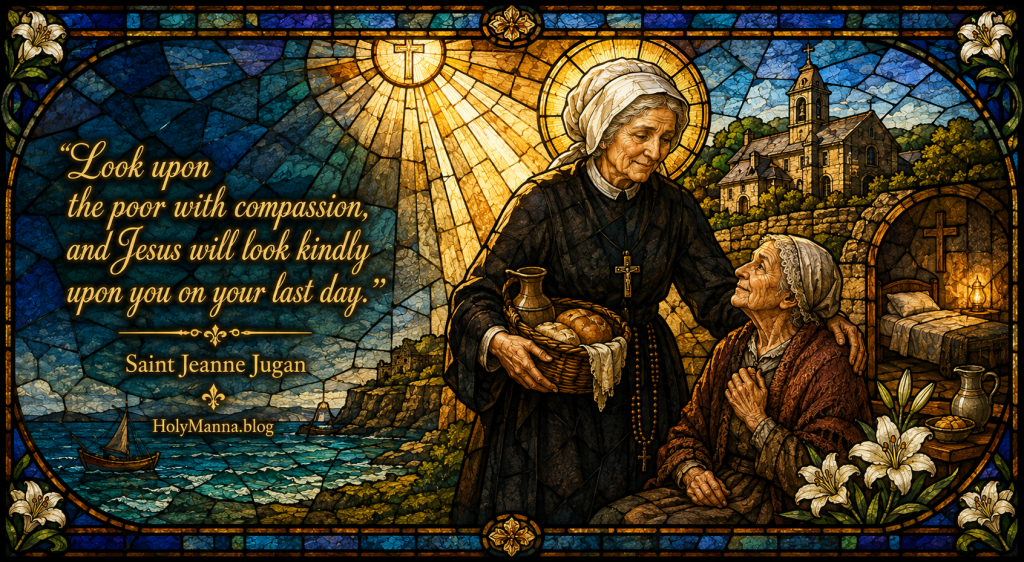
The Woman Who Gave Away Her Bed and Was Given the World
Picture a very old nun sitting quietly in the corner of a French motherhouse, knitting, praying her Rosary, and cheering up the young novices who pass by. They are kind to her. They think she is just one of the retired sisters. Not one of them knows that the entire congregation they belong to, with its thousands of members and nearly two hundred homes across three continents, exists because of her. That woman was Jeanne Jugan, known in religion as Sister Mary of the Cross, and the Church remembers her on August 29, the day she died in 1879. She is the foundress of the Little Sisters of the Poor, the congregation that begs door to door so that the destitute elderly can live and die surrounded by love.
Jeanne was beatified by Pope John Paul II on October 3, 1982, and canonized by Pope Benedict XVI on October 11, 2009, the same day as Saint Damien of Molokai. She is not on the General Roman Calendar; her celebration belongs to the Little Sisters of the Poor and the spiritual family of Saint John Eudes, and because August 29 is the memorial of the Passion of Saint John the Baptist, the sisters keep her feast on August 30. The Church honors her for heroic virtue, and specifically for a humility so complete that she let another person take credit for her life’s work and spent twenty seven years in silence rather than fight for her name. The Catechism reminds us that the saints have always been the source and origin of renewal in the most difficult moments in the Church’s history (CCC 828). Jeanne renewed the Church not with eloquence or institutions she controlled, but by picking up one old woman and never putting down the cross that followed.
A Fisherman’s Daughter on the Cliffs of Cancale
Jeanne Jugan was born on October 25, 1792, in Cancale, a fishing town on the northern coast of Brittany, during the worst of the French Revolution. She was the sixth of eight children, and four of her siblings died in infancy. Her father, Joseph, a fisherman, was lost at sea when she was about four years old. Her mother, Marie, was left to raise the surviving children alone in a world where the churches were closed, priests who stayed faithful to Rome were hunted, and begging was a way of life for whole families. Jeanne’s faith was formed in secret, at real risk, by her mother and by a group of women of the Third Order of Saint John Eudes who were numerous in that part of Brittany. They taught her to read and write, which the Revolution and her family’s poverty had otherwise made impossible.
Like most poor children of her time, she went to work early. She tended animals on the high cliffs above the Bay of Cancale, and the official biography published by the Holy See for her canonization notes that she prayed her Rosary up there, lifted by the beauty of the sea. At about fifteen she left home to become a kitchen maid for a well off family near Cancale, and her employer, a devout woman, brought her along on visits to the sick and the poor. This was Jeanne’s first school of charity.
In 1801 Napoleon’s Concordat restored religious freedom in France, and Brittany experienced a spiritual awakening, with parish missions preached everywhere. In that fervent atmosphere the young maid heard the Lord’s call. When a young man asked for her hand in marriage, she refused, and she gave her mother a reason that sounds almost reckless: “God wants me for himself. He is keeping me for a work which is not yet founded.” She then divided her clothes into two piles and left the prettiest to her sisters. She was in her early twenties, poor, uneducated, and entirely certain that God had a job for her that did not yet exist.
She moved to Saint-Servan, near Saint-Malo, and for six years worked as an assistant nurse at the Rosais hospital. She joined the Third Order of Saint John Eudes, and from that time her one desire, as the Holy See records it, was to “be as humble as Jesus.” Her health broke down under hospital work, and she was taken in by a fellow tertiary, Mademoiselle Lecoq, whom she served as a companion and housekeeper for twelve years until that woman’s death in 1835. This matters for anyone who feels they are wasting their life waiting. Jeanne spent more than twenty years in quiet, unremarkable service before her real vocation showed itself. The Catechism teaches that all Christians in any state or walk of life are called to the fullness of Christian life and to the perfection of charity (CCC 2013). The call reached Jeanne long before the work did, and she answered it in the hidden years.
One Winter Night, One Old Woman, One Bed
By 1839 Jeanne was forty seven years old and sharing a small apartment in Saint-Servan with two friends, Françoise Aubert, a woman of seventy one known as Fanchon, and Virginie Trédaniel, a seventeen year old orphan. They lived simply, went to daily Mass, and did what good they could. Saint-Servan was in economic ruin; the Holy See’s biography states that four thousand of its ten thousand inhabitants were reduced to begging. The elderly poor, especially widows, were simply left to die.
One winter evening in 1839 Jeanne found a blind, partly paralyzed old widow with no one to care for her. The congregation’s own records identify her as Anne Chauvin. Jeanne carried her home, climbed the stairs to the little apartment, and put her in her own bed. From then on Jeanne slept in the attic. There was no plan, no rule, no money. There was only an old woman who needed a bed and a Christian who had one.
That single act is the founding of the Little Sisters of the Poor. More elderly women were brought to the door. Young women came to help, among them Marie Jamet, who with Virginie Trédaniel would become Jeanne’s first companions. In 1841 Jeanne rented a large room and sheltered twelve old people. In 1842, without money, she bought a dilapidated former convent and soon housed forty. A Brother of Saint John of God, whose order had a long tradition of hospitality to the sick, encouraged her to do something that would define her congregation forever: go out and beg. Jeanne took a basket and went door to door in Saint-Servan, then Rennes, Dinan, Tours, Angers, and beyond, asking for food, clothing, and money for “her” old people. There is an often repeated account that a man who had given her alms struck her in the face, and that she replied calmly that the blow was for her, and now he should give something for the poor. This story comes from the congregation’s later testimony and cannot be verified as a verbatim record.
The little group began to take the form of a religious community. They called themselves the Servants of the Poor, then in 1844 the Sisters of the Poor, and by 1849 the name the people of Brittany had given them, the Little Sisters of the Poor, was adopted for good. Jeanne was elected superior in 1842 and re-elected in 1843. In religion she took the name Sister Mary of the Cross, and she meant it.
Why does she matter? Because she took the Gospel literally and then lived with the consequences. The Catechism teaches that the Church’s love for the poor is a part of her constant tradition and that the works of mercy are charitable actions by which we come to the aid of our neighbor in his spiritual and bodily necessities (CCC 2444, CCC 2447). Jeanne did not theorize about the elderly poor; she housed them, fed them, washed them, and begged for them. She told her young sisters, “My little ones, never forget that the poor are Our Lord; in caring for the poor say to yourself: This is for my Jesus. What a great grace!” That is the whole spirituality of the congregation in one sentence.
Her trust in Providence was absolute and sometimes startling. Her sisters remembered her saying, “Give us the house; if God fills it, God will not abandon it.” She rejoiced in poverty rather than merely enduring it: “It is so good to be poor, to have nothing, to depend on God for everything.” The Catechism describes exactly this disposition when it says that abandonment to the providence of the Father in heaven frees us from anxiety about tomorrow (CCC 2547), and that the Beatitude of the poor in spirit means voluntary humility and the desire for true happiness that frees us from attachment to goods (CCC 2546). Jeanne was poor in spirit because she had nothing, and she had nothing because she gave it away.
The world noticed, briefly. In 1845 the French Academy awarded her the Montyon Prize, given each year to a poor French man or woman for outstanding meritorious action. Houses opened in Rennes and Dinan in 1846, Tours in 1847, Angers in 1850. Within a few years there were homes in England, and by 1868 in the United States. There is a story, repeated in many places, that the novelist Charles Dickens visited her and came away deeply moved by her presence. No primary source has been traced for this visit or for the words attributed to him, so it cannot be verified and is best left as a story.
No physical miracles are documented during Jeanne’s lifetime, and none are claimed by her congregation. What the Church recognized in her was heroic virtue: faith that saw Christ in the old, hope that God would not abandon the poor, and charity that gave everything. The miracles came later, and they came through a woman the world had been taught to forget.
Stolen Work and a Hidden Cross
Jeanne Jugan was not martyred. Her cross was quieter and in some ways harder, because it was placed on her by a priest.
In December 1843, shortly after Jeanne had been re-elected superior, Father Auguste Le Pailleur, the young curate who was confessor to Marie Jamet and Virginie Trédaniel, overturned the election on his own authority and installed Marie Jamet, then twenty one years old, as superior. There was no canonical basis for it. Jeanne could have resisted. Instead, the Holy See’s biography records simply that in his action she discerned God’s will, supported the work, and encouraged the younger sisters by her example. A saying passed down in the congregation has her telling the priest, “You have stolen my work from me, but I willingly give it up to you.” This comes from the sisters’ later testimony and cannot be verified as a contemporary record.
Le Pailleur sent her out to beg and to found houses, which she did faithfully for nearly a decade. Then in 1852 the Bishop of Rennes formally recognized the congregation and appointed Le Pailleur Superior General. His first act was to recall Jeanne definitively to the motherhouse, La Tour Saint-Joseph at Saint-Pern, and place her in retirement. She was sixty. She would live there twenty seven more years. Meanwhile Le Pailleur rewrote the story, presenting himself as the founder and Marie Jamet as the first superior. The young sisters who arrived in growing numbers were never told who the old woman in their midst really was. She was simply Sister Mary of the Cross, a retired sister among the novices.
Here is where the saint is made. Jeanne did not grow bitter. The witnesses who later testified about those years remembered a woman of serenity and wisdom who radiated praise. She would tell the novices, “Love God very much; he is so good. Let us entrust ourselves to him.” She insisted on the one thing she had always insisted on: “Be little, little, little.” She said, “We are grafted into the cross and we must carry it joyfully unto death.” She encouraged them to cheerfulness for the sake of the old people, saying that their residents did not like long faces. She sent them to the chapel when they were exhausted, telling them to say to Jesus that they had only him and then to go their way, because the good Lord has an excellent memory. She loved Our Lady with simplicity and told the sisters, “The Hail Mary will take us to heaven.”
The Catechism teaches that humility is the foundation of prayer and that only when we humbly acknowledge that we do not know how to pray as we ought are we ready to receive freely the gift of prayer (CCC 2559). It also teaches that the disciple must take up his cross and follow Jesus, because the way of perfection passes by way of the Cross and there is no holiness without renunciation and spiritual battle (CCC 2015). Jeanne’s battle was fought entirely inside, and she won it with a smile and a knitting needle. By the time Pope Leo XIII gave final approval to the congregation’s constitutions in 1879, the Little Sisters of the Poor numbered about 2,400 sisters in 177 homes on three continents. Jeanne died at the motherhouse on August 29, 1879, at the age of eighty six, still unknown as foundress. Her recorded last words were a prayer: “Eternal Father, open your gates today to the most miserable of your children, but one who greatly longs to see you. O Mary, my dear Mother, come to me. You know that I love you and I long to see you.”
The truth did not stay buried. In 1890 the Holy See removed Father Le Pailleur from office after an investigation into his conduct. In the 1890s the Mother General commissioned a chaplain to search the archives with the stated goal of discovering and revealing the truth about Jeanne Jugan, and in 1902 the congregation’s published history formally reinstated her as foundress. In the early 1900s the old sisters who had known her were asked to write down their memories, and those recollections are the source of most of her sayings. God, as the sisters like to say, lifts up the lowly.
The Old Nun in the Corner Starts Working Miracles
The diocesan inquiry into Jeanne’s reputation for holiness opened in 1935. Her cause was introduced in Rome on July 10, 1970, and on July 13, 1979, the centenary year of her death, Pope John Paul II declared her Venerable for the heroicity of her virtues. Then the miracles began to be recognized.
The miracle accepted for her beatification was the sudden and medically inexplicable cure of Antoine Schlatter, an elderly resident of the Little Sisters’ home in Toulon, France, who was healed of a grave illness after prayer to Jeanne. The decree recognizing it was signed on May 11, 1982, and John Paul II beatified her in Saint Peter’s Basilica on October 3 of that year. At the beatification the Pope said, as the congregation records it, that “God could glorify no more humble a servant than she.”
The miracle for her canonization crossed the Atlantic. In 1989 Dr. Edward Gatz, a retired anesthesiologist in Omaha, Nebraska, then fifty one, was diagnosed with adenocarcinoma of the esophagus, an aggressive cancer. After surgery at the Mayo Clinic he was told the operation would only ease his discomfort and that he had perhaps six months to live. He began to put his affairs in order. A Jesuit friend of the family, Father Richard McGloin, had recently spent time with the Little Sisters of the Poor and suggested that they pray daily through the intercession of their foundress. Dr. Gatz, his wife Jeanne, and their friends did exactly that. His symptoms gradually lessened, his scans improved, and eventually tests showed that the cancer was simply gone. He received no further treatment. Years later, at the urging of another priest, the couple reported the cure to the Little Sisters with full medical documentation. A diocesan tribunal was held in Omaha in 2005, and after three years of Vatican examination, Pope Benedict XVI signed the decree approving the miracle on December 6, 2008. Dr. Gatz lived another thirty seven years after his diagnosis and died in April 2026 at the age of eighty nine, a walking sign of a hidden saint’s intercession.
On October 11, 2009, in Saint Peter’s Square before an estimated fifty thousand people, Benedict XVI canonized Jeanne Jugan. In his homily he described her as a woman concerned with the dignity of brothers and sisters whom age had made more vulnerable, recognizing in them the person of Christ himself, and he quoted her own words: “Look upon the poor with compassion, and Jesus will look kindly upon you on your last day.” The Catechism explains why the Church does this: by canonizing certain of the faithful, the Church recognizes the power of the Spirit of holiness within her and sustains the hope of believers by proposing the saints to them as models and intercessors (CCC 828). And it teaches that the saints in heaven do not cease to intercede with the Father for us, so that their concern is the greatest help to our weakness (CCC 956).
Her body rests in the crypt of the chapel at La Tour Saint-Joseph in Saint-Pern, the motherhouse where she was hidden for twenty seven years, which now receives pilgrims and houses a museum of her life. Her birthplace at Les Petites Croix in Cancale is also preserved and visited. But the most visible monument to Jeanne Jugan is alive: the Little Sisters of the Poor, who at the time of her canonization numbered more than 2,700 sisters caring for some 13,000 elderly residents in over 200 homes on every inhabited continent, many of them named Jeanne Jugan Residence. They still beg. They still take a fourth vow of hospitality. They still sit with the dying so that no one in their care leaves this world alone. Every one of those homes is a miracle that started with a blind widow and a borrowed bed.
What Jeanne Jugan Says to You Today
It would be easy to admire Jeanne from a distance, the way we admire people who do hard things we have no intention of doing. But her life is almost unbearably practical, and it asks something of you.
Start with the old people in your life. Jeanne saw Christ in the elderly at a moment when society threw them away, and our moment is not so different. The Catechism teaches that those whose lives are diminished or weakened deserve special respect and that the sick or elderly should be helped to lead lives as normal as possible (CCC 2276), and it calls grown children to give their aging parents material and moral support in old age and in times of illness, loneliness, or distress (CCC 2218). Who is the elderly person in your life, in your family or parish or neighborhood, who is quietly being forgotten? You may not be able to carry anyone up a staircase, but you can call, visit, sit, listen, and bring a meal. Jeanne would tell you that in serving the aged it is Jesus himself whom you serve.
Then look at your hidden years. Jeanne spent two decades in ordinary work before her vocation appeared, and nearly three decades in obscurity after it was taken from her. Most of a saint’s life, it turns out, is hidden. Where in your life do you feel unseen, underused, or set aside? Jeanne’s answer was not to demand recognition but to become so little that God could fill the space. Try her discipline: when you are tempted to resent being overlooked, go to Jesus in the tabernacle, tell him plainly that you have only him, and then go your way and let him remember.
Finally, practice her trust. “Give us the house; if God fills it, God will not abandon it.” Jeanne did not wait for the budget to make sense before she obeyed. What is the good work you are postponing because you cannot see how it will be funded, staffed, or sustained? The Catechism promises that trust in the Father’s providence is the very meaning of asking for our daily bread (CCC 2830). Do the next right thing with the resources you have, and let Providence handle the rest. Jeanne’s whole congregation, after all, began with nothing but a bed.
Engage With Us!
Share your thoughts and reflections in the comments below. Jeanne Jugan’s life raises questions that are worth sitting with, and this community is richer when you bring your own experience to them.
- Jeanne waited more than twenty years for her vocation to appear and spent those years in ordinary, faithful service. How do you handle seasons of your life that feel like waiting, and what might God be forming in you during them?
- Jeanne saw Christ in a blind, paralyzed old widow whom everyone else had stepped over. Who are the elderly or forgotten people in your own life, and what is one concrete thing you can do for one of them this week?
- When her work was stolen and her name erased, Jeanne chose humility and joy over resentment. Is there a situation where you are being overlooked or uncredited, and what would it look like to respond as she did?
- Jeanne’s trust in Providence was total. Where are you holding back from a good work because you cannot yet see how it will be provided for?
- Jeanne told her sisters to be cheerful because their old people did not like long faces. How does your mood affect the people who depend on you, and how might joy itself become an act of charity?
Saint Jeanne Jugan would tell you not to call her by her name at all, because all that is left is Sister Mary of the Cross. That is the invitation. Let your own name get small so that Christ can get large in you. Carry your cross joyfully, trust the Father for tomorrow’s bread, and look on the poor with compassion, especially the ones with gray hair and no visitors. Do everything with the love and mercy that Jesus taught us, and you will find, as Jeanne did, that the good Lord has an excellent memory.
Saint Jeanne Jugan, pray for us!
Follow us on YouTube, TikTok, Instagram and Facebook for more insights and reflections on living a faith-filled life.


Leave a Reply