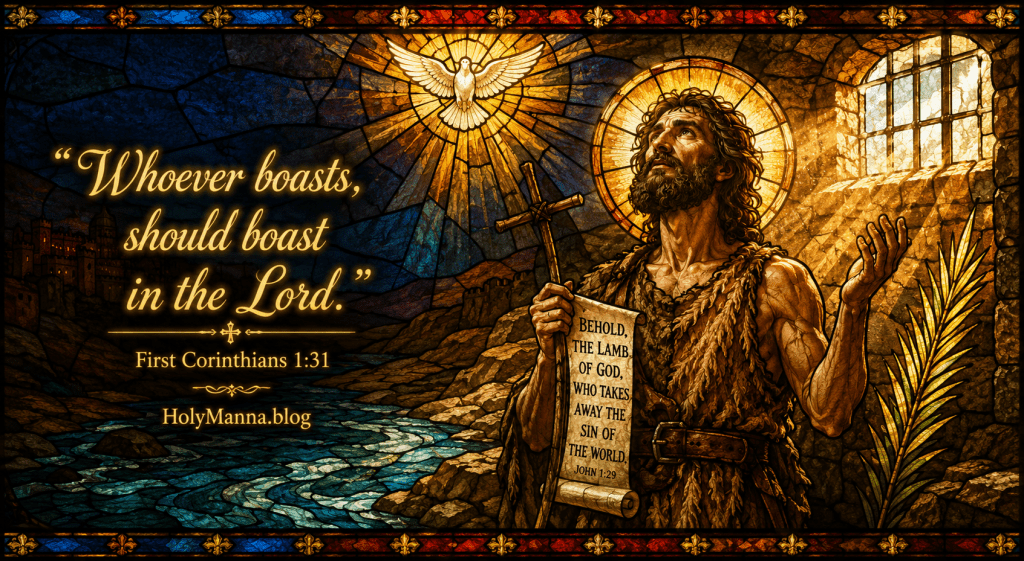
Memorial of the Passion of Saint John the Baptist – Lectionary: 430/634
1 Corinthians 1:26-31
Consider your own calling, brothers and sisters.
Not many of you were wise by human standards,
not many were powerful,
not many were of noble birth.
Rather, God chose the foolish of the world to shame the wise,
and God chose the weak of the world to shame the strong,
and God chose the lowly and despised of the world,
those who count for nothing,
to reduce to nothing those who are something,
so that no human being might boast before God.
It is due to him that you are in Christ Jesus,
who became for us wisdom from God,
as well as righteousness, sanctification, and redemption,
so that, as it is written,
Whoever boasts, should boast in the Lord.
Psalm 33:12-13, 18-21
R. (12) Blessed the people the Lord has chosen to be his own.
Blessed the nation whose God is the LORD,
the people he has chosen for his own inheritance.
From heaven the LORD looks down;
he sees all mankind.
R. Blessed the people the Lord has chosen to be his own.
But see, the eyes of the LORD are upon those who fear him,
upon those who hope for his kindness,
To deliver them from death
and preserve them in spite of famine.
R. Blessed the people the Lord has chosen to be his own.
Our soul waits for the LORD,
who is our help and our shield,
For in him our hearts rejoice;
in his holy name we trust.
R. Blessed the people the Lord has chosen to be his own.
The Head on the Platter and the Hands That Hold Us
There is a strange comfort in knowing that the man Jesus called the greatest born of women ended his life in a dungeon, killed to settle a dinner-party grudge. It tells the truth about how the world treats holiness, and it tells the truth about what God does with it.
Today’s Mass readings for the Memorial of the Passion of Saint John the Baptist circle one theme: God chooses the lowly and keeps them, and the only real security is found in him. Saint Paul reminds the Corinthians that God deliberately picked the weak, the foolish, and the nobodies so that whoever boasts, should boast in the Lord. The Psalmist answers that the people the Lord has chosen are blessed precisely because his eyes rest on those who fear him and wait for him. Then Mark shows what all of that looks like with a face on it. John the Baptist has no army, no court, no leverage, only a prison cell and a conscience. Herod has the title, the banquet, the officers, and the oath. By the end of the story, one of them is dead and free, and the other is alive and trapped.
The Church has kept this memorial since at least the fifth century. Its older name, the Decollation of Saint John, comes from the Latin for beheading, and tradition links the date to the veneration of John’s tomb at Sebaste in Samaria. The Roman Martyrology recalls that Herod imprisoned John for the sake of Herodias and had him put to death at the request of her daughter. The first-century historian Josephus adds that the execution took place at the fortress of Machaerus, east of the Dead Sea, and records that the Jewish people saw Herod’s later military defeat as God’s judgment for it.
This is a feast for anyone who has ever wondered whether telling the truth was worth the cost. John already answered that question.
First Reading — 1 Corinthians 1:26-31
The Church of Nobodies
Corinth in the mid-50s was a boomtown, a Roman colony sitting on the trade route between two seas, proud of its money, its rhetoric, and its sophistication. The Christian community there had caught the local disease. They were splitting into fan clubs around favorite preachers and measuring the Gospel by how impressive it sounded. Paul’s first letter opens by dismantling that pride, and the passage read today is his clinching move. He simply asks them to look around the room. God did not build his Church out of Corinth’s best and brightest. He built it out of ordinary people, and he did it on purpose. That is the same logic that will put a wilderness preacher in a king’s prison in the Gospel, and it is why this reading sits so naturally beside John the Baptist.
Detailed Exegesis
Verse 26: Consider your own calling, brothers and sisters. Not many of you were wise by human standards, not many were powerful, not many were of noble birth.
Paul does not say none, but not many. A few Corinthians had status, but the congregation as a whole was made of laborers, slaves, freedmen, and small traders. The word calling matters; their identity rests on God’s initiative, not their résumé.
Verse 27: Rather, God chose the foolish of the world to shame the wise, and God chose the weak of the world to shame the strong,
The verb chose appears three times across two verses, hammering home divine election. God’s choice of the lowly is not an accident of demographics but a revelation of his character, already seen in choosing Israel, the smallest of nations, and David, the youngest of brothers.
Verse 28: and God chose the lowly and despised of the world, those who count for nothing, to reduce to nothing those who are something,
The language is almost creation language. God calls into being what is nothing and unmakes what the world calls something. The cross, where a condemned criminal turns out to be the Lord of glory, is the supreme example.
Verse 29: so that no human being might boast before God.
Here is the purpose clause. God arranges salvation so that pride has nowhere to stand. The Corinthians were boasting about their teachers; Paul redirects them to the only legitimate object of boasting.
Verse 30: It is due to him that you are in Christ Jesus, who became for us wisdom from God, as well as righteousness, sanctification, and redemption,
Everything the Corinthians craved, Paul locates in Christ. He is the true wisdom, the source of our being made right with God, of our growth in holiness, and of our final liberation. The four words sketch the whole Christian life from justification to glory.
Verse 31: so that, as it is written, “Whoever boasts, should boast in the Lord.”
Paul condenses Jeremiah 9:23-24, where the prophet warns, Let not the wise boast of his wisdom, nor the strong boast of his strength, nor the rich boast of his riches; but rather, let those who boast, boast of this, that in their prudence they know me. To know the Lord is the only achievement that lasts.
Teachings
The Catechism reads this passage as a key to the mystery of God’s power. In CCC 272 it teaches, But in the most mysterious way God the Father has revealed his almighty power in the voluntary humiliation and Resurrection of his Son, by which he conquered evil. Christ crucified is thus “the power of God and the wisdom of God. For the foolishness of God is wiser than men, and the weakness of God is stronger than men.” God’s strength does not look like Herod’s banquet. It looks like a cross, and before that, like a prophet’s severed head.
Saint Augustine, who knew a thing or two about worldly brilliance, told a correspondent seeking the way to truth that the first, second, and third thing in the Christian life is humility. The Catechism echoes that instinct in CCC 2559: Humility is the foundation of prayer. Paul’s Corinthians were not being asked to despise themselves but to stop measuring themselves by Corinth’s yardstick.
Reflection
Most of us live with a quiet scoreboard. Education, income, followers, the right friends, the right parish. Paul asks you to consider your own calling and notice that God did not wait for you to be impressive before he chose you. That frees you from two traps at once: the despair of feeling like a nobody, and the pride of thinking you earned your seat. A concrete step this week is to name one area where you have been boasting, even silently, and deliberately thank God for it as a gift rather than a trophy. Another is to look for the person in your life whom the world counts for nothing and treat them as someone God has chosen, because he has.
Where have you been measuring your worth by human standards rather than by your calling? What would it look like to boast only in the Lord this week?
Responsorial Psalm — Psalm 33:12-13, 18-21
The Eyes of the Lord Are on the Small
Psalm 33 is a hymn of praise for God as Creator and Lord of history. It celebrates a God who speaks and the heavens appear, whose plans outlast the schemes of nations. Just before the verses sung today, the psalmist dismisses the things kings trust in: A king is not saved by a great army, nor a warrior delivered by great strength. Useless is the horse for safety. The selected verses then turn to where real safety lies. For a day that remembers a king with an army who could not save himself from his own oath, and a prisoner with nothing who was perfectly safe in God, this Psalm is almost a commentary.
Detailed Exegesis
Verse 12: Blessed the nation whose God is the LORD, the people he has chosen for his own inheritance.
The blessing belongs not to the powerful nation but to the chosen one. Israel was God’s inheritance, his own possession, and the Church inherits that identity. Like Paul’s Corinthians, the blessing rests on being chosen, not on being great.
Verse 13: From heaven the LORD looks down; he sees all mankind.
Nothing escapes God’s gaze, neither Herod’s banquet hall nor John’s cell. Divine sight here is not surveillance but sovereign care.
Verse 18: But see, the eyes of the LORD are upon those who fear him, upon those who hope for his kindness,
The Lord sees everyone, but his eyes rest in a special way on those who revere him and hope in his steadfast love. Fear of the Lord is the awe that keeps a person from fearing kings.
Verse 19: To deliver them from death and preserve them in spite of famine.
Death and famine were the two great terrors of the ancient world. God’s deliverance does not always mean escape from bodily death, as John’s story shows, but it always means that death does not have the final word.
Verse 20: Our soul waits for the LORD, who is our help and our shield,
Waiting is an act of trust. A shield does not remove the battle; it makes the warrior able to stand in it.
Verse 21: For in him our hearts rejoice; in his holy name we trust.
The Psalm ends where it began, in joy. Trusting in God’s name is the opposite of Herod’s trust in his own word.
Teachings
The Catechism defines the virtue this Psalm breathes: Hope is the theological virtue by which we desire the kingdom of heaven and eternal life as our happiness, placing our trust in Christ’s promises and relying not on our own strength, but on the help of the grace of the Holy Spirit (CCC 1817). Hope does not guarantee comfort; it guarantees God. The Catechism also teaches that the fear of the Lord is a gift of the Holy Spirit, and that the People of God is the community of those God has chosen and made his own, a people whose dignity comes from belonging to him and not from any worldly rank (CCC 781-782).
Reflection
When you are anxious, notice what you reach for. Money, control, reassurance from others, a plan for every contingency. The Psalmist invites a different posture: to wait, to let God be the shield, and to rejoice before the rescue arrives. Try praying verse 20 slowly at the start of your day, and again when something goes wrong. Let it become a reflex.
What are you tempted to trust in besides the Lord? Where is God asking you to wait rather than to grasp?
Holy Gospel — Mark 6:17-29
A Prophet Dies at a Party
Mark tells this story as a flashback. Jesus’ fame has reached Herod Antipas, tetrarch of Galilee and Perea, and the guilty ruler blurts out that John, whom he beheaded, has been raised. Mark then rewinds to explain. Antipas had divorced his wife, the daughter of the Nabatean king Aretas, to marry Herodias, his own niece and the wife of his half-brother. Mark names that brother Philip; Josephus names him Herod, and the discrepancy is best explained by the family’s habit of reusing names. John publicly called the marriage what it was, unlawful under Leviticus 18:16. Josephus places the execution at Machaerus and records that Herod also feared John’s influence over the crowds. The Gospel supplies the moral cause, the historian the political one, and both are true. Mark calls Antipas “king” with a straight face, though Rome never granted him the title, and the irony is the point. The man with the crown is the least free person in the room.
Mark 6:17-29
Herod was the one who had John the Baptist arrested and bound in prison
on account of Herodias,
the wife of his brother Philip, whom he had married.
John had said to Herod,
“It is not lawful for you to have your brother’s wife.”
Herodias harbored a grudge against him
and wanted to kill him but was unable to do so.
Herod feared John, knowing him to be a righteous and holy man,
and kept him in custody.
When he heard him speak he was very much perplexed,
yet he liked to listen to him.
She had an opportunity one day when Herod, on his birthday,
gave a banquet for his courtiers,
his military officers, and the leading men of Galilee.
Herodias’ own daughter came in
and performed a dance that delighted Herod and his guests.
The king said to the girl,
“Ask of me whatever you wish and I will grant it to you.”
He even swore many things to her,
“I will grant you whatever you ask of me,
even to half of my kingdom.”
She went out and said to her mother,
“What shall I ask for?”
She replied, “The head of John the Baptist.”
The girl hurried back to the king’s presence and made her request,
“I want you to give me at once
on a platter the head of John the Baptist.”
The king was deeply distressed,
but because of his oaths and the guests
he did not wish to break his word to her.
So he promptly dispatched an executioner with orders
to bring back his head.
He went off and beheaded him in the prison.
He brought in the head on a platter and gave it to the girl.
The girl in turn gave it to her mother.
When his disciples heard about it,
they came and took his body and laid it in a tomb.
Detailed Exegesis
Verse 17: Herod was the one who had John the Baptist arrested and bound in prison on account of Herodias, the wife of his brother Philip, whom he had married.
Mark lays responsibility squarely on Herod. John is imprisoned not for sedition but for telling a powerful man the truth about his marriage.
Verse 18: John had said to Herod, “It is not lawful for you to have your brother’s wife.”
The Greek tense suggests John kept saying it. He did not soften the message for the audience.
Verse 19: Herodias harbored a grudge against him and wanted to kill him but was unable to do so.
Herodias is the story’s engine of hatred, nursing her resentment and waiting for an opening.
Verse 20: Herod feared John, knowing him to be a righteous and holy man, and kept him in custody. When he heard him speak he was very much perplexed, yet he liked to listen to him.
This is the tragedy of a half-converted heart. Herod knows the truth when he hears it, enjoys it, even protects it, yet will not obey it.
Verse 21: She had an opportunity one day when Herod, on his birthday, gave a banquet for his courtiers, his military officers, and the leading men of Galilee.
The guest list is everyone Herod needs to impress. Pride sets the table.
Verse 22: Herodias’ own daughter came in and performed a dance that delighted Herod and his guests. The king said to the girl, “Ask of me whatever you wish and I will grant it to you.”
A princess dancing before drunken officers would have scandalized any decent household. Herod’s reckless promise comes from wine and vanity. Josephus gives the girl’s name as Salome; the Gospel does not.
Verse 23: He even swore many things to her, “I will grant you whatever you ask of me, even to half of my kingdom.”
The phrase echoes King Ahasuerus in Esther 5:3, but Herod has no kingdom to give. He is a client ruler swearing by borrowed authority.
Verse 24: She went out and said to her mother, “What shall I ask for?” She replied, “The head of John the Baptist.”
The girl has no agenda of her own; she is her mother’s instrument. Herodias has been waiting for exactly this.
Verse 25: The girl hurried back to the king’s presence and made her request, “I want you to give me at once on a platter the head of John the Baptist.”
The details she adds, at once and on a platter, are designed to leave Herod no time and no escape.
Verse 26: The king was deeply distressed, but because of his oaths and the guests he did not wish to break his word to her.
Mark uses the same word for Herod’s distress that he later uses for Jesus in Gethsemane. The difference is what each man does with it. Herod chooses his reputation over a righteous man’s life.
Verse 27: So he promptly dispatched an executioner with orders to bring back his head. He went off and beheaded him in the prison.
No trial, no appeal. The forerunner dies in the dark, offstage, exactly as his Lord’s glory was hidden on the cross.
Verse 28: He brought in the head on a platter and gave it to the girl. The girl in turn gave it to her mother.
The grotesque relay of the head from executioner to girl to mother shows how evil passes through hands that each refuse full responsibility.
Verse 29: When his disciples heard about it, they came and took his body and laid it in a tomb.
John’s disciples do for him what Joseph of Arimathea will do for Jesus. Mark is quietly telling us whose passion this story foreshadows.
Teachings
The Catechism honors John’s death as the completion of his mission: Going before Jesus “in the spirit and power of Elijah,” John bears witness to Christ in his preaching, by his Baptism of conversion, and through his martyrdom (CCC 523). Saint Bede, in the homily the Church reads on this feast, draws out why: His persecutor had demanded not that he should deny Christ, but only that he should keep silent about the truth. Nevertheless, he died for Christ. Does Christ not say: I am the truth? Therefore, because John shed his blood for the truth, he surely died for Christ. The Catechism defines that witness in CCC 2473: Martyrdom is the supreme witness given to the truth of the faith: it means bearing witness even unto death.
Herod’s oath is not a loophole. The Catechism teaches in CCC 2152, Pledging oneself by oath to commit an evil deed is contrary to the holiness of the divine name. A promise to do evil binds no one; breaking it is repentance, not perjury. And John’s stand on marriage is the Church’s stand. CCC 2384 calls divorce followed by remarriage a grave offense against the natural law and a public and permanent adultery. John did not invent a standard; he defended one.
Reflection
Herod is the warning and John is the invitation. Most of us are not Herodias, actively plotting. We are Herod, liking the sound of truth while declining to act on it, and caring more about what the guests think than what God thinks. A concrete step is to identify one conversation you have been avoiding because the truth would cost you. Pray for John’s courage and speak it with charity. Another is to examine your own rash promises and commitments made to please people, and to break the ones that lead you away from God.
Whose approval holds you hostage the way Herod’s guests held him? Where is Christ asking you to speak rather than stay silent?
The Prisoner Was the Free One
Picture the two rooms. Upstairs, torches, music, wine, generals laughing, a tetrarch playing king. Downstairs, a stone cell, a man in camel hair, and a silence that is about to be broken by footsteps. Every human instinct says the party is where the power is. Every reading today says otherwise.
Paul told the Corinthians that God chooses the weak to shame the strong, so that no one can boast before him. The Psalmist sang that the eyes of the Lord rest on those who fear him and wait for him, and that he is their shield even when death comes. John simply lived it. He boasted in nothing but the Lord, he feared God rather than Herod, and when his deliverance came, it came through death rather than around it. Herod kept his oath and lost his soul. John lost his head and kept his crown.
This is not a story for heroes only. It is for the person at the office who stays quiet when the faith is mocked, for the friend who knows the Church’s teaching on marriage but will not say it out loud, for the Catholic who likes listening to the truth but has not yet let it change anything. John’s feast says that God sees you, that you are chosen, and that the truth is worth it.
So today, boast in the Lord. Wait for him. Speak the word you have been swallowing. The Bridegroom is worth a witness, and the friend of the Bridegroom has already shown us how.
Engage With Us!
Please share your reflections in the comments below. Every story helps someone else find their way closer to Christ.
- Reading 1 Corinthians 1:26-31, where do you feel unqualified for the calling God has given you, and how does Paul’s reminder that God chooses the lowly change the way you see that?
- Reading Psalm 33:12-13, 18-21, what does it mean in your daily life to let the Lord be your help and your shield rather than relying on your own strength?
- Reading Mark 6:17-29, are you more like Herod, who liked to listen but would not obey, or like John, who spoke the truth regardless of the cost? What is one step toward John this week?
- Taking all the readings together, where is God inviting you to stop boasting in yourself and start trusting that he sees you, has chosen you, and will keep you?
Living a life of faith does not require a platform or a title. It requires the humility to boast only in the Lord, the hope to wait for him, and the courage to speak the truth in love. Do everything this week with the love and mercy Jesus taught us, and let Saint John the Baptist pray for you.
Sacred Heart of Jesus, we trust in You!
Immaculate Heart of Mary, pray for us!
Saint Michael the Archangel, defend us in battle!
Follow us on YouTube, TikTok, Instagram and Facebook for more insights and reflections on living a faith-filled life.


Leave a Reply