A Thief Who Became a Desert Father
On August 28 the Church keeps the memorial of Saint Augustine, the great Doctor whose restless heart found its rest in God. Fewer people know that the same day in the Roman Martyrology commemorates another African convert whose life tells the same story in a rougher key. The 2004 typical edition of the Roman Martyrology records for August 28: “In Egypt, Saint Moses the Ethiopian, who, from being a notorious thief, became a renowned anchorite, converted many of his former followers and led them with him into the monastery.”
That single sentence holds an astonishing amount. Moses was a slave, a thief, very likely a killer, and the leader of a gang that terrorized the Nile valley. He became a monk, a priest, a spiritual father to some seventy-five disciples, and one of the most quoted of the Desert Fathers. His sayings about refusing to judge one’s neighbor are among the most beloved lines that the early Church preserved. He is venerated in the Catholic Church, in the Byzantine Churches, and with particular warmth in the Coptic Church of his own Egypt, where he is called Moses the Strong.
The Catechism teaches that the saints are given to the Church as models and intercessors, and that by canonizing them the Church “recognizes the power of the Spirit of holiness within her and sustains the hope of believers by proposing the saints to them as models and intercessors” (CCC 828). Moses is a model for anyone who has ever wondered whether their past disqualifies them from God. His life answers that question with a firm no, and it does so not with a tidy conversion story but with decades of struggle, humility, and grace.
A Slave, a Sword, and a River at Flood
Nearly everything reliably known about Moses comes from three early witnesses: Palladius, who lived in the Egyptian desert in the 390s and wrote the Lausiac History around the year 420; the historian Sozomen, writing a generation later; and the collected Sayings of the Desert Fathers, the Apophthegmata Patrum. These sources agree on the outline of his early life, even where later tradition fills in details they do not give.
Moses was an Ethiopian by race, which in the language of the time included the Nubian peoples south of Egypt, and the sources note plainly that his skin was black. Nothing is recorded of his parents or his birthplace. The year 330, which appears in most modern accounts, is not a documented date; it is worked backward from the age at which Palladius says he died. He first appears in history as a slave in the household of an Egyptian official. Palladius says his master dismissed him for theft and for his generally vicious character, and adds that he was said to have committed murders. A later Coptic tradition relates that his masters were sun worshippers and that the young Moses used to lift his eyes to the sun and cry out, asking it to show him the true God if it was a god. That detail is a tradition and it cannot be verified.
What Palladius does record is vivid enough. Freed from service and answerable to no one, Moses gathered a band of robbers and became their chief. He was enormous in build and extraordinarily strong, and everyone who wrote about him mentioned it. Palladius tells one story to illustrate the man he was. A shepherd’s dog had barked and spoiled one of his robberies, and Moses swore revenge. Learning that the shepherd was camped across the Nile, he swam the river in full flood with his sword clenched in his teeth. The shepherd had hidden, so Moses killed his four finest rams, roped them together, swam back across, butchered and ate the best of the meat, sold the hides for wine, and walked fifty miles back to his gang. This is not a pious embellishment; it is the sober testimony of a man who knew Moses and his circle, and it is the measure of the distance grace would have to cover.
How the turn came, the early sources do not fully say. Palladius writes only that some misfortune, or the stirring of his own conscience, brought him to a monastery, where he repented. Sozomen agrees. The more familiar version, in which Moses fled from the authorities into the desert of Scetis, hid among the monks, and was overcome by the peace he saw in them, comes from later tradition and cannot be verified in its details. What is certain is the result. Moses placed himself under Abba Isidore, the priest of Scetis, and also came to know Saint Macarius the Great. The robber chief became a novice in one of the hardest schools of holiness the Church has ever known.
The Catechism describes exactly what happened in that desert cell: “Interior repentance is a radical reorientation of our whole life, a return, a conversion to God with all our heart, an end of sin, a turning away from evil, with repugnance toward the evil actions we have committed” (CCC 1431). For Moses, the radical reorientation was not a single moment. It was a long war.
The Long War Against Himself
Anyone who imagines that Moses walked into the desert and became instantly serene has not read Palladius. The old habits of violence and appetite did not simply evaporate. Palladius reports that Moses was tormented for years by temptations of the flesh so severe that he could barely remain in his cell. He answered them with weapons as fierce as the temptations themselves. He fasted to the point of eating almost nothing, he stood upright in prayer all night rather than lie down, and, when he found that even this was not enough, he took on a hidden work of mercy. The wells of Scetis were far from the cells, and the old monks were too weak to fetch their own water. Moses would go out by night, fill their jars, and set them at their doors before dawn, so that no one knew who had done it.
Palladius says that a demon, enraged at this, struck him as he bent over a well, and he was found lying paralyzed and carried back to the church. He lay helpless for a year. Abba Isidore prayed over him and, Palladius writes, God healed him, and Isidore told him that the temptation had now ceased in the name of Jesus Christ and that he should approach Holy Communion. From that time, Palladius says, Moses was left in peace, and the early Church remembered that he received such authority over demons that, in Palladius’s phrase, he feared them less than men fear flies.
The Sayings preserve another glimpse of this war. When Moses could not bear the struggle, he went to Isidore, who told him to return to his cell. Moses answered that he could not. So Isidore took him up onto the roof and told him to look west, and he saw a great crowd of demons flying about and making a noise before the attack. Then Isidore told him to look east, and he saw an innumerable host of holy angels shining with glory. Isidore said that the angels were sent by the Lord to help the saints while the demons fought against them, and that those who were on their side were far more than those against. Moses went back to his cell. The Catechism puts the same truth in doctrinal words: “The way of perfection passes by way of the Cross. There is no holiness without renunciation and spiritual battle” (CCC 2015).
One more episode from Palladius shows how thoroughly the robber had died. Four men broke into his cell one night to rob him, not knowing whose cell it was. The old strength had not left him. Moses overpowered all four, tied them together, slung them over his back, and carried them to the church, where he set them before the brothers and said that it was not lawful for him to harm anyone, and asked what should be done with them. When the robbers learned that the monk who had carried them like sacks was the Moses whose name had once made the valley tremble, they repented, stayed, and became monks themselves. The Martyrology’s note that he “converted many of his former followers and led them with him into the monastery” almost certainly refers to this and to similar conversions among his old companions.
This is why Moses matters. He was not a man with a gentle temperament who happened to choose religion. He was a man of violent habits who let God take the habits away, slowly, painfully, and completely. The Catechism teaches that sin “creates a proclivity to sin” and “engenders vice by repetition of the same acts” (CCC 1865). Moses shows that the opposite is also true. Grace, received again and again, engenders virtue by repetition, until the man who once swam a river to kill sheep carries his attackers to church and asks the brothers to forgive them.
The Leaking Basket and the Wisdom of Not Judging
As the years passed, the brothers of Scetis came to see Moses as a father. His sayings, gathered in the Apophthegmata, show a man whose whole spirituality had been distilled into humility and mercy, almost certainly because he never forgot what he had been forgiven.
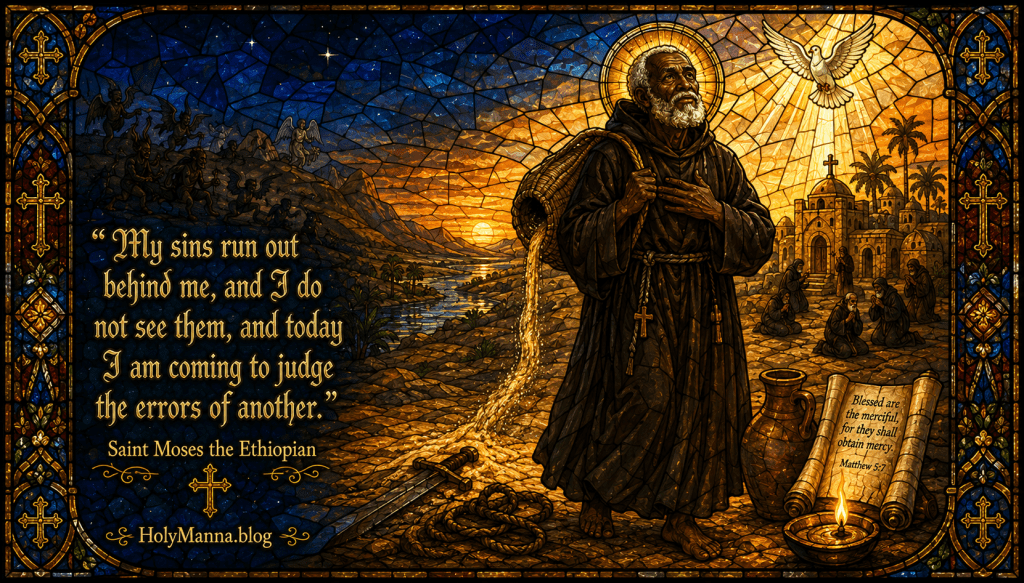
The most famous story is this. A brother at Scetis had committed a fault, and the brothers assembled to judge him. They sent for Abba Moses, but he would not come. The priest sent again, saying that everyone was waiting for him. So Moses got up and came, carrying on his back a basket full of sand that had a hole in it, so that the sand ran out behind him as he walked. The brothers went out to meet him and asked what this meant. He said: “My sins run out behind me, and I do not see them, and today I am coming to judge the errors of another.” When they heard it, they said nothing to the brother, and forgave him.
The same conviction runs through his other sayings. “The monk must die to his neighbor and never judge him at all,” he taught. He said that if a person is careful to watch his own faults, he will not have time to see the faults of his neighbor. When a brother asked him for a word, he gave one of the most repeated lines in all of desert literature: “Go, sit in your cell, and your cell will teach you everything.” And to anyone who thought prayer could be separated from how one actually lived, he said: “If a man’s deeds are not in harmony with his prayer, he labors in vain.”
Moses could also bend a rule for love. Once some brothers came to visit him on a fast day, and he cooked for them and ate with them. Monks who saw the smoke from his cell reported him, and when he was confronted he explained that the brothers who kept the fast had kept a commandment of God, and he, by showing hospitality, had kept a commandment of God. The elders praised him. The Catechism names the same balance when it lists the works of mercy and insists that “the works of mercy are charitable actions by which we come to the aid of our neighbor in his spiritual and bodily necessities” (CCC 2447). Fasting served love; it was never permitted to replace it.
The Conferences of Saint John Cassian, who lived at Scetis in these very years, place their first two dialogues in the mouth of an Abba Moses. Most Catholic readers have identified him with Moses the Ethiopian, though the identification is probable rather than proven. If it is right, then it was Moses who gave the West one of its foundational monastic teachings: that the ultimate end of the Christian life is the kingdom of God, but the immediate goal, the thing one aims at every day, is purity of heart. The Catechism echoes this when it teaches that the pure in heart “are promised that they will see God face to face and be like him” and that purity of heart is the precondition of that vision (CCC 2519).
Humiliation Accepted, Honor Refused
Moses had no martyr’s trial before a Roman governor. His hardship was the daily one of a man carrying a terrible past into a community that had not forgotten it, and carrying the color of his skin into a world that noticed it constantly. The sources do not hide this, and neither did Moses.
Sozomen records that Theophilus, Archbishop of Alexandria, ordained him to the priesthood, which dates the ordination after 385. The Sayings preserve what happened. When Moses was vested in the white garment of the clergy, the archbishop said to him that now Abba Moses was entirely white. Moses answered: “Outwardly, Father; God knows whether inwardly too.” The humility in that reply was then put to a harder test. Wanting to see whether he would be moved by contempt, the archbishop instructed the clergy to drive him out of the sanctuary, and they did, telling him to go outside, black man. Moses went out, and the brothers who followed him heard him reproaching himself by name, telling himself that they had done rightly, that he was ash-skinned and black, and had no business among men. Seeing that his humility was real, the archbishop ordained him.
Modern readers rightly wince at such a test, and it would be dishonest to pretend the world of Scetis was free of prejudice. What is striking is that Moses met it not with the rage that had once defined him but with a silence so deep that it disarmed the whole room. The Catechism teaches that Christ’s disciple is called to “renounce violence and bloodshed” and to bear witness to the dignity of every human being, made in the image of God (CCC 2306, CCC 1700). Moses had once answered every slight with a sword. He now answered the deepest slight of all with a humility that became, in the memory of the Church, his glory.
The same refusal of honor shows in another story. Word spread that a governor wished to meet the famous Abba Moses. Moses slipped out of his cell to avoid him, and met the governor’s party on the road. They asked the old man where the cell of Abba Moses was. He replied, “What do you want with him? He is a fool and a heretic.” The governor went away disappointed, and learned only later whom he had spoken with. The Catechism teaches that “humility is the foundation of prayer” (CCC 2559). Moses built his whole life on that foundation.
The Raiders, the Crowns, and the Monastery of the Romans
Palladius says simply that Moses died at about seventy-five years of age, a priest at Scetis, leaving some seventy-five disciples. He records no violent death. The Eastern Churches, however, hand down a fuller tradition about his end, and it is worth telling as the tradition it is.
Around the year 405, Berber raiders known as the Mazices were descending on Scetis. Moses, the tradition says, told the brothers that the barbarians were coming and urged them to flee. They begged him to come with them. He refused, saying that he had long expected this day, and citing the Lord’s words in The Gospel of Matthew: “All who take the sword will perish by the sword” (Mt 26:52). He had lived by violence, and he was willing to receive in his own body what he had once dealt to others. Seven brothers remained with him. When the raiders came, Moses and six of them were killed; one brother hid behind some reeds, and he afterward reported that he had seen seven crowns descend from heaven upon the seven. The Coptic and Byzantine Churches honor Moses as a martyr on the strength of this account. This tradition is ancient and widely cherished, but it is not found in Palladius or Sozomen, and it cannot be verified; the Roman Martyrology commemorates Moses as an anchorite rather than as a martyr.
What is beyond dispute is the veneration that followed. His body was laid to rest at Scetis, and his relics are venerated today at the Paromeos Monastery, the Monastery of the Romans, in the Wadi El Natrun of Egypt, where they rest beside those of his spiritual father, Saint Isidore. Pilgrims, Coptic and otherwise, still go to pray there. The Catholic sources do not record specific posthumous miracles attributed to Moses, and this post will not invent any. The Byzantine hymns for his feast call him a wonderworker and praise him as one through whom God works healings for those who approach in faith; that is the prayer of the Church rather than a catalog of cases, and it is presented here as such.
His memory has had a long reach. In the Byzantine calendar and in the Roman Martyrology his day is August 28. In the Coptic calendar his feast falls on 24 Paoni, which is July 1 on the common calendar. In recent generations Moses has become especially dear to Catholics of African descent across the world, who see in him a reminder that Africa’s place in the story of Christian holiness is not a footnote but a foundation, and that one of the most revered fathers of the desert was a Black man who had once been a slave. The Catechism reminds believers that the saints’ intercession is one of their most exalted services to God’s plan, and that the faithful “can and should ask them to intercede for us and for the whole world” (CCC 2683). Many who struggle with anger, with a violent past, or with the conviction that they have gone too far to be forgiven have found in Moses an intercessor who understands.
What Moses Teaches a Restless Heart
It is easy to admire a saint from a safe distance. Moses does not really allow that. His life presses three questions on anyone willing to sit with it.
The first is about the past. Moses did not pretend his old life had never happened, and the Church did not either; the Martyrology names him a notorious thief in the same breath that it calls him a renowned anchorite. He carried his history into the desert and let God carry it with him. Saint Paul wrote that “Christ Jesus came into the world to save sinners” and called himself the foremost of them (1 Tim 1:15), and Moses would have agreed about himself. The Catechism teaches that the sacrament of Penance “is a liturgical action” through which the sinner is “reconciled with the Church” and “receives again the grace of justification” (CCC 1480, CCC 1446). What part of your own story have you decided is beyond the reach of that mercy? Moses would say the decision was not yours to make.
The second is about the long war. Moses was not healed in a day, and neither is anyone. Years of fasting, vigils, and hidden service went by before the temptations ceased, and the Church has never taught that conversion spares a person the struggle. The Catechism says that the Christian’s journey of conversion “is the work of the grace of God” but also requires “human effort” and is accomplished “in daily life” (CCC 1432, CCC 1435). Where in your life have you quietly given up because the change did not come quickly enough? Moses kept carrying water for the old men. Keep carrying the water.
The third is about judgment. The leaking basket of sand is not just a memorable image; it is a whole way of seeing. Moses refused to sit in judgment because he never lost sight of what was trailing behind him. The Catechism warns against rash judgment and teaches that every person “should be careful to interpret insofar as possible his neighbor’s thoughts, words, and deeds in a favorable way” (CCC 2478). Whose faults have you been counting lately, and what would it look like to set the basket down? A practical way to begin is simple. Before speaking about someone’s failing, take one honest minute to name one of your own to God. Then speak, or, more often, do not.
There are other, humbler lessons. Moses practiced hospitality over strict fasting when love required it, which suggests that a person who is growing in holiness should become warmer, not colder, toward others. He hid his good works, which suggests that the best things a Christian does this week may be the ones no one sees. And he accepted humiliation in silence, which suggests that the moment when one is insulted is not the moment to prove one’s worth. What would change if you answered the next slight with the silence of Moses rather than the sword of the old robber?
Engage With Us!
The story of Saint Moses the Ethiopian has a way of meeting people exactly where they are, whether they are just returning to the faith or have been walking with the Lord for years. Please share in the comments below what struck you about his life and how his example speaks to your own journey. Here are a few questions to start the reflection.
- Moses carried a violent past into the desert and let God transform it over many years. What part of your own past do you most need to entrust to God’s mercy, and what is one concrete step toward the sacrament of Reconciliation this week?
- Moses fought temptation for years with fasting, vigils, and hidden acts of service to the elderly monks. What hidden act of service could become your own “carrying water at night” this month?
- The leaking basket of sand reminded the brothers that no one judges from a clean slate. Whom have you been quietly judging, and how might you “set the basket down” and extend the mercy you yourself have received?
- Moses answered humiliation, even humiliation about his race, with silence and self-accusation rather than with rage. When you are insulted or overlooked, what is your first reaction, and what would a more Christlike reaction look like?
- When love called for it, Moses set aside strict fasting to feed his guests. Where in your spiritual life might a rule or routine be getting in the way of charity toward a real person in front of you?
Saint Moses the Ethiopian is proof that God does not recruit from the ranks of the already holy. He takes thieves and makes them fathers, takes violent men and makes them peacemakers, takes the ones the world has written off and sets them among the saints. Whatever is trailing behind you, the Lord already knows it, and he is not waiting for you to fix it before he loves you. Go to confession. Carry water for someone who cannot carry it for themselves. Refuse to sit in judgment. And do everything this week with the love and mercy that Jesus taught us, the same mercy that reached a robber in the Egyptian desert and will not fail to reach you.
Saint Moses the Ethiopian, pray for us!
Follow us on YouTube, TikTok, Instagram and Facebook for more insights and reflections on living a faith-filled life.


Leave a Reply