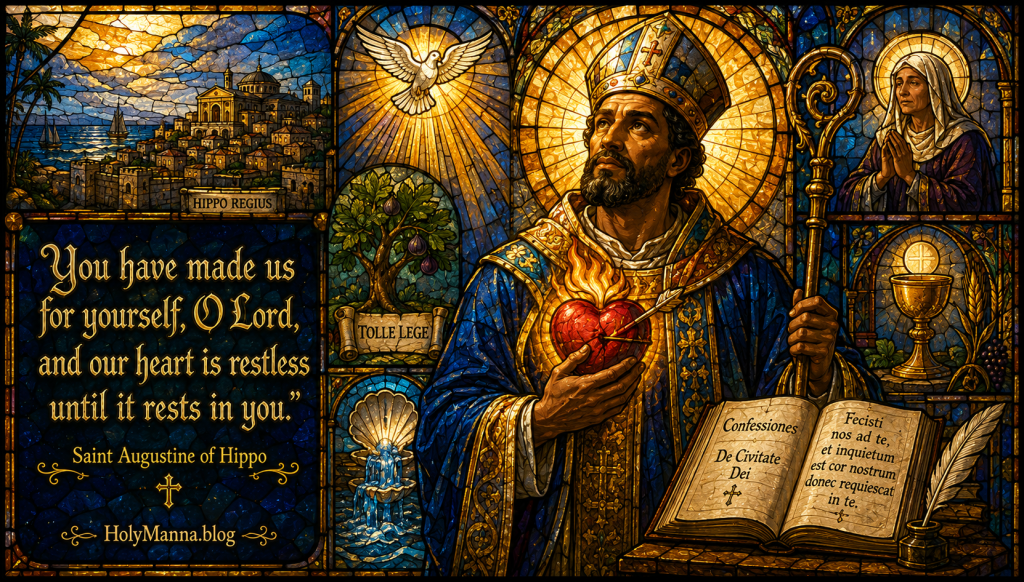
The Restless Heart of a Sinner That Found Its Rest in God
There is a reason Saint Augustine of Hippo still feels like a contemporary sixteen centuries after his death. He was brilliant, ambitious, and restless. He loved a woman he never married, fathered a son with her, and drifted through a sect that promised enlightenment without repentance. And then, in a garden in Milan in the late summer of 386, he heard a child’s voice say “Take up and read,” and everything changed.
Born in 354 in Roman North Africa and dying in 430 as the Vandals besieged his city, Augustine became the most influential theologian in the history of the Western Church. Pope Boniface VIII declared him a Doctor of the Church in 1298, one of the four original Latin Doctors with Ambrose, Jerome, and Gregory the Great, and the Church honors him with the title Doctor of Grace. His Confessions invented the spiritual autobiography. His City of God reshaped how Christians understand history and politics. The Catechism of the Catholic Church quotes him more than any other author except Scripture itself.
Catholic tradition venerates Augustine as the patron of theologians, of printers, of brewers (a nod to his wild youth), and of those who suffer from sore eyes. He is also the spiritual father of the Order of Saint Augustine, which has taken on new prominence since the election of Pope Leo XIV, the first Augustinian pope, in 2025. The Church celebrates his memorial every August 28, the anniversary of his death, a day after the memorial of the mother whose tears won him for Christ.
A Mother’s Tears and a Son’s Wandering
Aurelius Augustinus was born on November 13, 354, in Thagaste, a small town in the Roman province of Numidia, near today’s Souk Ahras in Algeria. His father, Patricius, was a town official of modest means and a pagan who was baptized only shortly before his death around 371. His mother, Monica, was a devout Christian whom the Church now honors as Saint Monica. He had a brother named Navigius and at least one sister whose name he never recorded. Following a common practice of the time, Augustine was enrolled as a catechumen as a child, but his baptism was postponed.
His parents sacrificed to educate him, first in Thagaste, then in nearby Madaura, and finally, with the help of a local patron named Romanianus, in the great city of Carthage from 371. He was a gifted student of rhetoric and a hungry young man. In Confessions, looking back with brutal honesty, he wrote of those Carthage years: “I came to Carthage, where a cauldron of unholy loves was seething and bubbling all around me.” He took a mistress, a woman he loved for some fifteen years and whose name he never gives, and around 372 she bore him a son, Adeodatus, whose name means “given by God.”
At nineteen Augustine read Cicero’s Hortensius, a book that set his heart on fire for wisdom. But when he turned to the Bible to look for that wisdom, its plain style repelled his polished taste. He drifted instead into Manichaeism, a sect that taught that good and evil were two rival eternal powers and that human beings were not really responsible for their sins. For roughly nine years he was a Manichaean “hearer.” Monica was heartbroken. She wept and prayed without ceasing, and when she begged a bishop to argue with her son, he told her to leave him alone and keep praying. Augustine preserved the bishop’s words: “Go your way, and God bless you, for it is not possible that the son of these tears should perish.”
He taught rhetoric in Thagaste and Carthage, and in 383 he sailed for Rome, deceiving his mother and leaving her weeping on the shore. In 384 he won the post of professor of rhetoric in Milan, the seat of the imperial court. It was there that God closed the trap of grace around him. In Milan he went to hear the bishop, Ambrose, purely to study his famous eloquence. But the content reached him along with the style. Ambrose showed him how the Old Testament could be read spiritually, and the objections Augustine had nursed for years began to dissolve. He also discovered the writings of the Platonists, which freed him from the Manichaean idea that God was some kind of material substance. The priest Simplicianus told him how the famous pagan rhetorician Victorinus had publicly professed Christ, and Augustine burned to do the same but could not let go of his attachments. Monica, now in Milan, arranged a respectable marriage, and the mother of his son was sent back to Africa. Augustine wrote that his heart, “which clung to her, was torn and wounded and bleeding.”
The decisive moment came in August 386. A visitor named Ponticianus told Augustine about Saint Antony of Egypt and the monks who had abandoned everything for God. Augustine was overwhelmed with shame at his own divided will. He rushed into a garden, threw himself under a fig tree, and wept. Then he heard a child’s voice from a nearby house chanting, “Take up and read, take up and read.” He took up the letters of Saint Paul and read the first passage his eyes fell on, Romans 13:13 to 14: “Not in reveling and drunkenness, not in debauchery and licentiousness, not in quarreling and jealousy. But put on the Lord Jesus Christ, and make no provision for the flesh, to gratify its desires.” He later wrote: “No further would I read, nor did I need to, for instantly, as the sentence ended, by a light of serenity infused into my heart, all the darkness of doubt vanished away.”
He resigned his chair, withdrew with friends and family to a country estate at Cassiciacum, and was baptized by Ambrose at the Easter Vigil of April 24 to 25, 387, together with Adeodatus and his friend Alypius. This is the heart of the Church’s teaching on conversion, which Augustine lived before he ever wrote it down. The Catechism teaches that “the human heart is heavy and hardened. God must give man a new heart. Conversion is first of all a work of the grace of God who makes our hearts return to him” (CCC 1432). Augustine would spend the rest of his life insisting on exactly that.
Bishop of a Small City, Teacher of the Whole Church
Before sailing home, Augustine and Monica stood at a window in Ostia and shared a moment of contemplation that he described as touching eternal Wisdom itself “for one instant, with the whole effort of our heart.” Days later Monica fell ill and died there at fifty-six. Her last request was simple: “Lay this body anywhere; let not the care for it trouble you at all. This only I ask, that you remember me at the altar of the Lord, wherever you be.” Her son never forgot it, and he pleaded with his readers to pray for her at the altar. Within a few years Adeodatus, whom Augustine called “my son in the flesh and my companion in grace,” was dead as well, at about sixteen.
Augustine returned to Thagaste in 388 and founded a small community of laymen devoted to prayer and study. He avoided towns with vacant sees, wanting no ordination. But in 391 he visited the port city of Hippo Regius, where the congregation seized him during Mass and demanded that the aged Bishop Valerius ordain him. He wept as it happened, because he knew what the burden meant. Around 395 he was consecrated as Valerius’s coadjutor, and in 396 he became sole bishop of Hippo, a post he held for thirty-four years.
What he did from that small African port is almost impossible to exaggerate. He lived in community with his clergy under a simple rule of shared goods and prayer. He preached constantly, and more than five hundred of his sermons survive, along with hundreds of letters and nearly one hundred books. Between 397 and 400 he wrote Confessions, the first great spiritual autobiography, which opens with the line the Catechism places near the very start of its teaching on man’s desire for God: “You are great, O Lord, and greatly to be praised: great is your power and your wisdom is without measure. And man, so small a part of your creation, wants to praise you… You have made us for yourself, and our heart is restless until it rests in you” (CCC 30). In the same book he wrote the confession that gives this post its title: “Late have I loved you, beauty so ancient and so new, late have I loved you! You were within me, and I was outside, and there I sought you.”
After Alaric’s Goths sacked Rome in 410 and pagans blamed Christianity for the catastrophe, Augustine spent thirteen years writing The City of God, which teaches that two loves have built two cities, the earthly city founded on love of self even to contempt of God, and the heavenly city founded on love of God even to contempt of self. He wrote On the Trinity, On Christian Doctrine, the Enchiridion, and near the end of his life the Retractationes, in which he reviewed his entire output and corrected himself. He participated in the Council of Hippo in 393 and in the councils of Carthage that confirmed the canon of Scripture the Church still uses.
His theology of grace shaped the whole Western tradition. He taught that God’s grace precedes, accompanies, and completes every good act, and the Catechism still uses his words to say it: “Indeed we also work, but we are only collaborating with God who works, for his mercy has gone before us” (CCC 2001). He taught the unbreakable link between freedom and grace in a line the Catechism quotes when it speaks of conversion: “God created us without us: but he did not will to save us without us” (CCC 1847). He taught the Church’s Eucharistic unity in words that still ring in CCC 1396: “Be what you see; receive what you are.” And he taught what prayer is in the single sentence the Catechism uses to open its treatment of prayer: “Man is a beggar before God” (CCC 2560).
Augustine matters because he shows that holiness and intelligence belong together, and that both are gifts. He is worth emulating because he never stopped being honest about his own need. As bishop he wrote: “What I am for you terrifies me; what I am with you consoles me. For you I am a bishop; but with you I am a Christian.” Pope Leo XIV quoted those words from the balcony of Saint Peter’s on the evening of his election, introducing himself as a son of Saint Augustine.
The historical record of miracles during Augustine’s life is modest, which fits a man who distrusted spectacle. His friend and biographer Possidius, who lived beside him for decades, records in his Life of Augustine that during the bishop’s final illness a sick man came with a relative and asked Augustine to lay hands on him. Augustine answered that if he had any such power he would use it on himself. The man replied that he had been told in a dream to go to Bishop Augustine and be healed. Augustine laid hands on him, and the man went away well. Possidius also records that Augustine, praying with tears, freed a possessed person from a demon. Augustine himself, in The City of God, recorded healings he witnessed in Hippo at the shrine of the relics of Saint Stephen, including the healing at Easter 425 of a brother and sister, Paulus and Palladia, who had been afflicted with uncontrollable trembling, and whom the whole congregation saw made whole.
Heresies, Schisms, and a City Under Siege
Augustine’s hardships were not the hardships of the arena. He was a confessor, not a martyr, and he endured a slower kind of suffering: the relentless work of a shepherd in a Church under attack from within and an empire collapsing from without.
His first battle was against the Manichaeans he had left behind. In public debates and in a series of books he dismantled their claim that evil was an independent substance, insisting that evil is the privation of a good that ought to be present and that a good God created a good world. The Church still teaches this, and the Catechism cites Augustine when it says that God “would not allow any evil to exist in his works if he were not so all powerful and good as to cause good to emerge from evil itself” (CCC 311).
His second and longest battle was the Donatist schism, which had divided the African Church for nearly a century. The Donatists claimed to be the only pure Church and rebaptized Catholics who came over to them. Augustine answered that the holiness of the sacraments does not depend on the holiness of the minister, because it is Christ who baptizes. The Catechism still teaches from him: “Christ himself is at work: it is he who baptizes, he who acts in his sacraments in order to communicate the grace that each sacrament signifies” (CCC 1127). The schism turned violent. Armed Donatist bands called Circumcellions attacked Catholic clergy, and Possidius records that Augustine himself once escaped an ambush only because his guide took a wrong road. At the Conference of Carthage in 411 Augustine’s arguments prevailed, but the wounds in the African Church never fully healed before the Vandals came.
His third battle was against Pelagius, who taught that human beings could achieve holiness by their own effort, with grace serving mainly as instruction and example. Augustine saw that this emptied the Cross of its meaning. He answered with the prayer that scandalized Pelagius: “Give what you command, and command what you will.” Grace was not decoration on top of human effort. Grace was the whole reason anyone could love God at all. This is why the Church calls him the Doctor of Grace, and why the Catechism teaches that “the preparation of man for the reception of grace is already a work of grace” (CCC 2001).
Through all of this he carried the daily weight of a bishop: judging lawsuits, feeding the poor, ransoming captives, and answering letters from across the Mediterranean. He grieved his mother, his son, and his closest friends. He lost his health. And in the spring of 430 the Vandals under Genseric crossed from Spain, burned their way across North Africa, and laid siege to Hippo. Augustine, now seventy-five, fell ill with fever in the third month of the siege.
Possidius tells the story of his death. Augustine had the penitential psalms of David written out on sheets and fastened to the wall beside his bed, and he read them continually, weeping. He asked that no one come in except the doctors and those bringing food, so that he could give himself wholly to prayer. On August 28, 430, in full possession of his faculties and surrounded by his brothers, he died. He left no will, Possidius says, because as a poor man of God he had nothing to leave, but he gave instructions that the church’s library be preserved. The following year the Vandals burned Hippo. His library survived.
A Voice That Never Stopped
Augustine’s own biographer records no miracles after his death, and the saint himself would probably have been pleased by that. His influence after death has been of another kind, the kind that shapes the mind and heart of the whole Church. Yet the story of his relics is remarkable in its own right.
When Vandal persecution drove Catholic bishops out of Africa around the year 500, they carried Augustine’s body across the sea to Sardinia, where it was venerated at Cagliari. Tradition connects this translation with Saint Fulgentius of Ruspe, though the details cannot be verified. Two centuries later, around 720 to 725, Sardinia fell under Saracen raids, and the Lombard king Liutprand paid a great sum to ransom the relics and bring them to his capital of Pavia. The Venerable Bede, writing in England at the time, recorded the translation. The body was enshrined in the church of San Pietro in Ciel d’Oro, where in 1362 a magnificent marble Ark of Saint Augustine was carved to house it, covered with scenes from his life. In 1695 workmen discovered a sealed box beneath the altar containing bones and an inscription identifying Augustine, and after investigation the relics were authenticated. They remain in Pavia today.
In 1842 a portion of the relics, the right ulna, was returned to Africa, to the soil of Hippo itself. The Basilica of Saint Augustine at Annaba, overlooking the ruins of his city, was completed in 1900 and still houses the relic. Pope John Paul II marked the sixteen hundredth anniversary of Augustine’s conversion in 1986 with the apostolic letter Augustinum Hipponensem. Pope Benedict XVI, who wrote his doctoral thesis on Augustine, prayed at the Pavia tomb in 2007 and devoted five general audiences to the saint in 2008. And on April 14, 2026, Pope Leo XIV, the first Augustinian pope in history, walked the ruins of Hippo and celebrated Mass in the Basilica of Saint Augustine at Annaba, then prayed at the Pavia tomb on June 20 of the same year.
The devotional stories that grew up around Augustine deserve honest handling. The most famous is the story of the seashore. Augustine, the story goes, was walking along the beach wrestling with the mystery of the Trinity when he came upon a child carrying water from the sea in a shell to pour into a small hole in the sand. When Augustine told the child the task was impossible, the child replied that it was no more impossible than for Augustine to fit the mystery of the Trinity into his mind, and then vanished. It captures something true about Augustine’s humility before the mystery of God, but it appears only in the thirteenth century, eight hundred years after his death, and it cannot be verified. Likewise, a tradition that his unnamed sister, sometimes called Perpetua, founded a convent that he guided cannot be verified from his own writings.
His cultural impact is simply enormous. The Rule he wrote for his community is one of the oldest monastic rules in the West and is followed today by the Augustinian friars and nuns, by canons regular, and by dozens of other congregations. The Order of Saint Augustine, united by the popes between 1244 and 1256, has sent missionaries across the world, and one of its sons now sits on the Chair of Peter, with an episcopal motto drawn from Augustine’s commentary on the psalms: In Illo uno unum, “in the One, we are one.” Cities, universities, and parishes beyond counting bear his name. And every August 28 the whole Church reads his words and remembers that the restless heart of the young man from Thagaste found its rest at last.
What the Restless Heart Teaches Us
Augustine’s life is the Gospel’s answer to the question so many people are afraid to ask: Is it too late for me? He was thirty-two when he was baptized. He had wasted years, broken hearts, and built a career on vanity. And the God who had waited for him did not hold it against him. The Catechism teaches that “there is no one, however wicked and guilty, who may not confidently hope for forgiveness, provided his repentance is honest” (CCC 982). Augustine is the proof.
His story also teaches that the mind is not the enemy of faith. He came to Christ partly through the hard work of thinking, through reading Ambrose and the Platonists and Paul, through refusing to accept easy answers. The Church still says in his voice that “faith seeks understanding,” and that reason rightly used leads toward God and not away from him (CCC 158). If you are the kind of person who has questions, Augustine is your saint; he never stopped asking them, even about his own earlier conclusions.
And his story teaches the power of the people who love us enough to pray for us. Monica did not argue her son into the Church. She wept him into it. She followed him across the sea and sat in the back of Ambrose’s church until the day she watched him baptized. Who is weeping for you? And for whom are you weeping? The Catechism reminds us that “intercession is a prayer of petition which leads us to pray as Jesus did” and that “in intercession, he who prays looks not only to his own interests, but also to the interests of others” (CCC 2634 to 2635).
Practically, you might take up Augustine’s own habit of honest self-examination, not to wallow in guilt but to let God’s light into the rooms you keep locked. You might read a page of Confessions each night. You might go to Confession this week, remembering a bishop who posted the penitential psalms on his wall and read them weeping until the end. You might pray, in his words, “Give what you command, and command what you will,” when some commandment feels impossible. And you might look at the person in your life who seems furthest from God and decide to be their Monica.
Where in your life have you been seeking outside what can only be found within? What is the one attachment you keep telling God “not yet” about? Who has been the Monica in your story, and have you ever thanked them?
Engage With Us!
Saint Augustine wrote his Confessions so that others could see what God had done for him and take heart. Share your own thoughts and reflections in the comments below, and let this community encourage one another the way Augustine’s friends encouraged him on the road to baptism.
- Augustine said, “Our heart is restless until it rests in you.” Where do you notice restlessness in your own life right now, and what might it be pointing toward?
- Augustine’s conversion was years in the making and came through books, friends, a preacher, and his mother’s prayers. Who or what has God used to draw you closer to Him?
- Augustine resisted grace for a long time, praying for chastity “but not yet.” Is there a “not yet” you are holding onto that God may be inviting you to surrender today?
- As bishop, Augustine said, “With you I am a Christian, for you I am a bishop.” How does it change your view of priests and bishops to remember that they are fellow sinners in need of grace?
- Augustine died reading the penitential psalms. What would it look like to build honest repentance into your daily life rather than saving it for a crisis?
Whatever your past holds, the God who waited for Augustine is waiting for you, and He has not grown tired. Take up the Scriptures and read. Go to the altar. Pray for the person who seems furthest from Him. And do everything today with the love and mercy that Jesus taught us, so that late or early, your heart too may find its rest in Him.
Saint Augustine of Hippo, pray for us!
Follow us on YouTube, TikTok, Instagram and Facebook for more insights and reflections on living a faith-filled life.


Leave a Reply