Memorial of Saint Augustine, Bishop and Doctor of the Church – Lectionary: 429
A Restless Heart and a Ready Lamp
Some of the smartest people who ever lived spent years running from the one thing that could satisfy them. Augustine of Hippo was one of them. He taught rhetoric for a living, chased every fashionable philosophy of the fourth century, and once picked up the Bible only to put it down because its plain style seemed embarrassing next to Cicero. Then the God he had been avoiding met him in a garden in Milan, and the cleverest man in the empire became the Doctor of Grace. The Church remembers him today, August 28, on the Memorial of Saint Augustine, Bishop and Doctor of the Church, and the readings the liturgy hands us could hardly fit him better.
Saint Paul tells the Corinthians that the message of the cross looks like foolishness to the world and is in fact the very wisdom of God. Psalm 33 sings that the plans of nations come to nothing while the plan of the Lord stands forever. Then Jesus tells the story of ten young women waiting for a wedding, five of them wise enough to bring extra oil, five of them not. One thread runs through all three: real wisdom is not cleverness. It is trusting the cross, resting in God’s plan, and keeping a reserve of love ready for the moment He arrives.
Augustine lived every piece of that. His famous prayer at the opening of The Confessions still names the ache behind every human search: You have made us for yourself, O Lord, and our heart is restless until it rests in you. Today’s readings are an invitation to stop running, to stop mistaking brilliance for wisdom, and to fill the lamp while there is still time.
First Reading — 1 Corinthians 1:17-25
When the Smartest Thing in the Room Is a Cross
Corinth in the year 56 was a boomtown, a port city rebuilt by Rome, full of new money and people anxious to look sophisticated. Travelling orators were the celebrities of the day, and the little church Paul had founded there was catching the fever, lining up behind favorite teachers and treating the Gospel like one more school of persuasive speaking. Paul, writing from Ephesus, will have none of it. His answer to Corinthian pride is not a better argument. It is the cross, which by every worldly standard is the worst possible marketing strategy. This passage is where The First Letter to the Corinthians lays down its deepest principle, and it reads like a portrait of the man the Church honors today. Augustine was exactly the kind of debater Paul describes, and he discovered that the “foolishness” of a crucified God was the only wisdom strong enough to save him.
1 Corinthians 1:17-25
Brothers and sisters:
Christ did not send me to baptize but to preach the Gospel,
and not with the wisdom of human eloquence,
so that the cross of Christ might not be emptied of its meaning.The message of the cross is foolishness to those who are perishing,
but to us who are being saved it is the power of God.
For it is written:
I will destroy the wisdom of the wise,
and the learning of the learned I will set aside.
Where is the wise one?
Where is the scribe?
Where is the debater of this age?
Has not God made the wisdom of the world foolish?
For since in the wisdom of God
the world did not come to know God through wisdom,
it was the will of God through the foolishness of the proclamation
to save those who have faith.
For Jews demand signs and Greeks look for wisdom,
but we proclaim Christ crucified,
a stumbling block to Jews and foolishness to Gentiles,
but to those who are called, Jews and Greeks alike,
Christ the power of God and the wisdom of God.
For the foolishness of God is wiser than human wisdom,
and the weakness of God is stronger than human strength.
Detailed Exegesis
Verse 17: Christ did not send me to baptize but to preach the Gospel, and not with the wisdom of human eloquence, so that the cross of Christ might not be emptied of its meaning.
Paul is not dismissing baptism, which he elsewhere calls being buried with Christ (Romans 6:4). He is refusing to let his ministry become a personal brand. The “wisdom of human eloquence” is the polished rhetoric Corinth adored, and Paul’s fear is precise: if the cross is dressed up in clever speech, people will admire the speaker and miss the Savior.
Verse 18: The message of the cross is foolishness to those who are perishing, but to us who are being saved it is the power of God.
Here is the dividing line of the whole letter. The same proclamation sounds like nonsense to one listener and like life to another, and the difference is not intelligence but the direction a person is heading. The present tense matters: salvation is a road being walked, not a finished transaction.
Verse 19: For it is written: I will destroy the wisdom of the wise, and the learning of the learned I will set aside.
Paul quotes Isaiah 29:14, where God warns the royal advisors of Judah that their clever alliances with Egypt will fail because they trusted strategy instead of the Lord. The pattern is ancient: human cleverness that leaves God out eventually collapses on itself.
Verse 20: Where is the wise one? Where is the scribe? Where is the debater of this age? Has not God made the wisdom of the world foolish?
Three types are named, likely the Greek philosopher, the Jewish scholar, and the professional arguer. Paul is not anti-intellectual. He is asking where any of them were when God actually acted to save the world.
Verse 21: For since in the wisdom of God the world did not come to know God through wisdom, it was the will of God through the foolishness of the proclamation to save those who have faith.
God, in His wisdom, arranged things so that human wisdom alone could not reach Him. Philosophy can glimpse that God exists, as the Church affirms (CCC 31-35), but it cannot save. Salvation comes by faith in what is preached, and what is preached looks foolish.
Verse 22: For Jews demand signs and Greeks look for wisdom,
Two kinds of pride are diagnosed. One wants proof on demand, as the Pharisees did when they asked Jesus for a sign (Matthew 12:38). The other wants an elegant system. Both want God on human terms.
Verse 23: but we proclaim Christ crucified, a stumbling block to Jews and foolishness to Gentiles,
A crucified man was, under the Law, accursed (Deuteronomy 21:23), so a crucified Messiah was literally a stumbling block. To educated Greeks, a god who could be executed by provincial soldiers was absurd. Paul does not soften either offense.
Verse 24: but to those who are called, Jews and Greeks alike, Christ the power of God and the wisdom of God.
The same cross that offends becomes, for those who respond to God’s call, the very definition of power and wisdom. Christ is not merely wise; He is Wisdom in person.
Verse 25: For the foolishness of God is wiser than human wisdom, and the weakness of God is stronger than human strength.
God’s “worst” outthinks humanity’s best. Paul is being deliberately shocking so that no one can boast.
Teachings
The Catechism takes up verses 24 and 25 directly: Faith in God the Father Almighty can be put to the test by the experience of evil and suffering. God can sometimes seem to be absent and incapable of stopping evil. But in the most mysterious way God the Father has revealed his almighty power in the voluntary humiliation and Resurrection of his Son, by which he conquered evil. Christ crucified is thus “the power of God and the wisdom of God. For the foolishness of God is wiser than men, and the weakness of God is stronger than men.” (CCC 272). Divine power does not look like domination; it looks like a cross that conquers death.
Saint John Chrysostom, in his Homilies on First Corinthians, argued that the cross persuaded the world precisely because it came without the weapons of eloquence, so its triumph can only be explained by the power of God. Saint Thomas Aquinas adds in his Commentary on First Corinthians that God chose this way so that no one could credit himself for his own salvation.
Saint Augustine is the living commentary. In The Confessions he admits that, as a young professor of rhetoric, he found Scripture beneath the dignity of Cicero and turned away from it. Years later, in a garden in Milan, he heard a child’s voice chanting “take up and read,” opened The Letter to the Romans, and read: not in orgies and drunkenness, not in promiscuity and licentiousness, not in rivalry and jealousy. But put on the Lord Jesus Christ, and make no provision for the desires of the flesh (Romans 13:13-14). The debater of the age surrendered to the foolishness of the proclamation, and the Church gained a Doctor.
Reflection
The temptation Paul names is not reserved for ancient Corinth. It is the temptation to want a faith that sounds impressive, wins arguments, and never embarrasses you in front of clever friends. The cross will always embarrass a certain kind of pride, and that is by design.
A concrete step for this week: pick one place where you have been dressing up your faith to make it acceptable, perhaps softening a teaching you find awkward, and simply let the cross be what it is. Another step: spend five minutes before a crucifix without words, letting the image of a dying God say what no argument can.
Where in your life do you demand signs before you will trust God? Where do you demand that everything make sense first? Is there a part of the Gospel you have quietly set aside because it seems foolish to the people you want to impress? What would change if you believed, as Augustine finally did, that the foolishness of God is wiser than your best thinking?
Responsorial Psalm — Psalm 33:1-2, 4-5, 10-11
The Song of a World That Still Belongs to God
Psalm 33 is a Temple hymn, twenty-two verses long, one for each letter of the Hebrew alphabet, as if to say that praise of the Lord runs from A to Z. It carries no heading naming an author or occasion, which makes it feel timeless. The liturgy selects three movements today: the invitation to praise with instruments, the reason for praise in God’s trustworthy word and world-filling goodness, and the contrast that links this Psalm to Saint Paul, since the plans of nations fall apart while the plan of the Lord endures. On the memorial of a man whose Expositions on the Psalms fill volumes, it is fitting to hear Augustine’s beloved prayer book answer Corinthian cleverness with simple, confident joy.
Psalm 33:1-2, 4-5, 10-11
R. (5) The earth is full of the goodness of the Lord.
Exult, you just, in the LORD;
praise from the upright is fitting.
Give thanks to the LORD on the harp;
with the ten-stringed lyre chant his praises.
R. The earth is full of the goodness of the Lord.
For upright is the word of the LORD,
and all his works are trustworthy.
He loves justice and right;
of the kindness of the Lord the earth is full.
R. The earth is full of the goodness of the Lord.
The LORD brings to nought the plans of nations;
he foils the designs of peoples.
But the plan of the LORD stands forever;
the design of his heart, through all generations.
R. The earth is full of the goodness of the Lord.
Detailed Exegesis
Verse 1: Exult, you just, in the LORD; praise from the upright is fitting.
Praise is presented as the natural posture of the righteous, not a duty squeezed in when there is time. For those whose lives are aligned with God, praise is “fitting,” the way a lamp fits a lampstand.
Verse 2: Give thanks to the LORD on the harp; with the ten-stringed lyre chant his praises.
The Psalm calls for music, and not quietly. Augustine, commenting on this Psalm, taught that the new song belongs to the new person, and that real praise eventually overflows words into pure jubilation.
Verse 4: For upright is the word of the LORD, and all his works are trustworthy.
Here is the reason for the song. God’s word is straight, reliable, without deceit, and everything He does can be leaned on. This is the answer to the Corinthian anxiety about which teacher to follow: follow the Word whose every work is trustworthy.
Verse 5: He loves justice and right; of the kindness of the Lord the earth is full.
The Hebrew word behind “kindness” is hesed, God’s covenant love, steadfast and faithful. The Psalmist looks at the created world and sees it soaked in that love. Creation itself preaches.
Verse 10: The LORD brings to nought the plans of nations; he foils the designs of peoples.
Empires plan, and their plans dissolve. The Psalmist is not gloating; he is stating a fact of history. Augustine watched Rome fall and wrote The City of God on exactly this theme.
Verse 11: But the plan of the LORD stands forever; the design of his heart, through all generations.
God has a “design of his heart,” a plan rooted in love, and it does not expire. This is the confidence that lets the just exult even in unstable times.
Teachings
The Catechism echoes verse 5 when it teaches that because creation comes forth from God’s goodness, it shares in that goodness (CCC 299), and it echoes verses 10 and 11 in its teaching on providence: The witness of Scripture is unanimous that the solicitude of divine providence is concrete and immediate; God cares for all, from the least things to the great events of the world and its history. The sacred books powerfully affirm God’s absolute sovereignty over the course of events (CCC 303). God’s plan is not a cold blueprint; it is the design of His heart.
Augustine’s own story proves verse 11. His mother Monica prayed for decades with no visible result, and the plan of the Lord stood through all of it until the son she wept over became a bishop.
Reflection
It is easy to believe the earth is full of bad news. The Psalm insists the earth is full of the kindness of the Lord, and both things can be true at once, because God’s plan outlasts every headline. A practical step: start one day this week by naming three concrete places where God’s goodness is visible before you look at a screen. Another: when a plan of yours collapses, pray verse 11 out loud and ask whether God’s design might be larger than the one you lost.
When was the last time you praised God with your whole body, singing, not just thinking? Which “plan of the nations,” or plan of your own, have you been trusting more than the design of His heart? Can you recall a time when a prayer that seemed unanswered was in fact part of a longer plan?
Holy Gospel — Matthew 25:1-13
The Oil Nobody Can Lend You
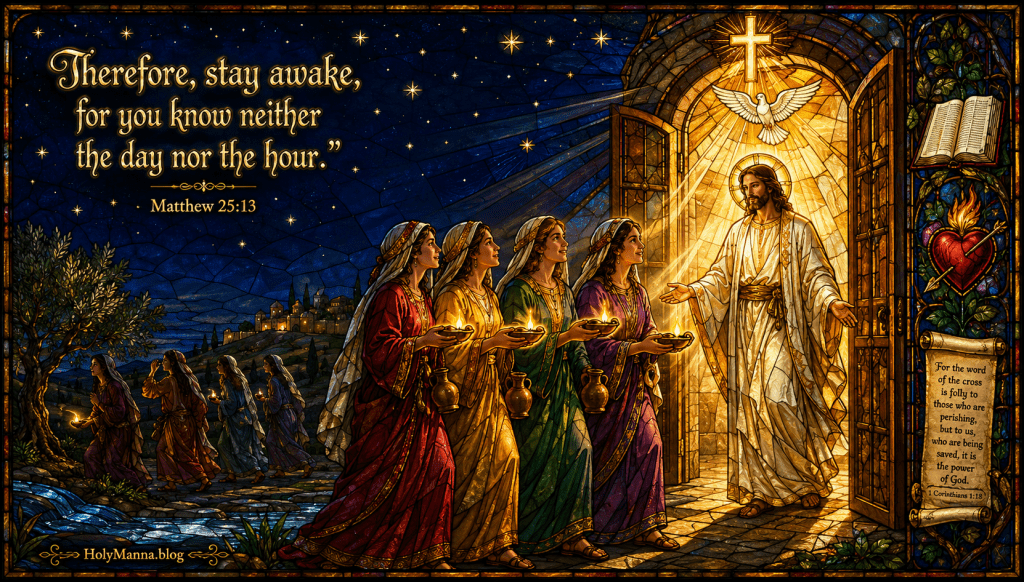
Jesus tells this parable on the Mount of Olives in the last week of His earthly life, part of the discourse on the end of the age in Matthew 24-25. The setting is a first-century Galilean wedding. The bridegroom would process, often after dark, to fetch the bride and lead the party to his father’s house for a feast that could last days, while attendants waited with lamps to light the way. Jesus uses this familiar scene to answer what it means to be ready for Him, and His answer is not a date but a posture. The wise bring more oil than they think they will need. Augustine preached on this exact text in his Sermon 93, and his reading, that the oil is charity and that the sleep is death, has shaped how the Church has heard this story ever since.
Matthew 25:1-13
Jesus told his disciples this parable:
“The Kingdom of heaven will be like ten virgins
who took their lamps and went out to meet the bridegroom.
Five of them were foolish and five were wise.
The foolish ones, when taking their lamps,
brought no oil with them,
but the wise brought flasks of oil with their lamps.
Since the bridegroom was long delayed,
they all became drowsy and fell asleep.
At midnight, there was a cry,
‘Behold, the bridegroom! Come out to meet him!’
Then all those virgins got up and trimmed their lamps.
The foolish ones said to the wise,
‘Give us some of your oil,
for our lamps are going out.’
But the wise ones replied,
‘No, for there may not be enough for us and you.
Go instead to the merchants and buy some for yourselves.’
While they went off to buy it,
the bridegroom came
and those who were ready went into the wedding feast with him.
Then the door was locked.
Afterwards the other virgins came and said,
‘Lord, Lord, open the door for us!’
But he said in reply,
‘Amen, I say to you, I do not know you.’
Therefore, stay awake,
for you know neither the day nor the hour.”
Detailed Exegesis
Verse 1: The Kingdom of heaven will be like ten virgins who took their lamps and went out to meet the bridegroom.
All ten are invited, all ten have lamps, all ten go out. Nothing distinguishes them at the start. The Church has long read the bridegroom as Christ and the wedding as His union with His Bride, the Church (CCC 796).
Verse 2: Five of them were foolish and five were wise.
The split is even, which is sobering. The difference is not that half are wicked; it is that half are careless. Augustine and Gregory the Great both saw in the number five the five senses, suggesting that every person, body and soul, faces this choice.
Verse 3: The foolish ones, when taking their lamps, brought no oil with them,
They came with the appearance of readiness and no reserve behind it. Saint John Chrysostom, in his Homily 78 on Matthew, observed that these young women possessed chastity, symbolized by their virginity, yet lacked the mercy and almsgiving that give a lamp something to burn.
Verse 4: but the wise brought flasks of oil with their lamps.
The wise planned for delay. They assumed the wait might be long and prepared accordingly. Augustine reads the oil as charity, the inward love that makes outward works burn with real light rather than mere show.
Verse 5: Since the bridegroom was long delayed, they all became drowsy and fell asleep.
All ten sleep, wise and foolish alike. Sleep is not the sin. Augustine reads the sleep as death, which comes to everyone. The question is what is in the flask when the sleeper is awakened.
Verse 6: At midnight, there was a cry, ‘Behold, the bridegroom! Come out to meet him!’
Midnight is the darkest, least expected hour. The cry echoes the trumpet of the Lord’s return. Augustine reads it as the resurrection that summons every soul to meet the Judge.
Verse 7: Then all those virgins got up and trimmed their lamps.
At the moment of truth, everyone wants to be ready. Desire to be ready is universal; actual readiness is not.
Verse 8: The foolish ones said to the wise, ‘Give us some of your oil, for our lamps are going out.’
Here the parable turns painful. The foolish realize too late that they are empty and ask to borrow what cannot be borrowed.
Verse 9: But the wise ones replied, ‘No, for there may not be enough for us and you. Go instead to the merchants and buy some for yourselves.’
This is not selfishness. The wise cannot give away their interior life. No one can love God on another person’s behalf, and no one can repent for someone else. Augustine saw in the “merchants” those who sell flattery and praise, the applause the foolish had lived on instead of love.
Verse 10: While they went off to buy it, the bridegroom came and those who were ready went into the wedding feast with him. Then the door was locked.
The feast begins and the door closes. The Catechism states it plainly: Death puts an end to human life as the time open to either accepting or rejecting the divine grace manifested in Christ (CCC 1021).
Verse 11: Afterwards the other virgins came and said, ‘Lord, Lord, open the door for us!’
They use the right title and the right request, and it is too late. Religious vocabulary is not the same as a full lamp.
Verse 12: But he said in reply, ‘Amen, I say to you, I do not know you.’
The echo of Matthew 7:23 is deliberate. To be known by the Lord is to be in living relationship with Him, built in the daylight hours, not at midnight.
Verse 13: Therefore, stay awake, for you know neither the day nor the hour.
Since everyone sleeps in the story, “stay awake” cannot mean never dying. It means living now in such a way that death finds the flask full.
Teachings
The Church hears this parable as a call to conversion rather than a threat. The Catechism teaches: The affirmations of Sacred Scripture and the teachings of the Church on the subject of hell are a call to the responsibility incumbent upon man to make use of his freedom in view of his eternal destiny. They are at the same time an urgent call to conversion (CCC 1036). It also ties watchfulness directly to prayer: In prayer the disciple keeps watch, attentive to Him Who Is and Him Who Comes, in memory of his first coming in the lowliness of the flesh, and in the hope of his second coming in glory (CCC 2612).
Augustine’s Sermon 93 gathers the whole thing up. The lamp is the good work, the oil is the charity that gives it light, and the foolish are those who do good to be seen. When the applause of the merchants runs out, the lamp dies. Augustine, who once lived for the praise of lecture halls, knew exactly what empty oil felt like, and he knew the moment the Bridegroom found him: Late have I loved you, O Beauty ever ancient, ever new, late have I loved you! (The Confessions, Book 10). Late, but not too late. The door was still open.
Reflection
The most unsettling line in this parable is that the wise could not share their oil. You cannot inherit a relationship with Christ from devout parents or borrow it from a holy friend. It has to be yours, built in ordinary days of prayer, confession, Mass, and quiet acts of love.
A concrete step: schedule confession this week if it has been more than a month. Another: choose one hidden act of charity each day, something no one will see, and let that be oil poured into the flask. A third: pray verse 13 at night before sleep, not in fear but as a way of handing the day to the Bridegroom.
If the cry came at midnight tonight, what would be in your flask? Have you been living on the “merchants,” on approval and appearance, instead of on love? Who in your life is still outside the door, and how can your own full lamp help light their way back before it closes?
Ever Ancient, Ever New
Picture the scene one more time. A brilliant young man in a Milanese garden, weeping because his cleverness has gotten him nowhere. A voice says “take up and read.” He opens the book he once found embarrassing and finds the Lord waiting there, the way the Bridegroom waits for anyone still willing to come out and meet Him.
Today’s readings are the story of Augustine, and they are the story of every restless heart. Saint Paul says the cross looks like foolishness and is the wisdom of God; Augustine learned that the hard way. Psalm 33 says the plans of the nations fail and the design of God’s heart endures; Augustine watched Rome crumble and wrote that the City of God was still standing. Jesus says the wise bring extra oil; Augustine spent the second half of his life filling the lamp he had once left empty, and he died with the Psalms on his wall.
The invitation is simple and it is urgent. Stop trying to be clever enough to earn heaven and let the cross be the only wisdom that matters. Stop trusting plans that cannot last and rest in the plan that stands forever. Stop waiting for a better time to fill the flask, because no one knows the day or the hour, and the oil of love can only be poured in now.
Augustine’s heart was restless until it rested in God, and so is every heart that has ever searched. The Bridegroom is coming, the door is still open, and the earth is full of the goodness of the Lord. Go out to meet Him with the lamp burning.
Engage With Us!
Please share your reflections in the comments below. Your honesty and your story may be the very thing another reader needs today. Here are some questions to get you started:
- In 1 Corinthians 1:17-25, Saint Paul says the message of the cross is foolishness to those who are perishing but the power of God to those being saved. Where has the cross seemed foolish to you, and where has it proven to be power?
- Psalm 33:1-2, 4-5, 10-11 declares that the plan of the Lord stands forever while the plans of nations come to nothing. What plan of your own do you need to release into the design of His heart?
- In Matthew 25:1-13, the wise virgins bring extra oil and the foolish cannot borrow it. What daily practice fills your flask, and what has been quietly draining it?
- Taking all the readings together on the Memorial of Saint Augustine: What would it look like this week to trade cleverness for wisdom, and to keep your lamp burning with love rather than applause?
Living a life of faith is not about being the smartest person in the room; it is about being the one who stayed awake and kept the oil ready. Do everything this week with the love and mercy Jesus taught us, and trust that the Bridegroom knows His own.
Sacred Heart of Jesus, we trust in You!
Immaculate Heart of Mary, pray for us!
Saint Michael the Archangel, defend us in battle!
Follow us on YouTube, TikTok, Instagram and Facebook for more insights and reflections on living a faith-filled life.


Leave a Reply