The Mother Who Would Not Stop Praying
Every parent who has ever lain awake worrying about a child has a friend in heaven named Monica. Born around 331 in Thagaste, in what is now Algeria, she never founded an order, wrote a book, or worked a public miracle. What she did was pray, weep, and refuse to give up on the people God had placed in her care. Because of that quiet stubbornness the Church counts her among its saints, and because one of those people was her son Augustine, the whole world knows her story.
Nearly everything reliably known about Saint Monica comes from that son. Saint Augustine of Hippo, Bishop and Doctor of the Church, wrote The Confessions about ten years after her death and devoted the heart of Book IX to her. He does not present a plaster figure. He shows a real woman with a real temper, a girl who sneaked wine from the cask, a wife married to a difficult man, a mother who could push too hard, and the grace of God working through all of it. That honesty is why her story still speaks today.
Monica is invoked as the patroness of mothers, wives, those in painful marriages, and parents praying for children who have drifted from the faith. Her feast falls on August 27, the eve of Saint Augustine’s. The Roman Martyrology remembers her at Ostia, near Rome, as the mother of Saint Augustine who prayed for him with many tears and rejoiced to see him converted.
A Girl from Thagaste and the Lesson of the Wine Cask
Monica was born into a Christian family of Berber stock in Thagaste, a provincial town of Roman North Africa. Her people were not aristocrats, but they were respectable and comfortable, and they were believers. Augustine tells the reader that Monica’s formation in the faith came less from her mother than from an aged household servant who had carried Monica’s own father on her back as a baby. This old woman was strict. She would not let the girls drink even water between meals, telling them to master their thirst now so that wine would not master them later, when they held the keys to the cellar.
The lesson nearly failed. Augustine records, without softening it, that as a girl Monica was sent to draw wine from the cask, began taking a sip each time, then a little more, until she was drinking almost a full cup a day. One day she quarreled with a servant girl, who taunted her by calling her a drunkard. The word stung so deeply that Monica stopped on the spot and never went back. Augustine draws the lesson himself: God can use even the insult of an enemy to heal us. This is documented history, told by her own son, and it shows a girl capable of real self-correction when the truth was put in front of her.
She was married young to a man named Patricius, a pagan and a member of the town council of Thagaste. He was generous by reputation, but he had a fierce temper and he was unfaithful. Augustine says plainly that Monica put up with his wanderings and never let them become the occasion for a fight. She had a rule that other wives in the town marveled at: she never answered Patricius while he was angry. When his fury had cooled she would calmly explain herself, and Augustine says the household noticed that Patricius, unlike many husbands of that time and place, never once struck her. When friends showed her bruises and complained of their husbands, Monica told them, half in jest and wholly in earnest, to stop provoking men they had promised to obey. That advice sounds hard to modern ears; Augustine simply reported that women who followed it were grateful.
She also inherited a mother-in-law turned against her by servants’ gossip, and won her over by patience until the older woman herself demanded that the gossips be punished. Monica had a gift for peacemaking. When one person spoke ill of another to her, she repeated only what could heal the quarrel, never what would inflame it.
Patricius did not convert quickly, but he did convert. Near the end of his life he became a catechumen and was baptized, dying about the year 371, when Augustine was around seventeen. Monica was left a widow at roughly forty with three children: Augustine, a second son named Navigius, and a daughter whose name Augustine never gives, though later tradition calls her Perpetua. She never remarried.
Following a Wandering Son from Africa to Milan
Monica is not remembered for miracles she performed. She is remembered for what God did through her persistence, and the Church teaches that this too is a way grace works in the world. The Catechism says that prayer “is a battle” and that “against our own selves and against the wiles of the tempter who does all he can to turn man away from prayer” we have to fight (CCC 2725). Monica’s whole adult life was that battle.
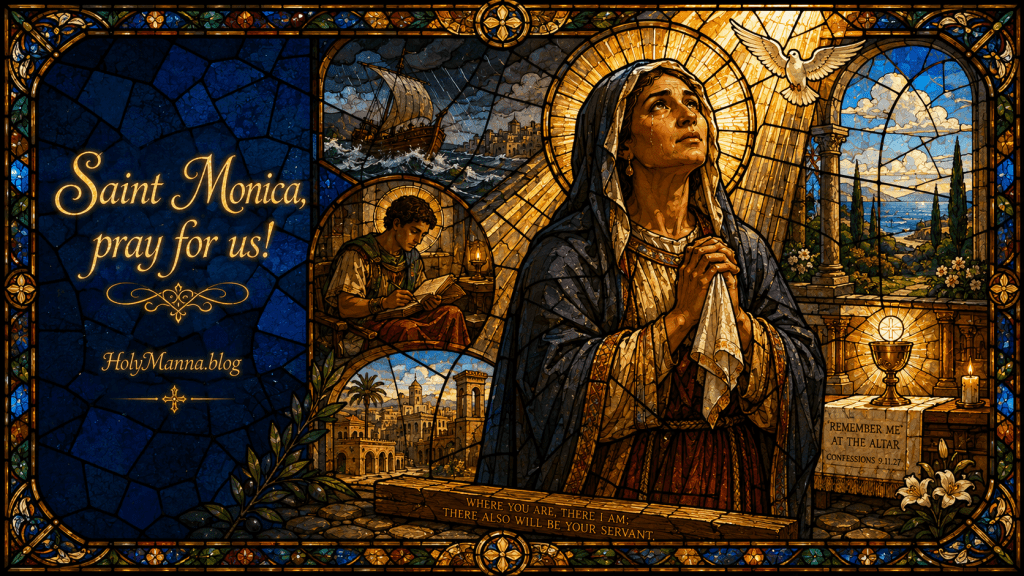
Augustine went to Carthage to study rhetoric, took a mistress, fathered a son named Adeodatus, and fell in with the Manichees, a sect that taught two eternal principles of good and evil and mocked the Catholic Scriptures. When he came home spouting these ideas, Monica refused to let him eat at her table; she could not stomach the blasphemies coming from her own son’s mouth. What softened her was a dream. She saw herself standing on a wooden ruler, grieving, and a radiant young man came and asked her why she wept. When she said she was mourning her son’s ruin, he told her to look and see that where she stood, her son stood too. She looked, and Augustine was standing beside her on the same rule. When Augustine tried to twist it into a promise that she would come around to his beliefs, she answered at once that the young man had not said “where he is, you will be” but “where you are, he will be.” Augustine writes that her quick reply shook him more than the dream itself.
She also went to a bishop, a man who had himself once been a Manichee, and begged him to talk sense into her son. He refused. He said Augustine was too puffed up with the novelty of his heresy to listen and that he would find his own way out in time, as the bishop himself had done. When Monica kept pressing him through her tears, he lost patience and dismissed her with words that have echoed for sixteen centuries: “Go your way, and God bless you, for it is not possible that the son of these tears should perish.” Augustine says she took those words as if they had come from heaven.
In 383 Augustine decided to leave for Rome. Monica was determined either to stop him or to go with him. Augustine, who admits it was a lie, told her the ship was waiting for a friend and persuaded her to spend the night praying at a chapel of Saint Cyprian near the harbor. While she prayed and wept for him to stay, he sailed away in the dark. Augustine later wrote that God refused her that prayer in order to grant the deeper one, since it was in Italy that he would be converted. God did not answer her prayers on her schedule or by her route. He answered them completely.
She followed him across the Mediterranean, and when a storm terrified the sailors she calmed them, saying God had promised her they would arrive safely. She reached Rome, found Augustine had moved on to Milan as public teacher of rhetoric, followed him there too, and in Milan met the man she had been praying for God to send: Saint Ambrose, the bishop of the city.
Monica loved Ambrose, Augustine says, “as an angel of God,” because she could see he was leading her son toward the truth, and Ambrose in turn congratulated Augustine on such a mother. She had brought the African custom of carrying bread and wine to the tombs of the martyrs; when she learned that Ambrose forbade it in Milan because it resembled pagan feasts and led to drunkenness, she stopped instantly and without complaint. She is also behind one of the most famous sayings in the Western world. Troubled that Rome fasted on Saturdays and Milan did not, she asked Ambrose which was right, and he replied that in Milan he did not fast on Saturday, in Rome he did, and she should follow the custom of whatever church she was in. Augustine preserved this in his letters to Casulanus and Januarius, and from it grew the proverb about doing in Rome as the Romans do.
Augustine also says she could distinguish, by an interior taste she could not explain, a dream sent by God from one born of her own soul, and that when she saw only vague images she knew they meant nothing. God gave her true visions sparingly and she did not pretend to more.
The Long Waiting and the Cost of Love
Monica was never martyred, but she carried a hidden cross for the better part of thirty years, and the shape of that cross is worth looking at closely.
The first hardship was her marriage. Patricius was unfaithful and quick to rage, and the culture around Monica accepted that as normal. She had to carry the faith of the household herself, praying for him for years before he finally asked for baptism. The Catechism teaches that in a marriage where one spouse does not share the faith, the believing spouse “has a particular task: ‘For the unbelieving husband is consecrated through his wife’” (CCC 1637, quoting 1 Corinthians 7:14). Monica lived that verse before it was catechized.
The second hardship was her son. Anyone who has watched a child walk away from the Church knows that grief: not the clean grief of death but a daily, unresolved ache. Augustine says she wept for him more than most mothers weep over a child’s grave. The bishop grew impatient with her. Her son lied to her and left her weeping on a dock. When she caught up with him in Milan he was no longer a Manichee, but he was a skeptic, and he told her so. She did not despair even then. She said she was confident that before she left this life she would see him a faithful Catholic, and she went on praying.
The third hardship was one Augustine does not spare her, and neither should honest storytelling. In Milan Monica pushed hard for Augustine to marry a girl of good family, partly, it seems, hoping that a respectable marriage would settle him and lead him to baptism. The arrangement required sending away the woman who had been his companion for some fifteen years and the mother of his son. The woman went back to Africa vowing to remain unmarried, and Augustine writes that his heart was torn and bleeding. Her motive was her son’s soul, but the episode shows that even saints can act with a mixture of faith and worldly calculation. Augustine does not condemn her, and neither does the Church, but the story reminds the reader that holiness is a journey and Monica was still walking it.
Then, in the late summer of 386, the long war ended. Augustine, wrestling in a garden in Milan, heard a child’s voice singing “take up and read,” opened Saint Paul’s letter to the Romans, and surrendered. He went straight to his mother, who blessed God who is able to do more than we ask or think, because she saw that God had granted her far more than she had asked with all her groans and tears. He was baptized by Ambrose at the Easter Vigil of 387, along with his son Adeodatus and his friend Alypius.
Before the baptism the household withdrew to a villa at Cassiciacum, where Augustine and his friends held philosophical conversations he later published as dialogues. Monica joined them, and Augustine says her grasp of the questions made her mind the equal of the men’s. At the end of On the Happy Life it was Monica who supplied the conclusion, quoting a hymn of Ambrose. The widow of Thagaste, who had never studied philosophy, ended up teaching the philosophers.
Ostia, the Window, and a Body Laid Anywhere
The party set out for Africa in the autumn of 387 and stopped at Ostia, the port of Rome, to wait for a ship. What happened there is one of the most famous passages in Christian literature. Monica and Augustine were leaning together at a window overlooking a garden, resting from the journey. They began to talk about what the eternal life of the saints might be like. Augustine describes how their conversation lifted them step by step, past all bodily things, past the heavens, past their own minds, until for one instant they touched eternal Wisdom “with the whole beat of the heart,” and then sighed and fell back into the noise of ordinary speech.
When they came back to themselves Monica said something to him that he wrote down word for word. She said: “Son, as for me, I no longer find any delight in this life. What I am still doing here, and why I am here, I do not know, now that my hopes for this world have been fulfilled. There was one thing for which I wished to linger a little in this life, and that was to see you a Catholic Christian before I died. My God has granted me this beyond my hopes, for I see you his servant, despising earthly happiness. What am I doing here?“
About five days later she came down with a fever. She lapsed into unconsciousness, then revived, looked at her two sons standing over her, and asked where she was. Then she said: “Here you will bury your mother.” Augustine held back his tears; his brother Navigius said something about hoping she would die in her homeland instead of abroad, and Monica gave him a look and turned to Augustine, saying, “See how he talks.” Then she said to both of them the words that Catholics have loved ever since: “Lay this body anywhere; do not let the care of it trouble you at all. This only I ask of you, that you remember me at the altar of the Lord, wherever you may be.“
Augustine marveled at that. Monica had always wanted to be buried beside Patricius in Africa. She had even prepared her tomb there. But God had emptied that wish out of her heart, and later Augustine learned that in Rome she had told friends that she was not afraid of dying far from home, because “nothing is far from God,” and there was no danger that at the end of the world he would not know where to find her to raise her up.
She died on the ninth day, in the fifty-sixth year of her life and the thirty-third of Augustine’s. He closed her eyes and forced back his tears; the boy Adeodatus burst out sobbing and was hushed; Evodius led the household in singing Psalm 101; the Sacrifice was offered at the graveside. Only later, alone, did Augustine weep. He then asked every reader of the Confessions to remember at the altar Monica and Patricius, his parents in the flesh, so that his mother’s last request might be fulfilled through more voices than his own. Every time someone prays for Monica after reading his book, that request is answered again.
From a Grave in Ostia to a Chapel in Rome
Monica was buried at Ostia. The former consul Anicius Auchenius Bassus composed a verse epitaph for her tomb praising the mother of Augustine, and its text survived in medieval copies. In 1945 boys digging beside the church of Santa Aurea in Ostia turned up a broken marble slab carrying a fragment of it, a documented find and a rare physical link to the woman herself.
In 1430, under Pope Martin V, her remains were solemnly taken from Ostia to Rome and given to the Augustinian friars, who eventually enshrined them in the church of Sant’Agostino in Campo Marzio, not far from the Piazza Navona. Her relics still rest there in a chapel to the left of the high altar, and mothers still come to kneel by them. Butler’s Lives of the Saints records that miracles were reported at the time of the translation of her relics; the record does not preserve the particulars, and those reports cannot be independently verified today. Beyond that, the Church has never attached a formal list of miracles to Monica, because she was never put through a canonization process. She belongs to the ancient saints whose sanctity was recognized by the acclamation of the faithful and confirmed by the tradition of the Church.
Her influence has come less through cures than through imitation. For centuries her feast was kept on May 4, the eve of the old feast of Augustine’s conversion, and the 1969 calendar reform placed her on August 27, again on the eve of Augustine. Confraternities of Christian mothers under her patronage spread across Europe in the nineteenth century, the best known founded at Lille in 1850, and countless parishes still host parents who gather under her name to pray for their children. The Augustinian orders honor her as a spiritual mother, and Spanish missionaries in California named a spring and eventually a city after her, so that Santa Monica appears on maps of the Pacific coast because a fourth-century African widow once cried for her boy.
Her story has also shaped the Church’s teaching on prayer itself. When The Catechism speaks of the persevering intercession of the faithful, it teaches that “filial trust is tested” and “proves itself in tribulation” and that “the principal difficulty concerns the prayer of petition” (CCC 2734). It goes on to insist that “prayer is a gift of grace and a decisive response on our part. It always presupposes effort” and that “the great figures of prayer of the Old Covenant before Christ, as well as the Mother of God, the saints, and he himself, all teach us this” (CCC 2725). Monica is one of those saints, and Augustine’s account of her is one of the reasons the Church can teach it with confidence.
What Monica Teaches a Restless Generation
First, Monica teaches that God’s timing is not our timing and that his route is not our route. She prayed for Augustine to stay in Africa, and God sent him to Italy. She prayed for years and got no visible result, and then the answer came all at once, in a Milanese garden, and it was bigger than anything she had dared to ask. The Catechism teaches that “we must pray always” and describes how “this tireless fervor can come only from love” (CCC 2742), and Monica’s love simply outlasted her son’s resistance. Is there someone in your life you have quietly stopped praying for because it seemed hopeless? What would it look like to pick that prayer back up?
Second, Monica teaches that holiness is often hidden in ordinary, unglamorous faithfulness. She kept a difficult marriage together without a single blow being struck in her home. She made peace between servants and in-laws. She refused to gossip. She followed the local customs of the Church out of obedience even when they were not her own. None of that makes headlines, and all of it is the stuff of sanctity. Where in your daily routine, at work, at home, online, could you become a peacemaker instead of a participant in the noise?
Third, Monica teaches that saints are not finished products. Augustine shows the reader a girl who drank on the sly, a mother who could push too hard, a widow who let social ambition mix with holy motives. God did not wait until she was perfect to use her. He used her while she was still learning. Do you hold back from prayer or from serving because you feel you have not yet gotten your own life together?
Fourth, Monica teaches the power of tears offered to God. The Church has never been embarrassed by weeping. The Catechism speaks of the “gift of tears” and of contrition that comes from love (CCC 1432), and Monica’s tears were exactly that: not despair, but love that would not stop asking. If a person has been ashamed of crying over a loved one’s soul, Monica gives them permission.
Fifth, and finally, Monica teaches the reader how to die. She asked for nothing for her body and one thing for her soul: to be remembered at the altar. That request points straight to the heart of Catholic faith, the Holy Sacrifice of the Mass offered for the living and the dead, and The Catechism teaches that “the Church offers the Eucharistic sacrifice in communion with and commemorating the Blessed Virgin Mary and all the saints” and “also for the faithful departed” (CCC 1370, 1371). When you go to Mass this week, whom will you bring to the altar with you?
Some practical steps follow naturally. Choose one person who has drifted from God and pray for that person by name every day for a year, without a deadline for results. Adopt Monica’s rule and refuse to answer anyone in anger. Have a Mass offered for a deceased relative you have not thought of in a while. And read Book IX of The Confessions, slowly; it is short, and it will not leave you unchanged.
Engage With Us!
Saint Monica’s story belongs to anyone who has ever loved someone enough to keep praying when it seemed pointless, and HolyManna would love to hear how it lands with you. Share your thoughts and reflections in the comments below, and take a few of these questions with you into prayer this week.
- Who is the “Augustine” in your life, the person whose conversion or return to the faith you most long for, and how might you commit to praying for that person the way Monica did?
- Monica prayed for years without visible results and got an answer greater than she asked. Where has God answered a prayer of yours in a way you did not expect or would not have chosen?
- Augustine shows Monica’s flaws alongside her holiness. Does that make her harder or easier for you to relate to, and why?
- Monica refused to answer her husband in anger and refused to pass along gossip. Which of those two habits would most change your relationships if you adopted it today?
- Her last request was to be remembered at the altar. Whom will you remember at Mass this week, and is there someone who has died whom you have never had a Mass offered for?
- Monica gave up a cherished custom, and even her hope of a grave in Africa, when God asked. Is there a preference or plan of your own that God may be asking you to hold more loosely?
Saint Monica did not conquer the world. She conquered her own temper, she outlasted her son’s stubbornness with love, and she died asking to be remembered at the altar of the Lord. That is a life any of us can imitate. Go and pray for the ones who have wandered, make peace where there is quarreling, and do everything with the love and mercy that Jesus taught us.
Saint Monica, mother of tears, pray for us!
Follow us on YouTube, TikTok, Instagram and Facebook for more insights and reflections on living a faith-filled life.


Leave a Reply