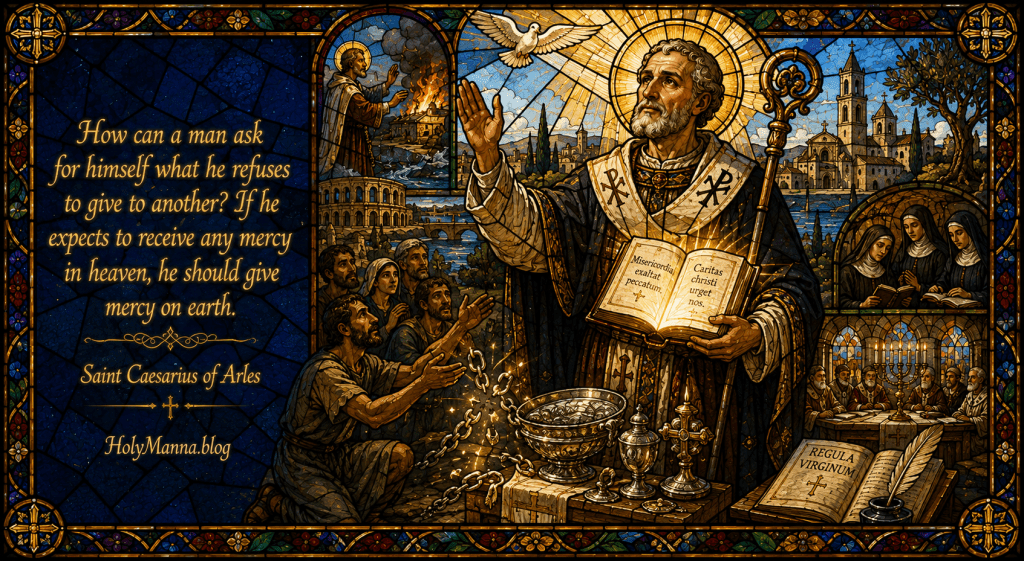
The Cost of Mercy
Every so often the Church gives us a saint who stood at a hinge of history and simply refused to let the door slam. Saint Caesarius of Arles is one of those saints. He was born around the year 470, when the last Roman emperor in the West still sat on a throne, and he died in 542, when Goths and Franks ruled the cities his grandparents had called Roman. In between, he was bishop of Arles for forty years, and in that time he became the most important churchman in all of Gaul.
He is remembered for many things at once. He presided over the Second Council of Orange in 529, whose teaching on grace was confirmed by the pope and still echoes in the Catechism today. He was the first bishop outside Italy known to receive the pallium from Rome. He wrote the first monastic rule in the West composed specifically for women, and he founded the community that lived by it, with his own sister as its abbess. He preached hundreds of short, plain, memorable sermons that traveled across Europe for a thousand years, often under other men’s names. He was exiled twice on false charges of treason, and he sold the silver off the altar to buy prisoners of war out of slavery.
The Roman Martyrology honors him on 27 August, the day of his death. What ties all of these threads together is a single conviction that Caesarius preached and lived: that the mercy of God, once received, has to be handed on. As the Catechism puts it, “The works of mercy are charitable actions by which we come to the aid of our neighbor in his spiritual and bodily necessities” (CCC 2447). Caesarius spent his life doing exactly that, and this is his story.
A Burgundian Boy Who Would Not Eat
Caesarius was born in the town the Romans called Cabillonum, today Chalon-sur-Saône in the Burgundy region of France. His family was Gallo-Roman, Catholic, and comfortable enough to give him an education. Sources place his birth anywhere from 468 to 471; about 470 is the date most commonly given.
What is clear from the earliest account of his life is that the boy was intensely serious about God from a young age. In his eighteenth year he received the tonsure from Bishop Silvester of Chalon and entered the service of his local church. Two years later he did what many fervent young men of Gaul did in that century: he went to Lérins, the island monastery off the coast of Provence that had already produced bishops and theologians such as Saint Honoratus, Saint Hilary of Arles, and Saint Vincent of Lérins. There, under Abbot Porcarius, Caesarius threw himself into monastic life with an intensity that got him into trouble.
He was appointed cellarer, the monk in charge of the food, and he took the job so seriously that he began withholding food from brothers he judged insufficiently austere. The monks complained, the abbot removed him from the office, and Caesarius turned the severity on himself, fasting so hard that his health broke down. Abbot Porcarius wisely sent him to Arles to recover.
When he arrived in Arles, he discovered that the bishop of the city, Aeonius, was both a fellow townsman from Chalon and a relative. Aeonius saw something in the fragile, fierce young monk. He arranged for Caesarius to study briefly with the rhetorician Julianus Pomerius, so that the future preacher would know how to speak, then obtained his release from Lérins and ordained him deacon and priest. Around the year 499 the bishop placed him as abbot over a monastery on a suburban island in the Rhône, and when Aeonius lay dying he named Caesarius as the man he wanted to succeed him.
Caesarius did not want the job and resisted the election. He was about thirty-two, a monk by temperament, and the See of Arles was the most prominent in Gaul, in a city ruled by the Arian Visigothic king Alaric II. Nonetheless, in 502 the clergy and people chose him unanimously, and he would hold the office for forty years.
The conversion of Caesarius, then, was not a dramatic turn from sin to grace. It was the slower, more common story of a devout heart being pruned. The zeal that made him a difficult cellarer had to be softened into the zeal that would make him a good shepherd, and God used a broken body, a patient abbot, and a kinsman bishop to do the softening. The Catechism reminds us that “the preparation of man for the reception of grace is already a work of grace” (CCC 2001), and the young Caesarius is a picture of that truth. Even his excesses were being turned to good.
Fifteen Minutes That Changed Europe
Once he became bishop, Caesarius set about doing something that sounds ordinary but was, in his day, close to revolutionary. He preached, constantly, plainly, and to everyone.
Roughly 238 of his sermons survive, and they are unlike the polished orations of the great fourth-century Fathers. His usual limit was about fifteen minutes. He opened gently, made a few clear points, and closed with a summary so that even the slowest listener would carry something home. His images came straight from the world his people knew: the vineyard, the sheepfold, the market, the sea, the field. He knew that people liked to slip out before the homily, and the earliest account of his life records that he had the doors closed to keep them in.
He did not keep preaching to himself, either. At the Council of Vaison in 529 he saw to it that priests, and not only bishops, were permitted to preach, so that the countryside would hear the Word and not just the cathedral city. He had his own sermons copied and sent to other bishops in Gaul, Italy, and Spain, with the instruction that clergy who could not compose their own should simply read his. For centuries his sermons circulated under the names of Augustine, Ambrose, and other Fathers, until the Benedictine scholar Dom Germain Morin reassembled the corpus in the twentieth century and gave Caesarius his name back.
He also wanted the laity to pray and read Scripture on their own. He brought the daily hours of Terce, Sext, and None into public parish worship so that ordinary Christians could join the Church’s prayer, and he urged people to read the Scriptures at home and to treat the Word of God with the same reverence they gave the sacraments. This is precisely what the Church still asks of the faithful. The Catechism, quoting the Second Vatican Council, teaches that the Church forcefully exhorts all the faithful “to learn the surpassing knowledge of Jesus Christ, by frequent reading of the divine Scriptures” (CCC 133). Caesarius was saying it fifteen centuries earlier.
Two of his sermons are still read every year in the Church’s Office of Readings. In one, preached at the dedication of a church, he turns the building into a mirror. He tells his people, “Whenever we come to church, we must prepare our hearts to be as beautiful as we expect this church to be.” He reminds them that “before our baptism we were sanctuaries of the devil; but after our baptism we merited the privilege of being temples of Christ.” He was preaching what Saint Paul had written to Corinth: “Do you not know that you are God’s temple and that God’s Spirit dwells in you?” (1 Corinthians 3:16). The Catechism says the same thing in its own words: through Baptism the Christian becomes “a member of Christ” and “a temple of the Holy Spirit” (CCC 1265).
In the other, on the words of Jesus in The Gospel of Matthew, “Blessed are the merciful, for they shall obtain mercy” (Matthew 5:7), he asks the question that cuts every one of us: “How can a man ask for himself what he refuses to give to another?” And then he gives the line that could serve as his epitaph: “Yes, there is mercy in heaven, but the road to it is paved by our merciful acts on earth.”
He built that road with more than words. Around 512 he founded a monastery for women in Arles, dedicated to Saint John, with his sister, Saint Caesaria, as abbess. For these women he wrote the Regula virginum, the Rule for Virgins, the first monastic rule in the Western Church composed specifically for women. It required strict enclosure so that no one, not even the bishop, could casually disturb their life of prayer, and it required that every sister learn to read. In an age when literacy was collapsing, Caesarius insisted that women consecrated to God should be able to open the Psalter for themselves. The community grew to some two hundred nuns and became one of the great houses of early medieval Gaul.
He was also a builder of the Church’s order. He presided over the Council of Agde in 506, which produced an important body of canon law, and over councils at Arles, Carpentras, Vaison, and Marseille that strengthened rural parishes and clerical formation. In 513 he traveled to Rome, and on 6 November of that year Pope Symmachus gave him the pallium, the woolen band worn over the shoulders that signified a special bond with the Apostolic See. He is generally described as the first bishop outside Italy to receive it. The following June the pope named him vicar of the Apostolic See for Gaul and Spain, and granted his deacons the right to wear the Roman dalmatic. He used that trust to keep the churches of Gaul knit to Peter as the political map fell apart.
The greatest of his councils came in 529 at Orange. The question was grace. Some in southern Gaul, wanting to defend human freedom, taught that a person could take the first step toward God on his own and that grace came only afterward to help. Caesarius, formed by Augustine, saw the danger. Under his presidency the Second Council of Orange taught that even the beginning of faith is God’s gift, that we cannot want God without God first moving us to want him. Pope Boniface II confirmed the council’s canons on 25 January 531, and the Church has taught this ever since. The Catechism cites the Council of Orange directly when it explains how the Church’s teaching on original sin and grace was clarified (CCC 406). A modest bishop in a Gothic frontier city helped settle one of the deepest questions in Christian theology, not with a treatise but with a council and a papal letter.
The earliest account of his life, written by five clerics who knew him, also records miracles worked through his prayers during his lifetime. It tells that at Ravenna he cured a dying boy and delivered a deacon named Helpidius, who was also a physician close to the king, from a demon. It tells that on his return to Arles he freed a woman from possession in the church itself, and it records many other healings and even visions of the saints and of Christ. These accounts come from men who lived alongside him and wrote within a few years of his death, but they belong to the tradition of his life rather than to independently verifiable history, and they are offered here as the tradition hands them down.
Accused, Exiled, and Ransoming His Enemies
Caesarius was a Catholic bishop in a city ruled by Arian Goths, and that alone made him a target.
Around 505 a notary named Licinianus went to King Alaric II and accused Caesarius of plotting to hand Arles over to the Burgundians, the people of his native region. There was no trial. Caesarius was simply exiled to Bordeaux. The earliest account of his life tells what happened there. A fire broke out and threatened to consume the city, and the exiled bishop prayed and the fire went out. The people of Bordeaux, it says, were saved by his intercession. This story rests on the near-contemporary account of his companions and on no other independent source, and it cannot be verified.
Alaric relented, and Caesarius came home. His first act on returning is the one that tells you who he was: he pleaded for the life of Licinianus, the man who had lied him into exile. Jesus had said, “Love your enemies and pray for those who persecute you” (Matthew 5:44), and the Catechism insists that this is not optional for the disciple, since “forgiveness is a high-point of Christian prayer” and “forgiveness also bears witness that, in our world, love is stronger than sin” (CCC 2844). Caesarius did not merely forgive his accuser; he defended him.
Then came the war. In 507 the Frankish king Clovis crushed the Visigoths at Vouillé and Alaric died. Franks and Burgundians besieged Arles through 507 and 508, and the Ostrogoths of Italy came to relieve it. Inside the walls Caesarius was suspected all over again, this time of plotting with the besiegers, and he was arrested and briefly deported. When the siege ended and the city passed to the Ostrogoths, he was cleared, but the accusations were not finished. In 513 he was summoned to Ravenna to answer to Theodoric the Great, king of the Ostrogoths and the most powerful ruler in the West.
Ravenna produced one of the loveliest scenes in his life. The earliest account says that Theodoric, an Arian and a formidable man, took one look at the humble bishop, listened to him, and called him an “apostolic man.” He acquitted him on the spot and gave him a gift, a heavy silver dish and money. Caesarius thanked him, walked out, and sold the dish to ransom captives. When the king heard what his gift had become, he was more impressed than before.
That is the thread that runs through every hardship of his life. The wars of the early sixth century left the countryside around Arles full of prisoners: farmers dragged off as slaves, women and children taken as plunder. Caesarius spent every resource he could find to buy them back. He sold church plate, melted down ornaments, and emptied the treasury. Some of his own clergy were furious and tried to have him removed for stripping the churches, and some of the people were angrier still, because he ransomed not only their own kin but barbarians and enemies of the city. His answer, as his companions recorded it, was that these too were human beings, and human beings can enter the City of God.
He was doing what the Lord had commanded when he said, “I was in prison and you came to me” (Matthew 25:36), and what the Church has always counted among the corporal works of mercy, which include ransoming the captive (CCC 2447). He was doing it in a way that cost him reputation, comfort, and safety, and he never stopped.
The final blow came in 536, when the Franks took Arles for good. Caesarius, now in his mid-sixties and worn out, withdrew to the convent of Saint John, the house he had built for his sister and her nuns. He lived there for roughly the last six years of his life, praying, writing, and quietly governing what he could. On 27 August 542 he died there, at about seventy-two years of age, in his fortieth year as bishop. Some older sources give the year as 543, but the near-contemporary evidence points to 542. He was not a martyr, and he never claimed the honor of one; his was the long, unspectacular martyrdom of a shepherd who stayed with his flock through siege, exile, slander, and conquest, and who was still forgiving and still ransoming when he died.
The Water That Washed His Body
Caesarius was buried in the basilica of Saint Mary that he had built for the nuns of Saint John, and the veneration began at once. The men who wrote his life within a few years of his death added a section at the end on “the miracles his relics performed after his death, but before this account was written,” and what they recorded is homely and moving.
They tell of Desiderius, the public archivist of Arles, who suffered from a recurring fever and was cured after drinking some of the water that had been used to wash the bishop’s body for burial. They tell of the son of a man named Salvius, cured of a fever the same way, and of the son of Martianus, whose fever the doctors could do nothing about, healed by drinking water that had washed the saint’s clothes. They tell of a Frank, one of the new masters of the city, cured of fever in the same fashion. Each of these accounts comes from the earliest account of his life, written by clerics who knew the people involved, and each is offered as the tradition records it. They cannot be independently verified.
That such stories were told at all fits the Catholic understanding of relics, which the Church has always honored, alongside pilgrimages, processions, and other expressions of popular piety, as forms of devotion that surround and support the sacramental life (CCC 1674). And the veneration of Caesarius did not fade. In the Middle Ages his relics were kept at the cathedral of Saint-Trophime in Arles, and pilgrims on the road to Santiago de Compostela stopped at Arles to honor him alongside Saint Honoratus and the martyr Saint Genesius.
What survives of him today is astonishing for a man who died in 542. His pallium, the very woolen band that Pope Symmachus gave him around 513, still exists and is the oldest known pallium in the world. So do his tunic, his sandals, and his leather belt with its ivory buckle carved with the soldiers at the tomb of Christ. These relics are preserved in Arles at the Musée départemental Arles antique, and in 2017 the Vatican Museums brought them to Rome for an exhibition titled with the words of the pope’s own letter to him, “Dilectissimo fratri Caesario,” to my most beloved brother Caesarius. Fifteen centuries after he walked to Rome to receive that pallium, it went back to Rome to be honored.
His deeper legacy is harder to see and far larger. The Rule he wrote for his sister’s community was the most widely used rule for women in the West until the Rule of Saint Benedict spread; Saint Radegund adopted it for her great abbey at Poitiers. His sermons formed the preaching of the early medieval Church, were copied in Anglo-Saxon England, and were quoted by Saint Thomas Aquinas. And the Second Council of Orange, over which he presided, remains the Church’s classic statement that salvation begins with God’s grace and not with us.
Paving the Road With Mercy
It would be easy to admire Caesarius from a distance, but almost everything he did is something an ordinary Christian can do in miniature.
He preached short and plain. You may never stand in a pulpit, but you talk about your faith, or you could. Caesarius would tell you that the goal is not to sound impressive but to be understood, and that fifteen honest minutes with a friend who is curious about God are worth more than an hour of showing off. When was the last time you explained something about your faith to someone in words they could actually use?
He read Scripture and begged his people to do the same. He wanted farmers and fishermen opening the Psalms at home. The Church still asks this of you (CCC 133). Is there a Gospel on your nightstand, or only on your phone, and when did you last open it without being told to?
He forgave the man who exiled him, and he pleaded for that man’s life. Most of us are not exiled, but most of us are nursing some grudge against someone who lied about us or cost us something. Caesarius did not wait until the feeling passed. He acted. The Catechism is honest that this is hard, that “it is not in our power not to feel or to forget an offense,” but that “the heart that offers itself to the Holy Spirit turns injury into compassion” (CCC 2843). Whose life would you plead for today if you had the chance, and whose would you rather not?
He sold the silver. This is the one that stings, and it is meant to. Caesarius looked at the beautiful things on the altar and decided that a captive child was more beautiful. He was criticized for it by his own clergy. What in your life is silver you are keeping polished while someone nearby needs it turned into bread, or rent, or a ransom of some kind? It might be a standing gift to a group that helps prisoners or the trafficked, or an afternoon given to someone who has no one.
And he ransomed his enemies. He bought back barbarians who had attacked his city, because they were human beings who could enter the City of God. That is the Gospel without any softening. Is there a category of person you have quietly decided is not worth your mercy?
Caesarius would tell you not to be discouraged by how far you are from any of this. He was the cellarer who starved his brothers and himself before he became the bishop who fed a city. God worked with what he was, and God will work with you. The Catechism promises that “all Christians in any state or walk of life are called to the fullness of Christian life and to the perfection of charity” (CCC 2013), and Caesarius is proof that the road to that fullness is paved one merciful act at a time.
Engage With Us!
Saint Caesarius spent forty years talking to ordinary people about how to live the Gospel, and he would want to hear from you. Share your thoughts and reflections in the comments below, and consider these questions as you go:
- Caesarius insisted that every nun in his sister’s community learn to read the Scriptures. What is one concrete way you could deepen your own reading of the Word of God this month?
- He preached in short, plain sermons full of images from daily life. Who in your life needs to hear about Jesus in language they can understand, and how might you say it?
- He pleaded for the life of the man who had him exiled. Is there someone you need to forgive, not by waiting to feel better, but by acting first?
- He sold the church’s silver to ransom captives, including his enemies. What are you holding onto that God might be asking you to give away for someone in need?
- The Second Council of Orange, under his leadership, taught that even our desire for God begins with God’s grace. How does it change your prayer to know that God moved first?
Saint Caesarius of Arles stood at the end of one world and the beginning of another, and he met it with mercy. Go and do the same. Read the Word, speak it plainly, forgive quickly, and give generously, and do all of it with the love and mercy that Jesus taught us.
Saint Caesarius of Arles, pray for us!
Follow us on YouTube, TikTok, Instagram and Facebook for more insights and reflections on living a faith-filled life.


Leave a Reply