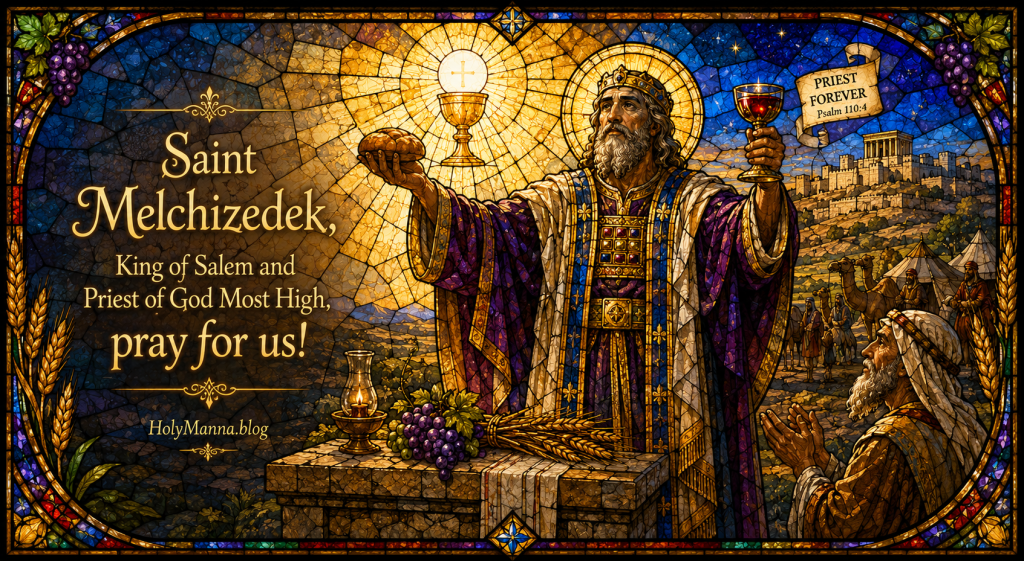
The Priest Who Came Out of Nowhere and Into Every Mass
Somewhere in the second millennium before Christ, a man walked out of a city called Salem carrying bread and wine, blessed the father of all believers, and then vanished from the pages of history. His name was Melchizedek. Scripture gives him three verses in The Book of Genesis, one line in The Book of Psalms, and one long, luminous meditation in The Letter to the Hebrews. That is all. Yet no Old Testament figure outside of Moses and David has done more to shape the way the Church understands Jesus Christ, His priesthood, and the sacrifice of the Mass.
Melchizedek is remembered on 26 August in the 2004 Martyrologium Romanum, which commemorates him as king of Salem and priest of God Most High, the one who blessed Abraham returning from victory, offered a holy sacrifice and a spotless victim, and stands as a figure of Christ, king of justice and peace and priest forever, without genealogy. Every time a priest prays the Roman Canon, he asks the Father to accept the gifts on the altar as He once accepted “the offering of your high priest Melchizedek, a holy sacrifice, a spotless victim.” The Catechism names him among the great righteous figures of the nations, calling him “the king-priest Melchizedek, a figure of Christ” (CCC 58), and teaches that “the Christian tradition considers Melchizedek, ‘priest of God Most High,’ as a prefiguration of the priesthood of Christ, the unique ‘high priest after the order of Melchizedek’” (CCC 1544).
He holds no documented patronage, and this post will not invent one. He worked no recorded miracle and left no relic. What he left instead was a pattern, and God Himself chose that pattern for His own Son. That is why a curious Catholic ought to know him.
A King Without a Genealogy
Nothing is known of Melchizedek’s birth, family, or upbringing, and The Letter to the Hebrews turns that silence into a doctrine. The sacred author writes that he is “without father or mother or genealogy, and has neither beginning of days nor end of life, but resembling the Son of God he continues a priest for ever” (Hebrews 7:3). The point is not that Melchizedek was some heavenly being with no parents. The point is that Scripture deliberately introduces him with no ancestry, no birth notice, and no death notice, so that he could stand as a living picture of a priesthood that does not depend on bloodline and does not end.
What Scripture does say is compact and rich. He was king of Salem. His name in Hebrew, Malki-tsedeq, means “king of righteousness,” and Hebrews reads Salem as “peace,” so that “he is first, by translation of his name, king of righteousness, and then he is also king of Salem, that is, king of peace” (Hebrews 7:2). Christian and Jewish tradition from the time of Josephus onward has identified Salem with Jerusalem, and Psalm 76:2 seems to support that reading when it says of God, “His abode has been established in Salem.” This identification is ancient and widely held, but it should be told as tradition rather than proven fact, since a few scholars place Salem elsewhere.
He was also “priest of God Most High” (Genesis 14:18), which is astonishing when one remembers where he appears in the story. Abraham has been called out of Ur. The Law has not been given. Aaron and the Levites will not exist for centuries. And yet here, in the land of Canaan, is a man who already worships the one true God, the Maker of heaven and earth, and already serves Him as priest. He was not an Israelite; there was no Israel yet. He belongs to that mysterious company the Catechism describes when it says that “the Bible venerates several great figures among the Gentiles: Abel the just, the king-priest Melchizedek, a figure of Christ, and the upright ‘Noah, Daniel, and Job’” (CCC 58). His conversion is never narrated because Scripture presents him already converted, already knowing, already worshiping.
Jewish tradition, recorded in the Targums and mentioned by Saint Jerome, identified Melchizedek with Shem, the son of Noah, imagining that the patriarch had lived long enough to bless his descendant Abraham. Jerome passes this along without endorsing it, and it is a tradition rather than a teaching of the Church. It cannot be verified.
The Meeting That Changed the Meaning of Priesthood
The one scene in which Melchizedek acts is worth reading slowly. Abram has just returned from a daring night raid to rescue his nephew Lot from four invading kings. He is met in the Valley of Shaveh by two very different rulers. One is the king of Sodom, who wants to bargain. The other is Melchizedek. Scripture says: “And Melchizedek king of Salem brought out bread and wine; he was priest of God Most High. And he blessed him and said, ‘Blessed be Abram by God Most High, maker of heaven and earth; and blessed be God Most High, who has delivered your enemies into your hand!’ And Abram gave him a tenth of everything” (Genesis 14:18 to 20).
Three things happen in those verses, and the whole Church has spent two thousand years unfolding them.
First, he brings out bread and wine. Every other priest in the Old Testament offers animals. Melchizedek offers bread and wine, and the Fathers of the Church could not stop pointing at it. Clement of Alexandria wrote in the second century that Melchizedek “gave bread and wine, furnishing consecrated food for a type of the Eucharist.” Saint Cyprian of Carthage, in his famous letter on the Eucharist, wrote that “in the priest Melchizedek we see the sacrament of the sacrifice of the Lord prefigured,” and asked who could be more truly a priest of God Most High than Christ, who offered to the Father the very thing Melchizedek had offered, bread and wine, that is to say His own Body and Blood. Saint Ambrose taught his newly baptized in Milan that Melchizedek’s bread and wine were a figure of the Christian sacraments and that his priesthood was older and greater than that of Aaron. Saint Augustine summed it up in The City of God, saying that in Melchizedek’s act “there first appeared the sacrifice which is now offered to God by Christians in the whole wide world.” The Catechism makes this the Church’s own reading: “The Church sees in the gesture of the king-priest Melchizedek, who ‘brought out bread and wine,’ a prefiguring of her own offering” (CCC 1333).
Second, he blesses Abram. That may not sound dramatic, but Hebrews draws out the consequence: “It is beyond dispute that the inferior is blessed by the superior” (Hebrews 7:7). Abraham, the father of the chosen people, receives a blessing from this Gentile priest, which means Melchizedek’s priesthood outranks anything that would later descend from Abraham, including the entire Levitical priesthood. Hebrews even says that Levi, “who receives tithes, paid tithes through Abraham, for he was still in the loins of his ancestor when Melchizedek met him” (Hebrews 7:9 to 10).
Third, Abram gives him a tenth of everything. The tithe is an act of worship and submission. Abraham, who bows to no king in Canaan and refuses to take so much as a sandal strap from the king of Sodom, freely honors Melchizedek as a priest of the true God.
Melchizedek then disappears. Genesis does not report his death. He simply steps off the stage, and for roughly a thousand years the Bible does not mention him again. Then, in the Davidic monarchy, the Holy Spirit brings him back in a single verse that Jesus Himself would quote about His own identity: “The Lord has sworn and will not change his mind, ‘You are a priest for ever after the order of Melchizedek’” (Psalm 110:4). David and his heirs were from Judah, not Levi. They could not be priests under the Law. Yet the psalm promises that the coming king would be a priest, and not a Levitical one, but a priest of the older, higher, kingly order of Melchizedek.
Why does any of this matter for an ordinary Catholic? Because it is the key to understanding what Jesus is doing at the Last Supper and on the Cross, and what the priest is doing at the altar. The Letter to the Hebrews insists that Christ “was designated by God a high priest after the order of Melchizedek” (Hebrews 5:10) and that Jesus has entered the heavenly sanctuary “having become a high priest for ever after the order of Melchizedek” (Hebrews 6:20). The Council of Trent taught that at the Last Supper Christ, “declaring Himself constituted a priest for ever according to the order of Melchisedech, offered up to God the Father His own body and blood under the species of bread and wine.” The Catechism binds these threads together: “Everything that the priesthood of the Old Covenant prefigured finds its fulfillment in Christ Jesus, the ‘one mediator between God and men’” (CCC 1544), and the Church’s whole priesthood exists to make present that one sacrifice, since “the sacrifice of Christ and the sacrifice of the Eucharist are one single sacrifice” (CCC 1367).
Melchizedek is worth remembering, then, not because he did great deeds but because he shows that God was already sketching the outline of the Eucharist and the priesthood before Israel even existed. He is a promise in the shape of a person.
The Weight of Being a Sign
Melchizedek endured no recorded persecution and no martyrdom, and it would be dishonest to dress him in a red robe or hand him a palm. His hardship, if the word can be used at all, is of a different and quieter kind. He was a priest of the true God in a land of idols, in a city surrounded by the Canaanite worship that would later horrify the prophets. He had no Law, no Temple, no chosen people to belong to. He served God Most High in a kind of solitude that Scripture does not describe but that any believer who has ever felt alone in faith can imagine.
There is also the hardship of being misunderstood after death. In the early centuries a sect known as the Melchizedekians, described by Saint Epiphanius, exalted Melchizedek into a heavenly power greater than Christ, twisting the very verses in Hebrews that were meant to point to Jesus. The Fathers had to labor to defend the true reading: Melchizedek is a figure of Christ, not a rival to Him. Even today, outside the Church, his name is attached to esoteric ideas that have nothing to do with the biblical man who brought out bread and wine. Part of honoring him is refusing to let him be turned into something he never was.
The Fathers themselves show how to hold him rightly. Saint Thomas Aquinas, in the Summa Theologiae, explains that Christ is called a priest according to the order of Melchizedek rather than Aaron precisely because Melchizedek’s priesthood is prior, universal, and undying, whereas Aaron’s was temporary and tied to one nation. Melchizedek is honored most when he is allowed to be exactly what Hebrews calls him: one who was “resembling the Son of God” (Hebrews 7:3). His greatness is entirely borrowed light, and that is the whole point.
Priest Forever
No miracles are attributed to Melchizedek after his death, no healings, no relics, no shrine that pilgrims can visit. His impact after death is real, however, and it is enormous; it simply takes a different form. He lives on in the worship of the Church.
The Roman Canon, the most ancient Eucharistic Prayer of the Latin Church, prayed for well over a thousand years and still prayed today, places him alongside Abel and Abraham at the very heart of the offering. The priest asks the Father to accept the gifts “as once you were pleased to accept the gifts of your servant Abel the just, the sacrifice of Abraham, our father in faith, and the offering of your high priest Melchizedek, a holy sacrifice, a spotless victim.” Whenever the bread and wine are carried to the altar, the Catechism says, “the presentation of the offerings at the altar takes up the gesture of Melchizedek and commits the Creator’s gifts into the hands of Christ” (CCC 1350). Every Offertory is a small echo of the Valley of Shaveh.
He lives on in the priesthood. At ordinations, in seminaries, on holy cards, and in the private prayer of countless priests, Psalm 110:4 is repeated as the definition of what a priest is: “You are a priest for ever after the order of Melchizedek.” The Catechism teaches that through the ministerial priesthood, “the presence of Christ as head of the Church” is made visible (CCC 1549), and that the priest “acts in the person of Christ the Head” (CCC 1548). Melchizedek’s name is woven into that whole reality.
He lives on in the art of the Church. The sixth century mosaics of San Vitale and Sant’Apollinare in Classe in Ravenna show him at an altar with bread and a chalice, robed as king and priest, beside Abel and Abraham, an unmistakable teaching in glass and stone about the Eucharist. He stands in the sculpture of Chartres and Reims. He appears in Dieric Bouts’s great Leuven altarpiece and in works by Rubens, and he decorates the tabernacles and altars of countless Baroque churches, always with bread and wine, never with a sword or a palm, because he was a priest and not a martyr.
He lives on across the Christian East as well. The Armenian Church commemorates him in July, the Byzantine tradition honors him among the holy forefathers of Christ before Christmas, and the Ethiopian Church keeps his memory in September. The Latin Church gave him his own commemoration on 26 August in the 2004 Martyrologium Romanum, which is why HolyManna.blog is telling his story today.
One more tradition deserves mention. Ancient Jewish writings, including the historian Josephus, held that Melchizedek was the first to build a sanctuary at Salem, and that Salem became Jerusalem, the city of the Temple and, one day, of the Cross. If that tradition is right, then the very ground where Melchizedek offered bread and wine is the ground where Christ would offer Himself. It is a beautiful thought and it is widely held, but it cannot be verified.
Living Like a Priest of God Most High
Melchizedek’s story is short enough that it can be carried around all day, and it has more to say to a modern Catholic than its length suggests.
Consider first the bread and wine. Melchizedek did not offer what was rare or exotic; he offered what was on the table. God took that ordinary offering and made it the first sketch of the Eucharist. The Catechism teaches that all the baptized share in Christ’s priesthood, that “the whole community of believers is, as such, priestly” (CCC 1546), and that the faithful “offer spiritual sacrifices” by uniting their lives to Christ (CCC 1141). What ordinary bread and wine are you being asked to bring to the altar this week: your work, your fatigue, your family, your unanswered prayers? Melchizedek suggests that the offering God wants is usually the one already in your hands.
Consider next the blessing. Melchizedek met a tired man coming back from a battle and gave him food and a blessing before he asked anything of him. He blessed Abram and he blessed God, in that order and in the same breath. When was the last time you spoke a real blessing over someone, out loud, in the name of God Most High? Catholic parents can bless their children with the sign of the cross; friends can pray a blessing over one another; a simple “God bless you” said with intention is not nothing. Melchizedek shows that a priestly people is a blessing people.
Consider also the tithe. Abraham gave a tenth of everything to a priest of God he had only just met, and Scripture treats it as an act of worship. Does your giving to God, of money, time, or attention, look like worship or like leftovers? Melchizedek received what was given not for himself but as a sign that everything belongs to the Maker of heaven and earth.
Consider finally the mystery of a man who is content to point beyond himself. Melchizedek is remembered only because he resembles the Son of God. He has no biography, no famous sayings, no monument. He is pure sign. Saint John the Baptist would later say the same thing in his own way: “He must increase, but I must decrease” (John 3:30). Where in your life are you being asked to be a sign of Christ rather than the center of the story? Melchizedek’s greatness was that he brought out bread and wine, blessed, and stepped aside. That is not a bad description of a Christian life.
And every time you go to Mass, when the priest raises the gifts and asks the Father to accept them as He accepted the offering of Melchizedek, you can remember that you are standing in a story that began before Israel, before the Law, before the Temple, in a valley outside a city called Peace, where a priest brought out bread and wine and God quietly began to prepare the world for His Son.
Engage With Us!
Melchizedek is one of the most mysterious figures in all of Scripture, and mysteries are best explored together. Please share your thoughts, questions, and reflections in the comments below. HolyManna.blog would love to hear how this king-priest of Salem speaks to your own walk with Christ.
Here are some questions to pray with and to talk about:
- Melchizedek offered ordinary bread and wine and God made it a sign of the Eucharist. What ordinary part of your life could become an offering to God this week?
- Melchizedek blessed Abram before asking anything of him. Who in your life needs to receive a blessing from you rather than a request?
- Abraham gave a tenth of everything as an act of worship. How does your giving of time, money, and attention reflect what you believe about God?
- The Letter to the Hebrews says Melchizedek was “resembling the Son of God.” In what concrete ways could your life more closely resemble Christ?
- Every Mass names Melchizedek in the Roman Canon. How might remembering him change the way you experience the Offertory and the Eucharistic Prayer?
- Melchizedek was a priest of the true God in a land of idols, without a community of believers around him. Where do you feel alone in your faith, and how can you stay faithful there?
Take Melchizedek with you into the week. Bring out whatever bread and wine you have. Bless the people God sends across your path. Give back to the Maker of heaven and earth what already belongs to Him. And do all of it, in the words the Church prays at every altar, as a holy sacrifice and a spotless victim, offered with the love and mercy that Jesus taught us.
Saint Melchizedek, King of Salem and Priest of God Most High, pray for us!
Follow us on YouTube, TikTok, Instagram and Facebook for more insights and reflections on living a faith-filled life.

 Holy Manna!
Leave a comment