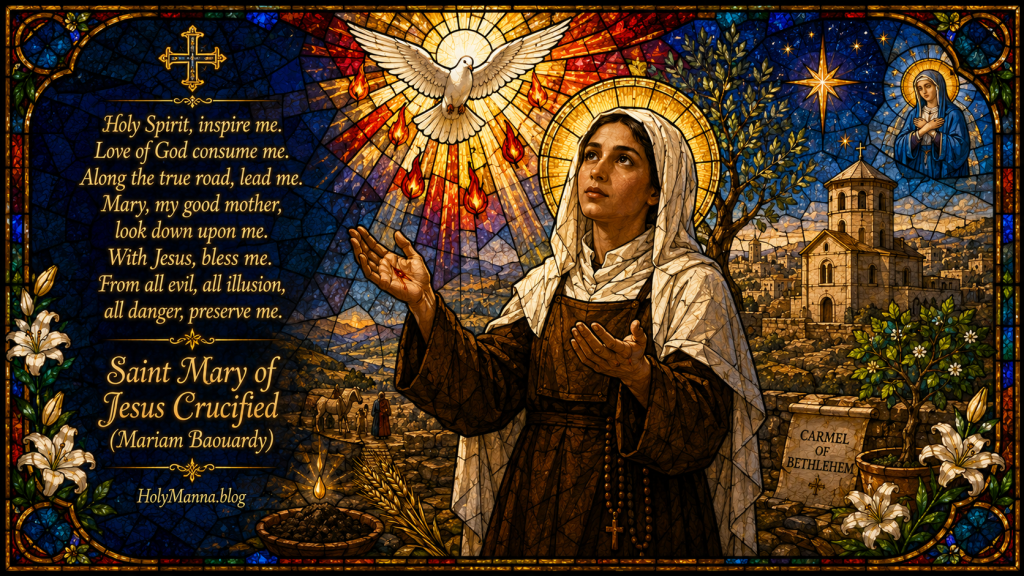
A Lily of Galilee Who Never Learned to Read
Every so often God chooses someone the world would never pick, and He does it on purpose. Saint Mary of Jesus Crucified, born Mariam Baouardy in a small Galilean village in 1846, could not read or write a single sentence, spoke Arabic and a rough French, and spent most of her short life as a servant girl and then as a Carmelite lay sister who scrubbed floors and hauled water. And yet, when Pope Francis raised her to the altars on May 17, 2015, he pointed to precisely this poor, unlettered woman as an example for the whole Church, noting that though she was poor and uneducated she was able to counsel others and to explain the things of God with a clarity that came from her constant conversation with the Holy Spirit.
She belonged to the Melkite Greek Catholic Church, one of the Eastern Churches in full communion with Rome, and she became a Discalced Carmelite in France, which is why she is often called a bridge between the two lungs of the Church, East and West. Her friends called her “the Little Arab,” and her home village still calls her Al Qiddisa, “the holy one.” She bore the stigmata, levitated to the tops of trees, endured a period of demonic assault, and prophesied with uncanny accuracy. But if you asked her what mattered most, she would have talked about the Holy Spirit and about being small.
The Church remembers her on August 26, the day she died in Bethlehem at the age of thirty-two, only a few hundred yards from the place where the Word became flesh. The Catechism teaches that “by canonizing some of the faithful, i.e., by solemnly proclaiming that they practiced heroic virtue and lived in fidelity to God’s grace, the Church recognizes the power of the Spirit of holiness within her and sustains the hope of believers by proposing the saints to them as models and intercessors” (CCC 828). Mariam is exactly that kind of model, and her story is worth telling from the beginning.
Twelve Brothers in Heaven and a Walk to Bethlehem
Mariam was born on January 5, 1846, the eve of the Epiphany, in Ibillin, a village in Upper Galilee not far from Nazareth. Her parents, Giries Baouardy and Mariam Shahine, were poor Melkite Catholics of Arab stock. Sources differ on the family’s deeper origins, with some pointing to the village of Hurfeish in Galilee and others to Lebanese or Damascene roots, so that detail should be held loosely. What every account agrees on is the sorrow that shadowed the home before she arrived. Twelve sons had been born to the couple, and all twelve died in infancy.
The story preserved in the Carmelite records is that Mariam’s mother, in her grief, said to her husband something like this: let us go to Bethlehem on foot and ask the Blessed Virgin for a daughter, and let us promise her that if our prayer is answered we will name the child Mariam and offer for the service of God a quantity of wax equal to her weight when she is three years old. They walked to Bethlehem, prayed at the Grotto of the Nativity, and returned home. Mariam was born the following year, and her brother Boulos, or Paul, two years after that. This account comes from the family tradition as recorded in the process of her cause, and while it cannot be independently verified, the Church has treated it as credible.
Joy did not last long. When Mariam was about two or three years old (sources vary), both parents died within a few days of each other. Her father’s dying prayer, according to the same tradition, was to entrust his little girl to Saint Joseph. The orphans were separated. Mariam went to a paternal uncle in Ibillin, and Paul went to an aunt in Tarshiha. Brother and sister never saw each other again in this life. Around the age of eight, her uncle moved the household to Alexandria, Egypt, and it was there that Mariam’s childhood ended.
The Night Her Throat Was Cut and the Lady in Blue
At thirteen, following the custom of the time, her uncle arranged for her to marry. On the eve of the wedding, after a night of prayer, Mariam cut off her hair and announced that she belonged to Christ alone. Her uncle was furious. As punishment she was stripped of her place in the family and put to the lowest work of the household, treated as a servant rather than a niece.
What happened next is the most dramatic episode of her life, and it must be told carefully. The only witness to it was Mariam herself, who related it under obedience to her confessor and superiors years later; the Church recorded her testimony in the process of her cause, and her confessor at Pau attested that she carried a visible scar across her throat and that physicians found her windpipe damaged. Everything else in the episode rests on her word.
According to that testimony, a former servant of the family, a Muslim, befriended her in her misery and offered to carry a letter to her brother in Galilee. In the course of the visit he pressed her to convert to Islam. She refused, saying that she was a daughter of the Catholic Church and hoped by God’s grace to die one. Enraged, he drew a scimitar and cut her throat, then wrapped her in a cloth and abandoned her in an alley. It was September 8, 1858, the feast of the Nativity of Our Lady.
Mariam later said that she believed she had truly died, that she saw heaven and was told her book was not yet finished, and that she awoke in a grotto being cared for by a young woman dressed like a religious in blue. This woman, whom Mariam believed to be the Blessed Virgin herself, sewed the wound, nursed her for about a month, told her she would go to France and become a Carmelite, and finally led her to a church and vanished. Mariam never returned to her uncle’s house. This story cannot be verified beyond her testimony and the physical scar, and it is presented here as the saint’s own account, not as established historical fact.
For the next several years the teenage girl worked as a domestic servant, moving from Alexandria to Jerusalem, Jaffa, and Beirut. In 1863 she sailed to Marseille with a family that employed her, and there, in 1865, she was received as a postulant by the Sisters of Saint Joseph of the Apparition. It was in Marseille, around 1866 and 1867, that the extraordinary phenomena began in earnest: ecstasies, and the first appearance of the wounds of Christ in her hands, feet, and side. The Sisters of Saint Joseph, unsettled, declined to admit her to profession. Her novice mistress, Mother Véronique of the Passion, an Englishwoman who was herself moving toward Carmel, took Mariam with her to the Discalced Carmelite monastery of Pau in June 1867. There Mariam received the habit as a lay sister and the name she would carry to heaven: Sister Mary of Jesus Crucified.
The Little Nothing Who Flew to the Treetops
Mariam’s years in Carmel, from 1867 to 1878, are among the best documented of any modern mystic, because her sisters and superiors were required to observe her closely and to record what they saw. Their testimonies formed the backbone of her cause.
The list of phenomena is long. Her ecstasies came suddenly and often. She bore the stigmata, and when she begged the Lord to hide the wounds so as not to draw attention, they became largely invisible while the pain remained. She was seen more than once, in the garden of the Pau Carmel, to rise from the ground and come to rest on the topmost branches of the lime trees, singing of love for God, until her superior called her down under obedience. She had knowledge of hearts and consciences, and she prophesied future events with a precision that unsettled those around her. On several occasions her guardian angel was heard to speak through her. In 1868 she endured a forty day period of what her superiors judged to be genuine diabolical possession, permitted by God, during which she never once lost her interior union with Him.
None of this made her proud, and that is the real miracle. She called herself “the little nothing.” She said, in words her sisters preserved, “Observance of the rule is of more value than all extraordinary states, more than the stigmata and the gift of miracles.” She said, “Everything passes here on earth. What are we? Nothing but dust, nothingness, and God is so great, so beautiful, so lovable and He is not loved.” And she left one of the most memorable images of humility in Carmelite literature: “The proud person is like a grain of wheat thrown into water: it swells, it gets big. Expose that grain to the fire: it dries up, it burns. The humble soul is like a grain of wheat thrown into the earth: it descends, it hides itself, it disappears, it dies; but to revive in heaven.”
The Catechism is careful about extraordinary gifts. It teaches that charisms are “graces of the Holy Spirit which directly or indirectly benefit the Church, ordered as they are to her building up, to the good of men, and to the needs of the world” (CCC 799), and it insists that “no charism is exempt from being referred and submitted to the Church’s shepherds” (CCC 801). Mariam lived that submission to the letter. She never asked for her gifts, she asked repeatedly for them to be hidden, and she placed every one of them under obedience. When she was told to come down from the tree, she came down.
Her mission stretched beyond Pau. In 1870 she was chosen for the founding group of a new Carmel in Mangalore, India, and there she made her solemn profession on November 21, 1871. India was hard on her. The phenomena intensified, misunderstandings arose, and she was sent back to Pau in 1872 by superiors who could not make sense of her. She accepted the humiliation without defending herself.
Then came the great work of her life. Mariam became convinced that Carmel must return to the land of Elijah and of Jesus. She spoke of Bethlehem, and the idea won the support of a wealthy benefactress, Berthe Dartigaux, and of the Latin Patriarch. In September 1875 a small group of nuns from Pau, Mariam among them, arrived in Bethlehem. She pointed out the site on the hill of David, and though she could not draw a plan or read a document, she supervised much of the building. She insisted the monastery be built in the round, in the form of a tower, and the Carmel of Bethlehem stands in that shape today. She spoke, too, of a Carmel at Nazareth, and there is a well established tradition that she urged Berthe Dartigaux to acquire the site venerated as Emmaus at el Qubeibeh; that last detail is preserved in Carmelite accounts and is presented here as tradition.
Above everything else, Mariam wanted the Church to love the Holy Spirit. Through the Melkite Patriarch Gregory II Youssef she sent a message to Pope Pius IX lamenting that the Holy Spirit was neglected, even in seminaries, and pleading that priests be taught to invoke Him. Her own prayer to the Holy Spirit has since gone around the world: “Holy Spirit, inspire me. Love of God consume me. Along the true road, lead me. Mary, my good mother, look down upon me. With Jesus, bless me. From all evil, all illusion, all danger, preserve me.”
She was, in the plainest sense, living what the Catechism describes when it says that “the Holy Spirit is the interior Master of Christian prayer” (CCC 2672), and that “the Holy Spirit is truly the master of prayer, and one must ask him for the gift of prayer” (CCC 2670). Her theology did not come from books. It came from asking.
Servant, Suspect, Exile, and a Fall on the Building Site
Mariam was not martyred, but there was hardly a season of her life without suffering, and she embraced all of it.
Her childhood was one long bereavement: twelve brothers she never knew, both parents gone before she could remember them, a brother she lost at the age of three and never found again. Her adolescence brought the humiliation of servitude in her own family’s house, and then, by her own testimony, a knife across the throat for the name of Christ. If that account is true, and the Church took it seriously enough to record it, then Mariam very nearly was a martyr at thirteen, and she carried the scar of that fidelity for the rest of her life.
Her years of wandering as a servant, from Alexandria to Beirut to Marseille, were years without home, family, or security. When she finally found a religious family in the Sisters of Saint Joseph, she was sent away because of gifts she had not asked for. In Carmel, the very graces God poured out on her became a source of suspicion. Extraordinary phenomena always are, and rightly so. The Church has always tested such things, and Mariam was tested. Her superiors in Pau examined her; the community in Mangalore misunderstood her and dismissed her back to France; and through all of it she never argued, never explained herself, and never asked to be believed.
The forty days of possession in 1868 were, by her sisters’ account, a torment beyond description. She was thrown about, blasphemies were spoken through her mouth against her will, and she was left physically wrecked. Yet the sisters also testified that in the middle of the ordeal she remained interiorly united to God, and that when it ended she was gentler than before. The Catechism teaches that “the power of Satan is, nonetheless, not infinite. He is only a creature, powerful from the fact that he is pure spirit, but still a creature. He cannot prevent the building up of God’s reign” (CCC 395). Mariam’s ordeal, seen through faith, was a demonstration of exactly that.
She was also physically frail, small, and often ill. In Bethlehem, in the summer of 1878, she was still doing the work of a lay sister, carrying water to the workmen on the building site. On the way she fell and broke her arm. Gangrene set in. Within days it was clear she was dying. She received the last sacraments with joy, and on August 26, 1878, at the age of thirty-two, in the twelfth year of her religious life, she died in the Carmel she had built at Bethlehem. She had said, in words her sisters preserved, “I desire to suffer always and not to die. I should add: this is not my will, it is my inclination. It is sweet to think of Jesus; but it is sweeter to do His will.”
The Church teaches that “suffering, a consequence of original sin, acquires a new meaning; it becomes a participation in the saving work of Jesus” (CCC 1521). Mariam took her religious name from the Cross, and she lived up to it. Her tombstone in Bethlehem reads: “Here in the peace of the Lord reposes Sister Mary of Jesus Crucified, professed religious of the white veil. A soul of singular graces, she was conspicuous for her humility, her obedience and her charity. Jesus, the sole love of her heart called her to Himself in the 33rd year of her age and the 12th year of her religious life at Bethlehem, 26 August 1878.”
A Dying Baby in Sicily and a Bridge Between East and West
Devotion to the Little Arab began at once among the Carmelites of Bethlehem and Pau, and it spread through the Holy Land, where Christians spoke of her as Al Qiddisa, the holy one. Her cause was formally opened in 1927. On November 27, 1981, Saint John Paul II declared her Venerable, and on November 13, 1983, having recognized a healing attributed to her intercession, he beatified her in Saint Peter’s Square. The details of that beatification miracle vary across the sources consulted for this post and could not be fully verified here, so they are not described further; what is certain is that a cure was examined and approved according to the Church’s norms.
The miracle that opened the way to canonization is well documented. In 2011 a baby boy was born in Sicily with a rare and severe heart malformation, total anomalous pulmonary venous return, in which the pulmonary veins fail to connect to the heart. He was rushed to the hospital in Taormina in a state of agony, with blood so acidic that death was expected within hours. A friend of the family who kept a relic of Blessed Mariam gave it to the child’s mother, and a chain of prayer for the boy’s healing spread through the family, their friends, and even the Carmelites of the Holy Land. The mother touched her son with the relic. What followed left the physicians unable to explain either the speed of his recovery or the complete absence of after effects; one doctor testified that it was almost unheard of for a child with this malformation to survive three days without surgery, and that at the moment of the operation the boy’s condition had offered no hope. The healing was attributed to Mariam’s intercession, and on December 6, 2014, Pope Francis approved the decree recognizing it as miraculous. Some online sources describe the canonization miracle as the healing of a woman from Aleppo; that claim conflicts with the Carmelite and Vatican record and should be treated as unreliable.
On May 17, 2015, in Saint Peter’s Square, Pope Francis canonized her together with Marie-Alphonsine Ghattas, another daughter of the Holy Land, and two European foundresses. In parishes and Christian neighborhoods across Israel and Palestine, posters and flags celebrated the two Arabic speaking nuns, and their canonization was received as a sign of hope for Christians of the Middle East at a moment of great fear.
Her tomb and shrine are at the Carmel of Bethlehem, the round monastery she built on the hill of David, and pilgrims to the Nativity often walk up to pray there. Ibillin honors her as its own; the Carmel of Mangalore in India and the Carmel of Pau in France keep her memory; and her prayer to the Holy Spirit is prayed daily on every continent. Countless private favors attributed to her are shared in devotional literature; they are testimonies of the faithful and cannot be verified. Above all, Mariam has become a symbol of unity, a Melkite Catholic who became a Latin Carmelite, an Arab woman who lived in Egypt, Lebanon, France, India, and Palestine, and whom Saint John Paul II summed up by saying that in her, everything speaks of Jesus. The Catechism teaches that “the Holy Spirit is the principle of every vital and truly saving action in each part of the Body” (CCC 798), and Mariam’s life is a picture of the Spirit knitting the parts of that Body together.
Becoming Small Enough for God to Use
It is tempting to read Mariam’s story as a collection of wonders that happen to other people. That misses the point. The Church did not canonize her for levitating. It canonized her because a poor, orphaned, illiterate servant girl allowed the Holy Spirit to make her a saint, and because she never once mistook the gifts for the Giver.
Consider how much of her life was ordinary and hard. She washed floors. She carried water. She was misunderstood by the very people who should have known her best. She was sent away, more than once, from communities she loved. She was frail and often sick. And she was joyful. Her secret was not a technique but a relationship: she talked to the Holy Spirit the way you would talk to your closest friend, and she asked Him for everything. The Catechism says that “prayer is the life of the new heart” (CCC 2697) and that “we must remember God more often than we draw breath” (CCC 2697). Mariam did.
When was the last time you actually asked the Holy Spirit to inspire you before you spoke, worked, or made a decision? Mariam’s little prayer takes about ten seconds to say. It could be the first thing you say when your feet hit the floor in the morning and the last thing before you sleep. Try it for a week and see whether the road looks any different.
Where in your life are you a grain of wheat in water, swelling up, and where are you a grain of wheat in the earth, hidden and dying so that something can grow? Mariam wanted no attention. She begged for her wounds to be invisible. That is not the same as false modesty; it is the freedom of someone who is not performing for anyone.
Consider, too, how she handled being wronged. She never once used her wounds as leverage. Is there a hurt you have been carrying as a grievance that Christ is inviting you to carry instead as a cross? The Catechism teaches that “by his passion and death on the cross Christ has given a new meaning to suffering: it can henceforth configure us to him and unite us with his redemptive Passion” (CCC 1505).
Finally, look at what she built. A woman who could not sign her name founded a monastery in the town of Christ’s birth. She did it because she trusted, obeyed, and kept showing up with the water buckets. What is the one small, faithful thing in front of you today that God might use for something far bigger than you can see?
Engage With Us!
Saint Mary of Jesus Crucified, the Little Arab, has a way of unsettling comfortable assumptions about who God chooses and how He works. Please share your thoughts and reflections on her life in the comments below. Which part of her story spoke to you most, and why?
Here are a few questions to take to prayer or to discuss with friends:
- Mariam refused to deny Christ even at the cost of her life at thirteen. Where are you tempted to soften or hide your faith to avoid conflict, and what would fidelity look like there?
- She called herself “the little nothing” and begged for her gifts to be hidden. What would change in your week if you stopped needing to be noticed?
- She said observance of the rule mattered more than stigmata or miracles. What ordinary, unglamorous duty is God asking you to do faithfully right now?
- Mariam pleaded with the Church to love the Holy Spirit more. How could you make room for the Holy Spirit in your daily prayer, beginning today?
- She was misunderstood and sent away by good people more than once and never defended herself. How do you respond when you are treated unjustly, and what might Mariam teach you?
- She built a Carmel in Bethlehem while carrying water for the workers. What small act of service could you offer this week without anyone knowing?
Go and be small enough for God to use. Talk to the Holy Spirit as Mariam did, hold your wounds with patience, do your hidden work with joy, and pour out on everyone around you the love and mercy that Jesus taught us.
Saint Mary of Jesus Crucified, pray for us!
Follow us on YouTube, TikTok, Instagram and Facebook for more insights and reflections on living a faith-filled life.

 Holy Manna!
Leave a comment